@samuraipips358 Hi Yumi, I know I need at least 1000 trades in my total sample to have a somewhat solid foundation. My question is, if I have 2 instruments that I trade, do I need 1000 trades for each, or can the 1000 be combined across both? The strategy is exactly the same. ✌️
Good question. To be clear, I'm not saying "never modify your system." Modifying and refining during the testing phase is exactly what testing is for. That's the whole point.
What matters is the order of operations.
There's a difference between these two processes. One: you test, you see that a group of trades lost, you remove them, and the numbers improve. Two: you understand your system's logic, you recognize that a specific condition conflicts with the premise of your strategy, you define a new rule, and you test the updated system as a new version.
The outcome might look the same, removing a parameter, but the process behind it is completely different. The first is fitting your rules to past results. The second is refining your system based on understanding. The first breaks down in the future. The second has a chance of holding up.
So if you genuinely understand why a parameter doesn't fit your strategy's logic, absolutely remove it. But if the only evidence is "the numbers got better when I took it out," that's not understanding, that's editing the past. Any dataset will look better if you remove the parts that lost.
On the 1,000 trades question: you don't test a single parameter in isolation. You test the system as a whole. When you make any change, even one parameter, that's a new version. And a new version gets tested from scratch.
Here's why 1,000 matters. Once you pass 1,000 trades, with a win rate around 50%, the confidence interval narrows to roughly plus or minus 3%. In other words, you're testing results after the law of large numbers has had enough room to work. With fewer trades, the results swing too much to tell whether you're looking at a real property of your system or just coincidence.
Every change to your system, no matter how small, creates a new system. And an untested system is a risk by itself.
@samuraipips358@Sala123456788 Hi Yumi, so if I can’t find a specific reason why a system parameter is not performing, then I shouldn’t modify or remove that parameter even if it would increase my expectancy? And also, to validate or invalidate that parameter, do I need 1,000 trades specifically for it? 😄
In trading, every decision you make and every action you take have the ability to make you feel stupid.
But so do the ones you don’t take, that you considered.
Trading makes you feel stupid regularly. That’s the nature of existence in a game that is barely more than a coin-toss choice each time.
Don’t beat yourself up over bad outcomes, that just compounds matters.
Accept it, live with it, factor that reality into your process.
🗣️ Arda Güler: 'Do you remember Alex Hunter? Some of you are probably too young. But FIFA 17 had this mode called The Journey, and you played as this random kid named Alex. You started out as a nobody and tried to get signed by the big clubs. If you “made it,” they would show you going out of the tunnel next to stars like Cristiano Ronaldo.
It was more than a game for us. It was our actual dream, on the TV screen. We were so addicted. Every time I came home from my friends’ house, I begged my dad for a PS4.
“I’ll be so good! I’ll study so hard!”
One day when I came home from school, there was a package on the kitchen table. It was a PlayStation shaped box.
I went crazy.
I looked at him like, “Really?!”
He said, “Really.”
When I switched it on, there were lots of games on the PlayStation already. No disc required. It seemed almost too good to be true. I was like, Wait, I had to beg Dad for one game, and now he’s giving me 20?
I asked him, “Hey Dad, did you win the Lottery?”
He was like, “Actually …… I got a deal.”
I was like, “You mean at the store?”
He was like, “No, no, at the market …….”
Then I found out that my FIFA had no Journey mode. I couldn’t find Alex Hunter. Some of the names were weird. When I wanted to be Cristiano Ronaldo, I had to select this club called “MD White.”
I played like this for weeks. I had never tried any other football game except FIFA, so I honestly thought mine was just a different version. But then one day my friends came over to play, and they were like, “Arda ........ what is this?”
I said, “What do you mean? It’s FIFA.”
I said, “No, come on guys, this is the football game.”
They said, “Bro, where is Fenerbahçe? What are all these weird names?
Your dad got scammed.”
They were all cracking up. I was trying to laugh along with them, but I was actually so embarrassed.
But I didn’t care that I had the fake FIFA. I loved it anyway. I don’t need a real pitch or a real goal or a new PlayStation. Even if I have rocks for goalposts, I am happy.
That’s the Turkish mentality.'
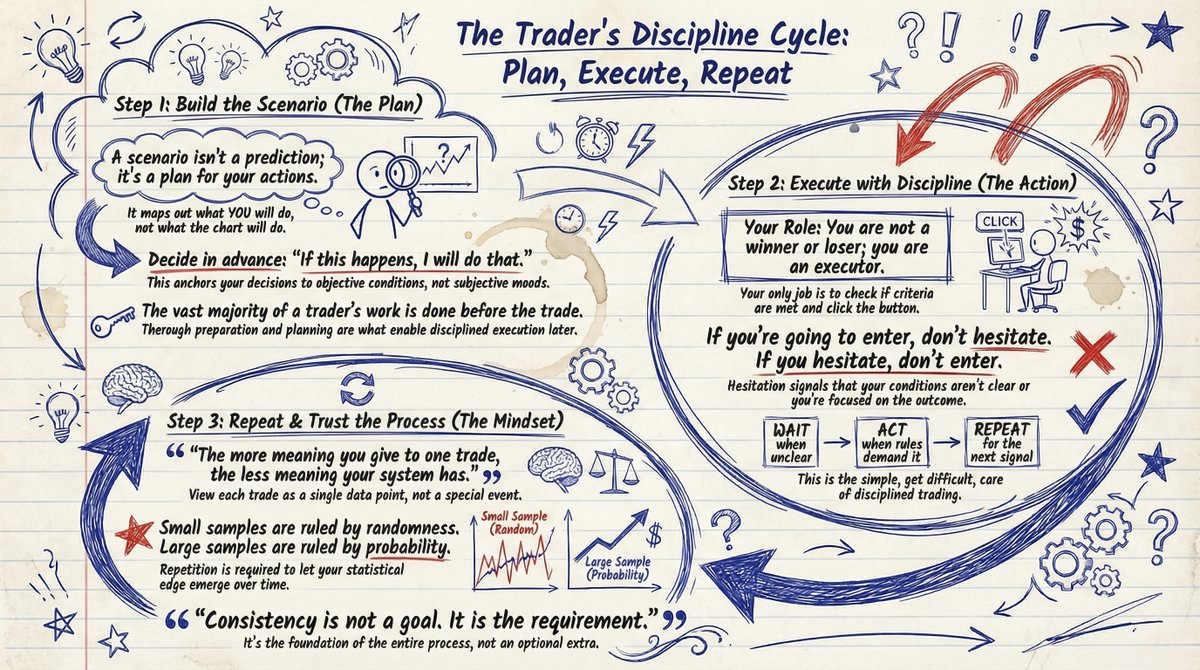
Build an "If this happens, then do this" scenario upfront, then execute it.
You don't need the desire to win or to avoid losing.
If you can execute the process exactly as the scenario dictates, stamp your card once.
Once you've collected 20 stamps, "one trade" is finished.
【The Psychological State While Waiting That Separates Great Traders From Everyone Else】
I get a question all the time.
“What do you do while you’re waiting?”
“Don’t you get nervous?”
It’s the kind of question that assumes trading is always at the center of your life.
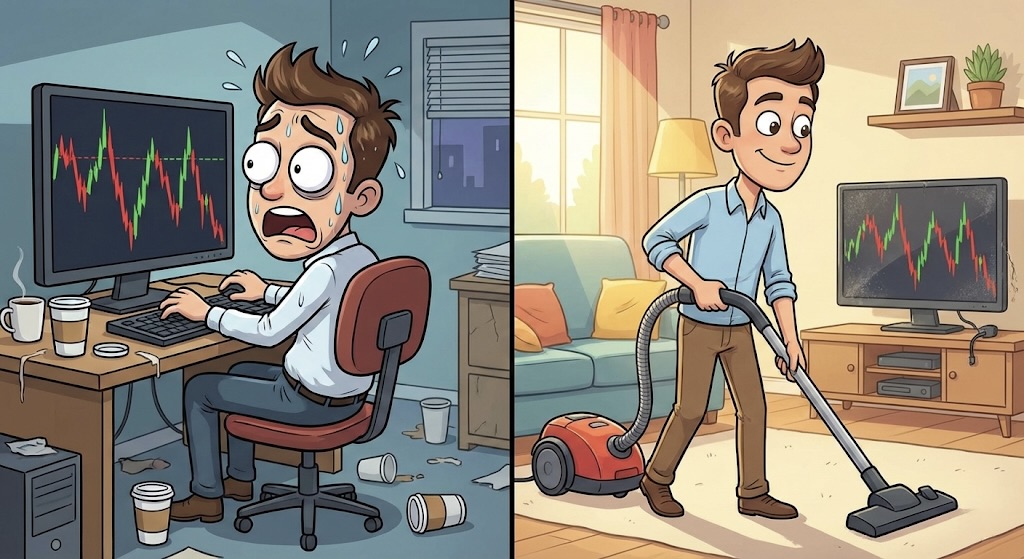
But for me, trading is something that’s largely finished at the preparation stage.
Once I’ve set my alerts, the time I spend waiting to click is time when trading has already disappeared from my mind.
“What do you do between brushing your teeth and the next time you brush your teeth?”
You probably aren’t thinking about your next brushing at all—you’re just living your normal day.
That’s what trading is like for me now.
Pressing the button isn’t fun, it isn’t sad, it isn’t even boring.
It’s simply a task.
But it wasn’t always like this.
There was a time when I rode every single tick—getting elated, getting deflated, and rushing because I wanted results.
Today, I want to talk about what it actually feels like when I’m trading.
■People Who Can’t Wait
Most of a trader’s job is waiting.
Waiting for opportunities.
Waiting for profits to expand.
All we can do is wait for the moment to click.
But the psychological state during that waiting period is the decisive difference between great traders and everyone else.
For many people, the fixation on outcomes makes their mind unstable while they wait.
They panic at the thought that “if I’m not doing something, I’m not earning,” and they force trades by hunting for setups.
Or they fear giving back open profit and exit early—before their rules say to—just to lock something in.
That unstable mental state makes it impossible to follow rules consistently, and as a result they fail to extract the system’s edge.
■The Root Cause Is Over-Indexing On “Results”
Why can’t people wait?
The entire cause is an excessive focus on “results.”
Our job is like having a coin that lands heads more often, and continuing to say “heads” mechanically.
You don’t need to think, “I’ve had a winning streak, so tails is due,” and decide, “Maybe I’ll call tails next.”
No matter what happens, the key is to keep saying “heads.”
The reason this is difficult is that you’re too aware of the “results” right in front of you.
What if you could participate in the game repeatedly, but you were never told the outcome of each individual round afterward?
You’d probably find it extremely easy to keep saying “heads” every time.
That’s the answer.
■Participating In The Game Without Knowing The Outcome
Because you’re not told the outcome of the game you joined, there’s nothing to celebrate and nothing to despair over.
When you participate, you simply say “heads.”
That is exactly my mental state when I trade.
I’m not interested in the outcome of each individual trade, and I often don’t even check it.
(Though these days, because I write this blog, I inevitably end up seeing them…)
I already know my losses are always contained within a controlled range.
So there’s no point in caring, trade by trade, how much I won or lost—and honestly, I’m not interested.
Because I don’t check, I don’t know how much I won or lost.
And naturally, that can’t emotionally bleed into the next trade.
In other words, the moment I say “heads,” my work is done.
Because I’m not trying to know the outcome, there’s nothing to wait for—and no reason to feel my heart racing.
■Why I’m Fine Not Looking At The Results
The reason I don’t check my results is that I understand, at a deep level, that checking has no meaning.
If anything, I believe it brings only downside.
The risk on each trade is already calculated, and I know the statistical profile of the system when it’s deployed over the long run.
The losing streaks and drawdowns within that distribution are fully accepted from the start.
So there is absolutely no need to pay attention to the outcome every time.
On top of that, I have a clear division of scope and responsibility: my job is “only to follow the rules.”
I also understand that probabilities work slowly, and through an overwhelming amount of practice I trust the system.
Because of that depth of understanding and trust, I don’t need to know outcomes—and I can focus purely on process.
■What It Means To Leave Only The Process
That said, if you try to imitate this superficially—“Starting today, I won’t look at results!”—it will probably be difficult.
Because if you lack the necessary understanding and practice, you haven’t built trust in your system.
Not looking at results without trust would feel like walking in the dark—anxiety-inducing no matter what you tell yourself.
The reason I can trade with the same feeling as brushing my teeth isn’t because I have no emotions.
In everyday life, I’m still just as emotional as anyone else.
The fact that I’m only in this state when I’m trading is because I deliberately trained myself into it over many years.
This isn’t something you can solve with knowledge alone, or with mindset talk.
To let go of attachment to results and concentrate on process, you need relentless preparation, a deep understanding of probability, and a rewrite of your “thinking OS.”
In my book Trading Psychology, I’ve systematized the “concrete solutions to emotional problems” that I’ve spent years thinking through and working on.
If you want to be freed from the nerves and impatience while trading—and turn trading into “just another everyday task”—this book will be your guide.
If you already own it, read it again.
In particular, the sections on “how to transform beliefs” will likely reveal something new when you revisit them multiple times.
The psychological state of great traders isn’t talent.
It can be acquired as a skill.
📚To Trade Calmly, Matter-Of-Factly—Like Brushing Your Teeth🪥👇
https://t.co/tMFssKR6Oz
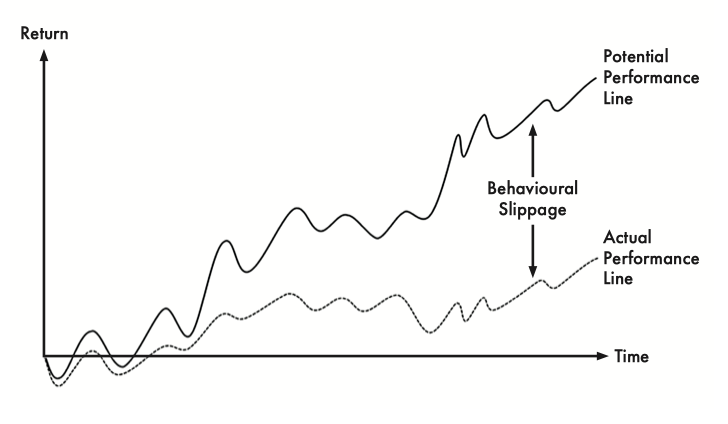
Behavioural Slippage in Trading and the hit to your P&L
Your potential P&L is what you could make if your behaviours were optimal, or at least significantly 'better', helping you improve how you execute fully on the opportunity sets that your system or process brings to you.
Then there is your Actual P&L, this is what you do make because you yourself get in the way by:
- anticipating,
- fearing,
- freezing,
- fleeing,
- fighting,
- result-seeking,
- tweaking,
- finessing,
- impressing,
- second-guessing,
- copying,
- protecting,
- dreaming,
- hoping,
- gambling,
- praying.
The difference between the two is P&L slippage caused by your behaviour.
You don’t need better signals, faster news, more data, an upgrade to your system, another screen; these are avoidance measures, a way of not taking responsibility, passing the buck, playing the blame game.
You need to develop 'better behaviours'.
The image below captures this and is taken from my book📘 'Mastering the Mental Game of Trading'
Our #FC26@OperationSports Community Sliders are posted as Version 2.5. We've been working through the patch updates as always, and starting to see some solid improvements overall. Follow the trello board for real-time updates: https://t.co/X38UAz8Svc
Where Will Altcoins Top?
When I first posted this $OTHERS vs $BTC chart back in May almost 6 months ago, I have been tracking the $BTC chart and waiting for a bubble formation. It's been 6 months since and BTC has still not formed a bubble. In fact, it is still trading under it's long-term growth trajectory mean. With it being so late in the cycle now, the only chance it has to form that bubble is for it to go into an extended cycle way in Q2 and beyond.
So now, 6 months later, with the knowledge that $BTC has not yet formed a bubble, the probability for target 5 being hit is completely lowered. These are my thoughts on the potential targets now:
Target 1: I'm still not considering this because BTC & Alts are trading at their mean and many alts are in macro demand zones. They might come into play if BTC triggers a bull run invalidation but I still give that a low probability.
Target 2: This is the all important horizontal Gann level which has been an important support / resistance throughout the history of this chart. This is my minimum expectation and the lowest risk target imho. Expect to see at least a reaction here.
Target 3: This is the target I'm most strongly considering at the moment. With no BTC bubble formation, I suspect the next move could be just a retrace into the fibs. The pink diagonal (1x1) Gann angle was the point of rejection and pivot swing high of the last alt run in Dec 2024. So this is a major resistance in confluence with the fibs.
Target 4: This target will be at the point of contact with the next pink diagonal, which is a major resonance line that captured major swing lows in the past. I expect this to be an extremely potent resistance moving forward. Should we hit it, this will give us a new all-time high on this chart, but barely. It could be a major bull trap as it breaks into price discovery, only to get rejected at this major resonance line. Will be extremely weary should we get there.
Target 5: This is the macro horizontal Gann level. As I always, the next cycles tend to top at least 1 macro Gann level higher. But since BTC has not formed a bubble this cycle, I do not see a massive rotation from Bitcoin like in past cycles. So this is the least likely target in my opinion, unless BTC goes into an extended cycle and manages to form that bubble eventually.
We will be tracking this chart and watching it in confluence with a multitude of other factors and charts in the Squared Circle on Whop in the coming months. Any future price interactions with these lines will be posted exclusively there. When price interacts with these levels, we will be watching those interactions on lower time frames using Vision to give us an early edge. Highly focused on getting our exits right.
Most traders are probabilists on Sunday, prophets on Monday, and gamblers by Wednesday.
No one succeeds changing professions twice mid-week.
Consistency means your Monday self and your Friday self are reading from the same rulebook.
The wait is over!
Introducing... 🥁
Bitcoin Quantile Model v2.
You’re going to want to bookmark this post—and follow for regular model updates.
After months of research and development, I’m very proud of this model—my flagship quantile framework.
I’m confident it’s one of the best—if not the best—long-term Bitcoin investment frameworks available.
As a full-time, unpaid Bitcoin researcher, I’m often asked how people can best support my free content.
Simply bookmark, repost, and comment on my posts :)
Thanks for all your continued support!
— PlanC
Key Features & Improvements:
1. Quantile lines never cross—mathematically impossible.
2. Cycle-length agnostic.
3. 133,000+ data points and 1,500 lines of code.
4. Fits and stores 999 quantile levels (τ = 0.001–0.999 in 0.001 steps) and identifies which level the last price is closest to.
5. Fits the two leading decay functions (stretched exponential decay & exponential decay) and selects the better fit via quantile-appropriate AIC.
Uses Akaike weights to identify the best-supported model.
Akaike weights (AIC-based):
Stretched exponential decay: 96.4%
Exponential decay: 3.6%
6. Piecewise Quantile Regression — Linear + Stretched Exponential Decay (Nonlinear).