ChatGPT is no longer just answering. It's proposing next steps.
We analysed 115M+ ChatGPT responses and something quietly shifted in April 2025.
ChatGPT started closing responses with a new pattern:
"If you want, I can narrow it down based on your budget, use case, and team size."
At first it was rare. By June 2026, it appeared in 1 in 7 responses.
Here's what we found:
📍 It always appears at the end.
95.7% of the time, in the last 10% of the message. A deliberate closing move, not a mid-response thought.
🎯 The follow-up matches the prompt type.
Task-oriented queries ("find me a lawyer", "build me a template") get specific action suggestions with bullet menus. Informational queries ("what is X?") get passive closings. ChatGPT reads intent and responds accordingly.
📋 Lists are replacing sentences.
In 2025, 97% were inline sentences. By mid-2026, over 40% had become structured bullet menus: "narrow by budget / compare options / recommend for your region."
🔴 Then OpenAI stepped in. Twice.
On March 16, 2026 they shipped an update explicitly targeting:
"teaser-style phrasing in responses (e.g. 'If you want…', 'You'll never believe…')"
On May 28, 2026 GPT-5.5 Instant launched with the note:
"fewer overly long or bullet-heavy responses"
OpenAI themselves identified this pattern as something worth correcting.
But here's the thing. Our data shows it was already deeply embedded in how ChatGPT handles product, service, and comparison queries, across 14 languages, in every market we track.
WDYT?
Your navigation might be eating your LLM reading budget ⁉️
We took a closer look at how pages are actually read in ChatGPT Deep Research, to understand what's really happening under the hood.
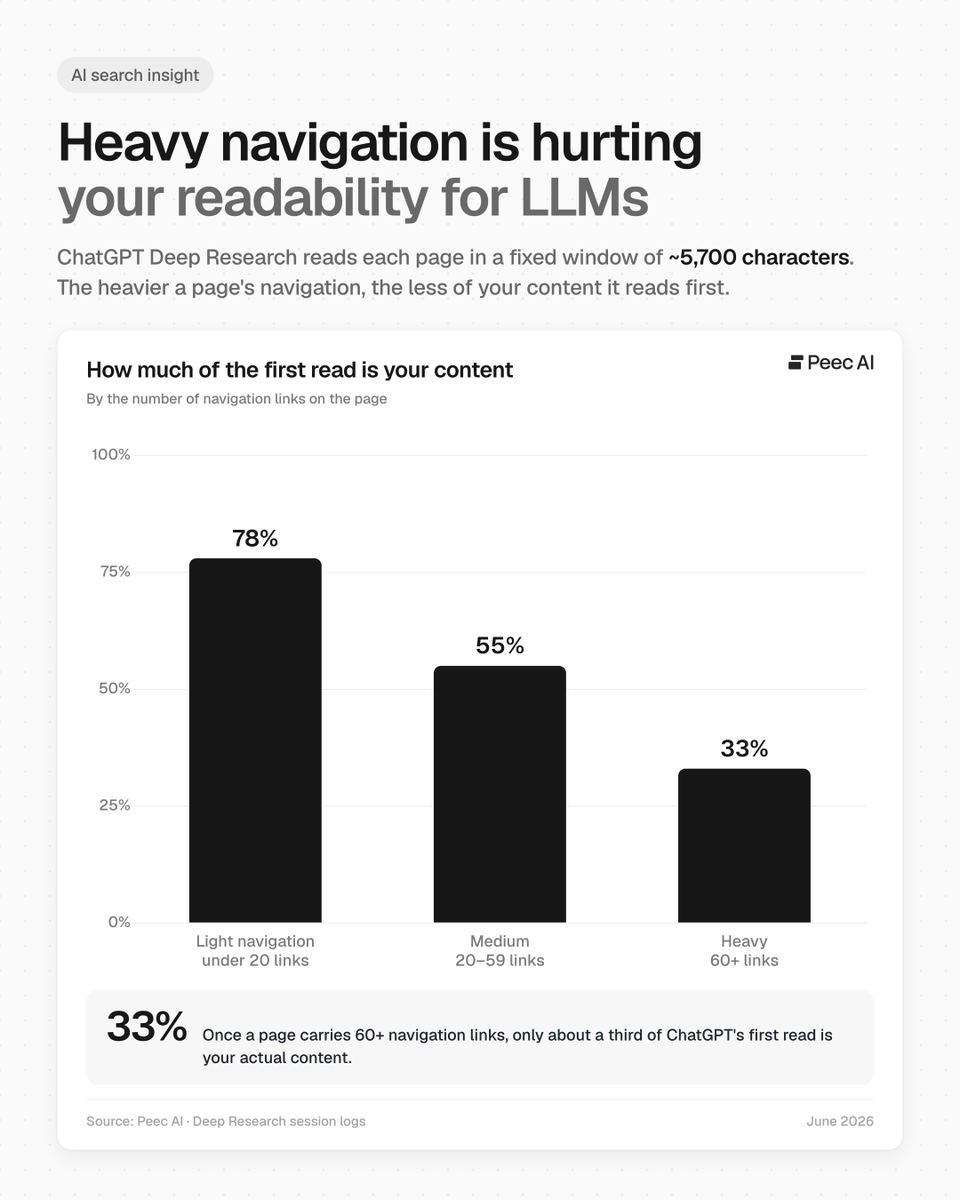
On its first visit, Deep Research reads each page through a fixed window of about 5,700 characters. The heavier a page's navigation, the less of that budget is left for your content.
We grouped pages by how many navigation links they carry:
➡️ 𝗟𝗶𝗴𝗵𝘁 𝗻𝗮𝘃𝗶𝗴𝗮𝘁𝗶𝗼𝗻 (under 20 links) About 𝟳𝟴% of the first read is your actual content. This is what a clean, content-first page looks like.
➡️ 𝗠𝗲𝗱𝗶𝘂𝗺 (20–59 links) About 𝟱𝟱%. Nearly half the read is already spent on navigation and markup, and this is where most pages land.
➡️ 𝗛𝗲𝗮𝘃𝘆 𝗻𝗮𝘃𝗶𝗴𝗮𝘁𝗶𝗼𝗻 (60+ links) Only about 𝟯𝟯%. Two-thirds of the read goes links before the model even reaches your answer.
So on cluttered sites, more than half the reading budget is gone before your real content even begins.
ChatGPT is no longer just answering. It's proposing next steps.
We analysed 115M+ ChatGPT responses and something quietly shifted in April 2025.
ChatGPT started closing responses with a new pattern:
"If you want, I can narrow it down based on your budget, use case, and team size."
At first it was rare. By June 2026, it appeared in 1 in 7 responses.
Here's what we found:
📍 It always appears at the end.
95.7% of the time, in the last 10% of the message. A deliberate closing move, not a mid-response thought.
🎯 The follow-up matches the prompt type.
Task-oriented queries ("find me a lawyer", "build me a template") get specific action suggestions with bullet menus. Informational queries ("what is X?") get passive closings. ChatGPT reads intent and responds accordingly.
📋 Lists are replacing sentences.
In 2025, 97% were inline sentences. By mid-2026, over 40% had become structured bullet menus: "narrow by budget / compare options / recommend for your region."
🔴 Then OpenAI stepped in. Twice.
On March 16, 2026 they shipped an update explicitly targeting:
"teaser-style phrasing in responses (e.g. 'If you want…', 'You'll never believe…')"
On May 28, 2026 GPT-5.5 Instant launched with the note:
"fewer overly long or bullet-heavy responses"
OpenAI themselves identified this pattern as something worth correcting.
But here's the thing. Our data shows it was already deeply embedded in how ChatGPT handles product, service, and comparison queries, across 14 languages, in every market we track.
WDYT?
@86julian This is based solely on my Deep Research study. So far, I haven’t seen it search for .md files or click on them, even when they are internally linked.
@JoelMesherghi Yes, since I can see that it tracks URLs, anchor text, alt text, and many other elements.
All through the WebSocket while running a DeepResearch Query
@CyrusShepard I was also very surprised when I saw the data. Everything was collected through the live Deep Research WebSocket. Sessions. Took quite some time😅
@natzir9 How did you run the test?
For me:
I used a logged in/non paid - account.
Was runnng deep research queries and used the DevTools to locate the right websocket. Then i just analyzed the recorded sessions
ChatGPT is trying to get more up to date sources ⁉️
We analyzed thousands of ChatGPT query fan-outs (QFOs) and looked at how often years and months appear in them.
One thing stood out immediately:
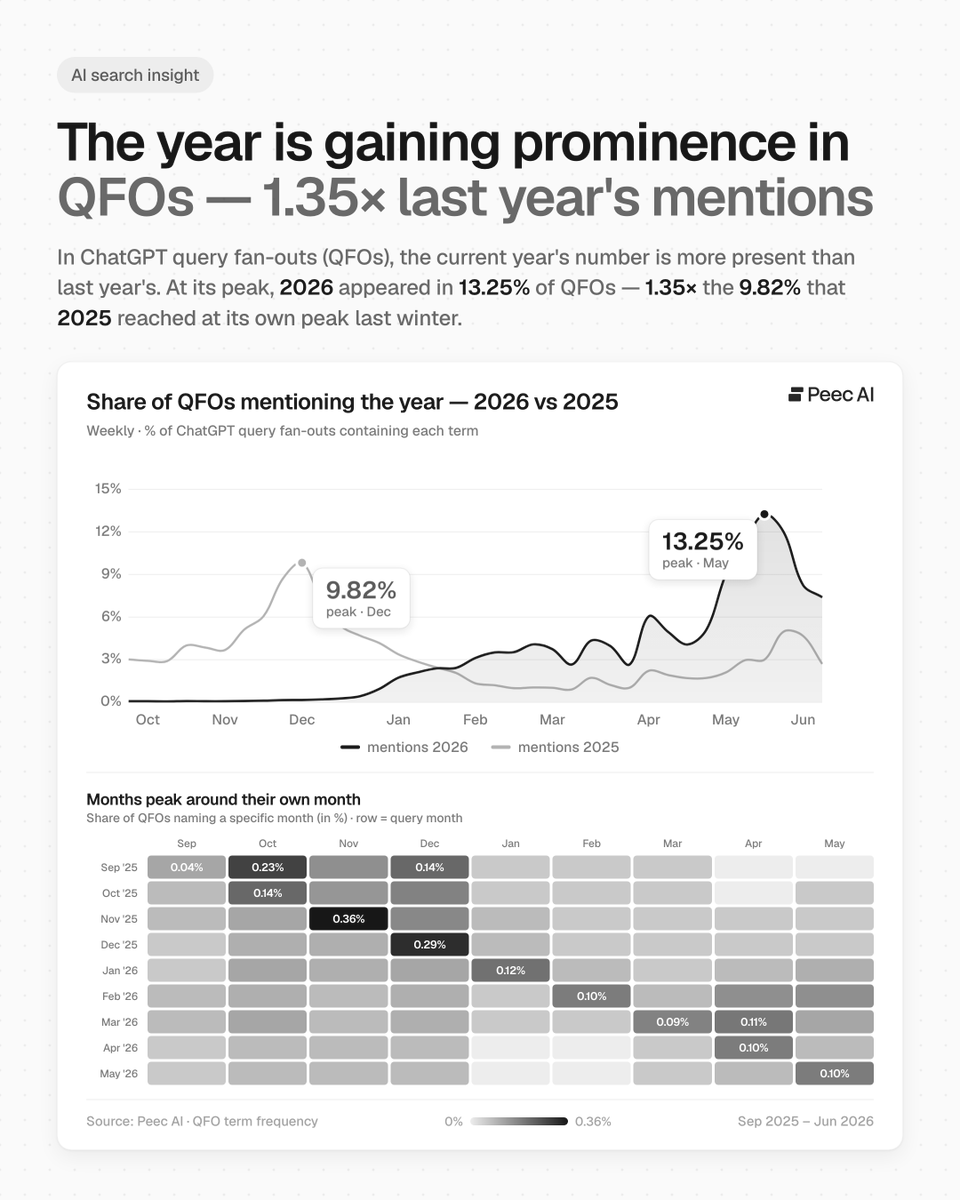
📈 "2026" appears in up to 13.25% of all query fan-outs at its peak.
For comparison: "2025" peaked at just 9.82% during its own cycle.
This suggests that ChatGPT increasingly searches for content associated with the current year before generating answers.
👉 But there was another interesting finding: "2025" hasn't disappeared. In fact, its share has increased slightly again in recent weeks. A likely explanation is comparison intent.
Queries such as:
→ Best X in 2025 vs 2026
→ What changed since 2025?
→ 2025 benchmarks compared to 2026 still require last year's information.
👉 We also looked at months. The current month occasionally appears in query fan-outs as well, but at much lower levels. The highest share we observed was just 0.36%.
So while months seem to matter for some time-sensitive queries, the year appears to be the much stronger freshness signal. ━━━━━━━━━━━━━━━━
My takeaway:
✅ Make sure your key pages are updated for 2026.
✅ Include the current year in titles, H1s, FAQs, and other prominent elements where it naturally fits.
✅ Maintain "2025 vs 2026" comparison content.
✅ Don't over-optimize for months unless the topic is highly time-sensitive.
ChatGPT is trying to get more up to date sources ⁉️
We analyzed thousands of ChatGPT query fan-outs (QFOs) and looked at how often years and months appear in them.
One thing stood out immediately:
📈 "2026" appears in up to 13.25% of all query fan-outs at its peak.
For comparison: "2025" peaked at just 9.82% during its own cycle.
This suggests that ChatGPT increasingly searches for content associated with the current year before generating answers.
👉 But there was another interesting finding: "2025" hasn't disappeared. In fact, its share has increased slightly again in recent weeks. A likely explanation is comparison intent.
Queries such as:
→ Best X in 2025 vs 2026
→ What changed since 2025?
→ 2025 benchmarks compared to 2026 still require last year's information.
👉 We also looked at months. The current month occasionally appears in query fan-outs as well, but at much lower levels. The highest share we observed was just 0.36%.
So while months seem to matter for some time-sensitive queries, the year appears to be the much stronger freshness signal. ━━━━━━━━━━━━━━━━
My takeaway:
✅ Make sure your key pages are updated for 2026.
✅ Include the current year in titles, H1s, FAQs, and other prominent elements where it naturally fits.
✅ Maintain "2025 vs 2026" comparison content.
✅ Don't over-optimize for months unless the topic is highly time-sensitive.
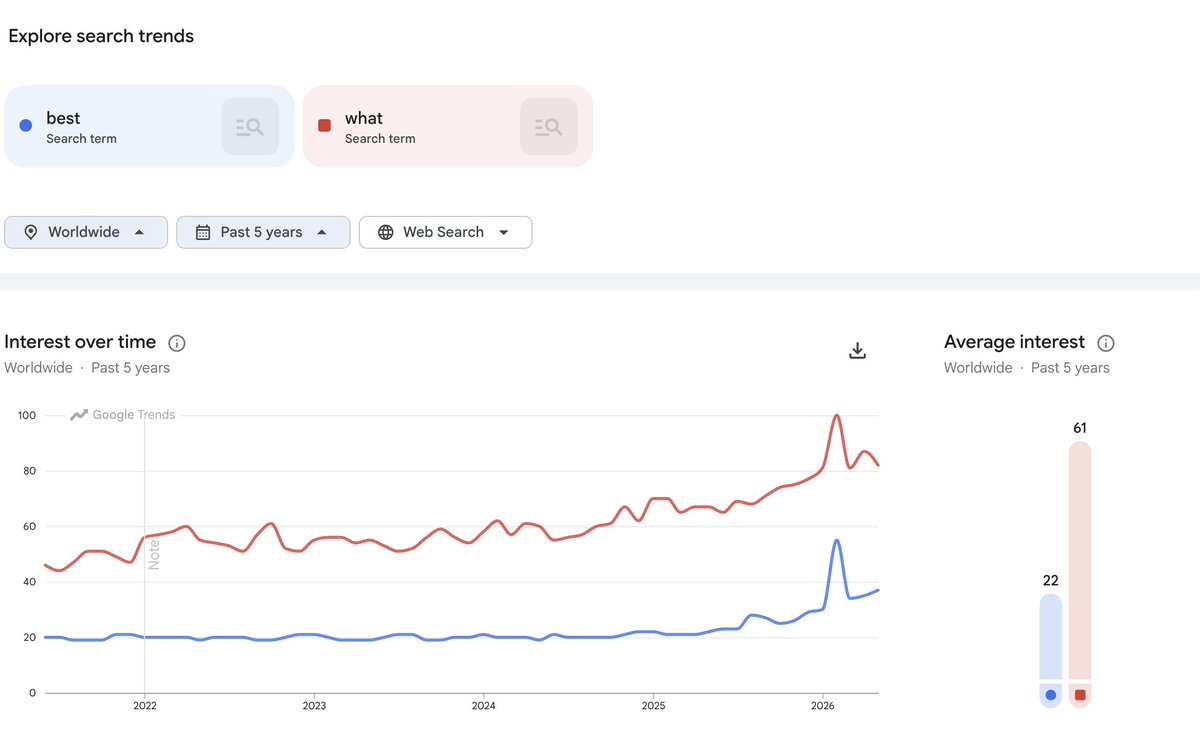
Did you know Google Trends is influenced by fanout queries from ChatGPT & Co?
The most common fanout query terms all show a strong increase in Google Trends.
And "2026" is showing a much higher demand than any previous year. Which is in-line with what @da__kon reported earlier this week.
The "reviews" peak happened around Back Friday. The time when ecommerce searches spike.
Important: These are probably not fanout queries from Gemini, AI Mode, or AI Overviews. Those should not affect Google Trends. But fanout queries from other LLMs, that also show up in Google Search Console, are almost guaranteed to impact Google Trends.
Kudos to @JamesFinlayson who spotted this first.