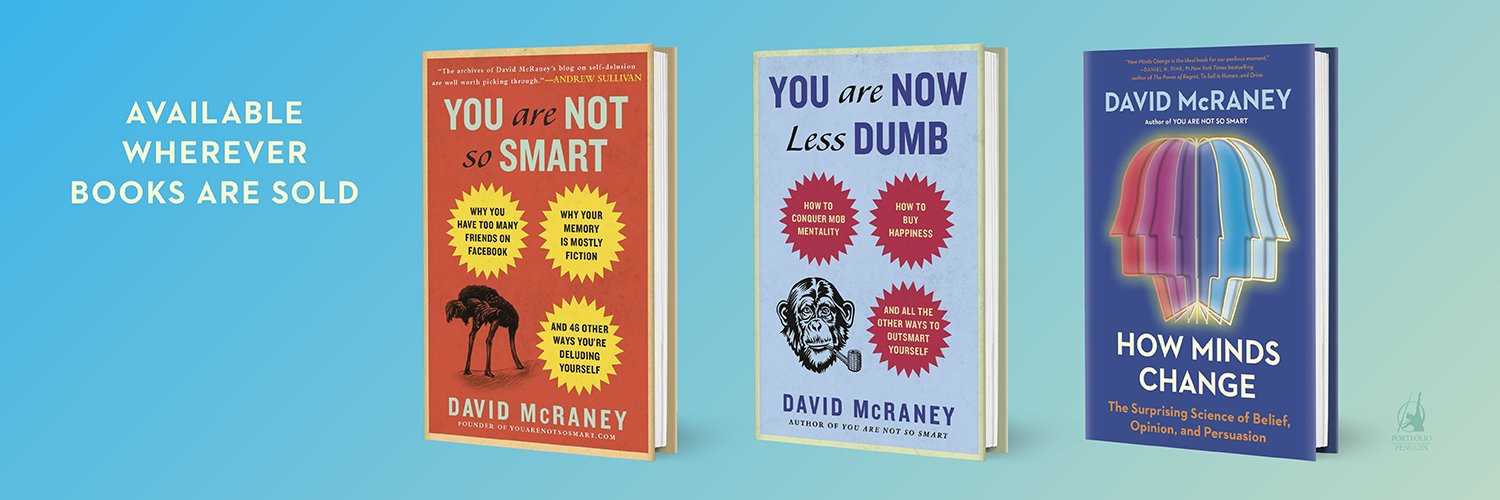
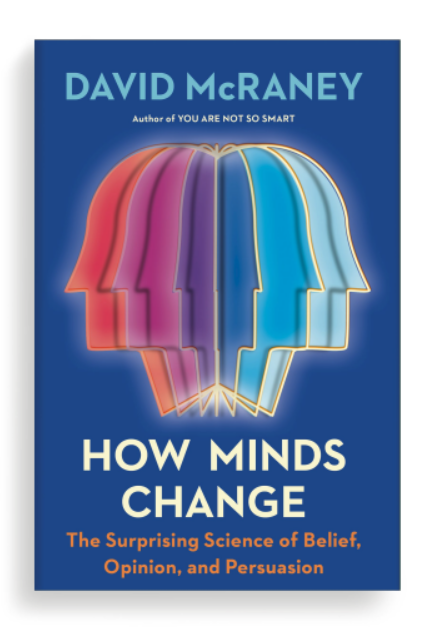
Want to read a brain-bending investigation of why some people never change their minds—and others do in an instant? Want to learn how to change minds, including your own? Here are all the ways you can preorder How Minds Change: https://t.co/iDiJIDHRFx
Just finished another chapter of this very strange book about the dangers of reification via collective sensemaking told through the story of a single word (genius). I will celebrate with a brief interlude in this long writer hermitage by buying coffee in person.
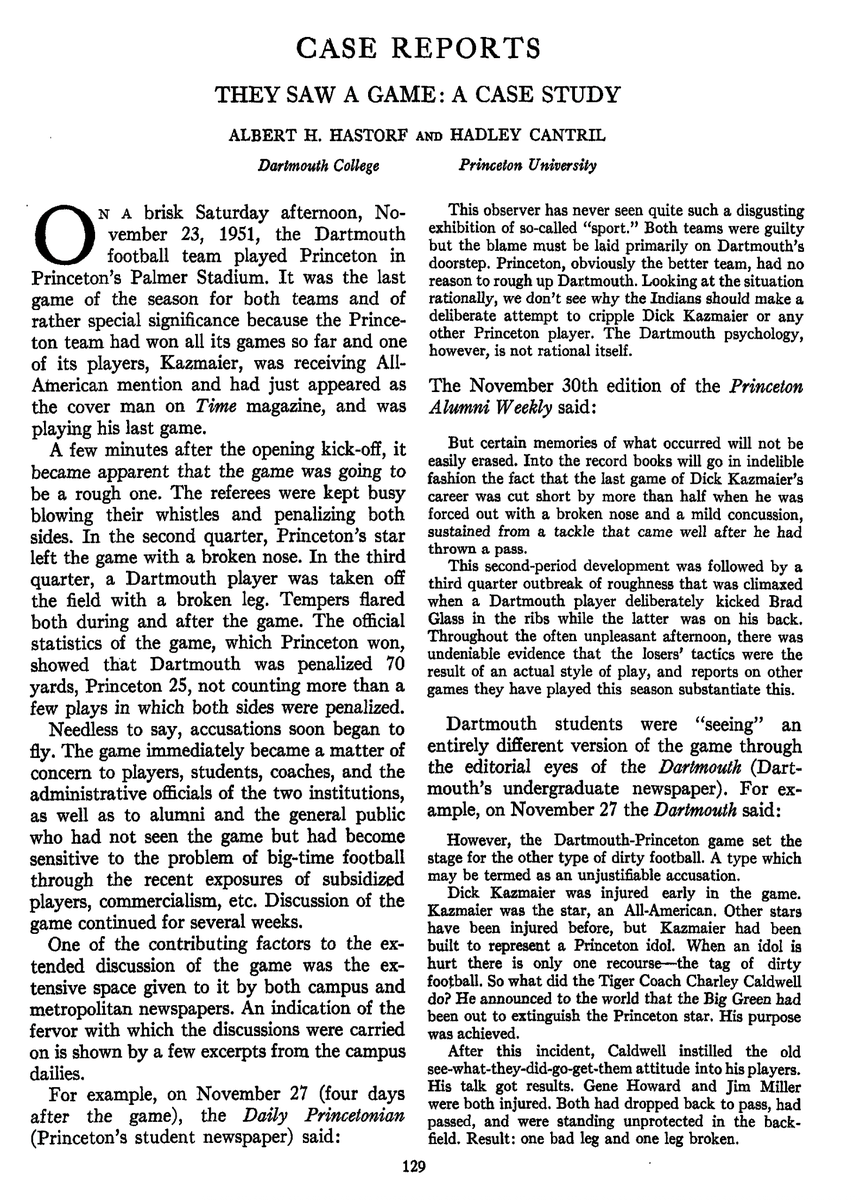
How can so many people watch the same event yet “see” so many different realities?
I was on @davidmcraney's podcast to explain why people from different groups generate different interpretations of reality. If there is video evidence, we assume people will come to the same conclusion. But extensive research finds that people often come to difference conclusions, starting with this classic paper from 1954.
Listen here: https://t.co/OFXX7pmtR1
Read the paper here: https://t.co/f5aGOWfX8i
Don't miss this last chance to contribute to the #PodsFightPoverty campaign. With donor matching, your donation doubles!
Join your favorite podcasters (@HiddenBrain@LaurieSantos@Katy_Milkman@DavidMcRaney etc) to pull families out of extreme poverty (and enjoy the tax break)!
Want to avoid a terrible holiday dinner? Cognitive scientists at Northwestern have created a game (that you can download for free) that makes it possible to avoid fights and find common ground when addressing the issues you likely avoid discussing.
https://t.co/xcmu7xVfHU
3) How Minds Change — @davidmcraney
A modern companion to Cialdini’s Influence. In a post-fact world, rational arguments rarely change beliefs—and you can’t force someone else to change their mind. What does work? Trust, psychological safety, and helping people reflect for themselves. The discussion on assimilation vs. accommodation explains why we default to: “I might be wrong… but probably not.”
P.S. The “strawberry illusion” alone is worth the read 🍓
@JennyGRankin@davidmcraney We're grateful to have David McRaney on our Ambassador Council! And he was an awesome guest on the Season 4 episode of The Decision Education Podcast, "Changing Minds in a Polarized World." https://t.co/NDLNAsIiu0
“𝙏𝙝𝙚 𝙥𝙤𝙨𝙞𝙩𝙞𝙫𝙚 𝙥𝙤𝙬𝙚𝙧 𝙩𝙝𝙖𝙩 𝙤𝙧𝙙𝙞𝙣𝙖𝙧𝙮 𝙥𝙚𝙤𝙥𝙡𝙚 𝙝𝙖𝙫𝙚 𝙞𝙨 𝙨𝙩𝙪𝙣𝙣𝙞𝙣𝙜 𝙖𝙣𝙙 𝙨𝙤𝙢𝙚𝙩𝙝𝙞𝙣𝙜 𝙩𝙝𝙖𝙩 𝙬𝙚 𝙙𝙤𝙣’𝙩 𝙛𝙪𝙡𝙡𝙮 𝙖𝙥𝙥𝙧𝙚𝙘𝙞𝙖𝙩𝙚.”
Listen to co-founder Joshua Greene (@MoralityLab), Harvard psychologist and neuroscientist, on the latest “You Are Not So Smart” podcast with @davidmcraney.
The interview discusses how the brain generates moral beliefs, the science on motivating high-impact charitable giving, and new research utilizing a cooperative quiz game to reduce political polarization.
🔗 https://t.co/om7gku4GWP
According to actual, real studies into this sort of thing, the number of people needed to ensure a protest movement succeeds is much lower than you might assume:
https://t.co/rd68WKm233
Apple Podcats: https://t.co/sqYKAMpp62
Spotify: https://t.co/BbVh38RueK
Why people don’t speak out against, and even defend, norms they secretly despise: https://t.co/t7VxbSgfIx
Apple Podcasts: https://t.co/5E6XNLYfle
Spotify: https://t.co/1HLXrlBBwm
If you had 200 people in a room, and wanted to *stop* them from meeting each other, a great way to do it would be to give one of them a mic, and put the other 199 in chairs
New Book Progress Update: I just drank chocolate Carnation Instant Breakfast out of a Mason jar for lunch before writing about the role of hermeneutics in the pursuit of intellectual humility when avoiding the fallacy of reification concerning abstractions like "genius" 👋
About to attend a conference of scientists who study disagreement at the Center for Enlightened Disagreement at Northwestern. Article about the center: https://t.co/W76aFtfOVf
Seems a good time to re-share this episode of YANSS about why civil resistance is incredibly powerful and how that works (scientifically), but also what it takes to make it work after the soldiers and police arrive: https://t.co/CnzcHw9Zf2
Why (and how) civil resistance works, and why the number of people needed to reach a protest movement's goals is much lower than you might assume: New episode with Erica Chenoweth - https://t.co/4Nwwk6pJJp
@kathryndevaney Y’all hosted a book event for How Minds Change which led to me meeting all sorts of amazing human beings who continue to improve my life. I also once meditated there with @michaelpollan — it’s a beautiful place where paths cross like that all the time
Hey everyone wondering if you can ever get through to people stuck in cult-like thinking and change their minds (spoiler - you can).
How Minds Change is, right now, a Kindle Daily Deal for $1.99 on Amazon.
Limited time, ends at midnight, here's a link: https://t.co/xbE9JYz5CN