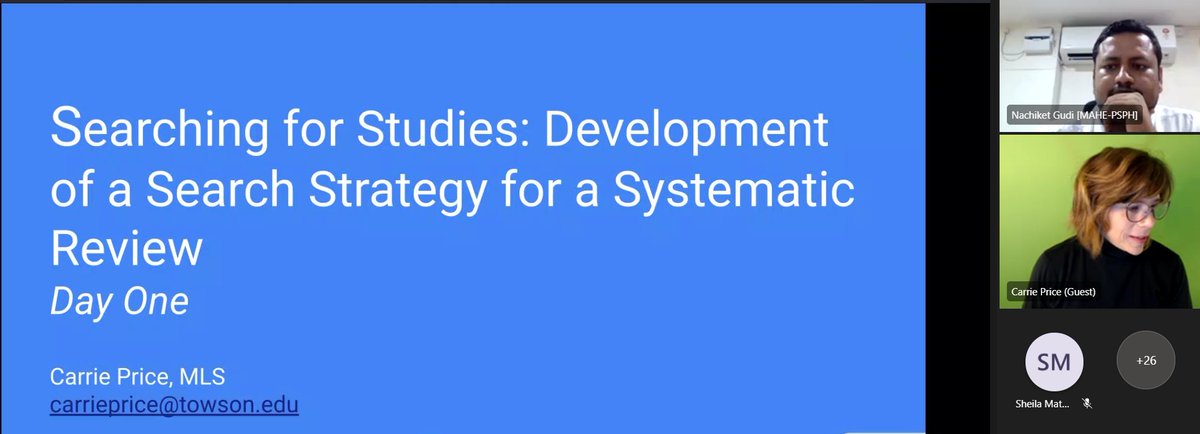
Day 1: Searching for studies- development of search strategy for a systematic review” was delivered by
@carrieprice78
She focused on developing a suitable search strategy for conducting a systematic review.
@EndNoteNews@DrOrgoProf @carrieprice78 @MushtaqBilalPhD I love Endnote! It’s the best citation management software on the market! And I use it everyday and troubleshoot issues for my patrons. I think it’s fabulous 😁
So, is anyone else surprised to learn that NCCN is now requiring folks to ask for permission before citing/using their content? O [Big] Brother, where art thou? Apparently working at NCCN.
https://t.co/jOPF92xhoC
#medlibs
???Riddle me this:???
"Infections/surgery"[Mesh] in PubMed =! Infections/su [Surgery] in Ovid Medline, but "Infections/surgery"[Mesh] = exp Infections/su [Surgery] Why? Here's a hint:
#medlibs#ExpertSearching
It's October, and you know what that means? It's National Medical Librarian’s Month! It's easier than ever for healthcare workers to make better decisions faster by consulting with a medical librarian or information professional!
#medlibs
Pro-searcher Tip: It's not just unquoted & untagged terms that automatically map in #PubMed; MeSH terms do too unless you enclose them with quotes & use [mh] tag.
Ex. cancer[mh] = 3.7+ M results; "cancer"[mh] = 0 results
https://t.co/GrMnA0S1zw
#medlibs#ExpertSearcing
@carrieprice78 Sure do! Double negation can be a bit of a mind-bend, but it works in this case because Humans are a narrower subject heading of Animals.
Pro-Searching Tip: Want to exclude animal studies from you search results? Use double negation: sarcoma NOT (animals NOT humans)
2nd NOT excludes humans & 1st NOT excludes animals leaving sarcoma results indexed with humans.
#medlibs#ExpertSearching
Peer review is "a wonderful, complex, multicolored beast"?! Well, that's an interesting way to describe it, but sure, why not: https://t.co/14Aejh8Bpg
#PeerReviewWeek22#medlibs#SystematicReviews
But, don't just copy/paste b/c subject headings are updated and entry terms can change over time. Hedges are a great starting place to gather possible terms to use. Look up headings to ensure they're still relevant to your topic (or even still in use).
#medlibs#ExpertSearching
Today's pro tip for searching biomedical & health sciences databases: use published search hedges to build your own search strategy (i.e. term-harvesting). Here's a great source: https://t.co/KWgBlsSAvO
#medlibs#ExpertSearching#SystematicReviews
Today's pro tip for searching biomedical & health sciences databases: use published search hedges to build your own search strategy (i.e. term-harvesting). Here's a great source: https://t.co/KWgBlsSAvO
#medlibs#ExpertSearching#SystematicReviews
Super interesting article: https://t.co/VawlsEEMf4
How do you choose between 2 really important resources and not alienate your patrons? Short answer: you include them in the decision-making process as much as possible. #MedLibs
To search for grey lit or not? That's still a question... https://t.co/xWCOmEpx9z
Maybe if conference proceedings authors adhered to CONSORT for abstracts, the ROI (time, effort, additional relevant results found) would be higher. #medlibs#expertsearching
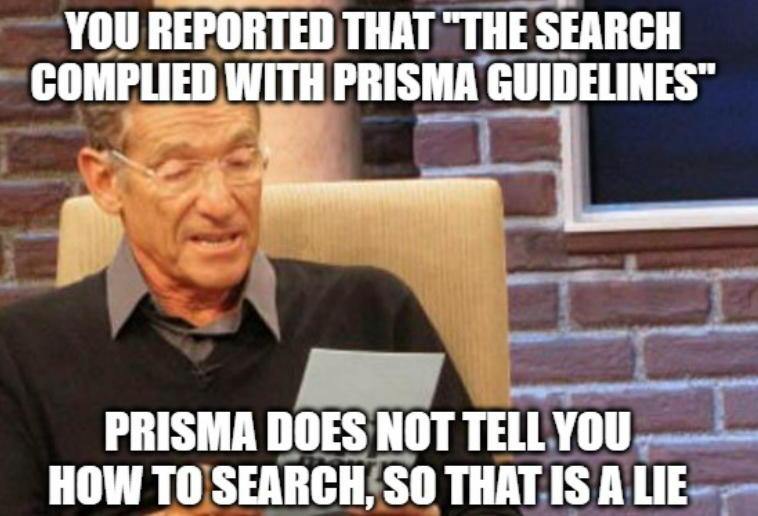
Your search cannot comply with #PRISMA because PRISMA does not tell you how to search.
But, your search reporting should comply with PRISMA.
Refer to standards and guidelines accurately!
#SystematicReviews
@carrieprice78 @ralebo06 I totally agree! I consider the search results (regardless of format) to belong to researchers, and I send the file(s) to them. I retain a copy as a backup.