"If you risk something important to you for something unimportant to you, it just does not make sense. I don't care if the odds are 99 to 1 or 1,000 to 1."
— Warren Buffett
Drink up now while you can afford to
There is a significant story to be told on the long-term coffee chart
A 50-base has been completed
Look for Coffee to rise from 343 presently to $510+ $KC_F
Tried and true market signal: a bull flag or bear flag confirming without follow through.
When a flag confirms and stalls, that is often marking a pivot on the larger timeframe.
Daily bull flag confirmed without follow through while looking for a weekly lower high? That is likely your weekly lower high shaping up. You've got reason to switch sides.
Any extended RSI conditions on the break increase the odds for this lack of follow through. If torqued on the resistance break, be skeptical. That's your cue to be defensive if you're long, or aggressive if you're looking short.
If you take trading too seriously you'll have a harder time succeeding.
Yes- money is important and it has real life ramifications, but when you make the game feel bigger than it is, you introduce pressure that degrades your execution.
The best version of your trading happens when you're locked in but not white-knuckling. When you care about doing it right more than you care about the specific dollar outcome.
Staying lighthearted and optimistic goes a long way in this racket.
I will very rarely cut a trade without my stop being hit.
When I enter I'm either going to stop out or hit my target.
Working on that concept has helped my trading big time. I used to self sabotage while in a trade - manufacturing hollow reasons to change the original plan.
Once in a while new information warrants a change of plans but more often than not, the game plan developed with a clear mind is the right one, not the one being built in real time with heightened emotions running the show.
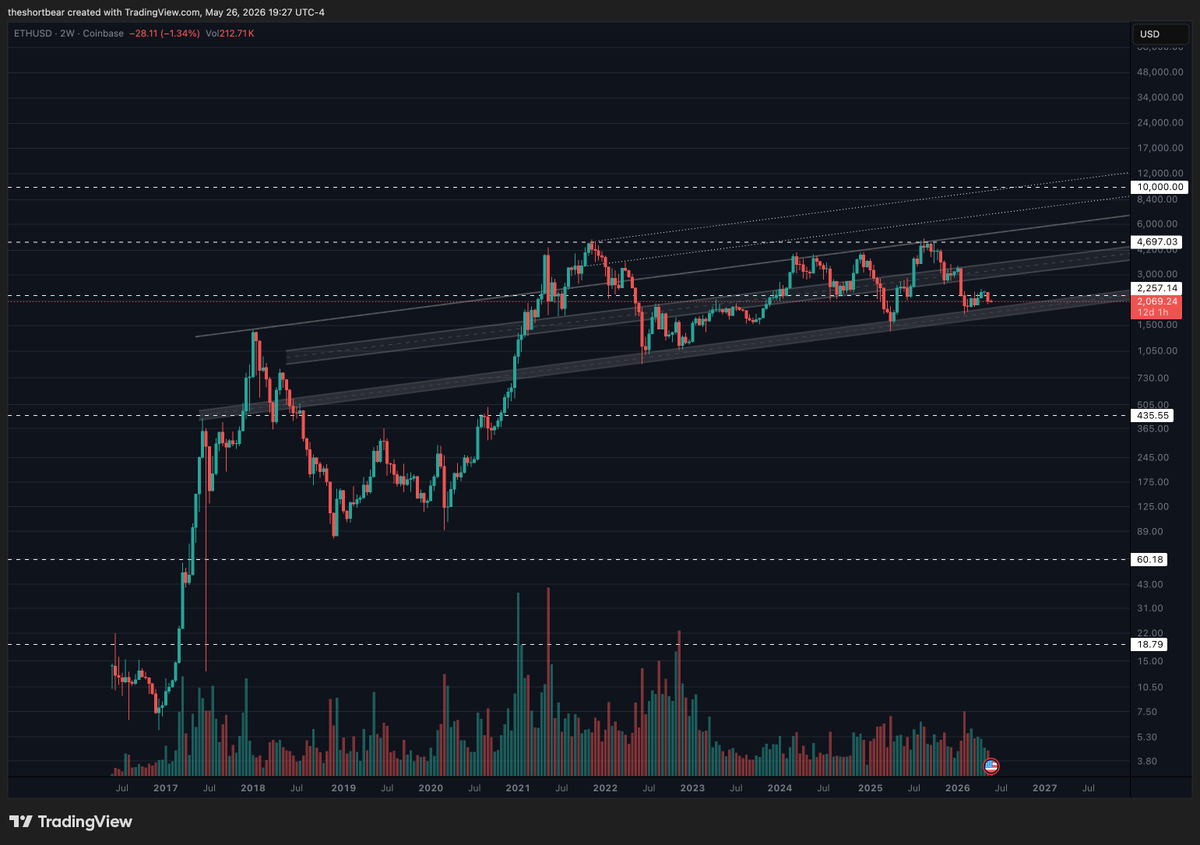
I have never seen so many people capitulating out of $ETH or crypto.
Some are writing blogs and essays explaining why it failed, mainly naming how other chains won the race, measured by fees taken in.
Some of my thoughts, in these hard times:
Time will tell, but I think many people are mistaken in treating $ETH like an end-stage $AMZN, as if the main question is already about mature margins, fees, and cash flows.
In reality, Ethereum is still very much earlier in its economies-of-scale phase, with nearly all metrics in the top right corner and growing at mid double digits to tripple.
Furthermore, most of the market is focused on the wrong battle: who can become the fastest and cheapest payment processor.
Lower fees, higher throughput, faster settlement. But that is likely a race to commoditization, similar to the payment processors crash over the last years.
If the only value proposition is speed and cost, then the moat gets thinner over time, easy disruptable. Someone can always be faster. Someone can always subsidize fees lower. Someone can always optimize one narrow use case.
The real value may not be in the transaction fee itself.
The real value is likely in the amount of economic activity secured by the network, the credibility of that security, the neutrality of the base layer, and the difficulty of replacing it once enough assets, applications, institutions, and users depend on it.
That is where Ethereum seems different to me and why so many institutions are choosing $ETH.
Most other projects still feel replaceable. They may have better performance in one area, better UX in another, or lower fees in the short term. But if their advantage is mainly technical efficiency, that advantage can be copied, competed away, or made irrelevant.
The newest hottest thing today is replacing the hottest thing from last quarter.
Ethereum’s bet appears to be much larger: become the most secure, decentralized, credibly neutral settlement layer for the internet economy.
Not the cheapest rail.
The hardest rail to replace.
In the end, the most valuable network may not be the one with the lowest transaction costs. It may be the one people trust most to secure the highest-value assets and applications over the longest period of time.
If $ETH can retain its market share while continuing to scale through upgrades that improve speed, throughput, and fees, its potential remains significant, especially if AI agents become truly crypto-native.
If it combines all of the above and earn the crown as the leading value-secured network, then $ETH could eventually be viewed as something like a truly decentralized, inflation-adjusting global bond: securing the world’s assets, free from political meddling, and deserving of a premium market cap because of the value it protects on top of the deflationary pressures create incentives to stake, get yield and trust the equivalent of buybacks and griwth in value secured to provide additional value.
Keep in mind over 1/3 of $ETH is now staked!
In that scenario, $ETH would not just be another asset to hold. It could become one of the only truly neutral and secure bonds for the digital economy.
... But sure, lets compare it to $SOL with 6% inflation, no moat, no security, massive outages, decreasing validator nodes and alike.
it just all feels like people are getting lost in short term fees and the easiest valuation attempt rather than what $ETH is actually built for, all while its testing its bottom range and players go full portfolio into AI.
Bitcoiners
Those of you predicting $250,000 in 2026 need to stop with the mushrooms
This is called a channel $BTC
While it does not preclude further price gains, it is NOT a bullish bottoming pattern
The Factor Report reports on classical chart analysis https://t.co/6nRit1xsVp
SpaceX IPO likely in June.
Here is how I'm thinking about participation:
1)priced at $1.75T i'll buy zero shares
2)priced at $1.5T i'll buy 25% position
3)priced at $1.25T i'll buy 50% postion
4)priced at $1T i'll buy a full position
THE FUTURE OF TRADING
Curious what everyone thinks.
What does the future of trading hold for us?
-Area I’m most confident in: trading hours will expand across products until all become 24/7.
-High-confidence: the “everything” store of trading products will arrive. Likely through tokenization, a brokerage will allow you to trade literally anything, anywhere. The biggest benefit for traders will be ability to cross-margin across assets. (Imagine one account for crypto, commodities, stocks, even homes or trad assets!!)
-Low confidence but kinda seems inevitable: AI will be able to learn from our trading data / feedback and we will be able to build trading agents that execute everything for us.
Trading frequency - a commentary from a five decade veteran
I follow about 40 global futures markets
I enter each year figuring that I might three good signals in a given market over the course of 12 months -- maybe four. That's it. For a given market there will only be three or four price bars that I will consider suitable for taking a risk position. If I trade a market more than five times in a year I consider that I over-traded -- that my nose was too close to the chart. Then it is time to be conscious about pulling back from daily charts and re-focusing on weekly charts. As a rule, if I cannot see a pattern on weekly chart then it is 80% certain there is no trade for me.
That's it -- three or four price bars that are important. The rest are noise.
I've traded futures markets for five decades. There is ZERO doubt in my mind that Trump money was behind this buying.
There is NOOOOO law that prevents the Trump machine from manipulating futures markets. Inside trading is legal
Trump family fortune grew today. Trump is playing markets like a fiddle