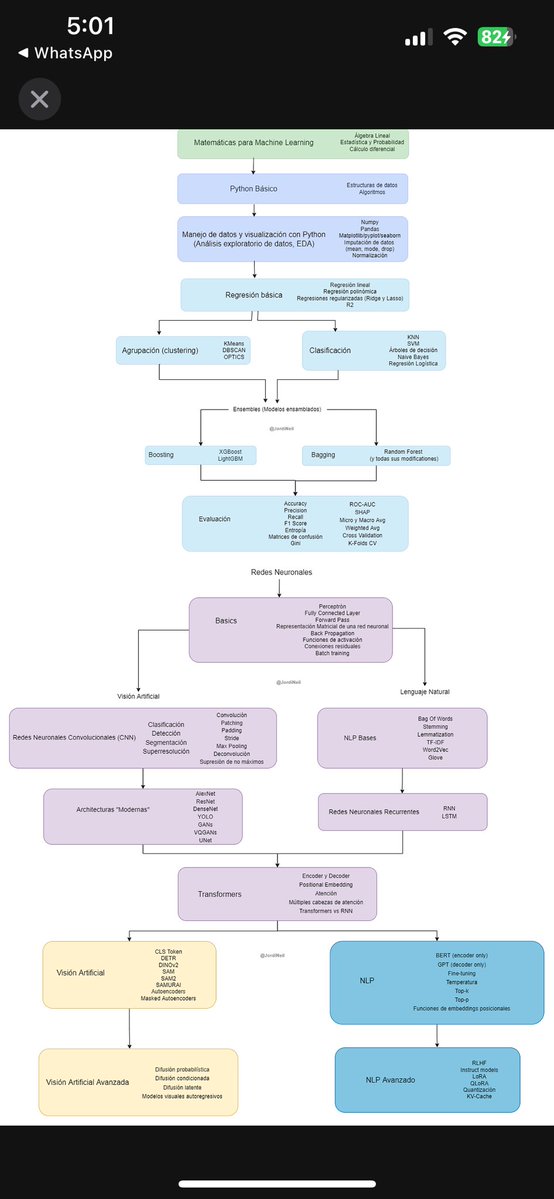
Ya está, lo subí así. Un roadmap que hice para IA y Machine Learning.
Traté de agregar todos los temas y términos que considero importantes respecto al tema.
Creo que si alguien va paso a paso y entiende a detalle cada una de las palabras de este roadmap, va a aprender muchísimo.
Cada bloque puede tener la profundidad de un curso completo, seguro que si ponen "curso de <título de cualquier bloque>" les va a salir un montón de material.
Se los dejo en el link de abajo también por si en la imagen no se ve bien.
Igual es la versión 1.0, seguro se me quedan temas por fuera y lo voy a seguir actualizando con más y más información.
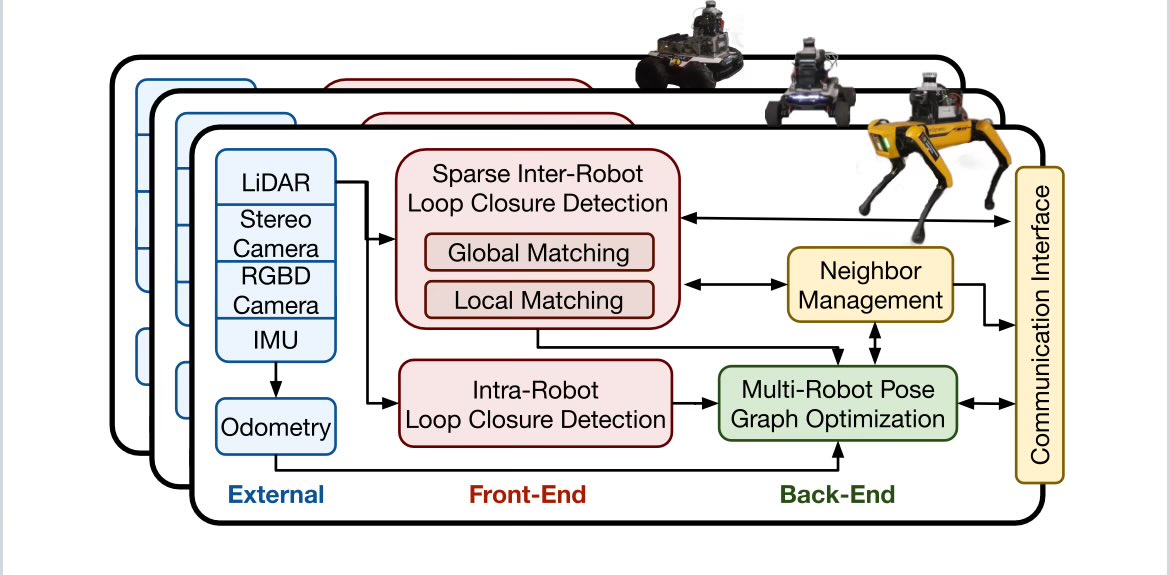
once you get past the basics of robotics software (ros, simulation, kinematics), the next frontier opens up:
control → perception → planning → ai
control → pid, mpc, adaptive controllers. how robots stay stable & precise.
perception → cameras, lidar, sensor fusion. turning raw data into understanding.
planning → path planning, obstacle avoidance, motion planning. giving robots foresight.
ai → deep learning, reinforcement learning. robots that learn & adapt.
this is where robotics starts feeling like science fiction; but it’s all real.
learn the math + code behind each layer, and you’ll see how robots become autonomous systems, not just remote-controlled machines.
While learning various algorithms, the visualization plays a significant role in grasping the concepts easily.
The https://t.co/uby1YJwoap is an excellent resource with amazing collections of algorithms.
30 key system design concepts
Most engineers struggle with system design interviews not because they lack knowledge – but because they lack structure.
You don’t need to memorize 100 different architectures.
You need a clear, repeatable framework to tackle any system design problem.
After analyzing 30 key system design concepts, I’ve put together this one-page cheat sheet to help you:
1. Scale like a pro – Auto-scaling, horizontal scaling, database sharding, and CDN strategies.
2. Manage data efficiently – Data partitioning, NoSQL, SQL transactions, and indexing best practices.
3. Ensure reliability & fault tolerance – Load balancing, redundancy, heartbeat mechanisms, and event-driven architecture.
4. Master caching strategies – Read-through vs. write-through caching, Denormalise Databases, and Distributed Caching.
5. Design flexible architectures – Microservices, async tasks, and avoiding over-engineering.
6. Define problems before jumping into solutions – System constraints, trade-offs, WebSockets, and security.
This is the ultimate cheat sheet I wish I had before my system design interviews.
Save this post for your next interview prep.
Share it with a friend who’s preparing for system design interviews.
What’s the hardest part of system design interviews for you? Let’s discuss in the comments.
📊 ¿No sabes qué gráfico elegir? Esta mini-guía te evitará errores comunes 🚫📈
Una visualización mal elegida no solo confunde: puede hacerte tomar malas decisiones.
Si quieres que tus gráficos transmitan ideas con claridad, empieza con tres preguntas clave:👇
#stats#dataviz
AI & Machine Learning: Key Concepts
AI and Machine Learning rely on best practices, model selection, and optimization to improve performance and accuracy. Here’s a breakdown of essential components:
1. Best Practices
Effective data preprocessing, feature engineering, and model evaluation techniques enhance model performance and generalization.
2. Model Selection
Choosing the right algorithm depends on data size, problem type, feature complexity, and trade-offs between bias and variance.
3. Model Optimization
Techniques like gradient descent, dropout, and transfer learning help fine-tune models for better efficiency and accuracy.
4. Core AI Principles
AI should be scalable, interpretable, fair, and safe, ensuring responsible automation and human-AI collaboration.
5. AI & ML Algorithms
From regression and decision trees to clustering and boosting, different algorithms solve various machine learning problems.
6. Loss Functions & Metrics
Evaluation metrics like MSE, cross-entropy loss, F1-score, and AUC-ROC ensure accurate model predictions.
Explore more in the image below.
Follow me at @goyalshaliniuk for more such information!
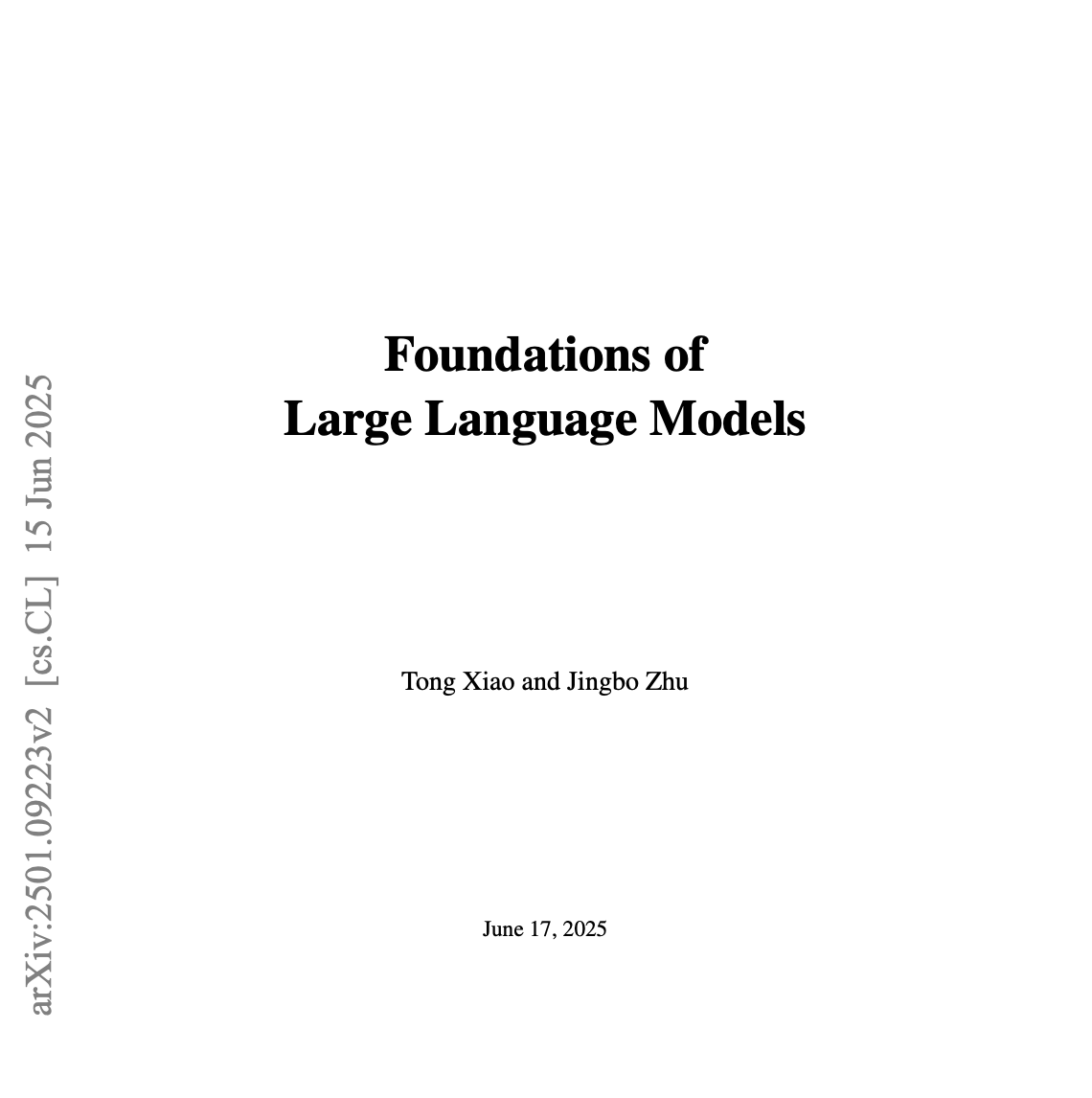
what are large language models actually doing?
i read the 2025 textbook "Foundations of Large Language Models" by tong xiao and jingbo zhu and for the first time, i truly understood how they work.
here’s everything you need to know about llms in 3 minutes↓
Free course to learn GPU programming from the ground up, covering everything from CPU vs GPU fundamentals to advanced topics like neural network implementation, memory optimization, and modern GPU architecture.
Link in comment 👇















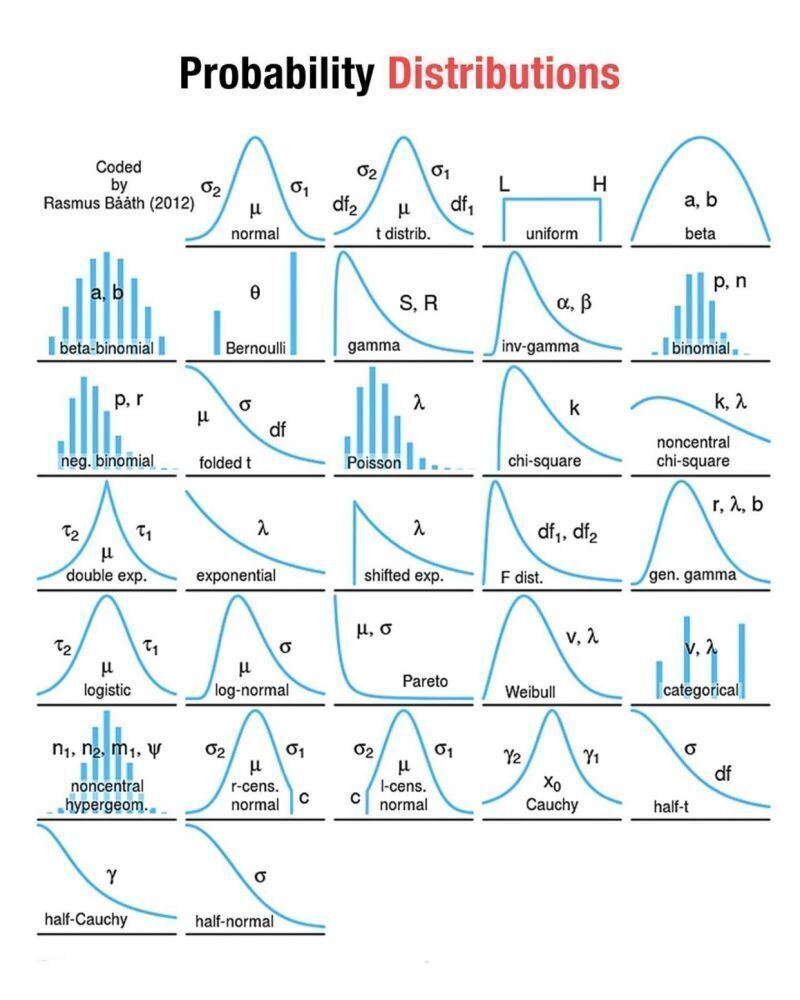
![pickover's tweet photo. Mathematics.
Please enjoy these curve-fitting methods.
[Select the figure to reveal the entire image.]
Source: Randall Munroe, xkcd/2048/ https://t.co/fLiR43GWlm](https://pbs.twimg.com/media/GwlqROaWoAAjYb6.png)