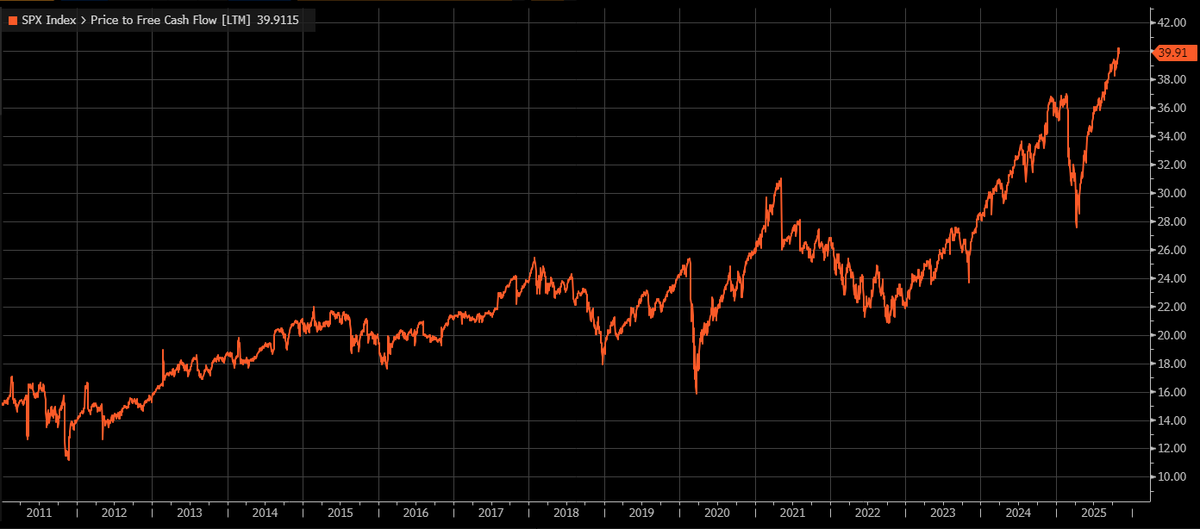
The S&P 500 now trades at 40x free cash flow
That's only 25% below the March 2000 high of 50x free cash flow
Its also nearly double the average valuation of 22x during this bull market
But please keep telling me how "valuations are reasonable" and this is "nothing like the Dot Com bubble"
Daniil Trifonov, age 20, performing Liszt's "Mephisto Waltz No. 1" during the first round of the 2011 International Tchaikovsky Competition, where Trifonov was awarded first prize.
I spent 6 years at Enron right out of college, including through the bankruptcy, but I didn’t really grasp what happened until I studied GE. It’s basically the same story.
GE was an industrial company that transformed into a conglomerate under a hard-charging, visionary CEO. Early success and a high-growth culture led to significant expansion and a variety of business lines, including heavy industry, healthcare, media, appliances, financial services, and insurance.
The p/e multiple of each unit independently would have been roughly 10x (GE Capital) to 30x (Healthcare). But with years of high and consistent earnings growth, GE transcended their peer group and traded over 50x at the peak. But, this was dependent upon high and consistent earnings growth. If GE ever missed earnings, the company would be rerated. It wouldn't drop 10%; the stock would be cut in half. The pressure from the CEO to division heads was clear: make earnings or else.
This led to a culture of aggressive accounting practices, including using the financial arm to prop up underperforming units. Jack Welch defended this practice even after leaving the company, saying earnings management was a sign of operational excellence. GE Capital, the pension fund, actuarial assumptions in the insurance business, and a portfolio of appreciated real estate became an endless well that was used to manage earnings, at least for a long time.
Eventually severe underperformance in certain units, particularly insurance, after the 2000 bubble led to questions about quality of earnings, particularly in light of Enron's bankruptcy. The stock rerated over several years, falling 60% by 2003, where it stabilized until the GFC. By this point, GE Capital was roughly 50% of total earnings. It was easier to sell consumers more loans than refrigerators. The company had effectively become a bank, though avoided the capital requirements of one.
The financial crash in 2008 was the exogenous shock that sent the company into crisis as it was undercapitalized for the portfolio risks and dependent on Wall Street for financing. Having lost the market's trust, the company couldn't roll over its short term debt and the company was days away from bankruptcy in October '08. Worried about contagion effects, the Federal Reserve and FDIC decided to guarantee over $200 billion of new GE debt. Without this, GE would have met the same fate as Enron.
Still, GE was severely weakened and had to go back to its core. It took nearly 15 years for the company to recover and start to thrive again.
Enron was a similar story but a different ending. Enron was an industrial company (pipelines) that transformed into conglomerate under its own hard-charging, visionary CEO. Early success and a growth culture led it to expand into finance (trading and merchant bank) and then retail electricity, international assets, and broadband.
The alchemy of the agglomeration was similar to GE. Enron traded at 30-40x multiple for a collection of businesses that would have been worth <10x (trading) to maybe 20x (retail) if independent. During the broadband bubble in 2000, the p/e reached a staggering 60x.
Enron transcended its peer group because of high and consistent earnings growth. And like GE, the knowledge that the stock would substantially rerate if it ever missed estimates created a culture of "make the numbers," which led to aggressive accounting. Like GE, underperformance in some units was hidden by both real and managed profits in the financial unit. It was easier to give the traders more risk capital than grow an electric utility in Brazil that it owned for some reason.
The trigger for the initial decline was similar. A few outsiders pointed out major red flags in Enron’s financials, particularly the gap between reported profits and actual cash flow, which the company failed to adequately explain. This started a steady decline from the peak in 2000 through 2001. The broadband bubble popped, more accounting questions arose, the CEO resigned (within 1 month of Jack Welch leaving GE), and 9/11 happened. There was also a realization that the company, like GE, was heavily reliant on its trading operation. A credit downgrade could have jeopardized that entire unit.
With outsiders, internal accountants, and external auditors digging into the company's financials, the company announced a $618 million loss for 3q '21. That triggered the announcement of an SEC investigation. Like GE, Enron had significant exposure to the short-term, commercial paper market. With Wall Street skittish post 9/11, significant debt maturing in the near-term, questions about undisclosed liabilities, and no government bailout coming, the company’s collapse became inevitable. The credit agencies downgraded the debt, triggering collateral calls and restricting access to capital. Four days late, in December, 2001, Enron declared bankruptcy.
The similarities were stark: valuation that transcended the sector, earnings management, ‘growth at all costs’ culture, opaque and growing financial arms, reliance on short term debt, hyper-aggressive/illegal accounting, praise by analysts and media, weak internal controls, and hubris. Only government intervention in the case of GE kept their fates from being the same.