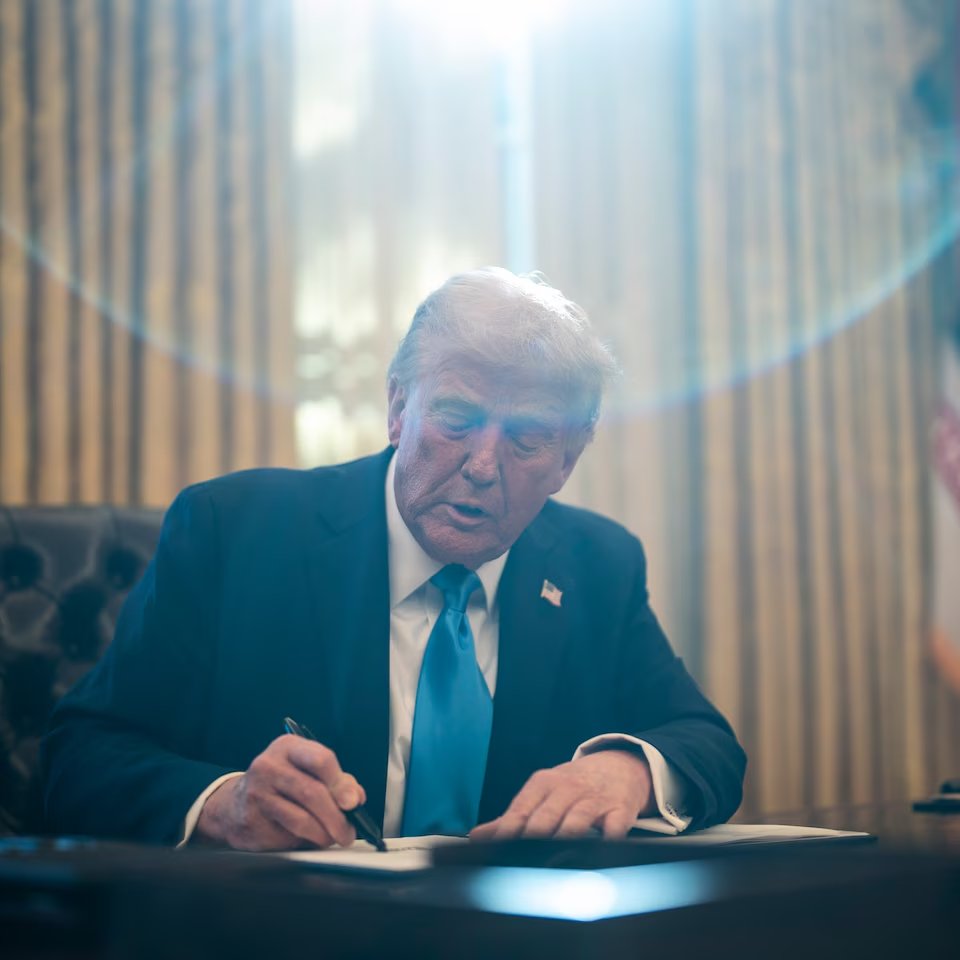
Eric Schmidt just said the quiet part out loud.
"I don't like [China's AI] because it's all open source... not controlled in any way by us."
He is essentially admitting that the United States prefers to act as the gatekeeper of advanced AI, keeping it under centralized control rather than allowing it to spread freely through open source.
In contrast, China has been releasing powerful open-source AI models that developers, companies, and countries worldwide can use, modify, and run independently, without needing permission or paying access fees to American platforms.
This approach is reducing global dependence on the United States as the primary gatekeeper of AI technology. It’s giving more nations and organizations the ability to develop and deploy AI on their own terms.
As a result, AI capabilities are becoming more widely distributed rather than concentrated under American control.
The US doesn't oppose China's AI because it's inferior, they oppose it because it's open source and they can't control who uses it or how.
They want to stay the gatekeeper. China is refusing to play that game by releasing powerful models that anyone can run, modify, and build on without asking permission or paying American fees. That's the real shift happening right now.
The Truth: China Will Continue to Strictly Control the End-Use of Rare Earths Supplied to the U.S.—Approving Only Compliant, Civilian Applications While Denying Military Uses
Yesterday, China's Ministry of Commerce released further factual details regarding the preliminary outcomes of the China-U.S. economic and trade consultations, with the section concerning rare earths drawing particular attention. The specific details are presented below in a Q&A format:
**Question:** The U.S. White House website stated that "China will address U.S. concerns regarding supply chain shortages of rare earths and other critical minerals (including yttrium, scandium, neodymium, and indium). China will also address U.S. concerns regarding prohibitions or restrictions on the sale of equipment and technology for the production and processing of rare earths." What is China's comment on this?
**Answer:** The economic and trade teams from China and the U.S. have engaged in thorough communication and exchange regarding export control issues. Both sides will jointly explore ways to address each other's legitimate and lawful concerns. The Chinese government implements export controls on rare earths and other critical minerals in accordance with relevant laws and regulations, and reviews license applications that are compliant and intended for civilian use. China stands ready to work with the U.S. to create favorable conditions for fostering mutually beneficial cooperation between enterprises of both countries, and for safeguarding the security and stability of global industrial and supply chains.
In fact, regarding heavy rare earths, China possesses an even more pronounced resource advantage; it would be extremely difficult for the U.S. to source sufficient quantities globally—let alone undertake the necessary processing and purification. Heavy rare earths are of critical importance to the defense industry and high-tech sectors, and are essentially irreplaceable.
Notably, the content released by the Ministry of Commerce this time made no mention of semiconductors or chips, indicating that discussions regarding these specific matters are still ongoing.
🇨🇳 BREAKING: BYD isn’t mucking about. They’re in active talks to join Formula 1. 🏁
BYD vice president Stella Li confirmed it: the company met F1 CEO Stefano Domenicali in Shanghai, they’re in regular contact and they’re seriously discussing involvement. Full team entry as the 12th squad? Power unit supplier? Both apparently on the table.
And the latest twist: fresh reports say they’re deep in talks with Christian Horner about potentially running the whole operation.
The timing makes perfect sense. The 2026 regulations push the hybrid electric component hard, which is exactly where BYD already has the edge. This is the world’s leading EV company using motorsport’s biggest stage to test and show off tech that’s already outselling everyone else on the planet.
What the West continues to disregard as mere “cheap knockoffs” is, in reality, advanced powertrain engineering. These are the drivetrains currently being discussed at the forefront of Formula 1.
F1 needs access to the China market and China is bringing the innovation. This is a vastly different discussion than the one from five years ago.
This is a strategic decision. Showcasing the tech’s durability in the most demanding environments to lift the global brand.
The question worth asking: how long before a Chinese-powered car is leading the pack at Monaco?
🇨🇳🇷🇺UPDATE : Putin is IN Beijing RIGHT NOW, shoulder-to-shoulder with Xi Jinping on day two of this historic visit! While the US and its lapdogs are still crying about an ‘axis of evil’, the two strongest independent powers on Earth are locking arms tighter than ever. 25th visit. 30th anniversary of strategic partnership. 25th anniversary of the Good-Neighborliness Treaty. And they just kicked off the China-Russia Years of Education to train the next generation of unbreakable friendship.This isn’t diplomacy. This is a steel wall. No sanctions, no threats, no colour revolutions can break it. China and Russia are done asking permission from Washington. They’re building the multipolar world in real time, protecting the Global South, smashing unilateralism, and giving the American empire the middle finger it deserves.
The West had its unipolar moment. It’s OVER. This partnership is only getting stronger, faster, and more confident. You were warned. Now watch it happen live. #ChinaRussiaStrong #PutinInBeijing #MultipolarWorldIsHere #TheEmpireIsShaking
Russia’s President Putin is landing for his 25th visit to China, perfectly timed with the 30th anniversary of the China-Russia strategic partnership and the 25th of their Good-Neighborliness Treaty!
This alliance isn’t some fragile thing, it’s at its absolute BEST period in history and it’s getting stronger and stronger every single day!
Xi and Putin have met over 40 times, guiding this rock-solid bond with deep mutual trust, shoulder-to-shoulder, back-to-back cooperation that no third party can touch or dictate.
The West loves to cry ‘axis of evil’ but the facts are clear: while the US throws tantrums, sanctions, interference and long-arm jurisdiction nonsense, China and Russia are pushing back HARD. They’re the pillar holding up international fairness and justice in a world the Americans keep trying to destabilise. Coordinating in the UN, BRICS, SCO – protecting the Global South and building real multipolarity.
China and Russia are true neighbors who can’t be moved. This partnership is injecting massive stability and positive energy while the US bully keeps trying to divide and conquer.
The US’s unipolar days are finished. The China-Russia machine is only accelerating. Deal with it! The multipolar world is here and it’s unstoppable.
🇨🇳 Remember when the West said China could only copy cars? Yeah… about that. 👇
The West has spent decades saying that China “just copies” their cars. Cheap knock-offs, no original ideas and poor quality rubbish. Every headline, every politician, every legacy auto exec in Detroit, Stuttgart and Tokyo repeated the same silly line like a mantra.
Well, that went well, didn't it?
As of May 2026, Chinese EV makers aren’t copying Western tech anymore. They’re reinventing it and the old guard can’t keep up. BYD’s Yangwang U9 Xtreme just reached 496 km/h to become the world’s fastest production car. Full stop.
Their U8 SUV has four independent electric motors and does a tank turn, spinning 360 degrees on the spot, Geely’s Zeekr 001 FR does the same and Xiaomi’s SU7 Ultra Prototype just set the fastest four-door lap record around the Nürburgring at 6:46.8. These aren’t concepts, they’re on the roads right now.
Fifteen years ago the narrative was all “Chinese cars are unsafe copies with dodgy build quality”. Today those same brands are running ultra-fast charging at up to 1000 kW, AI voice assistants that actually work, sleek interiors that make German luxury look dated and over-the-air updates that turn your car into a smartphone on wheels. Development time? Chinese EV makers are pumping out new models in just 24 months. While legacy giants still need 36 to 55.
What about the price? They undercut everyone while delivering better battery tech, software integration and range.
Tesla used to dominate China. Now its share of the new-energy vehicle market has collapsed to about 3 percent, down from 8 percent at the end of last year. Local buyers aren’t stupid, they want fresher styling, more advanced infotainment and real value.
I see it every day driving around here. Whether I am in a DiDi or driving around in my own Chinese EV.
Here's the most astonishing detail. China doesn’t just build the cars, it controls the entire supply chain: mining, refining, battery cells and rare-earth processing.
CATL is the global king and China is basically the only large-scale producer of the heavy rare earths that make high-torque motors possible. Get it though your heads, this isn’t “copying.” This is structural dominance on a scale Japan achieved in the 80s with electronics, except cars matter more to jobs and geopolitics and China is now firmly leading.
So what does the West do? Slap 125% tariffs on Chinese EVs to keep them out of America and panic in Europe about “protecting” their markets. They can’t compete on merit, so they block the doors. Pathetic really.
The centre of gravity in the global car industry has shifted to China. Legacy brands still have dealer networks and brand history, but brand loyalty is dying when the new stuff feels like the future and costs less.
The West screamed “China copies everything” for twenty years. What they were really doing was projecting their own fear of falling behind.
How long before they admit the future of mobility was never theirs to keep?
China's tyranny? When? Where?
How many innocent civilians has China bombed? ZERO
How how many hospitals and schools has China bombed? ZERO
How many dead filipinos are there by China? ZERO
Dead invaded Taiwanese thanks to China? ZERO
How many millions of civilians in other countries starved by China sanctions? ZERO
When's the last time China started war slaughtering countless innocents?
They haven't ever.
Japan invaded China. China didn't start the Korean war or the Vietnam war.
The Sino Indian war back in the 60s half a century ago was tiny and short compared to the thirty eight million people slaughtered by US warmongering across the world according to the Brown university Watson Institute
How am I doing so far?
Basic math and simple facts are better than your disgusting despicable lies
China is the world's first peaceful global superpower in seven centuries
You should be saying thank you
#China #Japan #CounterPointGlobal
China’s research and development of 6G technology currently holds a leading position globally and has entered a critical phase of industrial implementation.
The Ministry of Industry and Information Technology (MIIT) of China recently granted the IMT-2030 (6G) Promotion Group a license to utilize 6G experimental frequencies within the 6 GHz band. This authorization supports the group in conducting 6G technology trials in select regions, focusing on technical R&D breakthroughs and verification testing aligned with the typical scenarios and key performance indicators for 6G established by the International Telecommunication Union (ITU). The approval of these experimental frequencies marks a pivotal transition in China’s technological research—moving from the laboratory into the realm of industrial application.
As of June 2025, China accounted for approximately 40.3% of global 6G patent applications, ranking first worldwide; commercial deployment is projected to commence in 2030.
China’s proactive strategic positioning in the 6G sector aims to consolidate its dominant role in next-generation digital infrastructure. This domain is also poised to become a key arena for competition between China and the United States (given its lag in 5G technology and applications, the U.S. is currently channeling full efforts into the R&D and verification of 6G technology).
In December 2025, the United States signed the "Winning the 6G Race" memorandum, designating it as a national roadmap for securing the technological high ground. Currently, the U.S. is prioritizing the development of terminal chips (spearheaded by companies such as Qualcomm and Intel) and integrated artificial intelligence technologies. Furthermore, it has issued joint statements with multiple nations—emphasizing the security, openness, and resilience of 6G—in an attempt to construct a global telecommunications ecosystem grounded in its own values while excluding China.
The American Public: We want to purchase products from China—such as BYD and Huawei—yet, due to trade sanctions imposed by the United States—a nation that professes to uphold a free-market economy—we are unable to freely purchase high-quality, affordable goods
🚨🇺🇸 US Congress IMPLODES in Rape, Cash & Suicide Scandal Tsunami, “Beacon of Democracy” Exposed as a Moral Sewer 💩
While America lectures the world on “rules-based order” and human rights, its own House of Representatives is tearing itself apart in a fresh wave of sex assaults, stolen taxpayer millions and affairs that ended in suicide. Axios just called it straight: Congress is in full “moral crisis,” teetering on the edge of collapse.
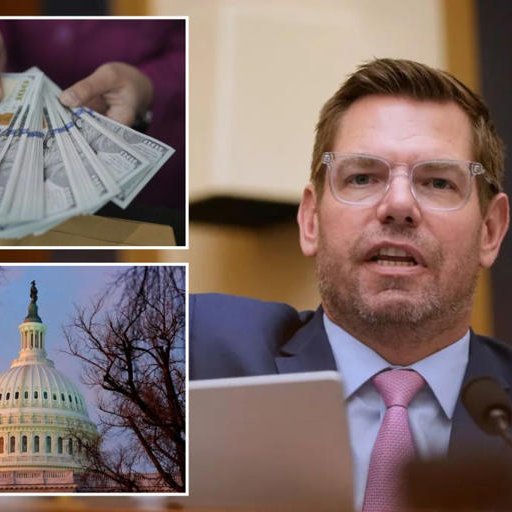
The latest domino to fall? California Democrat Eric Swalwell, once a loud #MeToo cheerleader and frontrunner for California governor, just resigned his congressional seat after multiple women came forward with credible accusations of rape, sexual assault and harassment, including against a former staffer under his supervision. He admits “poor judgment” but denies the worst of it and says he’ll fight the claims. House Ethics Committee had already opened a formal probe. Too little, too late.
At the same time, Texas Republican Tony Gonzales is filing retirement papers after admitting an extramarital affair with a staffer who later died by suicide. Florida Democrat Sheila Cherfilus-McCormick has been hit with multiple ethics violations for allegedly funnelling $5 million in COVID relief cash straight into her own campaign, federal criminal charges already filed, she still claims innocence. Florida Republican Cory Mills is under fire for domestic violence allegations, false military record claims and more.
This isn’t one bad apple. It’s the whole darn barrel rotting. The bipartisan House Ethics Committee, equal Dems and GOP, has been dragging its feet for years on these exact cases. Swing-district Democrats are now openly furious at the “defective” process. Expulsion needs a two-thirds vote; it almost never happens. Politicians protect their own through backroom deals and voter bases that look the other way. South Carolina Republican Nancy Mace summed it up on X: “The American people deserve a Congress they can trust. The House needs a thorough cleaning.”
This is peak Western institutional decay. The same Washington crowd that obsesses over “CPC corruption” and “authoritarianism” can’t even police its own members without descending into partisan paralysis and public farce. Beijing’s anti-graft drive under Xi has taken down tigers and flies alike with real speed and results, no endless ethics theatre, no “he said/she said” shielding the powerful. China’s system, for all its flaws, delivers stability, accountability at scale and focus on actual governance instead of endless scandal cycles.
America’s “democracy” isn’t collapsing because of China. It’s collapsing under the weight of its own hypocrisy, elite impunity and structural gridlock. While DC distracts itself with this sewer, Beijing keeps building high-speed rail, lifting living standards and shaping a multipolar world that actually works for its people.
The world is watching. The contrast has never been clearer.
Tô Lâm’s China visit: comrades and brothers in a turbulent world
Vietnamese President Tô Lâm arrived in Beijing on 14 April for a state visit to China – his first overseas trip since being elected president – where he held talks with Xi Jinping at the Great Hall of the People.
The visit, coming just a year after Xi’s own state visit to Hanoi, marks the third summit between the two countries’ top leaders in less than two years, a frequency that speaks volumes about the depth and dynamism of the relationship.
The most important element of the bilateral relationship is that both the Chinese and Vietnamese flags remain red. These are two socialist states, led by communist parties, committed to the road of people-centred development and modernisation.
Xi put it plainly, expressing confidence that Vietnam will “firmly follow the path of socialism” and noting that “defending the socialist system and the ruling position of the communist party is the greatest common strategic interest” of the Communist Party of China and the Communist Party of Vietnam. The relationship, as the two parties have long characterised it, is one of “comrades and brothers”.
Washington has long sought to exploit historical tensions between the two neighbours – in particular the memory of the 1979 border conflict, and ongoing territorial disputes in the South China Sea – in order to pull Vietnam into its anti-China geopolitical game plan. The leverage it hopes to use is primarily economic: the US is a major export market for Vietnamese goods, and Trump’s tariffs are biting hard.
But Vietnam is refusing to be used as a pawn. Tô Lâm stated clearly that developing ties with China is “an objective requirement, a strategic choice and a top priority” in Vietnam’s foreign policy.
Xi, for his part, was equally direct: “China and Vietnam should uphold the principles of peace, development, cooperation and mutual benefit, and work together to oppose unilateralism and protectionism”. The message – that the two socialist neighbours stand together against Washington’s economic coercion – could not have been clearer.
The two sides agreed to deepen cooperation across a wide range of areas: infrastructure connectivity, artificial intelligence, semiconductors, supply chains, and cultural exchange, with 2026-2027 designated as China-Vietnam Tourism Cooperation Year.
The two sides reaffirmed that any differences should be managed through dialogue and the framework of mutual respect, demonstrating that neighbouring friendly countries can handle disputes without resorting to confrontation or allowing third parties to exploit them.
China and Vietnam continue to develop their relationship, rooted in shared ideology and genuine mutual benefit, capable of weathering both internal differences and external pressure. In a world of escalating US aggression and economic coercion, such a model of cooperation is both inspiring and urgently necessary.
The world isn’t “talking” about moving away from the dollar anymore — it’s already happening.
And it’s happening quietly at scale. Major banks, sovereign governments, and global institutions are increasingly borrowing in Chinese yuan instead of dollars, and the numbers are now too big to ignore. In March 2026 alone, foreign issuance of Panda bonds tripled year-on-year to 27.8 billion yuan, while total yuan-denominated financing by foreign borrowers has already surged past 218 billion yuan in just the opening weeks of the year, far outpacing the entire trajectory of 2025.
What’s more telling is who’s actually making this shift. Deutsche Bank just issued the largest Panda bond ever by a foreign bank, and it was heavily oversubscribed. Asian Infrastructure Investment Bank and Asian Development Bank are both active in the market, while Indonesia managed to borrow in yuan at significantly lower cost than euro-denominated debt issued in the same week. At the same time, Morgan Stanley and Barclays are now repeat issuers, and even Hungary has entered the market with sovereign yuan bonds. This isn’t fringe behaviour, it’s mainstream capital making calculated decisions.
The reason: cost. China’s 10-year government bond yield sits around 1.82%, while the equivalent U.S. Treasury is closer to 4.46%. That gap — around 260 basis points makes borrowing in yuan roughly 60% cheaper. For countries and institutions that already trade heavily with China, the decision isn’t ideological, it’s mathematical. You borrow where it’s cheaper, especially when your trade flows already align with that currency.
The foundations of dollar dominance are starting to show cracks. The dollar’s share of global foreign exchange reserves has fallen to its lowest level since 1995, while China has steadily reduced its holdings of U.S. Treasuries over the past decade. More importantly, the behavior of the Treasury market itself is changing. Research has shown that the traditional “convenience yield”, the premium investors used to accept just to hold the world’s safest asset has turned negative. In simple terms, U.S. Treasuries are no longer behaving like a true safe haven.
Recent market behavior reinforces that shift. During the global bond sell-off triggered by geopolitical tensions and rising energy prices, U.S. and other Western yields spiked sharply, signaling stress. China’s 10-year yield barely moved. That relative stability is exactly what large institutions look for when deciding where to park capital.
Then you layer on what’s happening in global trade and energy flows. Following the recent ceasefire involving Iran, transit through the Strait of Hormuz is reopening, but with a new structure where fees are charged per barrel and can be paid in yuan or Bitcoin, not dollars. This is a deliberate move to bypass the dollar-based financial system, and early indications suggest that yuan settlement was already being used before the announcement. When one of the most critical energy chokepoints in the world starts accepting alternatives to the dollar, it sends a very clear signal about where things are heading.
The yuan now accounts for over a third of China’s cross-border trade settlements, up dramatically from just a few years ago. China is the largest trading partner for more than 120 countries, and when trade is increasingly settled in yuan, those countries naturally begin holding yuan as part of their reserves, and investing in yuan-denominated assets to support that. The rapid growth of both onshore Panda bonds and offshore dim sum bonds reflects exactly that dynamic.
For decades, the dollar’s dominance was built on one core assumption: there was no real alternative. What’s changing now isn’t that the dollar has suddenly collapsed, it’s that the rest of the world is no longer convinced it’s the only option. And once that assumption breaks, it doesn’t easily come back.
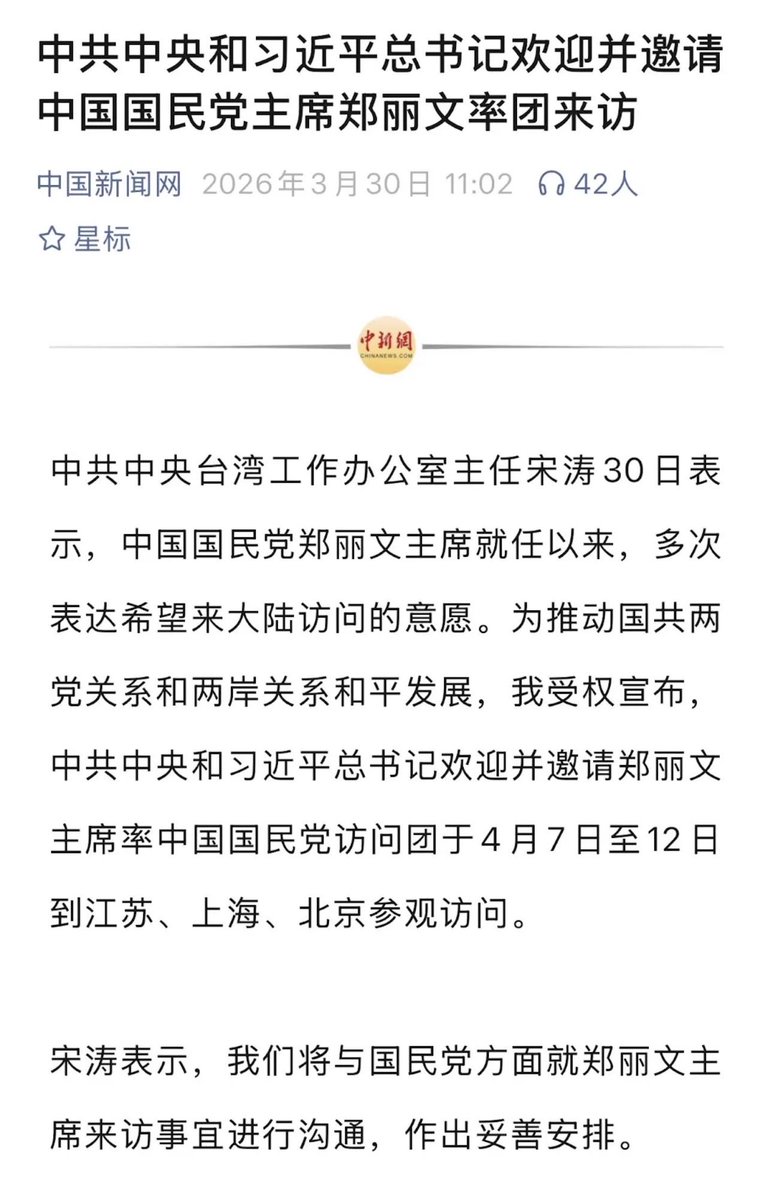
IT’S HAPPENING! KMT Chairwoman Cheng Li-wen is gonna meet Xi in China forreal! April 7th to 12th.
This is incredibly exciting. I knew given how Cheng made some high-profile statements that it was probably going to happen.
Here in Taiwan, some KMT’ers are terrified that being too close to China will tank the KMT’s November electoral process. Maybe but only if you are pathetic bedwetters about it.
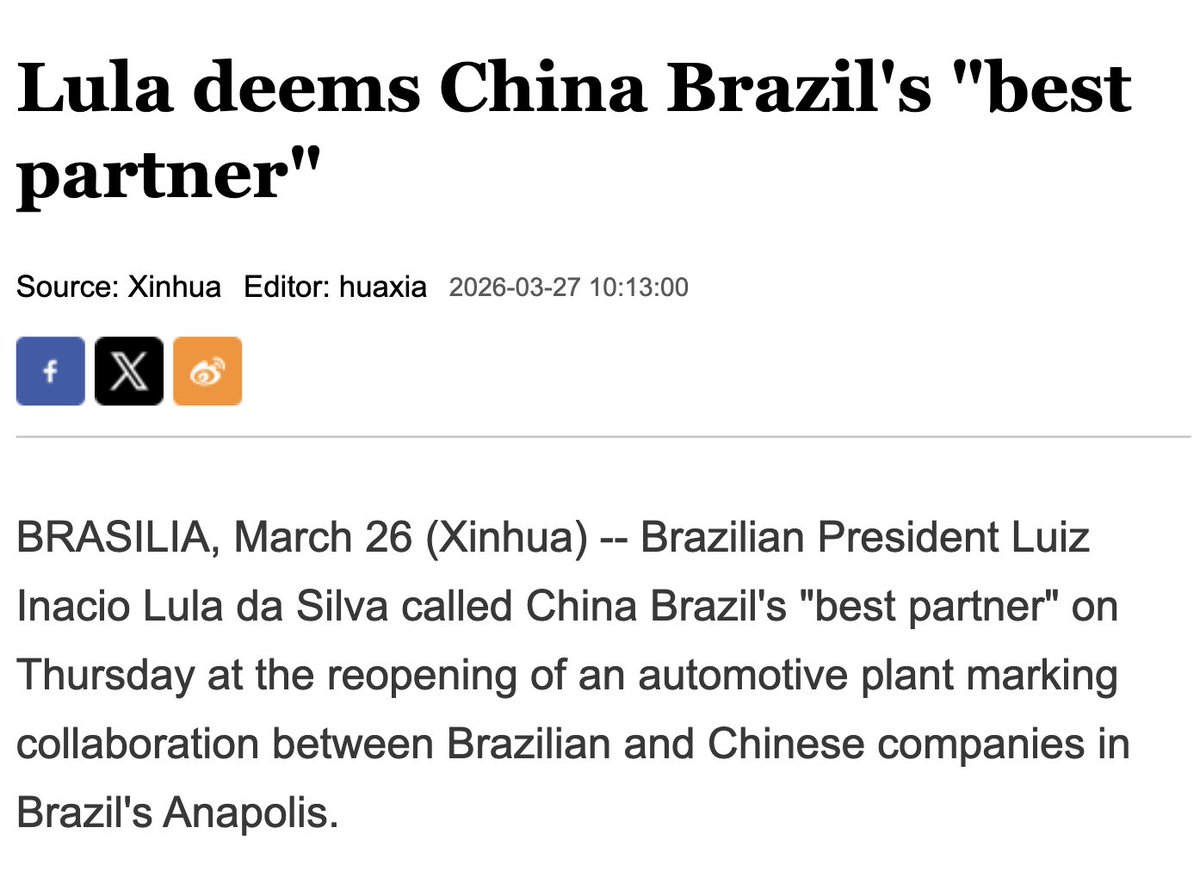
China is sharing advanced technology with other Global South countries so that they can modernise, develop, create jobs and improve living standards whilst protecting their sovereignty. That's why Lula says China is Brazil's "best partner".
Oil just smashed through $107 a barrel, and that should be setting off alarm bells across the entire United States. Because the moment Americans start seeing that number show up at the gas pump, millions of people are going to realize something very quickly — Trump has backed himself into a corner, and this time there’s no way out of it. The only thing holding the illusion together until now was an artificially inflated stock market, pumped up by the AI bubble while politicians pointed at rising 401k balances and told Americans everything was fine.
But anyone paying attention knew that market wasn’t built on solid ground. It was speculation, hype, and cheap money. And now Trump has poured gasoline on the fire by launching a war that won’t be measured in weeks… it’ll be measured in months, maybe longer.
And the oil markets have already reacted. At $107 a barrel, the shock is already rippling through the global economy. The United States runs on cheap energy, and when oil spikes like this everything becomes more expensive overnight — logistics, groceries, manufacturing, aviation. The entire cost structure of the American economy shifts upward, and ordinary Americans are the ones who end up paying the bill.
And here’s the political reality: the one group that tolerated the chaos — the MAGA base — did so because their retirement accounts kept climbing. When the stock market turns south and gas prices surge, that loyalty will evaporate very quickly.
What we’re witnessing is an administration that walked blindly into a geopolitical storm without a real plan for the economic consequences. No preparation. No strategy. Just reckless escalation and the assumption that markets would somehow ignore reality.
They won’t.
You couldn’t ask for a more incompetent and unprepared administration — and unfortunately it’s the American public that’s about to absorb the shock.
The Great Flip: From “Crazy” to $1.5 Trillion
December 3, 2018.
Fresh from G20 photo-ops, Trump tweeted:
> “...an uncontrollable Arms Race... The U.S. spent 716 Billion Dollars [on] Military. Crazy!”
He called it crazy.
He dreamed aloud of sitting down with Xi and Putin to finally stop the madness.
That was the Donald Trump MAGA loved: the outsider who saw the Pentagon grift, who promised to end endless wars, cut the waste, and put America First.
January 7, 2026.
Same man, second term, same platform:
“Our Military Budget for 2027 should not be $1 Trillion Dollars, but rather $1.5 Trillion Dollars.”
One point five trillion.
More than double the “crazy” number he once denounced (adjusted for inflation).
The peacemaker now wants the biggest military budget in human history to build his “Dream Military.”
The faithful didn’t blink.
The ones who once raged against bloated defense spending now cheer the largest single-year appropriation ever—enough to fund healthcare, infrastructure, debt relief, and still have billions left for more missiles and carriers.
This isn’t ordinary hypocrisy.
It’s narrative jujitsu: turn restraint into costume, discard it when convenient, then convince the crowd the costume was never real.
Loyalty isn’t to principle.
It’s to the man.
The same man who called it crazy… now calls it destiny.
And just like that, the movement that swore to drain the swamp became its most lavish, trillion-dollar tributary.
Welcome to the Dream Military era.
$1.5 trillion dreams are expensive.
Amnesia, apparently, remains free.
🚨🇺🇸 The Monroe Doctrine Didn’t End: It Was Rewritten and Enforced by a Power-Hungry Nation That’s Gone Mad
In late 2025 the US National Security Strategy formally introduced a “Trump Corollary to the Monroe Doctrine” defining the Western Hemisphere as a US core interest zone and committing Washington to actively enforce dominance there. That includes blocking external powers from controlling strategic assets authorising direct intervention to secure resources and treating migration crime infrastructure and energy as national security issues.
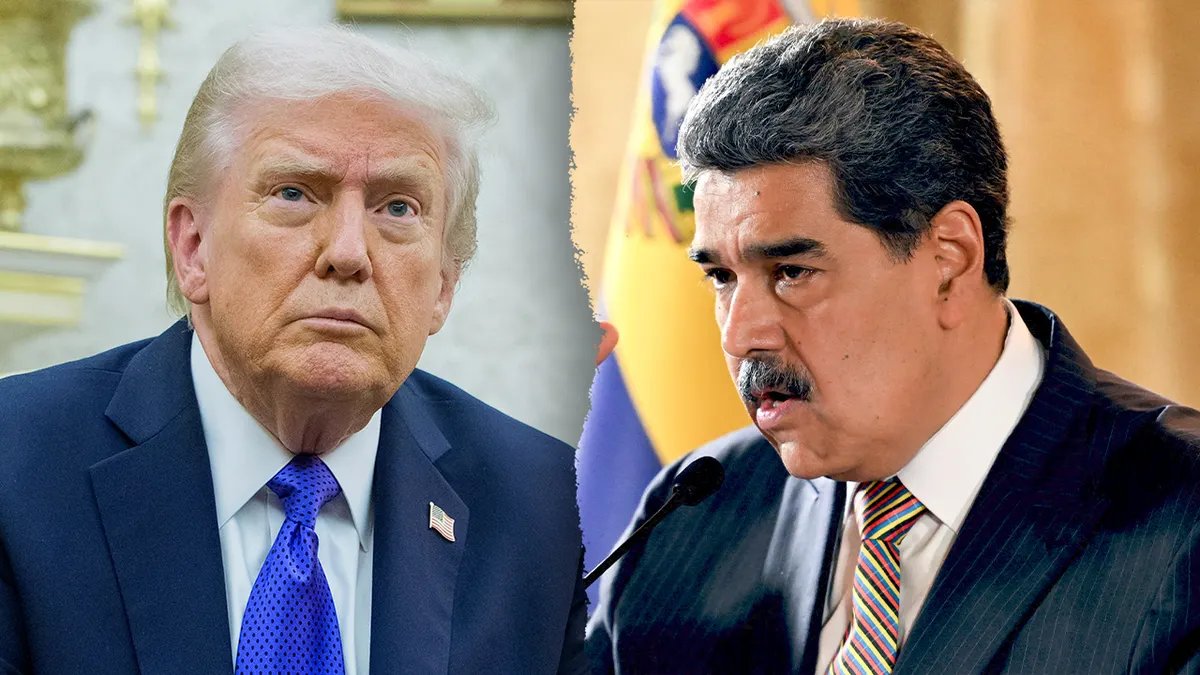
Days later it moved from paper to practice. US forces launched an operation against Venezuela forcibly detaining President Maduro triggering international condemnation and legal backlash. US officials and Trump himself then signalled that further action was possible issuing public warnings toward Colombia Mexico Cuba and others.
This is not the old Monroe Doctrine. The original opposed European colonialism while the Roosevelt Corollary turned it into hemispheric policing and the Trump Corollary drops the moral language entirely.
It openly frames Latin America as an absolute security and resource zone tied to “America First.”
Crucially the strategy explicitly targets “non hemispheric competitors” a clear reference to China and Russia and seeks to block their access to energy ports infrastructure finance and political influence across the Americas.
This is where China and BRICS come in.
Latin America has been drifting toward China led trade finance and infrastructure networks. Venezuela Brazil Bolivia Argentina and others have explored alternatives to dollar centric systems expanded yuan trade deepened BRICS ties and welcomed Chinese investment in energy ports mining and logistics.
From Washington’s perspective that isn’t diversification it’s erosion of control.
Venezuela sits at the centre of this shift the world’s largest proven oil reserves growing cooperation with China and Russia and symbolic leadership of the Latin American left. Trump has since spoken openly about US dependence on Venezuelan oil and the need for access to it. The message is no longer subtle.
This isn’t about democracy.
It’s about resources currency leverage and who sets the rules.
What we’re witnessing is a shift from “the Americas belong to Americans” to “the Americas belong to the United States.”
Less diplomacy, less disguise and more force.
Under international law, these actions are widely regarded as illegal. Using military force against a sovereign state without UN Security Council approval or a valid self-defence claim violates the UN Charter. Domestic criminal charges do not justify invading another country or seizing its head of state and UN officials, legal scholars and multiple governments warn that this breaches Venezuelan sovereignty and the international legal order.
If the US can do this without consequences, it can do it to any country it chooses.
The Monroe Doctrine didn’t disappear; it has escalated.


![angeloinchina's tweet photo. The Great Flip: From “Crazy” to $1.5 Trillion
December 3, 2018.
Fresh from G20 photo-ops, Trump tweeted:
> “...an uncontrollable Arms Race... The U.S. spent 716 Billion Dollars [on] Military. Crazy!”
He called it crazy.
He dreamed aloud of sitting down with Xi and Putin to finally stop the madness.
That was the Donald Trump MAGA loved: the outsider who saw the Pentagon grift, who promised to end endless wars, cut the waste, and put America First.
January 7, 2026.
Same man, second term, same platform:
“Our Military Budget for 2027 should not be $1 Trillion Dollars, but rather $1.5 Trillion Dollars.”
One point five trillion.
More than double the “crazy” number he once denounced (adjusted for inflation).
The peacemaker now wants the biggest military budget in human history to build his “Dream Military.”
The faithful didn’t blink.
The ones who once raged against bloated defense spending now cheer the largest single-year appropriation ever—enough to fund healthcare, infrastructure, debt relief, and still have billions left for more missiles and carriers.
This isn’t ordinary hypocrisy.
It’s narrative jujitsu: turn restraint into costume, discard it when convenient, then convince the crowd the costume was never real.
Loyalty isn’t to principle.
It’s to the man.
The same man who called it crazy… now calls it destiny.
And just like that, the movement that swore to drain the swamp became its most lavish, trillion-dollar tributary.
Welcome to the Dream Military era.
$1.5 trillion dreams are expensive.
Amnesia, apparently, remains free.](https://pbs.twimg.com/media/G-IEogUWgAEFntd.jpg)








![angeloinchina's tweet photo. The Great Flip: From “Crazy” to $1.5 Trillion
December 3, 2018.
Fresh from G20 photo-ops, Trump tweeted:
> “...an uncontrollable Arms Race... The U.S. spent 716 Billion Dollars [on] Military. Crazy!”
He called it crazy.
He dreamed aloud of sitting down with Xi and Putin to finally stop the madness.
That was the Donald Trump MAGA loved: the outsider who saw the Pentagon grift, who promised to end endless wars, cut the waste, and put America First.
January 7, 2026.
Same man, second term, same platform:
“Our Military Budget for 2027 should not be $1 Trillion Dollars, but rather $1.5 Trillion Dollars.”
One point five trillion.
More than double the “crazy” number he once denounced (adjusted for inflation).
The peacemaker now wants the biggest military budget in human history to build his “Dream Military.”
The faithful didn’t blink.
The ones who once raged against bloated defense spending now cheer the largest single-year appropriation ever—enough to fund healthcare, infrastructure, debt relief, and still have billions left for more missiles and carriers.
This isn’t ordinary hypocrisy.
It’s narrative jujitsu: turn restraint into costume, discard it when convenient, then convince the crowd the costume was never real.
Loyalty isn’t to principle.
It’s to the man.
The same man who called it crazy… now calls it destiny.
And just like that, the movement that swore to drain the swamp became its most lavish, trillion-dollar tributary.
Welcome to the Dream Military era.
$1.5 trillion dreams are expensive.
Amnesia, apparently, remains free.](https://pbs.twimg.com/media/G-IEov_XMAADiNx.jpg)