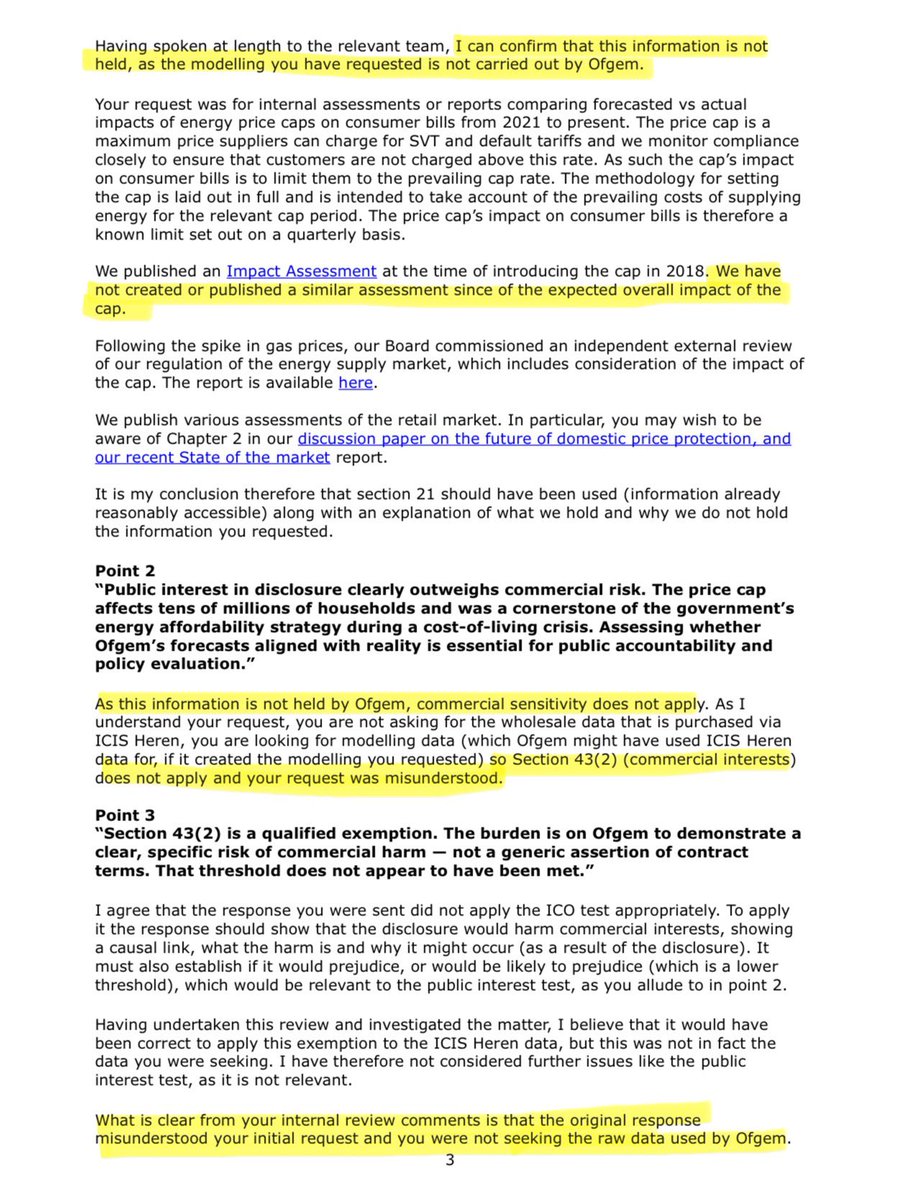
Ofgem admits it never evaluated whether the energy price cap worked in real life
After submitting an FOI and pushing for internal review, I can confirm:
Ofgem, the UK’s energy regulator, holds no internal modelling or reports comparing its price cap forecasts to actual outcomes.
Despite setting energy caps that affect tens of millions, including during the cost-of-living crisis, Ofgem:
- Made no effort to test if forecasts matched reality
- Has no evidence the cap helped consumers or suppliers
- Doesn’t assess if households were overpaying, or if suppliers made excess profit
Ofgem is responsible for modelling and setting the price cap. But this means they model costs before setting the cap, and never check afterwards if they got it right.
There is now a serious accountability gap in performance audit and scrutiny.
Have households been misled or overcharged without anyone in government checking?
Watching politicians and mainstream media suddenly change their rhetoric on the genocide makes me feel like I’ve truly gone crazy. Can someone please confirm that a few weeks ago they villainized us on the front pages for being against this while they were very much pro-genocide.
What if the U.S. started a trade war, and the White House got bored halfway, and wandered away?
Well, we're living it. It has been 12 E̵p̵s̵t̵e̵i̵n̵ days since the White House bothered to issue a tariff letter, and it has left the job only about one-seventh done.
So exactly how effectively has govt, water industry and regulators been in dealing with pollution, sewage dumping and the despicable state of our rivers and beaches in the last 12 months?
"Serious pollution incidents up 60% in 2024 from previous year."
It's over. Enough of the niceties, the finger wagging, the pointless foot stamping, heads need to roll.
https://t.co/x93UipiOBv
Britain pays wind farms to turn off when it’s windy and overpays gas plants to switch on instead. It'll cost bill payers up to £8b/yr by 2030. Zonal energy pricing would slash this.
We’ve started tracking this (avoidable) waste live on our site: https://t.co/cSvypnOSQs
.@labourlewis: "In truth, our welfare system is increasingly the state subsidising employers who pay poverty wages, landlords charging unaffordable rents & corporations extracting vast profits, all at societys expense" 🎯
TRUMP WANTS THE DARKEST CORNERS OF BIG TECH TO OWN THE DOLLAR
The IMF-World Bank Spring meetings are usually placid affairs that participating central bankers wish to forget soon after they are over. Not this Spring. This April the feeling several central bankers brought back home with them was not the usual relief but something far more visceral: dread, terror even. The reason? The spectre of the Genius Act—the U.S. stablecoin bill barrelling toward law in 2025, hot on the heels of Donald Trump’s January 23 executive order heralding a strategic cryptocurrency reserve.
Central bankers have hitherto seen cryptocurrencies as a nuisance whose upside is that, thankfully, they lack the capacity to cause serious raptures in the architecture of the monetary systems under their care. They no longer think now that President Trump’s team are counting on cryptocurrencies pegged to the dollar as part of their strategy to rejig the global monetary system.
What unsettled central bankers this Spring wasn’t just the policy itself, but its implications: a deliberate, chaotic unravelling of the 20th century’s monetary order where central banks reigned as the sole architects of money. The Genius Act doesn’t just allow private stablecoins—it prohibits central bank digital currencies (CBDCs), anointing corporate-issued tokens as the new guardians of dollar hegemony. This isn’t innovation; it’s a hostile takeover of money itself. Lacking anything resembling serious regulation, stablecoins are neither stable nor merely an alternative dollar payment option. They are a Trojan horse for the full privatisation of money.
The European Central Bank sees the danger. If securities migrate to blockchain, with bonds, stocks, and derivatives becoming tokenised, then settlement must follow. The ECB’s solution is a tokenised euro, ensuring public money remains the bedrock of finance. So far, the ECB had to face down resistance to this plan from the German and French banks who seek to maintain the status quo. Now, the ECB has another, a bigger headache: the spectacle of Washington racing in the opposite direction. By banning CBDCs and greenlighting stablecoins, Trump’s team do not just reject public digital money—they also outsource dollar supremacy to the darkest forces within Big Tech.
The irony is grotesque. The same libertarians who rail against government are now begging the state to anoint their stablecoins as de facto official currency. Worse, they demand access to the Federal Reserve’s balance sheet—allowing private issuers to back their tokens with central bank reserves. Imagine a world where Tether, Circle, or Elon Musk’s X Coin enjoys the implicit backing of the US Treasury while operating outside banking regulations. This isn’t just regulatory arbitrage; it’s monetary feudalism.
Lest we forget, there is a reason 19th century America was a monetary dystopia: thousands of wildcat banks issuing private notes, regular panics leaving the public, the working class in particular, holding worthless paper. Even J.P. Morgan was so appalled and threatened that he decided to strongarm the federal government and other bankers to establish the Federal Reserve as a public institution with a remit to stabilise money.
Now, we’re hurtling backward. The Genius Act, whose final draft we have not seen yet, could unleash a digital wildcat era, where stablecoins—pegged to the dollar but controlled by private actors—flood the globe with digital pseudo dollars. Even if well-intentioned stablecoins, like Circle’s USDC or Tether’s USDT, are run by privateers who stand no chance of maintaining their tokens’ dollar peg once their volume escalates after they receive the official imprimatur of the federal authorities. In what must surely constitute the grossest example of truth reversal, President Trump’s executive order ill-defines stablecoins as instruments that will "promote and protect the sovereignty of the US dollar." Loosely translated this calls upon shady privateers to flood the world with private dollar proxies, ensuring that even if nations ditch the greenback, they’ll still be trapped in its digital shadow.
Europe is scrambling. The ECB, realising the existential threat, is fast-tracking a ‘wholesale CBDC’—a digital euro for institutional use that acts as a stopgap: a quick and dirty hybrid system syncing traditional payments with blockchain, buying time until true atomic settlement can be pushed past the vicious resistance of private bankers.
But it may already be too late. While Europe dithers with committees, the US is acting. The Markets in Crypto-Assets (MiCA) regulation has already driven Tether out of Europe—not because MiCA is too strict, but because the European Union’s political leadership still does not grasp the stakes. If stablecoins become the default money of crypto markets, DeFi, and emerging economies, the ECB’s half-baked digital euro will arrive to a battlefield where the war is already lost.
Meanwhile developing countries face a brutal choice. Already choking under the dollar’s dominance, they must now either ban stablecoins (thus forfeiting access to crypto capital flows) or create their own to compete with the dollar’s network effects. A third, unappetising alternative, is to surrender to a new – even more perilous –
form of de facto dollarisation.
The only central bank that has planned ahead of this tsunami is China’s, along with some of the rest of the BRICS. Having the luxury of its own, already functioning digital yuan, China’s central bank can afford to refuse lending legitimacy to stablecoins by regulating them, preferring to ban them altogether to be on the safe side. But this sensible defiance leaves one gigantic dilemma still unanswered: China’s accumulated savings of approximately $4.5 trillion held by public and private institutions. Should they dump them, thus giving a boost to the Trump team’s plan to devalue the dollar? Or hold them, thus remaining exposed to the turbulence that Trump’s team is so adept at stirring up?
In the longer term, the real danger that looms is a bifurcation that fuels geo-monetary tensions, in addition to the existing geopolitical and geo-economic ones. Two parallel monetary systems seem to be heading for a clash: One made of public monies issued in China, India and, maybe, the Eurozone. And another comprising private money, increasingly dominated by dollar-pegged stablecoins colonising the dollar zone.
Is it any wonder that, this Spring, dread was the order of the day as our central bankers boarded their planes to return from Washington?
https://t.co/UFPIkyGUiR
Just figured out where these fake tariff rates come from. They didn't actually calculate tariff rates + non-tariff barriers, as they say they did. Instead, for every country, they just took our trade deficit with that country and divided it by the country's exports to us.
So we have a $17.9 billion trade deficit with Indonesia. Its exports to us are $28 billion. $17.9/$28 = 64%, which Trump claims is the tariff rate Indonesia charges us. What extraordinary nonsense this is.
Your bills are going up because this government would rather protect the profits of a few corporations than the livelihoods of millions of ordinary people.
End this outrageous rip-off, and take water and energy into public ownership now.
Wowch! A “house price ponzi” and
“A suicidal move by @RachelReevesMP” says @yanisvaroufakis then makes @krishgm laugh with his assessment of the UK government.
If you give White House faith adviser Paula White $1,000 before Easter, she promises that you will receive "seven supernatural blessings.": "God will assign an angel to you ... He'll give you prosperity. He'll take sickness away from you. He will give you long life."
The single most important article yet published on Trump's second term, by two scholars who since 2016 have been consistently correct in anticipating Trump's effect on our political system. Everyone should read it.
Albert Einstein wrote this in 1949; it's true in 2025
"Private capital tends to become concentrated in few hands, partly because of competition among the capitalists, and partly because technological development and the increasing division of labor encourage the formation of larger units of production at the expense of smaller ones. The result of these developments is an oligarchy of private capital the enormous power of which cannot be effectively checked even by a democratically organized political society. This is true since the members of legislative bodies are selected by political parties, largely financed or otherwise influenced by private capitalists who, for all practical purposes, separate the electorate from the legislature. The consequence is that the representatives of the people do not in fact sufficiently protect the interests of the underprivileged sections of the population. Moreover, under existing conditions, private capitalists inevitably control, directly or indirectly, the main sources of information (press, radio, education). It is thus extremely difficult, and indeed in most cases quite impossible, for the individual citizen to come to objective conclusions and to make intelligent use of his political rights"