Barack and I have known Mark Bradford for a long time, and have always been amazed by his work.
His beautiful new piece at the Obama Presidential Center, City of the Big Shoulders, is three stories tall and weaves together Chicago’s history – our hope, our power, and our resilience. Somehow, Mark’s story might be even more extraordinary.
Watch this, and I think you’ll agree.
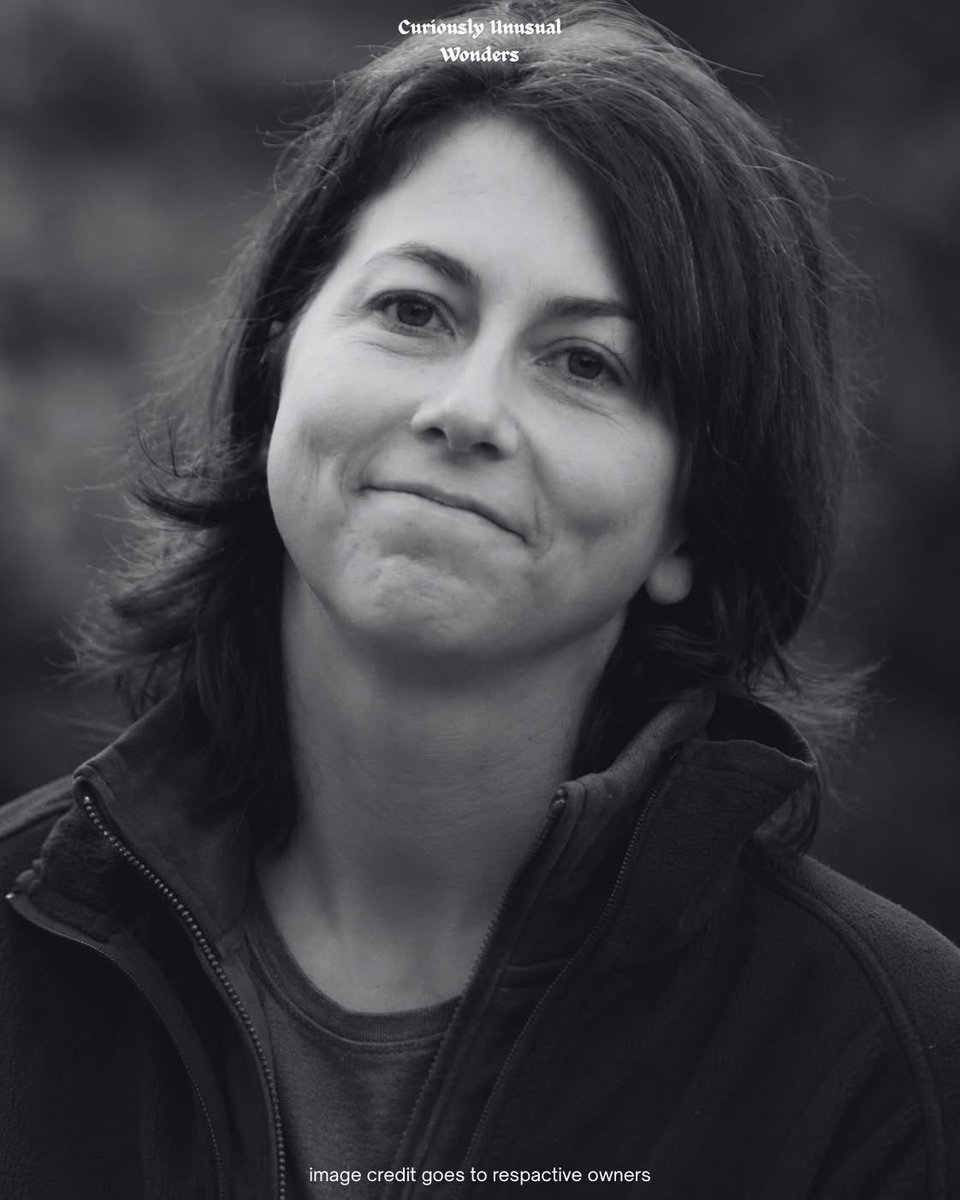
A young woman named MacKenzie Tuttle graduated from Princeton in 1992 with a degree in English. One of her professors was Toni Morrison, who later described her as one of the finest creative writing students she had ever taught.
After graduation, MacKenzie took a job at the New York investment firm D. E. Shaw. There she met a colleague named Jeff Bezos, who had an ambitious idea: selling books on the internet.
She didn’t laugh at the idea.
They married in 1993, and the following year drove across the country to the Seattle area to build what would become Amazon.
In the beginning, there was no global empire.
There was a garage.
MacKenzie handled accounting, wrote business materials, answered customer emails and phone calls, and packed orders alongside Jeff. Like many startups, everyone did whatever needed to be done.
As Amazon grew, MacKenzie stepped away from day-to-day operations to raise their four children while continuing to pursue her own passion for writing.
Her debut novel, The Testing of Luther Albright, won the American Book Award. She later published a second novel and quietly built a respected literary career.
Meanwhile, the story of Amazon became one of the most famous business stories ever told.
Jeff Bezos became one of the world’s most recognizable entrepreneurs.
MacKenzie’s role was rarely part of the public narrative.
She never seemed interested in changing that.
What many people don’t know is that she also knew financial hardship.
Her family filed for bankruptcy while she was still a student, and she has spoken about the kindness of people who helped her through difficult times—acts of generosity she never forgot.
In 2019, after her divorce, MacKenzie Scott received approximately 4% of Amazon’s shares.
Almost immediately, she made a decision that surprised the world.
She signed the Giving Pledge, promising to donate the majority of her wealth during her lifetime.
Then she did something even more unusual.
Instead of building a massive public foundation or attaching her name to buildings, she began giving away billions of dollars through large, unrestricted grants.
Universities.
Food banks.
Housing organizations.
Rural communities.
Women’s health initiatives.
Tribal colleges.
Climate organizations.
Small nonprofits that had never imagined receiving gifts of that size.
Many recipients reportedly thought the phone calls were scams.
They weren’t.
Since 2019, MacKenzie Scott has donated tens of billions of dollars to thousands of organizations, making her one of the most significant philanthropists of the modern era.
Despite giving away enormous sums, her fortune has remained substantial because of Amazon’s continued growth.
The woman who once packed Amazon’s first orders is now helping fund opportunities for millions of people she will probably never meet.
She never asked for buildings in her name.
She never demanded headlines.
Sometimes the greatest legacy isn’t the company you help build.
It’s what you choose to do with the success that follows.
In 2013, Amanda Nguyen was three months from graduating Harvard. She'd spent summers at NASA, hunting for planets. She was the daughter of Vietnamese refugees who once read the stars to find their way to freedom by boat. She had one dream since childhood: to go to space.
Three days after her 22nd birthday, a classmate raped her.
She did everything she was told to do. Hospital. Forensic exam. Rape kit collected as evidence.
Then she found out the evidence had an expiration date.
Massachusetts gave her 15 years to decide whether to press charges. But her state would destroy the rape kit in just 6 months — unless she filed a renewal request. Every six months. For fifteen years. With no instructions on how. She'd have to relive the worst day of her life on a recurring deadline, just to stop the system from erasing its own evidence.
She checked the other 49 states. The rules were a patchwork — some kept evidence for years, some for months, some charged survivors to even collect it. Justice depended on a zip code.
So in 2014, at 23, with zero legislative experience, she wrote a bill herself.
For two years she sat in congressional offices hearing "this isn't a priority" from staffers who'd never been asked to wait six months to matter. She kept showing up anyway.
In 2016, the Sexual Assault Survivors' Rights Act passed the Senate 89–0 and the House 399–0 — unanimous, in one of the most divided Congresses in history. President Obama signed it on October 7, 2016. Nguyen stood in the Oval Office. She was 24.
That law covered federal cases only — about 1% of assaults. So she kept going, state by state, helping pass similar protections in more than 40 states.
In 2019, she was nominated for the Nobel Peace Prize.
And the dream she'd put on hold? On April 14, 2025, Amanda Nguyen flew to space aboard Blue Origin's NS-31 — becoming the first Vietnamese and Southeast Asian woman ever to leave Earth's atmosphere. She carried 169 lotus seeds from Vietnam with her, a gift of peace marking 50 years since the end of the Vietnam War.
When she landed, she said: "I want all survivors — or anyone who has ever had a dream deferred — to know: you will make it through."
She delayed her own dream for over a decade to fight for people she'd never meet. Then she reached for the stars anyway.
Chioma Sonia Eze, the young Black woman who grew up as an orphan after losing both parents, made history by earning her Electrical Engineering degree with honors.
From facing life’s toughest challenges to graduating from Covenant University and aspiring to become a machine learning expert while guiding her younger siblings, she defied all the odds.
Can just sit anywhere and be deeply content & in bliss
In my humble opinion that is true wealth
The only people better at this that i know are my recluse/monk friend who has been sitting in silence every morning for 6 hours for 50 years, my taoist master friend who does very long retreats on his own deep in the forest, and my reiki master friend who has the most impressive energy & healing skills i have ever seen. They have my utmost respect
All three are financially poor and care zero about money but in my humble opinion they are by far the wealthiest people i know. Inner development is the ultimate journey and nothing is more important in a human life than figuring out what the ¨I¨ is (not), exactly as every sage has said throughout human history
People think that me repeating the same thing ¨turn inside¨ is just boring or repetitive, but seriously, the only people i have ever met that i consider truly free of suffering or truly content have spend a lot of time turning their attention inside instead of on the outside like our entire human culture and civilization encourages all the time
So....👇
THE DOG WOULDN’T LET THEM TAKE HIS HEADLAMP OFF
After the Venezuela earthquake, the rescue team was finally done for the night.
But their search dog sat outside the tent, refusing to settle down. He wouldn’t let anyone take off his headlamp, and kept pulling toward an area they had already combed. His handler was exhausted, but finally said, “Alright, let’s go.” The dog led them straight back into the rubble.
Then they heard it a tiny cry. Under the broken concrete, wrapped in a blue blanket, was a baby still alive. Everyone else thought the search was over.
The dog knew it wasn’t.
The men who carved the pharaohs' tombs spent their evenings writing love songs. The one in this tweet is about a man who would rather fake a deadly illness than tell the girl he likes how he feels.
Almost all of Egypt's surviving love poetry comes from a single place: Deir el-Medina, a walled village across the Nile from modern Luxor. This is where the workers and artists lived, the people who dug out the royal tombs and painted their walls. By day they built eternity for the pharaohs. At night, some of them wrote about wanting someone who wasn't thinking about them.
It survived for an odd reason. Papyrus rots almost everywhere on Earth, but the sand around that village is so dry that fragile things held on for more than three thousand years. A few of the poems turned up scratched onto chips of limestone, the cheap scrap paper Egyptians used for practice, copied out by students learning to write.
Some of it gets lost in translation. Across these love songs, the lovers call each other "my sister" and "my brother." Those weren't family words. They were the warmest things a person could call someone they loved, the same habit you find centuries later in the Bible's Song of Songs. And these poems were songs. They were meant to be sung aloud and probably set to music, not read in silence the way we read now.
The feeling survives the distance. A man lies down, plays sick, and waits for the neighbors to crowd in, hoping she comes with them. When she does, he won't need a doctor. She is the reason he is ill. It is a small, slightly ridiculous plan, the kind of thing a teenager might text a friend tonight. Take away the chisels and the Nile and the gods, and you are left with one person trying to get another person's attention and not knowing how.
This poem is older than Homer's Odyssey. The kings who ran that village filled their tombs with treasure and spells so they would be remembered forever. The thing that actually reached us, whole and unbroken, is a tomb-worker's joke about pretending to die for a girl whose name we will never know.
Stanford researchers proved you are not being rejected by 10 companies. You are being rejected by one algorithm 10 times.
Your score is stored for 330 days. Every company that uses the same vendor sees the same number. They call it the algorithmic blackball.
Researchers at Stanford HAI, Chapman University, and Northeastern University published the largest audit of AI hiring algorithms ever conducted.
The paper is called "Algorithmic Monocultures in Hiring." Published at FAccT 2026, May 26. The data came from Pymetrics, the AI hiring platform used by major Fortune 100 companies.
Here is what they found.
When you apply for a job at a company that uses Pymetrics, you play a series of assessment games. Your scores are stored. For up to 330 days. If another company also uses Pymetrics, your application is evaluated using the same stored scores. You are not getting two separate evaluations. You are getting the same score twice.
If the algorithm rejects you once, it rejects you everywhere.
The researchers call this the "algorithmic blackball." One bad score locks you out of every company that shares the same vendor. You never find out why. You never get a second chance. You just stop hearing back.
They ran a large-scale simulation using real applicant data. The result: over 40,000 job advances were lost because applicants who would have succeeded at one company were screened out by an algorithm calibrated for a different one.
Then they measured who gets hit hardest.
25.87% of Black applicants were routed into algorithmically discriminatory hiring processes. 14.74% of Asian applicants. These are not hypothetical projections. These are rates measured in deployed, real-world hiring systems used by some of the largest employers on earth.
The same algorithm. Applied across companies. Producing the same racial disparities at every one of them.
This is already in the courts. Mobley v. Workday is a federal class-action lawsuit alleging that AI hiring tools systematically discriminate against older, Black, and disabled applicants. The case is ongoing.
In Europe, the EU AI Act classifies hiring algorithms as high-risk AI systems by default. Compliance requirements take effect August 2, 2026. Weeks away.
In the United States, there is no equivalent federal law.
The researchers make four recommendations. Measure adverse impact at the position level. Strengthen cross-employer surveillance. Monitor risks from algorithmic concentration. Create legal pathways for independent researchers to access hiring data.
The last one carries an implicit warning. This study was only possible because Pymetrics voluntarily shared its data. Most vendors would prefer their algorithms remain opaque.
The next time you apply for a job and never hear back, the rejection may not have come from a human. It may have come from a score you received 330 days ago, at a company you have already forgotten, for a role that had nothing to do with the one you just applied to.
She studied chemistry at Princeton because she believes bad forensic science has contributed to wrongful convictions—and now she’s going to law school to change that.
#BlackWomen#BlackLawyers#BlackExcellence
Gorilla in the African forest tried to keep an injured elephant alive after a leopard attack, but researchers were left in tears when they saw what happened next.
In the Congo Basin rainforest, a trail camera captured a young elephant stumbling through the trees with deep scratches along its side, believed to be from a leopard attack.
The elephant tried to keep walking, but its body finally gave out and it collapsed onto the forest floor.
Hours later, a lone gorilla appeared.
At first, it stood back, watching the elephant from a distance like it was trying to understand what was wrong. Then it slowly moved closer, gathered leaves, and pushed them toward the elephant’s mouth as if it was trying to help it eat.
But the elephant was too weak. When the gorilla realized the animal wasn’t getting up, it sat beside it, placed one hand gently on its head, and stayed there while the elephant took its final breaths.
Researchers watching the footage said the hardest part came after.
The gorilla began gathering leaves and placing them over the elephant’s body, almost like it was trying to cover it with whatever the forest could give.
Nobody knows exactly what the gorilla understood in that moment.
But the footage showed one thing clearly.
It tried to save the elephant, and when it couldn’t, it stayed to make sure it didn’t die alone.
Arthur Hayes thinks the AI bubble will lead to a Credit Event worse than 2008
"If we do get an AI credit event... it will be bigger than 2008.... and the Fed can't outprint Moore's Law
If this thesis is correct, and you time this well... you'll never work again
So what's the first response by the authorities to save the Banks? They're going to shovel money in...
And all investor capital will rotate to Crypto"
Your brain can't tell the difference between financial stress and being chased. Same hormone flood, same tunnel vision. A 2013 Science paper from Harvard and Princeton measured the cognitive damage at about 13 IQ points, roughly equal to going a full day on zero sleep.
The researchers called it "tunneling." Under financial pressure, the brain locks onto the immediate threat so completely that long-range planning, impulse control, and creative problem-solving all fall apart at once. Struggling financially makes it harder to make the exact decisions that might stop the struggling.
When something you love comes and sits near you during that spiral, the shift is measurable. Shelley Taylor at UCLA named this in 2000. Under threat, mammals don't only fight or flee. They also seek closeness with those they're bonded to, a response Taylor called "tend and befriend." Your brain can't cleanly separate a financial emergency from a physical threat, so the same instinct kicks in.
Oxytocin (a bonding hormone) rises. Cortisol (your stress hormone) drops. A 2019 Washington State University study found 10 minutes of contact with a pet produced a measurable drop in cortisol among students. Research on skin-to-skin contact between parents and newborns shows the same effect. The thing costing you money breaks the chemical loop that makes financial problems feel unsolvable.
There's one more layer. Researchers who study meaning and purpose as distinct from day-to-day pleasure, a field called eudaimonic wellbeing, find that life's biggest financial costs rank highest for meaning too. Children, pets, and homes all follow this pattern. The brain filed the "burden" into a different account long before it showed up in the budget.
It didn't comfort you despite the cost. It comforted you because your brain categorized it as meaning before it ever registered as expense, and meaning is what breaks the cortisol cycle when financial anxiety takes over.
Fred Rogers met with a child psychologist every week for 22 years to build his show. She shaped everything: every script, prop, and song. The whole point was to give a child's nervous system time to slow down. In 1984, a single regulatory decision ended all of it.
The psychologist was Dr. Margaret McFarland, who co-founded the Arsenal Family and Children's Center alongside Benjamin Spock and Erik Erikson. She and Rogers understood that the prefrontal cortex in children, the part of the brain that controls impulse, emotion, and attention, takes decades to fully develop. At the start of every episode, Rogers tied his sneakers and changed his sweater while children settled in. Those pauses were intentional, designed to help a child's nervous system shift into a calmer, more focused state.
What ended it had nothing to do with child development science. In 1984, Reagan's FCC chairman Mark Fowler abolished the advertising limits that had protected children's programming from commercial pressure. Toy companies moved within months. Between 1984 and 1985, cartoons tied to toy lines increased by 300%, from a handful of shows to more than 40 animated series. In almost every case, the toy was designed first. The cartoon was built to sell it.
Researchers later put numbers to what parents were already noticing. A 2011 study in Pediatrics from the University of Virginia tested 60 four-year-olds across three groups: one watching SpongeBob, which cuts scene every 11 seconds; one watching a slow PBS show, which cuts scene every 34 seconds; and one drawing. Nine minutes later, all three took tests on attention, impulse control, short-term memory, and problem-solving. The SpongeBob group scored significantly worse across every measure.
In the 1970s, children began watching television around age 4. Research from pediatrician Dimitri Christakis found that by 2009, the average age of first screen exposure had dropped to 4 months, as the content got faster and the audience got younger. Researchers separately found that each additional hour of daily screen time at ages 1 or 3 raised the risk of attention problems at age 7 by 9%.
It was great joining Njideka Akunyili Crosby — a gifted Nigerian-born, Los Angeles-based artist — to unveil our first portrait together. This piece reflects so many chapters of Michelle and my story, and we’re thrilled that it will be on display in the Hope and Change lobby at the Obama Presidential Center starting this Juneteenth.