Happy 9th Anniversary to Bitcoin Cash! 💚
A lot of people have been interested to learn more in what BCH has achieved, so here's an overview!
Bitcoin Cash enabled 3 big things:
1) Maximally capable VM (with covenants, loops and functions)
2) native consensus-enforced tokens (CashTokens)
3) on-chain scaling improvements (CTOR, adjustable blocksize limit)
Many people may know BCH has OP_CAT and OP_CHECK_DATA_SIG since 2018, but the real story is all the VM upgrades which have happened since!
However almost nobody knows about the fact that BCH can do zero-knowledge-proof verifiers in BCH smart contracts, or that BCH has native tokens with AMM DEXes and prediction markets! 🤯
CashScript is BCH's equivalent to solidity and the high level entry point for working with Bitcoin Cash smart contracts. BCH has already long activated everything BTCers wish for with the "Great Script Restoration" idea.
In fact most of what people SAY they want, BCH already HAS: you can create quantum-secure spending contracts on Bitcoin Cash TODAY. 😎
It's now 2026, and it's time for many people to admit they were bamboozled in the scaling/blocksize debate
Unfortunately it's easier to fool people than to convince them they have been fooled...
If you feel crypto is not playing out the way you wanted (custodial solutions, Bitcoin consortium, lack of progress and leadership), i want to make a single call-to-action:
please revisit Bitcoin from first-principles, and challenge your own hard-held beliefs
With BIP110 and the failure to activate covenants, some people might start to realize they have in fact been fooled.
@gavinandresen Will be fun to play around with to find surprising combos. I like telling people the older you get, the riskier things you should try, because the cumulative chance of dying always increases. So the relative risk of, say, skydiving at 70 is much smaller than at 20.
Good Morning Freedom Money Fans! ☕
Let's kick off the day with some enlightening BCH history and innovation.
You might recall the old tale: BCH as just a Bitcoin fork with bigger 32MB blocks for faster, cheaper transactions. But oh, how it's grown!
Today, it boasts dynamic block sizes that auto-adjust like a smart highway adding lanes during rush hour, keeping things smooth no matter the demand.
And that's not all: Enter CashTokens, baked right into the protocol for native tokens, NFTs, DEXes, and even DAOs. All secured by tried-and-tested SHA-256 Proof of Work.
It's reclaiming Bitcoin's roots as programmable, scalable peer-to-peer cash for the world.
Curious for more? Dive into this quick 6-min recap from @LaEconomiaP2P:
https://t.co/XJf0XRpC0b
What BCH upgrade excites you most? Share below! 🚀 #BitcoinCash #BCH
It's just 25 (!!) days until BLISS & only 11 (!!!!!) days until Jessica NFT sales cease!
That's right, on April 30th TapSwap NFTs will all be delisted & unwanted Jessicas 🔥🔥burned🔥🔥.
Better grab yours today! These ladies won't wait for much longer.
https://t.co/zQyFMz2qQB
I feel so incredibly grateful for all the advancements humanity has been able to achieve. Lets continue this trajectory and accelerate it so we can increase everyone’s standard of living. One great way to do this, is by using #bitcoincash, removing friction in an open economy.
BCH Guru Alpha testing is going great, we are diligently testing and improving the application interfaces. We also decided to add a very pretty gamelog for each user, and the ability to not only choose your preferred BCH Guru NFT as an avatar, but now users can also add a nickname! #bitcoincash #cashtokens
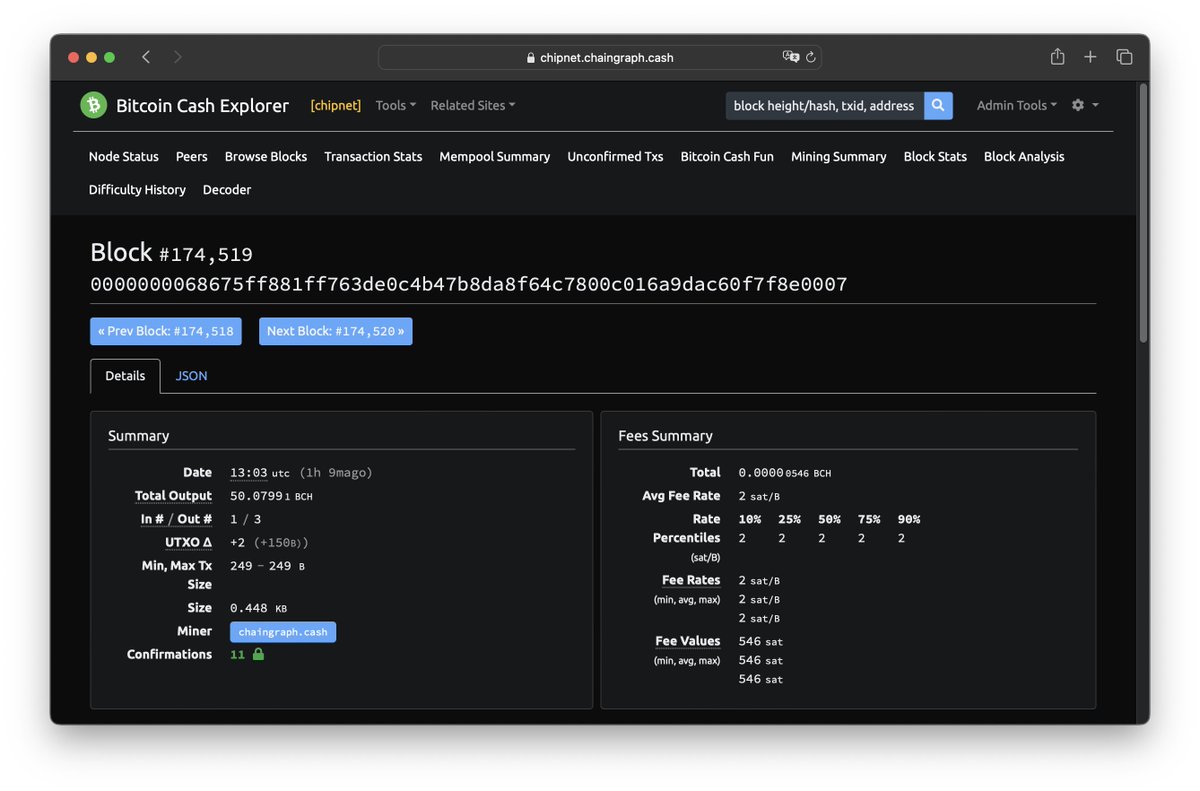
The May 2024 upgrade to Bitcoin Cash (BCH), CHIP-2023-04 Adaptive Blocksize Limit Algorithm, is now active on chipnet at block #174519 (0000000068675ff881ff763de0c4b47b8da8f64c7800c016a9dac60f7f8e0007)! 🎉
This upgrade resolves an economic vulnerability that was introduced in 2010 and led to the BCH/BTC network split in 2017.
The algorithm automatically adjusts Bitcoin Cash's block size limit to reduce infrastructure costs during periods of lower usage while enabling up to a doubling of the maximum block size per year at peak growth.
Why Limit Block Size?
The block size limit caps the technical requirements of network infrastructure, enables reliable infrastructure cost projection, and prevents attacks that increase the cost of participating in the network.
Excessively large blocks could require users and businesses to waste resources on unnecessary infrastructure, switch to cheaper and less secure validation strategies, or even to abandon running their own infrastructure and instead rely on third-party service providers – reducing the overall privacy, independence, and financial freedom of all users.
Vulnerability of Static Block Size Limits
To limit block size, most bitcoin-like networks (BCH, BTC, BSV, XEC, etc.) employ a static block size limit. For Bitcoin Cash mainnet, this limit is currently 32MB.
If a payment network is growing, usage will eventually approach any previously-established static limit. If this limit is reached before a successfully coordinated upgrade, network service degrades: transaction fees and confirmation times become less predictable as size-limited blocks become more common.
Uncorrected, market actors begin to adapt to this artificial scarcity by using alternatives to on-chain transactions: custodians, intermediaries, and competing networks. This in turn compromises the long-term economics of mining – cumulative transaction fee revenue is suppressed, and long-term network security grows to rely on continuous inflation via block subsidies.
Because static block size limits can only be changed as part of a widely coordinated network upgrade, they present a focal point for network interruption or capture by motivated attackers: rent seeking institutions, competing networks, opponents of peer-to-peer cash, etc. To make matters worse, the attackers have a significant coordination advantage – while honest network participants must achieve near-unanimous consensus to activate an upgrade, attackers must only create sufficient uncertainty among the honest participants to delay limit increases, as inaction results in degradation of the network’s functionality and long-term security.
Adaptive Block Size Limits
Adaptive block size limits resolve the economic vulnerability of static limits by automatically adjusting the maximum block size over time.
While an adaptive block size limit could still diverge from a hypothetical "ideal" size due to significant changes in the rate of technological advancement or the availability of capital, such divergences would likely remain much smaller than with static limits, and attackers are no longer afforded an advantage.
Bitcoin Cash's Adaptive Algorithm
The new algorithm is conservative and based on observed usage. In cooling-off periods of falling network usage, the limit slowly decreases to preserve the resources of infrastructure operators. On the other hand, during periods of rapid growth, the limit can increase at a rate of up to 2x per year.
---
This post is adapted from my earlier blog post about the May 2024 upgrade. You can find more information about this upgrade and Bitcoin Cash's upgrade process in that post (link in bio). Thanks for reading!