Easy going guy that's learning is way through life!
Freedom is the ultimate prize!
Want a social media were you truly own your content?
Register on the link
For the first time, OKX has made Pi available to millions of people in the US through its platform, adding another access point to the Pi ecosystem for US users.
Pi continues to expand its global network of Pioneers and partners, and strengthen ecosystem participation, utility, and real user adoption across the world.
More users. More usage. Stronger network
Vibe coders and creators can now tap into Pi Network’s massive user base of over 60 million Engaged Pioneers by easily bringing their external AI-created apps to Pi’s real distribution network and utility ecosystem through Pi App Studio!
Creators, who may be technical developers or non-technical product people, can build apps using platforms such as Codex, Claude Code, Replit, Cursor, Lovable or other AI-assisted coding tools, and then use Pi App Studio to convert those apps into Pi Apps.
That changes the equation for creators.
AI can already help people generate apps quickly; the harder part is distribution and turning those apps into products people actually use.
Pi helps close that gap.
Instead of rebuilding infrastructure from scratch, creators can connect their apps to an existing ecosystem with users, payment capabilities, identity verification, decentralized human infrastructure and platform-level tools already in place.
This feature makes Idea → App → Users that much faster.
Because your ideas are too good not to be seen.
Try the Pi App Studio Now! If you’re a vibe coder or know someone building apps with AI who needs distribution, head to Pi App Studio today to convert AI-created apps into Pi Apps and access the Pi ecosystem’s users, infrastructure, and monetization opportunities.
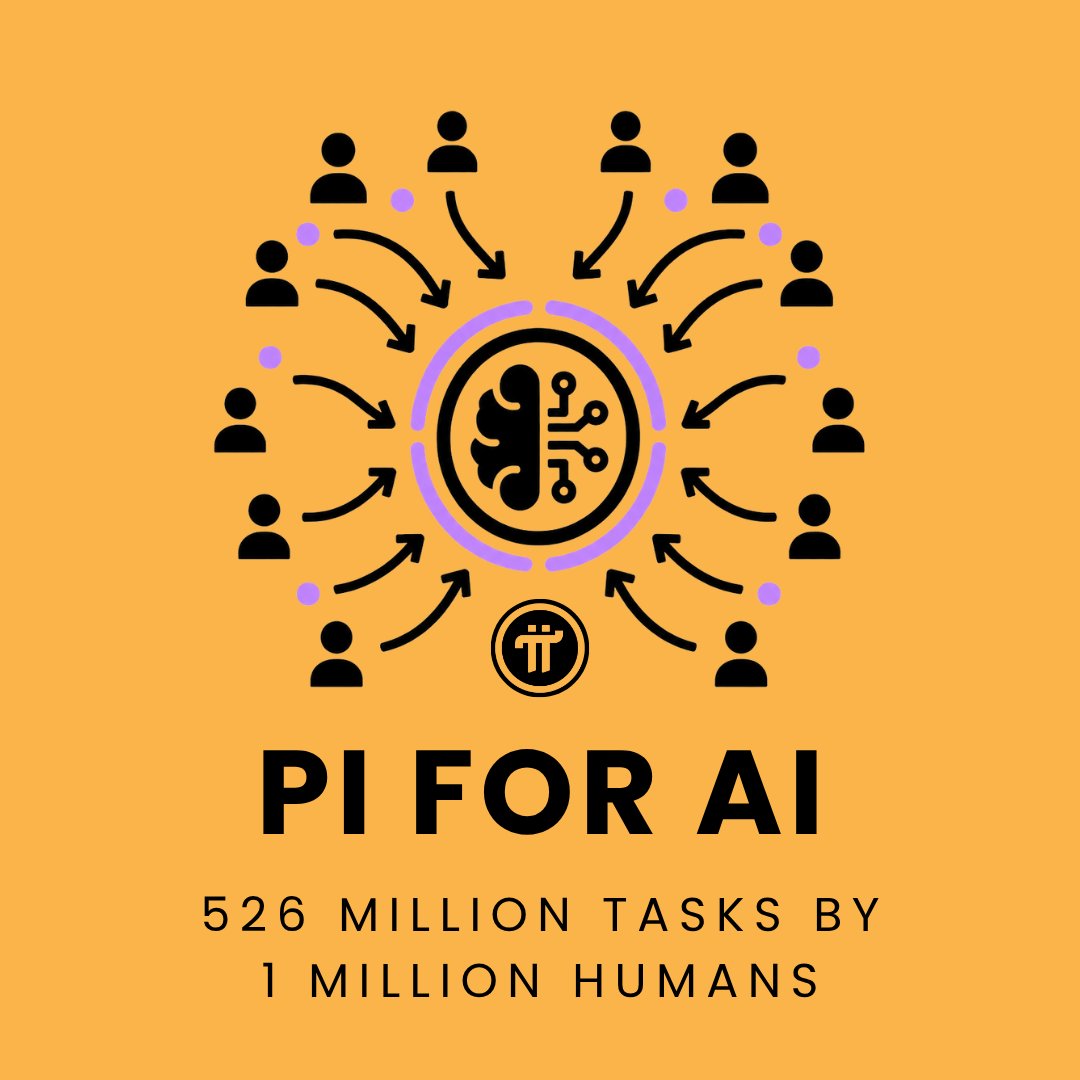
526 million human KYC validation tasks have already been completed on Pi.
By over 1 million verified people.
AI is advancing quickly.
But the hardest part of building reliable systems is still deeply human.
Models don’t improve from compute alone.
They improve from:
Judgment
Correction
Context
Nuance
Pi represents something different.
A globally distributed, identity-verified human workforce that has already demonstrated coordination at scale, already active in the Pi ecosystem.
This is real infrastructure, it’s already been used to process hundreds of millions of real tasks.
For AI systems, that changes what’s possible.
Go to the Pi mining app home screen to learn more.
How to beat the DOJ and SEC: A story that involves getting raided by the FBI, arrested, and getting recruited by multiple prison gangs before eventually having all charges dismissed with prejudice.
Big thanks to @laurashin from Unchained for helping me tell this story.
Pi’s first smart contract capability is now live on Testnet: subscriptions!
This fosters real, recurring, utility-driven use cases.
Think e-commerce, streaming, online tools, and more, powered on-chain.
Read more in the Pi mining app.
I've never told this story but Kevin was an investor and advisor with me on my last company Basis where we were pioneering an algorithmic central bank. At one point we even did a fireside chat together at a private event and I got to grill him 1:1 about what it was actually like being at the fed and deciding on policy, why policies get set the way they do, and what he would do if he were actually in charge. It was incredible.
We're very lucky to have him as our fed chair and I'm personally grateful for people like him who stay by your side and believe in you through thick and thin. DeSo is just getting started.
The first distribution of KYC validator rewards is now complete!
Rewards were calculated for over 526 million validation tasks completed by more than 1 million KYC validators.
This demonstrates the scale and capability of Pi’s decentralized human workforce worldwide in driving meaningful real-world outcomes, especially in areas that require human judgment and input.
To benefit from future KYC validator rewards and other decentralized work opportunities, become a KYC validator. Complete accurate validation tasks and join Pi’s decentralized workforce!
https://t.co/pN8VpeZzvy
The Pi Mainnet is upgrading to Protocol 21 – Deadline: Apr 6. All Mainnet nodes are required to complete this step before the deadline to remain connected to the network. Details here: https://t.co/9VehO7hhj1
Since Pi Day 2026, Pi Network has continued its gradual rollout of second migrations and referral mining bonuses.
This opens the door for Pioneers to bring additional Pi to Mainnet and further participate in the ecosystem. Note that first migrations still take priority for the network to complete, and second migrations do not impact the rate of first migrations.
Read more about second migrations https://t.co/FybNaW61kT
Operation chokepoint was a 100% real effort to de-bank the crypto industry, and I experienced it first-hand. Nobody who actually experienced it talks about it because it's embarrassing to get de-banked, but I don't care anymore and the story needs to be told. I will tell you exactly how it worked, about a dark practice called "subpoena-sniping," and what made it so evil.
In the past three years I have had over ten bank accounts and brokerages, and got kicked out of every single one except my last two, which I have been using for a while now. There was a day when both my main bank account AND my backup bank account were closed on the same day and I had to walk down a street full of banks in Beverly Hills just trying to get a new account opened so I could operate. The worst, by far, though, was Amex. They kicked me out and voided over 4 million points I never spent worth over $40k usd, which is why you should "always be dumping" your points (cc @stoolpresidente). But more on that later...
The way de-banking works is this: People in the political administration, could be the president or uppity members of congress like Elizabeth Warren, decide that they don't like a particular person or a particular industry (crypto, marijuana, etc...). They could call the banks and tell them to stop banking that industry explicitly, but that's actually not even necessary. Instead, they can have a regulator like the SEC just start issuing subpoenas to everyone's bank who works in that industry. Much less work and much lighter-touch (low-level employees at the SEC can issue a subpoena without much paperwork).
A bank's reaction to a subpoena from a federal agency is almost always to immediately shut down that person's bank account. With most banks that means you instantly can't log in, can't access your money, and, best of all, you have to wait for a snail-mail check to get your money, which you can't actually deposit because you don't have a bank account (the irony...). And did I mention the check takes a week to clear even after you've deposited it into your new bank? This is why I always have a main bank account and a "backup" bank account, always.
Why a check, why not a wire transfer? It lets the banks sit on your money and earn interest on it for longer. Yes, that's actually the reason...
But it gets even better: When you lose your bank account, they don't even tell you why it happened, they just stonewall you completely, even if you've been a customer for over a decade. My favorite experience with this was with a neobank where I actually knew the founder and HE couldn't even tell me why they debanked me because the decision was made by their partner bank, which wouldn't tell THEM the reason, so he didn't even know it. Insane!
The way I found out about this practice was actually by talking to lawyers after things got serious with my SEC case. Apparently, the most common tactic when the SEC or DOJ go after someone is to try and de-bank them by throwing subpoenas at all of their financial institutions as fast as they can open them. We called it "subpoena-sniping" and it was such a well-known and disruptive practice that multiple law firms actually recommended I wire them a lot of money up-front to "keep it safe" so that I wouldn't lose my ability to pay them halfway through what we were doing. Luckily, only thanks to crypto, that wasn't necessary...
My top advice for Amex customers in particular is to always be dumping your points. The reason is that a high points balance is viewed as a liability by Amex, and thus makes it more likely they'll randomly decide that your account is non-compliant, even without a subpoena (I learned this from lawyers as well). Put another way, accounts with a lot of points are "expensive" to Amex, and so they will look for any excuse to close them before you can cash them out. In my case that meant losing over 4 million points worth over $40k usd. The crazy thing is they took my points even though I lived in New York at the time, and even though NY literally passed a law and SUED Amex precisely to stop the practice of closing accounts to steal points. Just think about it for a minute: Enough people got mad at Amex for points-stealing that NY, a place where Amex has regulatory capture, passed a LAW to ban it (which I can confirm from first-hand experience they are completely ignoring). If that's not a sign you should always be dumping those points then I really don't know what is... To this day, Amex is the only financial institution that I actually lost money with. Even the sketchiest crypto exchanges I've used over the years never did something as greasy as what Amex did, let alone after being a customer for over a decade.
Now for a list of some banks and brokerages that kicked me out, just to name and shame explicitly: Bank of America, Fidelity, Chase, Wells Fargo, Amex, First Republic (rest in peace), SVB (rest in peace), Webull, Mechanics Bank (got desperate lol), Bank of the Orient (also lol).
In many cases I came in through a relationship, had a contact at the bank, and was happily banking for years, sometimes over a decade-- none of it mattered, I was out the second a subpoena came in, with zero explanation. Also funny story about SVB: By pure coincidence they debanked me ONE WEEK before they went insolvent-- you can't make this stuff up. There are also three neobanks that kicked me out but I know the founders, I like them, and it was the underlying partner bank's fault not their fault so I won't name them.
Now, thankfully, it's all over and I can talk about these things. But the problem isn't actually resolved. Banks still auto-cancel your account when they get a government subpoena, the process still sucks for people when it happens, and every bank and brokerage that kicked me out in the past is still inaccessible to me. Even though "operation chokepoint" ended under Trump, everyone who was affected by it previously is still affected.
One solution to this problem is new banks that are willing to stand up against this practice, and that's why I'm excited about things like Palmer Luckey's Erebhor and William Hockey's Column. But it only works if they make it a point to stand by their customers through thick and thin. I hope they will do this.
Of course, we all know the ultimate solution, though: Crypto itself. The very thing that scared the politicians into de-banking us in the first place will be their eventual downfall. They can delay it but, thankfully, they can't stop it.
The Pi Mainnet has successfully upgraded to Protocol 20, laying the foundation for supporting smart contracts. Node operators, please ensure your systems are up to date and stay tuned for instructions regarding the upcoming v21 upgrade.
Pi Network is excited to announce that second migrations have started and will continue with a gradual rollout, opening the door for Pioneers to bring additional Pi to Mainnet and further participate in the ecosystem! While second migrations roll out, first migrations for eligible Pioneers will continue as normal.
To be eligible for migrations, Pioneers must set up Pi Wallet two-factor authentication (2FA) through the Mainnet Checklist Step 3. This may include adding a trusted email address to their accounts if not set up yet. 2FA is enforced before migrations to enhance wallet security because transfers on the blockchain are irreversible and immutable.
Second migrations will also include referral mining bonuses attributable to Referral Team members who fully passed KYC. Pioneers should therefore remind their Referral Teams to complete KYC so these bonuses can be migrated.
This is so true, and it's disappointing to see the reporters from top publications who rushed to report on my arrest now publishing absolutely nothing upon full reversal of the charges.
But what's even more disappointing, honestly, is the behavior of the government. Both the DOJ and SEC issued and promoted flowery press releases explicitly calling me a liar when they arrested me. This is a literal quote from the SEC's press release about me:
"The dedicated staff of the SEC uncovered Al-Naji’s lies and will now hold him accountable for misleading investors." - Gurbir S. Grewal, Director of the SEC’s Division of Enforcement
He didn't even say ALLEGED lies! And yet when I asked them to issue a simple press release about the dismissal to correct the record they refused. Not only that, but they made sure to file the dismissal paperwork on Friday right before the weekend to try and bury the story. My lawyer says this is an intentional and common practice to try and hide their mistakes.
Ironically, the lack of accountability and truth-seeking when it comes to traditional media channels is precisely why I became so passionate about decentralized social media and DeSo in the first place. Elon buying X has done a lot for people being able to directly tell their story, and we should be extremely grateful for that. But there's clearly more work to do.