$SPCX shares are priced at $135 for its $2 trillion IPO.
Its return is 100x-200x by 2035.
These 20 companies will benefit the most:
1. $BKSY ~$34
AI-ready Earth observation satellites feed SpaceX orbital intelligence layer.
2. $SPIR ~$20
Space data analytics monetizing SpaceX's growing orbital constellation.
3. $ACHR ~$5
Air mobility networks integrate with Starlink's low-latency infrastructure.
5. $SATL ~$7
High-resolution imaging complements SpaceX orbital AI compute constellation data.
6. $VIAV ~$50
Optical networking components critical for Starlink ground station upgrades.
7. $OUST ~$40
Sensor fusion tech supports SpaceX booster catch reusability automation.
8. $GILT ~$15
Satellite ground infrastructure scales alongside Starlink enterprise deployments.
9. $POET ~$11
Optical interposer chips slash data center power costs inside COLOSSUS AI cluster.
10. $ARQQ ~$12
Quantum encryption securing Starshield government classified orbital networks.
11. $TWST ~$74
Synthetic biology tools accelerate SpaceX long-term Mars life support research.
12. $LUNR ~$30
NASA lunar lander tech directly supports SpaceX Moon base buildout.
13. $AEVA ~$24
LiDAR sensors enable autonomous Starship landing and booster catch precision.
14. $KTOS ~$60
Defense tech partner powering Starshield national security satellite contracts.
15. $IONQ ~$58
Quantum compute layer powering next-gen orbital AI satellites.
16. $RDDT ~$178
Real-time social data feeds Grok's truth-seeking AI via X integration.
17. $RKLB ~$115
Small payload launch fills exact gaps Falcon can't efficiently serve.
18. $ASTS ~$97
Direct-to-phone satellite broadband. Starlink's closest competitor and partner.
19. $MTSI ~$375
RF semiconductors power Starlink phased-array antenna signal processing.
20. $BWXT ~$200
Nuclear propulsion R&D aligns with SpaceX Mars mission power requirements.
I'm definetly a buyer of $SPCX IPO and want to get it super cheap.
♻️ RESHARE this post and write 1 comment, I'll DM you the PRICE I want to buy $SPCX at this month.
OpenAI agreed to acquire Ona which is a cloud startup that builds secure persistent environments for AI agents.
The team will fold into Codex which now has more than 5M weekly users as OpenAI moves faster to turn coding agents into long-running workflows.
@VdykCFC Those shite CBs are definitely going to be in the squad and Alonso will be working with both hands tied behind his back. Don’t expect anything good next season unless you are happy with 5th place
Claude is going to make many millionaires
Claude is going to make many Millionaires
What’s stopping you from learning this and selling it as a service to founders? 👨🏽💻
Claude 5.0 built a Chinese girl a trading bot.
skip to 0:08 look at her journal, bot easily earns your monthly salary in a couple of days.
how it works:
the bot runs mean reversion on s&p 500 and nasdaq on 15-min candles, catching the small overextensions indices make every few hours. on bitcoin it switches to momentum breakouts on the 1-hour crypto trends harder than indices, so you ride the move instead of fading it. gold and oil get a slower trend-following layer on the 4-hour, because commodities move in cleaner waves and you don't want noise from intraday whipsaws.
position sizing is ATR-based per instrument, so a quiet day on gold gets a bigger size than a volatile day on bitcoin - risk stays constant even when volatility doesn't. every trade has a hard 1% stop, no exceptions, no "let me give it room." and there's a correlation filter on top: if s&p and nasdaq are already long, it won't pile into another risk-on asset and double the real exposure.
claude code writes and updates the logic. the bot just executes.
then claude cowork sends her two messages a day:
- 7am: what's happening in the market
- 9pm: how did the bot do
that's the whole job. two messages. five instruments. zero screen time.
manually she could only watch one chart at a time. this thing watches five. doesn't sleep. doesn't tilt. doesn't revenge trade at 2am.
what used to need a team of quants and a $200k bloomberg terminal now runs on a laptop and claude.
And your friend is still trading manually and is constantly in the red.
save this and read the article in the comments below to write your own bot using Claude
Elon Musk says @SpaceX's Terafab will be around 100 million square feet, which is 10x larger than Tesla's Giga Texas factory.
• Terafab output: 1TW/year
• Current annual U.S. consumption: 0.5TW
Okay this is genuinely insane.
SpaceX just unveiled a satellite whose only job is to run AI. Not internet. Not GPS. Just compute, floating in orbit.
It's called AI1, and the reason behind it breaks your brain.
AI data centers on Earth are hitting a wall, not a chip wall, a physics wall.
They need staggering amounts of power and water just to stay cool, and we're running out of grid and land to build them.
So Musk's answer is: stop building them on Earth.
In orbit, the sun never sets. Free power, 24/7. No water for cooling, you just radiate heat into the vacuum of space. The two things choking AI on the ground barely exist up there.
And here's the wild part: Musk says it's easier to build than a Starlink satellite. Strip out the complex antennas and it's "a lot of solar cells, a radiator, and some laser links."
One AI1 carries the compute of an Nvidia GB300 rack, the same hardware data centers fight over down here.
AI1 is just the first one. The plan is a constellation of up to a million of them.
And the timing isn't an accident, SpaceX goes public this week at a ~$1.75 trillion target. This isn't a rocket company anymore. It's positioning itself as the power grid for AI, in space.
The race for AI compute just left the planet. Literally.
@SpaceX
Anthropic and OpenAI are both telling engineers to write loops.
Not prompts.
Not agents.
Loops.
That is not a coincidence.
When the two most important AI labs on the planet independently converge on the same pattern — that is a signal worth paying attention to.
Most engineers are still thinking in terms of single calls.
Input → model → output.
The engineers winning in 2026 think in cycles.
Output becomes input. The model evaluates its own work. The loop runs until the result is right.
This is the complete breakdown of what loops are, why they matter, and how to build them ↓
AI SUPER CYCLE STACK
Most want to know where to START.
This is a good start to keep WATCH for the NEXT pullback opportunity .
MEMORY
$MU
$SNDK
$AMAT
$AEHR
COMPUTE
$NVDA
$AMD
$ARM
$INTC
$NBIS
NETWORKING
$ANET
$AVGO
$MRVL
$CRDO
OPTICS
$AAOI
$NVTS
$ALAB
$GLW
$TTMI
INFRASTRUCTURE
$DELL
$IREN
$CORZ
$CIFR
SOFTWARE
$MSFT
$NOW
$CRM
$SNOW
$MDB
DEFENSE
$PLTR
$AVAV
$KTOS
$ONDS
$RCAT
$DPRO
$UMAC
$SWMR
ROBOTICS
$OUST
$TSLA
$SYM
POWER
$BE
$TE
SPACE
$ASTS
$RKLB
$RDW
$LUNR
$PL
My takeaways from writing my power semiconductors article:
• SiC is extremely competitive. $IFX.DE, $ON, $STM, Rohm, and $WOLF are all scaling capacity aggressively. $WOLF substrate supply is the bottleneck today.
• That’s why my Top 5 picks each occupy a different layer of the stack, substrate $WOLF, GaN pure-play $NVTS, test infrastructure $AEHR, power delivery architecture $VICR, and deep value SiC $AOSL.
$SPCX unveiled AI1 which is its first AI compute satellite featuring a 150kW payload and deployable liquid cooling.
Elon Musk says AI1 repurposes proven Starlink V3 power, cooling and laser-link technology into an orbiting AI compute platform.
Everyone is chasing $SIVE or looking for the next
$AEHR or $AXTI.
I think I found it… Not one. But two. Both sitting at the exact chokepoint.
This is maybe my favourite trade ideas the market hasn’t priced yet:
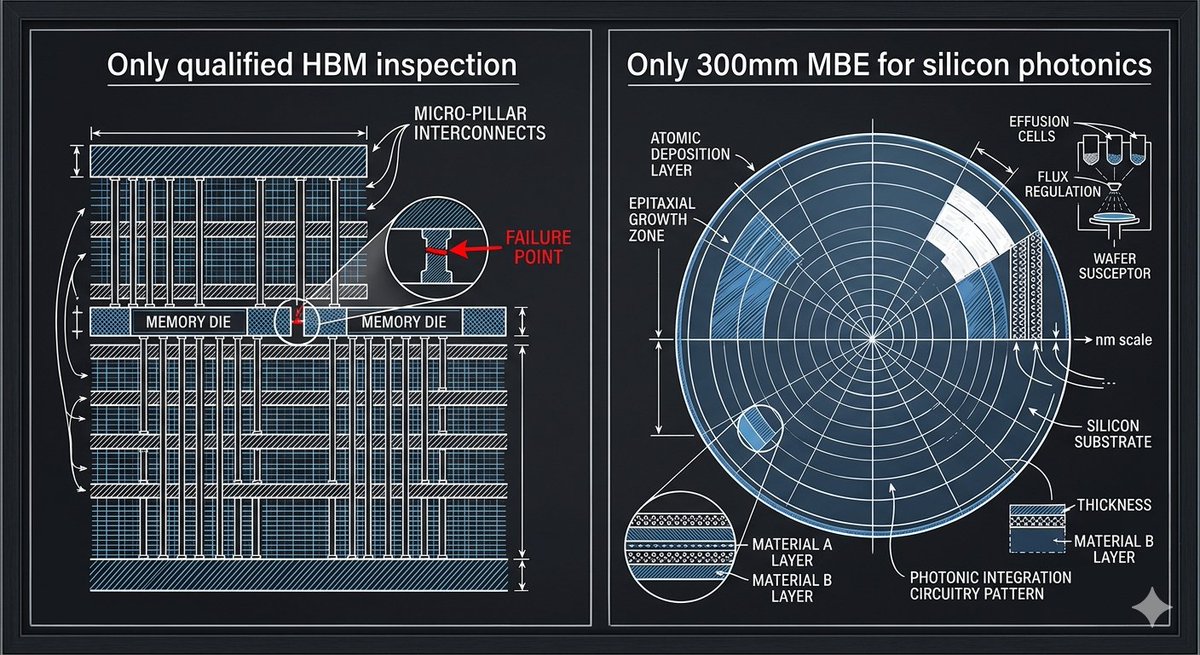
CONSTRAINT 1: HBM inspection AI chips are not a single piece of silicon.
A modern $NVDA GPU is a stack. A logic die at the bottom. Four to eight HBM memory dies bonded on top.
Each memory die connected to the next through thousands of through-silicon vias, copper pillars drilled through the chip itself.
Then that entire memory stack gets attached to the logic die through thousands more micro-pillar interconnects.
Each pillar is smaller than a human hair. One defective pillar.
One. That’s all it takes to kill a $40,000 AI GPU package.
No buffer. No workaround. The whole unit is scrap.
And here’s the constraint that makes this critical right now:
HBM supply is sold out through at least 2027. No significant new capacity comes online until late 2027. There is no spare capacity. Every die that gets made needs to reach a GPU. A defect found late in the process isn’t a minor setback, it’s a $40,000 unit written off with nothing to replace it.
So the industry doesn’t sample-inspect HBM stacks.
It performs 100% INSPECTION. Every device. Every pillar. Every generation.
As HBM advances from HBM3e to HBM4, the die gets larger, the micro-pillar density increases, and the inspection requirement becomes more complex, not less.
There is one company with qualified equipment for this job at a leading US memory manufacturer.
$COHU - Cohu Inc.
Their Neon platform performs full 6-sided optical inspection of every HBM device using proprietary AI-trained software, defect recognition trained specifically on each customer’s device architecture.
You can’t buy a competitor’s system and retrain it in a quarter. The switching cost is measured in years.
The numbers:
→ $488M cash. No dilution risk.
→ Orders up 163% year-over-year Q1 2026
→ $750M pipeline. 5 customers in active qualification.
→ HBM revenue guidance raised from $15M to $80–100M in a single year
The market is pricing this as a test equipment cycle recovery.
The correct frame: the only qualified inspection bottleneck in the HBM supply chain.
Test equipment multiple: 3–4x EV/Revenue. AI infrastructure bottleneck multiple: 7–10x.
CONSTRAINT 2: Silicon photonics fabrication Copper wires are hitting their physical limit inside AI data centers.
Moving data between GPUs at the speeds AI training requires generates heat, signal loss, and power draw that copper interconnects can no longer handle efficiently. The industry’s answer is silicon photonics, lasers built directly onto chips, transmitting data as light instead of electrons.
Co-packaged optics (CPO) embeds those lasers directly into AI switches. Forecast penetration: from near-zero today to 35% of all optical networking by 2030.
Every one of those lasers is grown using a process called molecular beam epitaxy; MBE. A process that deposits semiconductor materials one atomic layer at a time, under ultra-high vacuum, with tolerances measured in atoms.
The problem: the entire industry’s MBE infrastructure was built for 150mm and 200mm wafers. Silicon photonics runs on 300mm production lines, the same wafer size used in leading-edge logic fabs.
There was no MBE system compatible with 300mm production lines.
Until $ALRIB built one.
Meet ROSIE; Riber Oxide on Silicon Epitaxy is the first MBE platform engineered specifically for 300mm silicon photonics production lines. No other equipment company makes this.
The first two systems were ordered in 2025. ROSIE 2 the dual-chamber production version, goes into manufacturing in 2026.
This is Year 0 of the ramp. Analyst consensus price target: €6. Current price: €15+.
The gap exists because analysts are modeling Riber as a €40M scientific instruments company.
Not one single sell-side model contains ROSIE as a separate revenue line.
Silicon photonics is a $17B market by 2035. Riber’s current revenue: €40M. Market cap: €320M (~$340M USD).
If ROSIE becomes the production standard for 300mm silicon photonics the way MOCVD became the standard for LED manufacturing, the revenue trajectory and the multiple both re-rate from here.
Two constraints. Two chokepoints. One sits between every HBM die and every AI GPU that ships.
The other is the only equipment that can grow the lasers replacing copper in AI infrastructure. Both are being priced on the wrong metrics.
The market finds them eventually.
This is not financial advice. Do your own due diligence.
For full disclosure I haven’t taken a position myself, yet.
They are both on my watchlist. I'm considering adding one of them to mmy short-term portfolio.
$ALRIB looks like the most asymmetrical setup. A potential ten-bagger.
$COHU the more safe-play. 3-5X. A potential
$OUST look a like setup.
@ParadisLabs any thoughts? I can’t call out @aleabitoreddit since I’m blocked, apparently.
I'm also curious on other great investors perspective here: @moninvestor@Kaizen_Investor and @daniel_koss
-BP
My favorite names in every sector right now. The full conviction list, three deep in each.
Humanoid Robotics
$AMBA
$OUST
$VPG
AI Infrastructure
$NBIS
$PENG
$CRDO
Defense
$EOS.AX
$MRLN
$KRKNF
Data Center Power
$CEG
$BE
$FCEL
Photonics & Optical
$AAOI
$LITE
$COHR
Memory & Semiconductors
$MU
$MX
$SNDK
Small Cap Data Center
$VIVO
$DGXX
$KEEL
Quantum Computing
$INFQ
$LAES
$IONQ
Satellite & Space
$ASTS
$RKLB
$OPTX
Different sectors. One theme tying them together. Real businesses, real catalysts, and valuations the market has not fully caught up to yet.
This is where I am positioned for the next few years.