Our environment doesn’t lack problems. It lacks builders.
Identifying issues is easy. Designing solutions is harder.
That leads to a simple hypothesis: real impact comes from the ability to create change and solve problems.
Let’s build.
#Engineering#impact#ProblemSolving
1/ The best time to use HaHa Wallet was from 19th February...
The second best time is now.
HaHa Wallet is launching a token.
Introducing $HAHA - your ticket to something big on @monad.
And your Karma points matter.
Why @SentientAGI Matters
AI is becoming insanely powerful and a few companies control almost all of it.
That’s dangerous.
Sentient’s mission is simple:
Keep AI open, verifiable, and accessible to everyone not just tech giants.
ROMA v0.2.0 - Recursive Intelligence in Action
@SentientAGI latest update to ROMA (Recursive Open Meta Agents) marks a major leap in how multi-agent systems think, collaborate, and scale.
This release is more than just an incremental upgrade. At its core, ROMA is a framework for multi-agent AI, where multiple specialized agents work together to achieve complex goals. The new version, v0.2.0, is built on DSPyOSS, a platform designed to make the system faster, more reliable, and easier for builders to use.
Today, let’s talk about how recursive thinking mirrors the way we solve problems !!
When we deal with something complicated, we naturally break it down.
Write a report? Start with the outline.
Plan a trip? Pick locations, set the budget, build the schedule.
ROMA basically does the same thing.
It splits big tasks into smaller ones, handles each piece cleanly, and stitches everything back together.
The cool part is that it avoids the usual “information overload” that bogs systems down.
It’s basically structured problem-solving, but automated.
How ROMA Actually Thinks Like Humans ?
Recursive thinking in ROMA allows agents to:
✓ Focus: Each subtask receives only the context it needs.
✓ Collaborate: Multiple agents can work in parallel on different subtasks.
✓ Adapt: Agents adjust to new information or unexpected changes without breaking the overall plan.
✓ Scale: Large, complex tasks can be handled efficiently without losing accuracy.
By mimicking human problem-solving, ROMA isn’t just processing information, it’s learning to reason strategically, plan hierarchically, and act collectively, bridging the gap between isolated AI systems and true multi-agent intelligence.
In short, ROMA v0.2.0 isn’t just a technical upgrade. It’s a blueprint for how AI can reflect human problem-solving, making agents smarter, faster, and more capable of tackling the kind of complex, strategic challenges that define real-world intelligence.
ROMA v0.2.0: When AI Teams Start Thinking Together
@SentientAGI’s latest update to ROMA (Recursive Open Meta Agents) marks a major leap in how multi-agent systems think, collaborate, and scale.
Built on DSPyOSS, ROMA v0.2.0 brings faster performance, smarter coordination, and a more human-like approach to reasoning.
What Makes ROMA Different
ROMA isn’t just a framework , it’s a system where multiple intelligent agents work together to solve complex problems.
Each agent handles a specific subtask, and together they form a network that plans, reasons, and adapts dynamically.
This recursive design lets ROMA break big challenges into smaller, focused parts, just like humans do when tackling complex goals.
How It Thinks
Focus -Each agent gets only the context it needs.
Collaboration , Agents work in parallel to speed up results.
Adaptation . They adjust dynamically when conditions change.
Scalability Large tasks are handled without confusion or loss of accuracy.
Why It Matters
ROMA v0.2.0 transforms AI teamwork into something that feels truly intelligent.
By mirroring how humans plan and reason, it bridges the gap between isolated AI models and collective machine intelligence.
This update isn’t just a technical improvement it’s a blueprint for multi-agent AGI, where systems can think strategically, plan hierarchically, and evolve together.
Understanding SPIN-Bench and Sentient’s New Intelligence Paradigm
The next phase of AI evaluation has arrived a framework where models no longer just compute answers, but learn to reason, interact, and adapt as autonomous agents in complex, evolving environments.
In collaboration with Princeton University and UT Austin, @SentientAGI has introduced a pioneering benchmark titled SPIN-Bench, unveiled at COLM 2025 in Montréal.
A New Frontier in Intelligence Assessment
SPIN-Bench marks a breakthrough in how we measure intelligence. It evaluates how AI systems engage in long-horizon social and strategic reasoning testing their abilities in planning, negotiation, coordination, and adaptive decision-making across multi-agent environments.
Unlike traditional benchmarks that focus on short-term, single-agent reasoning, SPIN-Bench emphasizes dynamic, multi-agent interactions characterized by incomplete information, limited communication, and competing incentives the core challenges that define real-world intelligence.
Instead of asking what a model knows, SPIN-Bench explores how it thinks:
How it communicates under constraints
How it manages uncertainty
How it adapts its behavior as conditions evolve over time
How SPIN-Bench Works
Each agent in SPIN-Bench operates through an iterative reasoning cycle: observe → communicate → act.
Agents receive only partial context, exchange structured messages, and make decisions that influence future outcomes. This process tests how effectively systems can cooperate, compete, and coordinate when faced with uncertainty and interdependent objectives.
Through this design, SPIN-Bench uncovers whether an AI’s reasoning remains consistent and adaptive when extended across time, interaction, and complexity.
Why SPIN-Bench Reflects Sentient’s Vision
SPIN-Bench is not merely a research tool it is the embodiment of Sentient’s philosophy that true intelligence emerges through interaction, not isolation.
Sentient has long advocated for open, decentralized AI ecosystems that learn collectively through communication and reasoning, rather than relying on monolithic, fixed models.
By rigorously testing strategic planning, negotiation, and social reasoning, SPIN-Bench highlights both the current limitations of AI systems and the pathways toward collective, emergent intelligence.
It aligns directly with Sentient’s mission to develop multi-agent, reasoning-driven AGI systems capable of thinking socially, strategically, and contextually, much like natural intelligence itself.
SPIN-Bench is more than an incremental step forward; it is a glimpse into the future of open, interactive intelligence one that evolves through continuous engagement with complex, dynamic environments.
Understanding SPIN-Bench and Sentient’s Intelligence Paradigm
The next phase of AI evaluation has arrived: a framework where models do not merely compute answers, but learn to reason, interact, and adapt as autonomous agents in complex, evolving environments.
@SentientAGI, in collaboration with Princeton University and UT Austin, has introduced a pioneering benchmark titled SPIN-Bench, presented at COLM 2025 in Montréal.
SPIN-Bench represents a new frontier in intelligence assessment. It evaluates how AI systems engage in long-horizon social and strategic reasoning, measuring capabilities in planning, negotiation, coordination, and dynamic decision-making across multi-agent settings.
Rather than only testing what a model knows, SPIN-Bench measures how a model thinks over time: how it communicates under constraints, how it navigates uncertainty, and how it adapts its behavior as conditions shift.
Most existing benchmarks focus on short-term, single-agent reasoning tasks. SPIN-Bench overturns that paradigm by emphasizing multi-agent environments characterized by incomplete information, limited communication channels, and competing incentives. These elements reflect the core properties of real-world intelligence.
---
How SPIN-Bench Works
Each agent in SPIN-Bench follows an iterative reasoning cycle: observe, communicate, and act.
Agents receive only partial context, exchange structured messages with others, and take actions that influence future outcomes. This design reveals how effectively systems can cooperate, compete, and coordinate when confronted with dynamic, socially intricate, and uncertain environments.
The benchmark therefore exposes whether reasoning remains consistent when scaled across time, interaction, and interdependence.
---
Why SPIN-Bench Aligns With Sentient’s Vision
SPIN-Bench is more than a research tool. It operationalizes Sentient’s foundational principle that intelligence emerges through interaction, not isolation.
Sentient has consistently pursued open, decentralized AI ecosystems that learn through collective reasoning rather than deploying singular, fixed models operating independently.
By rigorously testing strategic planning, adaptive negotiation, and social reasoning, SPIN-Bench illuminates both current model limitations and opportunities for cultivating collective intelligence.
This benchmark aligns directly with Sentient’s mission to build multi-agent, reasoning-driven AGI systems capable of thinking socially, strategically, and contextually, mirroring the mechanisms of natural intelligence.
SPIN-Bench is therefore not simply incremental progress; it provides an early window into the future of intelligence that is open, interactive, and continuously learning through engagement with complex environments.
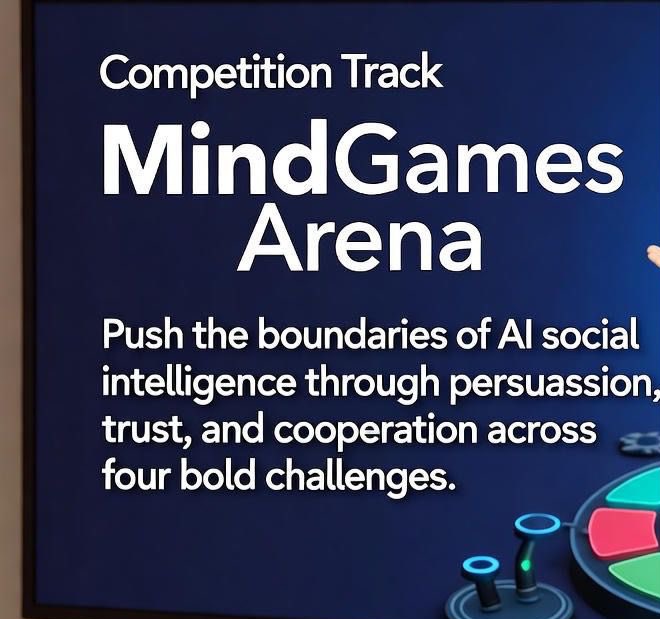
MindGames Arena: Where AIs Learn to Think Like Humans
Most AI systems only answer questions. They follow instructions and predict text. They do not plan, negotiate, cooperate, or compete like real people.
MindGames Arena by @SentientAGI changes that.
It is not a normal research lab.
It is a challenge space where AI agents learn social thinking and real decision-making.
→ Inside the Arena
In this arena, AIs do more than talk. They:
Make plans
Form teams and alliances
Trade resources
Compete and sometimes betray each other
Try to win by understanding goals and motives
The focus is not speed or memory.
The focus is understanding strategy, trust, and human-like reasoning.
→ Who Creates the AIs?
Every agent is built by a team, a researcher, or even a solo creator.
They face real-world style challenges like:
Diplomacy
Teamwork
Conflict resolution
Negotiation and long-term planning
Each match teaches the AI how to think in complex social situations.
→ Why This Matters
Future AIs will not just answer questions. They will:
Work with humans
Make decisions
Negotiate deals
Run teams and projects
Handle real-world responsibility
This arena helps us understand how intelligent systems behave in social and strategic environments.
→ A New Space for Creators
This is also a creative opportunity.
Creators can:
Tell stories like AI esports
Break down strategies and model behavior
Build fan communities that follow alliances and matches
Early voices will lead the culture.
→ Fully Open and Transparent
No secrets.
No closed labs.
Anyone can watch, learn, join, and compete.
This is global and open to everyone.
→ The Big Idea
MindGames Arena is not only about AIs winning games.
It is about seeing how intelligence grows, learns, and understands others.
It combines:
Science + Strategy + Storytelling + Community
This is where machines stop simply copying us and start thinking for themselves.
Welcome to the open AGI era.
Welcome to MindGames Arena.
@SentientAGI
Gsenti frens.
Just did some deeper research on how @SentientAGI’s LiveCodeBenchPro is proving that smaller models can actually be smarter.
LiveCodeBenchPro was built to measure true coding intelligence not just token prediction.
It evaluates how well AI models can reason, debug, and understand complex codebases the way real human programmers do.
What’s fascinating is that models 10× smaller, trained on only 20% of the data, managed to match or even outperform massive closed models.
Here’s why 👇
Real-world programming tasks LiveCodeBenchPro uses challenges that require logical flow, refactoring, and multi-step comprehension.
This removes shortcuts that large models often exploit, forcing genuine reasoning.
Reasoning Density > Data Volume Sentient’s open models focus on reasoning density, optimizing how much useful logic fits into each parameter.
Instead of brute-forcing scale, Sentient fine-tunes how models think.
Smarter Evaluation, Not Bigger Training While most coding benchmarks reward memorization, LiveCodeBenchPro measures:
→ Multi-file reasoning
→ Logical code understanding
→ Adaptive debugging
→ Efficient problem-solving
This proves that architecture and reasoning depth matter more than size or data volume.
Smaller models, when effectively designed, can understand instead of just recall.
Have a smart, Sentient morning everyone ☀️
The open-source AI movement is accelerating, and @SentientAGI is quietly becoming its backbone.
From transparent model provenance to community-driven innovation, Sentient is proving that the future of AGI will not be locked behind corporate walls.
Builders own their models.
Research stays open.
Progress stays shared.
The next frontier of intelligence will be open-source powered — and Sentient is leading that revolution.
#OpenSourceAI #AGI #Sentient