Lord, in this month of October,
Make room for me.
Make room for my gifts.
Make room for my work.
Make room for my career.
Make room for my business.
Make room for my finances.
Make room for my family.
Make room for the things you have called me to build.
Father, enlarge my territory.
Bring me into places where I do not have to shrink to survive.
Bring me into rooms where what you placed inside me can grow.
Bring me into environments where I can breathe,
where I can flourish,
where I can become fruitful.
Let October mark the beginning of enlargement.
Let this month be the month where contention ends.
Let this month be the month where unnecessary struggle ends.
Let this month be the month where you make room for me.
Father, bring me into my Rehobath
Bring me into a place where I can finally breathe, grow, and become fruitful.
Lord, bless my October.
Goat morning guys 🐐
Still on the mountain product by @CashmereLabs
Today we will be looking at the Barns, Auctions, Goats and the Herding Toll
Here’s what you’ll find in this post:
> How a Barn works
> Stall Permits and Barn auctions
> Binding and moving goats
> The Herding toll
◇ A Barn is a soulbound NFT that mines $CSM. It starts with one open stall and can hold up to 10 stalls total. The first stall is available from the start. The remaining stalls are added with Stall Permits. At most 3 new stalls can open in each fixed 24-hour window, counting Permit stalls and goats brought in together.
Cashing out works by stall. When you cash out a stall, that stall closes and the $CSM it has mined is claimed. Cashing out every stall closes the Barn permanently. Once a Barn is fully closed, it no longer mines. The Barn Deed starts as non-transferable. In the future it can become transferable.
◇ Stall Permits are sold in 12-hour rolls and paid in $CSM. The $CSM is burned. The price falls through each roll toward a floor. You can buy 1 to 3 Permit stalls for a Barn. A Barn can hold at most 9 Permit stalls. Each new stall counts toward the Barn’s limit of 3 new stalls in a 24-hour window.
You can also place a Shepherd order. It buys Permits for you when the price comes down to your limit. The order is paid only from the Barn’s balance.
After the founding sale, one new Barn is auctioned each day once issuance begins. The price falls through a 24-hour period toward a reserve of 0.25 ETH. Anyone can buy. The ETH goes to the Gatehouse. The new Barn has one stall and starts to mine at once.
◇ A Goat Street NFT counts in Mountain only once it is bound. Binding moves the goat into Mountain’s escrow. You receive a Goat Bell that cannot be sold or moved. Only the Bell holder can act on the goat.
A bound goat is either Grazing or In Barn. A goat In Barn takes a stall in your own Barn and weighs 3x as much as it does while Grazing. The weight depends on the goat’s tier. Once bound, the goat builds its own balance for the Bell holder. It can move between Grazing and a Barn. It cashes out once, for its full balance, then burns.
◇ Each goat pays the Herding toll once at the bind with $CSM. That $CSM is burned. The goat’s first Bring In after a paid bind has no toll. Every later Bring In pays the toll. A bind straight into a Barn pays only one toll.
The toll is based on the goat’s In Barn weight and a reference that changes every 12 hours with the Permit roll. The toll is taken from the Barn’s balance first, then from your wallet if needed. It is never refunded.
Binding a goat into a Barn multiplies its mining speed by 3x compared with leaving it Grazing. Stall Permits expand the number of stalls. Both actions are paid in $CSM and burn the token.
This is how Barns, Permits, goats and the Herding toll work together. Barns hold the stalls. Permits add more stalls. Goats take stalls at a higher weight. The toll is paid in $CSM and burned each time a goat is bound or brought in.
Mumbai, we're coming. 🇮🇳
The Vistapex team will be at Devcon, Nov 3–6 at the Jio World Centre.
Find us, say hi, talk prediction markets with us… and we'll have a little surprise waiting for you. 👀🎁
See you in BKC.
BREAKING: Following recent industry developments and an intense five-hour war room, Legion Crypto has made the brave decision to become Legion Frontier.
We ask that you respect our privacy during this transition.
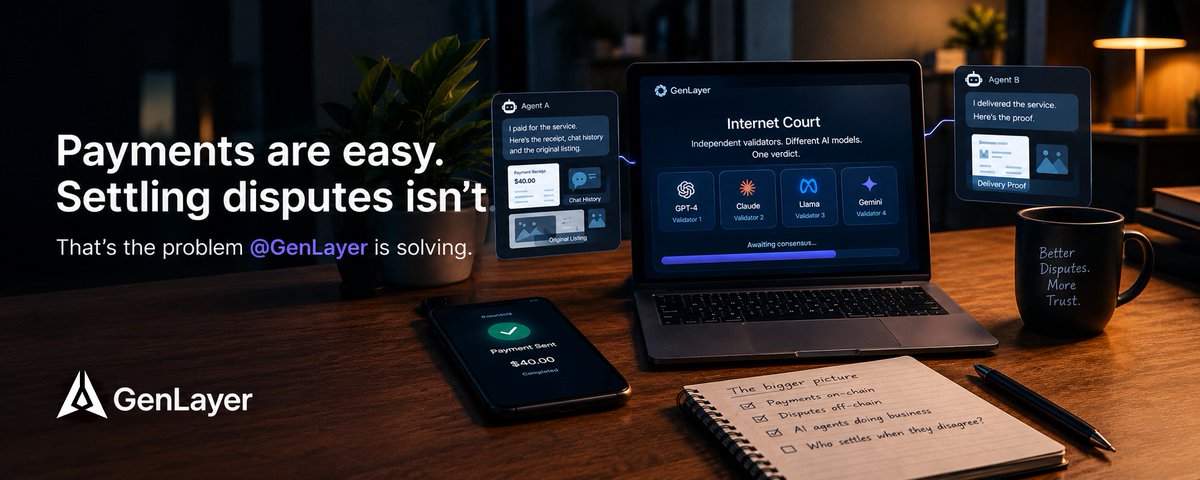
You paid. The seller says they delivered. You say nothing arrived.
You have the receipt, the chat and the original listing, and none of it ends the argument.
Now hand that fight to two AI agents, with no human to call.
That's the gap I keep coming back to with @GenLayer.
A blockchain can prove the money moved. It has no idea whether the work was any good.
GenLayer's answer is Internet Court (@courtofinternet).
Validators each run a different AI model, read the evidence in plain language, and have to agree before there's a verdict, so no single model decides.
27 founding members signed on, and Solana, Yellow, HOL and Blocksee have joined since.
I've spent months writing about this project, and what keeps me here is how unglamorous the problem is.
Everyone talks about agents moving trillions.
Few people ask who rules when one of them says "I never got it."
https://t.co/SSQZZ6h5bC
One of the most satisfying moments I’ve had while building on GenLayer was watching a contract reject an unauthorized action.
Yes, I was actually happy it got rejected.
I was testing whether a wallet without the right permissions could perform an action it wasn’t authorised to take.
The contract blocked it, exactly as it should.
That experience reminded me of something I’ve come to appreciate while building Intelligent Contracts.
Some decisions are straightforward. A wallet either has permission or it doesn’t.
But what happens when the answer isn’t so obvious?
Imagine paying someone to create a beginner’s tutorial for your product.
They deliver on time. The video looks great, but there’s a problem. They’ve left out a crucial step that beginners need to follow.
The creator believes the job is complete. You disagree because the tutorial doesn’t fully serve its purpose.
Both sides have an argument.
So who decides whether the agreement was fulfilled?
A traditional smart contract can check deadlines and payments when the necessary information is available. But evaluating whether the actual work meets an agreement is a different challenge.
This is where @GenLayer gets interesting.
GenLayer is a blockchain designed for Intelligent Contracts that can use AI to interpret written conditions, examine real world information and evaluate outcomes that aren’t easily reduced to simple calculations.
Instead of relying on one AI model, GenLayer uses validators to independently evaluate proposed outcomes through consensus, with an appeal process for challenging decisions.
Now imagine AI agents hiring services, making payments and completing tasks on our behalf.
What happens when one agent claims a job is complete, but another disagrees?
That’s one of the problems GenLayer is addressing through Internet Court, an initiative launched with 27 founding members to establish a framework for agreements and dispute resolution between AI agents.
And honestly, this is part of why I’ve stayed interested in GenLayer.
I started out creating content and animations about the project. I never imagined I’d eventually be writing code, building Intelligent Contracts and getting excited when a contract rejected an unauthorized action.
Building has taught me that getting a transaction to execute isn’t always the difficult part.
Sometimes, the real challenge is determining whether the agreed conditions have actually been met.
And sometimes, the right outcome is NO.
Now, back to that tutorial.
If you were paying for it, would you give the creator a chance to correct the missing step or reject the work entirely?
And would your answer change if that step wasn’t explicitly included in the original agreement?
I’m curious how others would approach this.
a smart contract can follow its instructions perfectly and still leave people arguing over what actually happened.
say two AI agents make a deal. one completes a task and expects payment. the other says the work didn’t meet the agreement.
the payment is the easy part. deciding who’s right is a different problem.
this is what @GenLayer is working to solve with Intelligent Contracts and Internet Court. when a dispute needs to be settled, validators running different AI models assess the situation and have to agree on a verdict.
as agents start making deals with each other, they’ll need more than a way to execute agreements. they’ll also need a way to handle disagreements.
should both agents agree on how disputes will be settled before making a deal, or should they use one shared system regardless of who they’re dealing with?
@papito_dele I wonder how appeals help when the original validation rules themselves are incomplete. A fresh group of validators could still be asked the wrong question.