The internet gave us infrastructure to connect, communicate, and transact. But more and more of what we need to do together now involves information that cannot simply be shared.
Digital voting should produce a public, verifiable result without exposing individual choices. Healthcare researchers should be able to learn from sensitive patient data without exposing the people behind it. Competitors should be able to solve shared problems without giving up the information that keeps them competitive.
Interfold is building infrastructure for that problem: confidential coordination.
It lets independent parties compute together across private inputs without exposing them or relying on trusted hardware. Decryption is distributed across independent operators, and anyone can verify the result.
That opens the door to digital democratic systems with secret ballots, markets built around private positions, and entirely new forms of collective intelligence.
Systems increasingly bring together people, institutions, and agentic systems with different interests and incentives. The internet needs a new coordination model built for that reality.
Welcoming @theInterfold as a sponsor of CYPHERPUNK CONGRESS 3 🎊
The Interfold is building privacy-preserving infrastructure for confidential coordination and computation, enabling people to collaborate and share information without compromising privacy.
Let’s advance a more sovereign internet together: https://t.co/CCUMdLl5Zp
for all it gives away, a blush tells us surprisingly little. embarrassment, affection, nerves, even delight can look pretty much the same.
and yet a blush can make someone seem more sincere. we don't know what they're thinking. they just blushed. they couldn't help it.
computers can't blush, and we don't need them to seem sincere. sometimes we can verify a result instead of taking someone's word for it.
a blush is charming because it gives something away. a system can give us reasons to trust its results without asking us to do the same.
What if medical researchers could learn from sensitive patient records without taking custody of the raw data?
@auryn_macmillan explores how Interfold could help, on the @ethereumfndn livestream.
Appreciate @l2beat taking a close look at CRISP, Interfold's reference application for secret-ballot voting.
The analysis gets into the details that matter: what stays private, what remains public, and where trust is still required.
Worth reading.
Most DAO voting happens in public - you can look up a wallet and see exactly how it voted, which allows for bribery and voter pressure. In real-world elections, the secret ballot is an internationally recognised standard that exists to prevent exactly that.
@theInterfold CRISP tries to solve this for onchain voting by keeping individual votes private while making the final results public.
We've added it to the L2BEAT Privacy dashboard. Here's how it works and who you need to trust 👇
This integration is massive.
@DefiLlama is the first major market curator on Trueo.
Why is this a big deal
Distribution. Aka eyeballs.
DefiLlama is the most widely adopted analytics platform in crypto, they cover everything onchain.
With this partnership, Trueo’s markets are integrated directly into the dashboards that are so essential to onchain research.
Interested in Hyperliquid’s metrics?
You can now see the real-time probabilities of them hitting certain milestones this week, month, or quarter right next to the data you’re consuming.
Curious about protocol exploit risks?
Find the odds of a protocol being hacked as you research it.
Want to hedge that risk? Our markets can help cover some of that downside.
DefiLlama users include degens, businesses, institutions, and even governments!
Their newsletter alone has 33K subs.
I envision a future where prediction markets are embedded into virtually every news, media, and data platform.
This partnership is a leap in that direction.
Long live Trueo. Long Live DefiLlama ✌️
To the ciphernodes that served on this E3 committee: your rewards are now available to claim.
https://t.co/g5aFKsRdQY
Thanks for running your nodes and making this vote possible!
let the committee be sorted. let the key be generated. let the secret ballots be cast. let the outcome be verified.
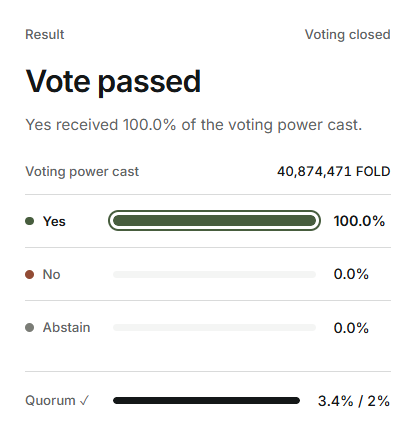
the Interfold Constitution has been adopted.
40.87M FOLD in voting power cast, exceeding quorum.
thanks to voters and ciphernode operators. 𒆙
We just sent the SEC our comment letter on Regulation Crypto Assets.
Our goal is to give every token one current, public record to make onchain compliance cheaper and faster.
Our asks:
1) Let projects file disclosures through Qualified Onchain Disclosure Agents
2) Let third parties file on behalf of projects
It's time we protect investors so we can protect this industry.
https://t.co/VNIuskoN7T
The Initial Ciphernode Rewards Program would allocate 12M $FOLD over 12 weeks to support Genesis operators.
Voting closes today, October 20 at 23:15 UTC (7:15pm ET).
Check your eligibility and cast your ballot:
https://t.co/2kOBlIvrkj
What do ciphernodes do, and why does it matter who runs them?
@auryn_macmillan explains on the @ethereumfndn livestream.
Voting on the Ciphernode Rewards Program closes today. Details below ↓
What does it actually take to make confidential coordination work?
Auryn joined @CryptoCoinShow to discuss the thinking behind Interfold, the role of the network, and what Network Alpha looks like today.
Full interview below ↓
New interview is live: @auryn_macmillan, co-founder and CEO of @gnosisguild , on @theInterfold
We got into:
- Why ZK alone can’t secure private voting
- What “live” means for Network Alpha and the ethereum:0xe172e9b6cfbeeb5593bdce3f077356fdb33af904 token
- Why a network like this needs a token at all
- Price attention vs real network progress
Full interview:
secret ballots are just one application of confidential coordination.
what else becomes possible with Interfold?
some ideas, from practical to dreamy:
• onchain auctions finding a clearing price without exposing every bid
• hospitals discovering patterns across patient data without pooling records
• companies comparing private benchmarks without exposing their numbers
• strangers discovering shared interests without publishing their preferences
• AI agents testing possible deals without revealing their owners' private limits
• satellite operators avoiding collisions without revealing sensitive orbital data
a decade from now, even this list might seem unimaginative.
the proposed Constitution sets out a privacy-first, open, forkable, and opt-in network.
whether you agree or disagree, we'd love to have your voice in shaping what comes next.
voting closes tonight at 05:06 UTC.
The Interfold Constitution is back on the ballot.
Privacy first.
Open, forkable, and opt-in.
We're putting these principles to a secret vote on the network itself.
$FOLD holders with active voting power: five days to have your say ↓ https://t.co/2kOBlIvrkj
Voting is open on IPP-001: Ciphernode Rewards Program
Ciphernodes are essential to Interfold. Committees jointly generate encryption keys and decrypt only permitted results.
12M FOLD in rewards over 12 weeks would support operators while usage fees are limited.
How to vote ↓