Fun fact, the idea for The Interfold was born out of my unease of being the MACI coordinator for several @clrfund rounds.
MACI's privacy guarantees relay on an honest coordinator assumption. MACI is essentially private voting in a ZK circuit. But in ZK, one must know the data one is making proof about. A compromised coordinator can reveal any inputs because the coordinator must see all of the inputs to generate a proof of their tally.
For those clrfund rounds, I knew that I was not compromised. But would always ask myself "why should anyone else trust me to secure their privacy?", "how can the be confident that I'm not compromised?".
The natural step was to attempt distribute coordinator trust as broadly as possible, without compromising on the other fundamental guarantees that make MACI interesting. This lead us to the combination of ZKPs, FHE, and MPC (threshold cryptography).
The real light-bulb moment was when we realized that voting was just one of a whole class of similar problems; where private inputs from many parties are aggregated to produce some public output.
This is what ultimately lead us to build @theInterfold.
More people should know about the Interfold.
It's basically what I've been yelling at people to build with the MACI ideas ( https://t.co/mlDy84zXQo ) for almost a decade, and now it exists, in a generalized form.
The idea is: a privacy protocol optimized for things like voting (and other use cases eg. secret-ballot auctions). The mechanism generates a threshold encryption key, and people send in their votes onchain, using a ZKP to prove eligibility. An arbitrary computation on the votes gets run inside FHE, and then threshold-decrypted.
From what I can tell (the docs are good https://t.co/adzwK6ezMN ), it gets pretty optimal security guarantees:
* Voter anonymity can be made unconditional if eligibility is proven with ZK-SNARKs
* Censorship resistance is guaranteed by ethereum (votes can be posted directly onchain, and there's a proof that all posted votes are taking into account)
* The correctness of the outputted result can be ensured via ZK over FHE
* Liveness and coercion resistance depend on M-of-N honesty; unavoidable given present-day technology
The main limitation is that today "ZK over FHE" is only properly available for additive vote tallying, as it's too expensive for computations that involve multiplication or other more complicated manipulation at the moment. There's work in progress on slashing-based / optimistic computation for such situations.
(And of course ideally in the long term we'd figure out obfuscation so you can get rid of the M-of-N committees😃)
Satoshi owns 1.1 million bitcoin.
He hasn't said a word in over 15 years.
On @ethereum, you won't have to disappear.
Introducing GhostBalance - speak freely, backed by your $ETH, without ever showing your wallet.
Let your balance speak.
Your identity stays private.
🧵👇
New from the Interfold Cryptography series:
How do you make a multiparty cryptographic system publicly verifiable, from distributed key generation through final decryption?
Private voting fails if you can still prove your choice.
The Interfold uses vote masking to break that proof.
Read the technical deep-dive on vote masking and receipt-freeness by @ctrlc03 ↓
Catch up on what’s new in our latest community update!
From protocol progress to ecosystem growth, we’re building toward a future of verifiable, privacy-preserving computation.
https://t.co/ojMkesuVsB
Enclave is now The Interfold.
What we built isn’t a hardware enclave, but a distributed network for confidential coordination.
The Interfold names that network. 🌐
Enclave’s first community update is live.
We’re advancing toward our public testnet, making progress on PVSS, and exploring exciting ecosystem use cases such as confidential voting in DAOs.
Today, we introduce Zodiac as an OS for onchain operations.
Bringing together years of Safe-native work into a single system, Zodiac gives teams programmable control over permissions, execution, and automation.
Zodiac launches with access limited to early teams.
As far as I know, the election we just ran is the first time an American elected office has been decided in a majority-digital vote, open to all registered voters, despite party affiliation.
Results were just announced: https://t.co/K9lXFNw2KU
Interesting highlights ⬇️
One of the most fascinating hypothetical use-cases I've seen for @EnclaveE3 is in satellite collision avoidance.
Many different entities have things in orbit, many other want to put more things in orbit, none want to disclose their trajectories. How to ensure new space stuff doesn't collide with esisting things in orbit?
This is a great example of where mutually distrusting parties can aggregate information to their mutual benefit. Each party provides their current or proposed trajectory as encrypted input, output is some likelihood of collision. No trajectories are revealed. 🤯
New post: the first entry in our Enclave Cryptography series.
It examines a core issue in hybrid FHE–ZK systems:
how to prove that a ciphertext actually encrypts the value referenced in a ZK witness.
Private voting protects participants.
Verifiable secret ballots protect the process.
We’re thrilled to partner with @EnclaveE3 to begin work on expanding Aragon’s privacy stack, introducing confidential, verifiable voting that removes trusted intermediaries.
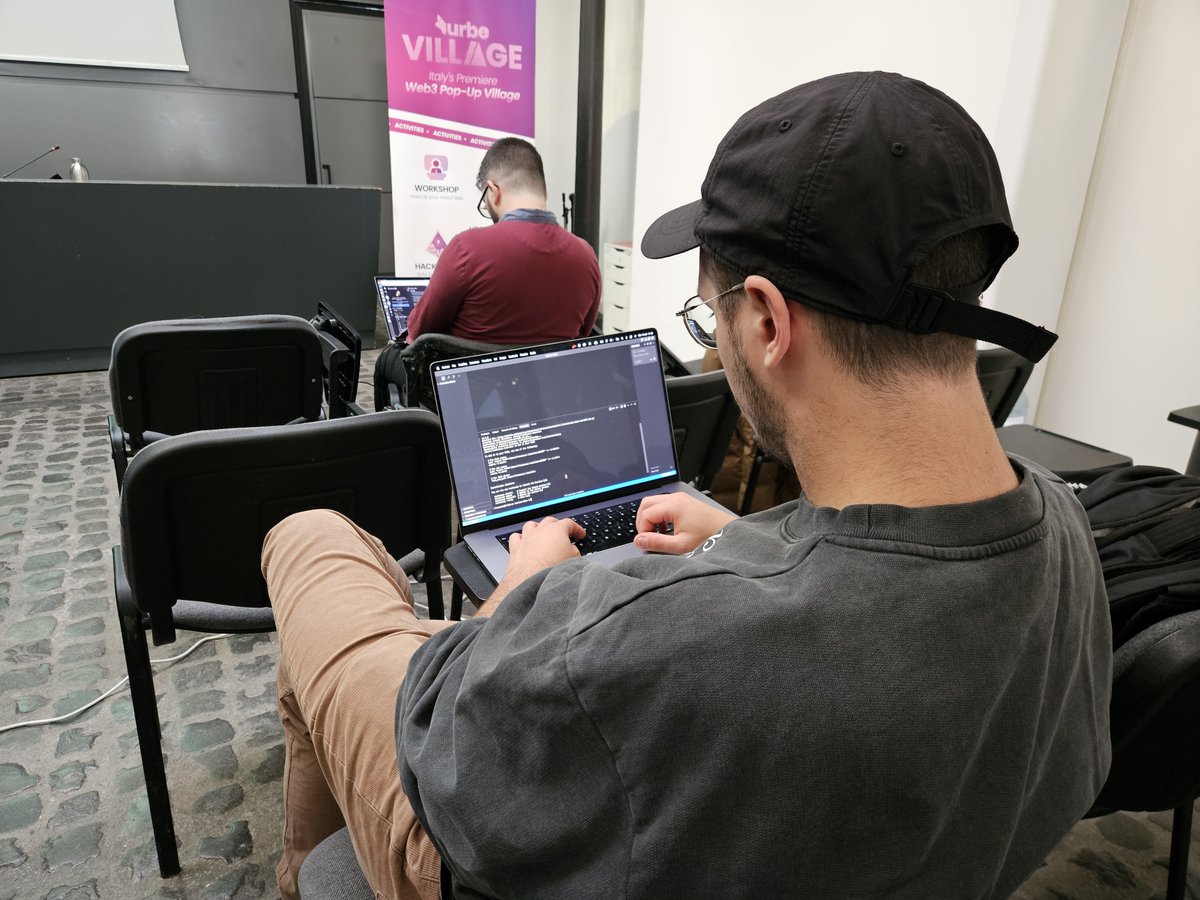
Day 7 of the Urbe Campus @ETHRome edition 🇮🇹
We’re getting close to the hackathon, just 3 days to go!
Today, we hosted a hands-on workshop with @0xjei from @EnclaveE3, diving into privacy tech and helping builders get ready for their ETHRome challenge
One day left!
On-chain voting has immense promise, but the UX is often complex & lacks privacy.
We're fixing it.
With support from @PrivacyEthereum , we've shipped major updates to Privote, making secure on-chain voting simple & intuitive.
Here’s what’s new 🧵
https://t.co/b1gV9Eu74S