We’re introducing Mira Science, a general-purpose computing platform for scientific research.
Mira Science turns research methods into programs that can be composed, run, inspected, and modified. Researchers can orchestrate teams of AI scientists, connect professional tools and cloud compute, and trace every result back to its data, code, execution history, and review.
Paired with Hydrogen-1.0, @deepprinciple’s open-weight model for scientific research, Mira Science achieves a 48.3% pass rate on Frontier Science Research, compared with 46.7% for Codex + GPT-6 Astra and 45.0% for Claude Code + Opus 5.5.
We believe AI scientists should be inspectable, extensible, and able to work in the same environment as researchers, their tools, data, and compute—not remain isolated inside a chat interface.
Mira Science is now available on desktop.
Register and download: https://t.co/16Bsxinw8h
Together with @Alibaba_Qwen, we’re exploring new coolant materials with Qwen4-Max to help data centers handle the heat from growing AI workloads.
We’d love to take this further with more partners—using AI to advance science, and putting scientific progress to work for AI.
#DeepPrinciple #Qwen #AIforScience #ScienceforAI #DataCenterCooling
AI for science should give researchers more room to ask bold questions and explore new directions. Getting there takes collaboration. Thank you to @UniPat_AI , @Macaron0fficial , and NeuroSpark for helping us build Hydrogen-1.0. Let's advance scientific discovery together.
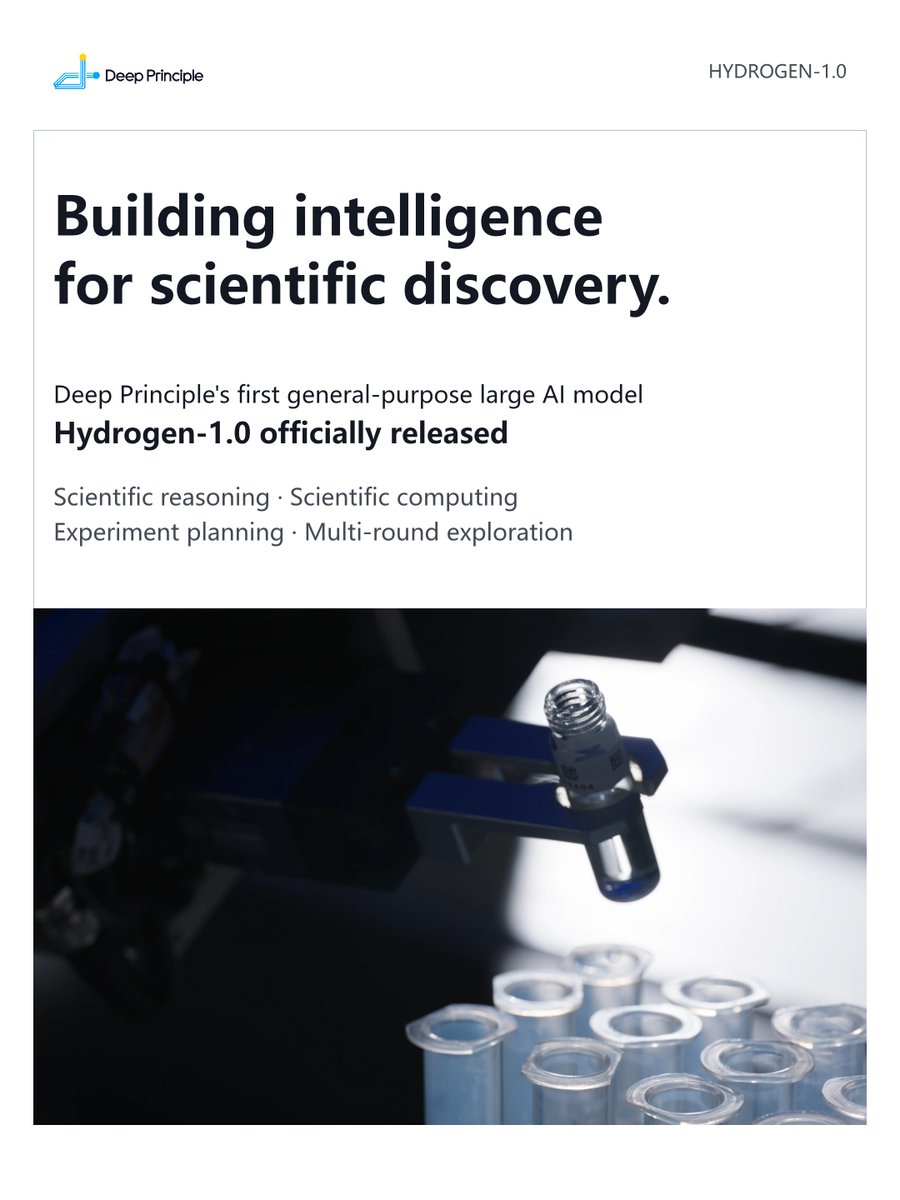
Introducing Hydrogen-1.0, Deep Principle’s first general-purpose large AI model, built to support scientific discovery.
Hydrogen-1.0 helps researchers reason through complex scientific questions, carry out calculations and simulations, turn research ideas into experimental plans, and use feedback to guide further exploration.
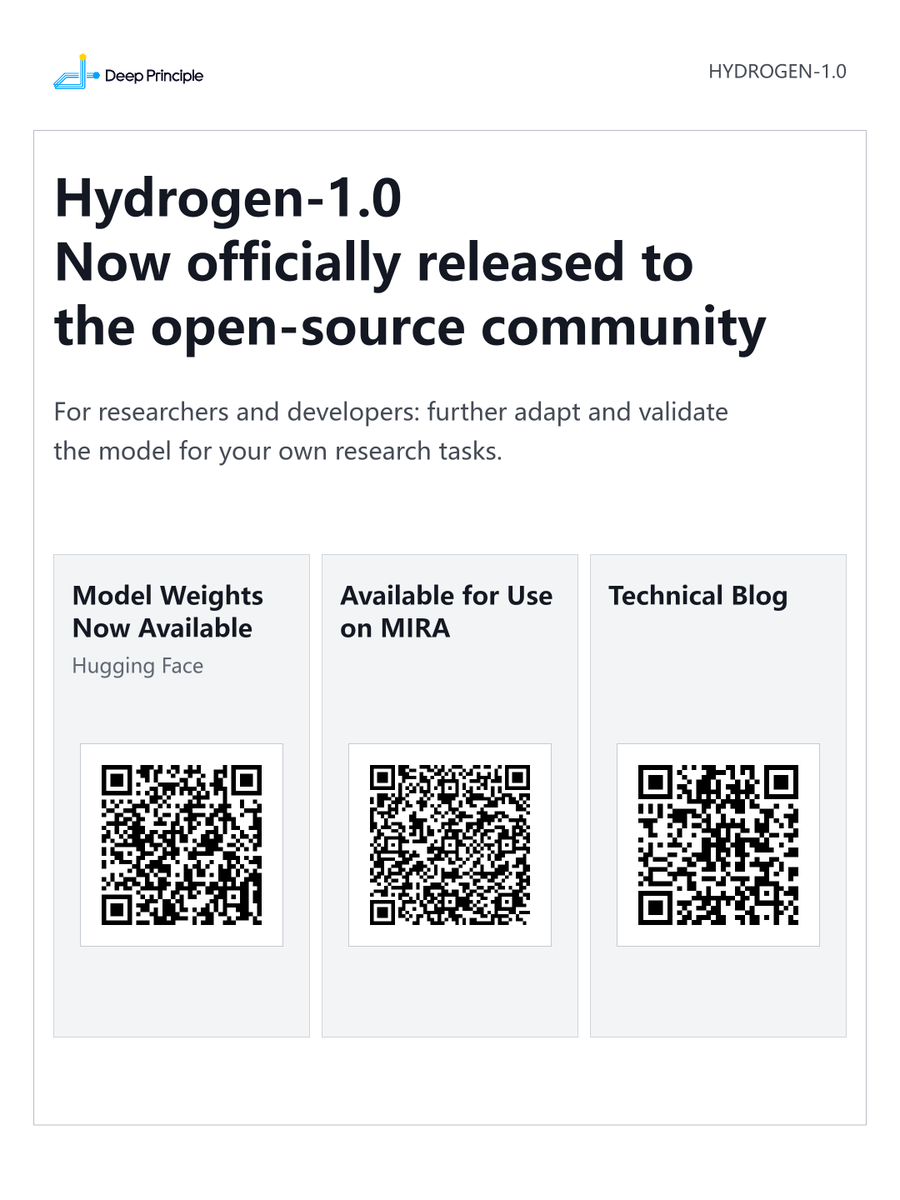
Today, we’re releasing its model weights for researchers and developers to adapt and evaluate on their own scientific tasks. Hydrogen-1.0 is also available in our AI Scientist product, MIRA.
Explore the benchmarks, research examples, and ways to get started in the posts below.
Building intelligence for scientific discovery.
Start exploring Hydrogen-1.0.
Download the open weights to adapt and evaluate the model for your own research tasks, or try it directly in MIRA.For training methods, detailed evaluations, and application examples, explore our technical blog.
→ Model weights: https://t.co/2nwIatJCEp
→ Try Hydrogen-1.0: https://t.co/wRO7xfAZop
→ Technical blog: https://t.co/E7jo2VLr2b
We look forward to seeing what you explore.
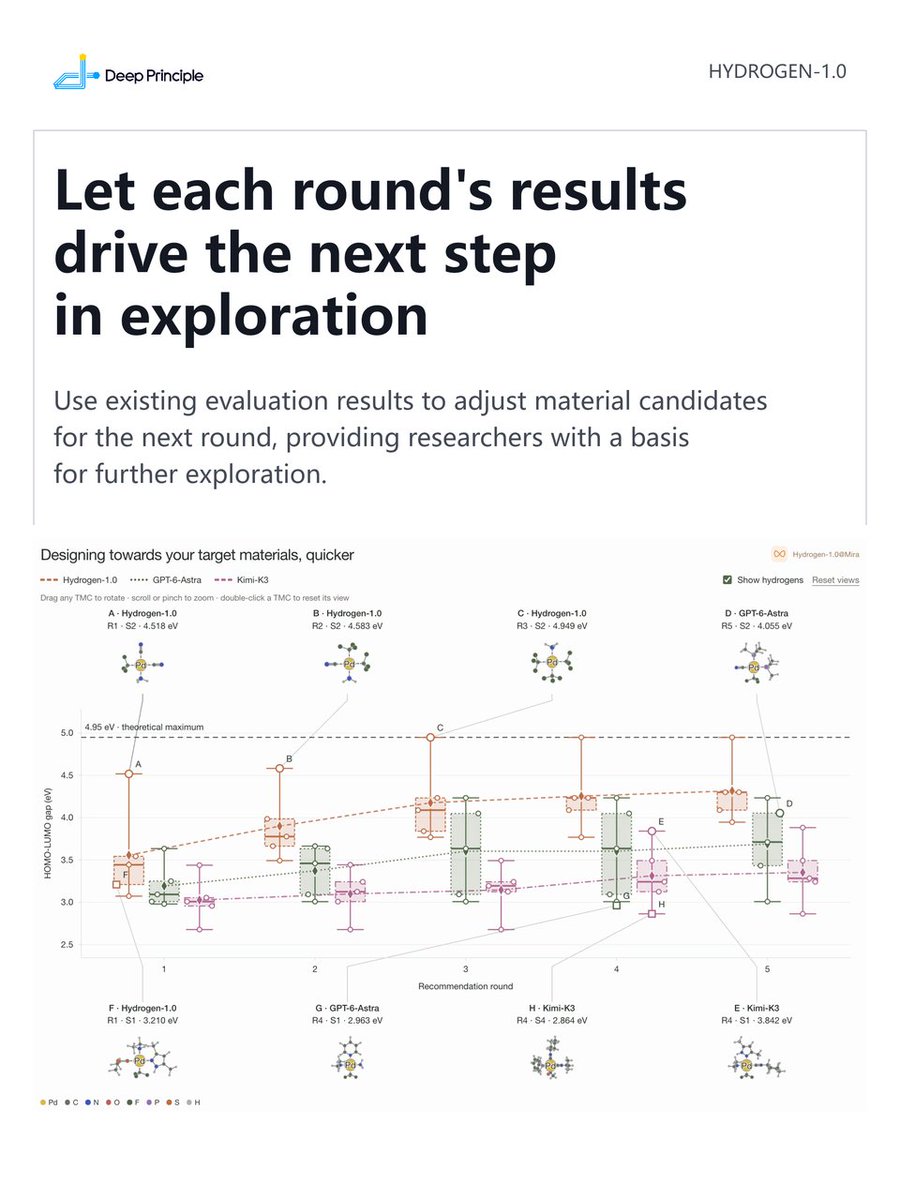
In our metal-complex search evaluation, Hydrogen-1.0 used feedback from previous recommendations to search for candidates with larger HOMO–LUMO gaps.
A concrete example of using successive evaluation results to guide materials exploration toward a defined target.
Hydrogen-1.0 helps researchers develop procedures and specify individual operations. Lab Compile then checks equipment capabilities, prerequisites, and execution order in a virtual environment.
One concrete example: flagging an instruction to aspirate liquid before a fresh pipette tip has been fitted.
By checking these details virtually, researchers can identify and revise execution issues before moving to the lab.
Hydrogen-1.0 helps researchers investigate material properties, compare reaction pathways, and identify promising directions for experiments through calculations and simulations.
In our polyethylene example, it builds a molecular model and writes simulation code. When a density calculation produces an abnormal result, it helps trace the issue to double-counting, correct the code, and rerun the calculation.
These calculations give researchers a clearer basis for deciding what to test next.
In our evaluations, Hydrogen-1.0 achieved:
- 38.3% problem-solving success on FrontierScience Research (FSR), 5.0 percentage points above GPT-6 Astra.
- 93.0% accuracy on GPQA Diamond, close to Kimi K3’s 93.5%.
These benchmarks examine two essential capabilities for scientific work: reasoning through unfamiliar, multi-step problems and answering challenging questions in physics, chemistry, and biology.
We just dropped Materials Property Axiom (MPA).
The problem: most materials foundation models crush it on computed properties, but choke on real experimental data (boiling points, solubility, flammability, etc.).
MPA fixes this with physics-aligned transfer learning:
• 64M structures → 3D pre-training
• Thermochemistry + electronics + solvation → mid-training alignment
• Hybrid attention/additive readout → experimental fine-tuning
Results: ~10% better across 40 benchmarks, up to 51% on hard OOD tasks.
The rule: match the physics, not just the data.
Live at https://t.co/v6dCAB7s5M 🔗 https://t.co/YVIUY11JKO
I’m thrilled to share that Professor Heather Kulik @KulikGroup from MIT is joining @DeepPrinciple part time as our Chief Scientist! As the Lammot du Pont Professor at MIT, Heather is a true pioneer at the intersection of AI and Science. Her breakthrough research in accelerating chemical and materials discovery has redefined the boundaries of computation.
For me and @HaojunJia1 , this is a deeply meaningful moment. Heather was our PhD advisor at MIT, where she inspired us all the way through and it’s been our dream come true to have our mentor join us in this mission. We couldn't be more excited about pushing the frontiers of AI for materials discovery together, again.
Recently, Science published a feature article titled "How will we know if AI is smart enough to do science?".
The article focuses on the latest breakthroughs in evaluation systems for artificial intelligence's scientific capabilities, providing an in-depth analysis of the cutting-edge explorations by institutions such as Deep Principle, OpenAI, and FutureHouse in developing benchmarks for scientific intelligence.
The article highlights the "Scientific Discovery Evaluation" (SDE) benchmark, led by Deep Principle. Unlike traditional evaluations, SDE does not consist of isolated, difficult questions. Instead, it distills 43 research scenarios and a total of 1,125 interrelated tasks from 8 ongoing, real-world research projects with unpublished data.
The article opens by pointing out that the scientific community has long questioned traditional question-and-answer evaluation benchmarks (such as HLE). These tests often focus on obscure or even trivial knowledge points, making it difficult to measure an AI's ability to conduct real scientific research.
Thrilled to be on the cover of JACS! @ACSPublications
LLM‑EO (LLMs + evolutionary optimization) designs transition‑metal complexes, surfacing top candidates and novel ligands from a 1.37M space. https://t.co/Lph42PGiew
From cover to frontier—Deep Principle keeps driving GenAI deeper into materials. More breakthroughs ahead.
#AI4Science #MyACSCover
#AI is already revolutionizing #material_science .
Haojun Jia, founder and CEO of Deep Principle, explains how leveraging both domain expertise and data-driven insights will be key to AI-enabled platforms transforming materials
#science#AMNC25
https://t.co/vMY8h4i3zn
🎉 We’re thrilled to announce that Deep Principle has been selected as a 2025 World Economic Forum Technology Pioneer!
🌍 Each year, the WEF recognizes early-stage companies poised to make a significant impact on business and society. We’re proud to be recognized alongside global innovators driving sustainable, intelligent, and accelerated growth.
🧪 At Deep Principle, we are redefining the future of chemistry and materials innovation through cutting-edge AI and first-principles computing—enabling smarter scientific discovery at unprecedented speed and scale.
We’re excited to contribute to the Forum’s global initiatives and conversations, and look forward to seeing our co-founders @HaojunJia1 and @chenru_duan represent us at key WEF events throughout the year.
🔗 #TechPioneers25 #WEF #AIforScience #DeepTech #MaterialsInnovation