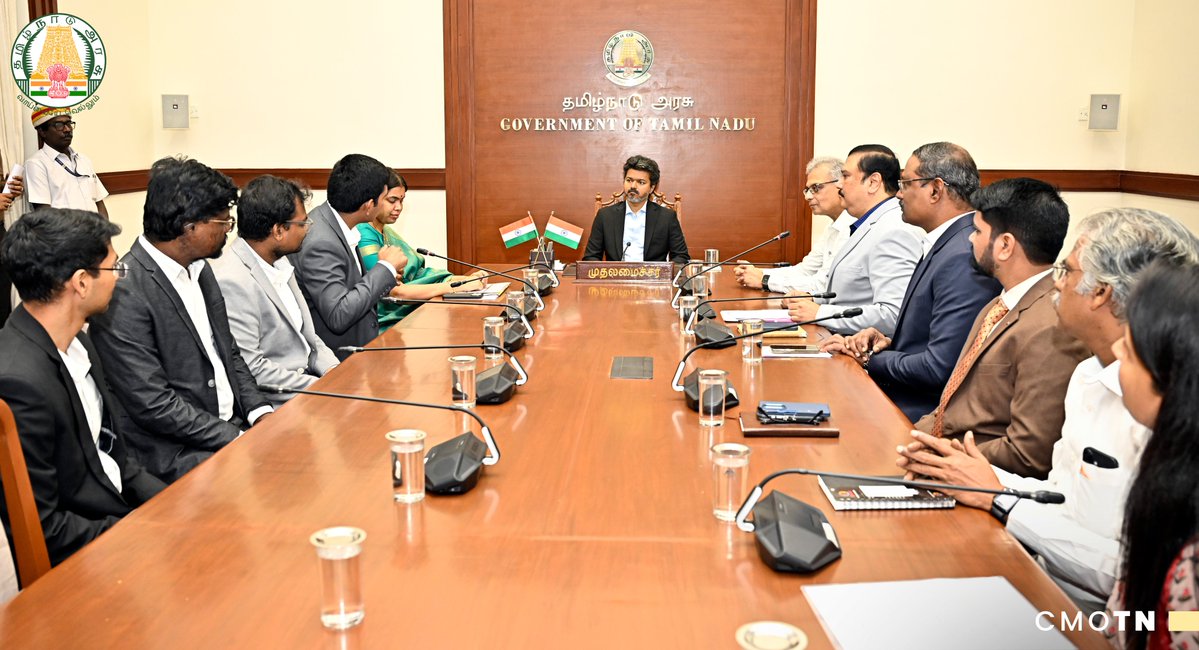
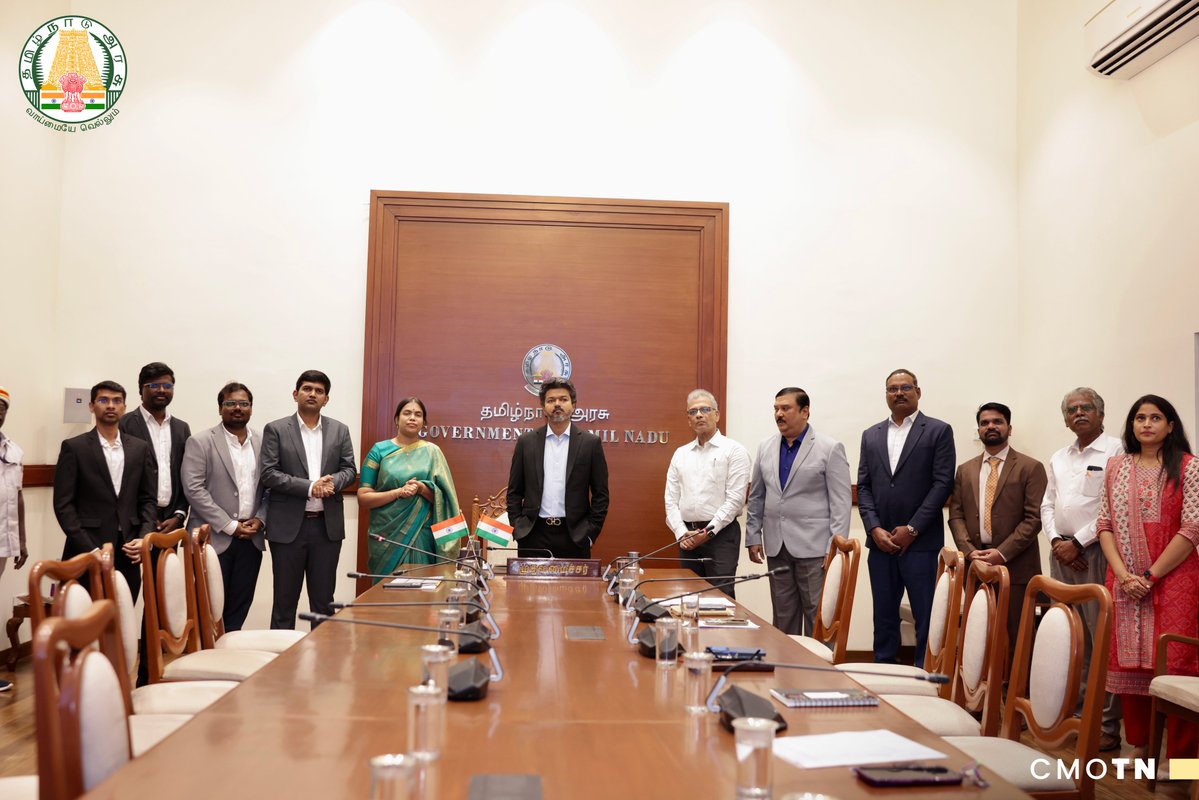
மாண்புமிகு தமிழ்நாடு முதலமைச்சர் திரு.ச.ஜோசப் விஜய் அவர்கள் இன்று (11.11.2026) தலைமைச் செயலகத்தில், இந்தியாவின் முன்னோடி உயர் மின்னழுத்த (High-Voltage) மின்சார மோட்டார் சைக்கிள் தயாரிப்பு நிறுவனமான Raptee.HV நிறுவனம், சென்னை, பெருங்குடி, OMR சாலையில் நிறுவியுள்ள மூன்று தளங்களைக் கொண்ட புதிய முதன்மை அனுபவ மையத்தைக் (Flagship Experience Centre) காணொலிக் காட்சி வாயிலாகத் திறந்து வைத்தார்.
The Hon’ble Chief Minister of Tamil Nadu Thiru.C.Joseph Vijay inaugurated the new three-storey Flagship Experience Centre established by Raptee.HV, India’s pioneering high-voltage electric motorcycle manufacturer, on OMR Road at Perungudi, Chennai, through video conference from the Secretariat today (11.11.2026)
#CMJosephVijay
Proud moment to have the CM of Tamil Nadu, Vijay to inaugurate Raptee's experience centre on OMR in Chennai. Lots of exciting stuff ahead for @RapteeEnergy.
Congrats @DineshArjunV and team!
So this happened! 😎
Today, the Hon’ble Chief Minister of Tamil Nadu, Thiru C. Joseph Vijay, inaugurated Raptee.HV's first three-storey flagship Experience Centre on OMR, Perungudi, Chennai, from his chamber at the Secretariat.
He also marked the occasion by handing over a Raptee motorcycle to our 100th customer.
We are building an electric motorcycle brand from Tamil Nadu, with plans to take Raptee to international markets, including Colombia and Sri Lanka.
Another important milestone is our association with TIDCO. Raptee is the first startup to receive TIDCO funding since its investment in Titan in 1980.
There is a lot more ahead.
If you're on OMR, drop by our Experience Centre and take a test ride!
Jio's plan to build a 1600-satellite constellation first emerged in June 2026. It became a talking point this month after Elon Musk accused Ambani of blocking Starlink. This triggered a bit of jingoism in India, and a debate on how and when a private constellation could actually happen.
Let us explore how practical that ambition is.
Globally, only two companies currently build broadband satellites at scale, and neither sells them to anyone else: SpaceX (~2500 a year) and Amazon (~1800 a year). Airbus with a capacity to build 2/day is a notable mention having built hundreds of satellites for OneWeb. Both have taken years of trials, errors, dollars and iterations to build up this capacity.
Additionally, building a broadband satellite is not the same as assembling a conventional communications satellite. These are sophisticated machines carrying phased-array antennas, RF payloads, onboard processing, power systems, propulsion and increasingly complex software. All of these systems have to be integrated into a compact, reliable and economically viable platform.
A LEO constellation also needs to be continuously replenished. Starlink's broadband satellites have an estimated useful life of approximately five years. Assuming a similar replacement cycle, maintaining a 1,600-satellite constellation would require around 300 new satellites to be manufactured and launched every year.
This effectively means running a satellite manufacturing factory and a launch programme in perpetuity.
Satellites alone don't deliver broadband. You also need ground stations to connect them to the internet backbone, user terminals with antennas to track satellites as they move across the sky (at 25000km/hr+ in LEO), and software to seamlessly hand over connections from one satellite to another. This also requires spectrum coordination and a sophisticated network operations capability.
Jio’s proposal reportedly needs 20+ ground stations and that's a substantial telecommunications network in its own right. Jio has an advantage here with its experience in building terrestrial telecom infrastructure, managing millions of connections and deploying network infrastructure at scale, could translate well into this part of the business. But Space is a different engineering challenge altogether.
Now, assuming the manufacturing challenge can be addressed with the Jio might, there is still no way to put these satellites into Low Earth Orbit at anything close to the required rate.
2010 - 2026, ISRO has averaged < 6 launches/year. The only Indian rocket currently capable of lifting a meaningful batch of satellites into orbit is the LVM3. ISRO currently builds about three a year and is now looking to outsource LVM3 production to industry to double that capacity.
When LVM3 flew OneWeb's constellation, it carried 36 satellites per launch. At that deployment density, putting 1600 satellites into orbit would require approximately 45 LVM3 launches. That's more than seven years of India's entire planned LVM3 production capacity, focused only on this project. SpaceX’s Falcon 9 (with 16ton+ to LEO capacity) missions are booked a few years out. Early versions of Starlink satellites weighed roughly 250 kg each. The attached photograph of 60 Starlink satellites packed within the Falcon 9 fairing, gives a sense of the scale of the deployment challenge.
Today, Indian private launch companies are still working towards demonstrating orbital launch capabilities. Skyroot, which made India proud delivering India's first successful private launch recently, carries a <500kg payload, which would not immediately suit constellation launches. Bluehill portfolio Ethereal Exploration Guild is developing a medium-lift, fully reusable launch vehicle targeting 25 tons to LEO. And they are working towards commercial launches by 2028. But even that involves hard iterations and testing before achieving a launch cadence that a constellation of this scale would demand.
Building a sovereign satellite constellation is fantastic strategic ambition for India. But it requires an industrial manufacturing ecosystem spanning semicon, RF, satellite manufacturing, ground infras, launch vehicles and operations, at a scale that we are not close to achieving today.
This requires vision and planning from both the government and private players at a level that we aren't thinking about yet. Having said that, it would be an amazing problem statement to be tackled by one of our top industrial houses, and that would provide a massive impetus to an already high-flying space startup market in India.
If geopolitics has taught us anything it's that sovereign capabilities are no more optional. Here's to building them!
@BluehillVC
@kingofknowwhere Yeah, with two tapeouts already completed at 130nm and 12nm, they are already on their way to the next 12nm tapeout with a significantly improved design.
Read on our thesis here:
https://t.co/5XdwvZaTcJ
75% of AI energy is spent moving data, not compute.
That’s the real bottleneck.
Our latest investment, optoML, is changing this with analog in-memory compute + optical interconnects.
Read more:
https://t.co/uXsoSVc63Z
@BluehillVC
@DineshArjunV Theoretically. But needs better equipment on the ground.
Looks like the TVK govt has the right approach for aviation in the state - 1) Reduced ATF VAT significantly 2) Asked the Centre to private MAA.
That's not fully correct. MAA runways intersect at the very beginning of Runway 25 and Runway 30. BOM has runways that intersect right through the middle. We already do quasi "simultaneous" operations. It's very possible to do arrival on 7/25 and take off on 12/30. BLR uses 27L/9R for landing operations and 27R/9L for takeoff, simultaneously.
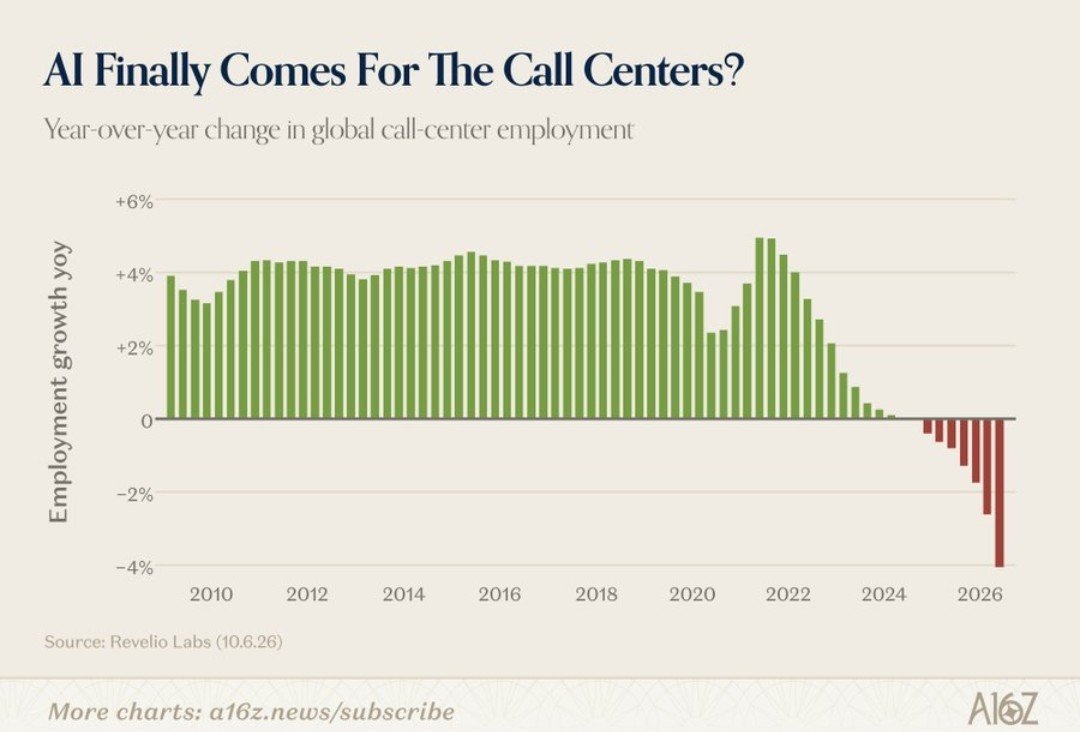
One of India's biggest job creation engines may be staring at a structural disruption. For decades, call centres powered India's services exports and created millions of jobs.
This chart from @a16z is quite startling.
Global call-centre employment growth has gone from +4% to -4%. And it feels like just the beginning.
India needs to pay attention..
*Pune Metro Line 3 (First 13km section)
CMRS nod: July 2026
Inauguration: Likely on Nov 3, 2026
*Chennai Metro Phase 2 (Poonamallee Bypass-Vadapalani Section)
CMRS nod: Conditional approval in Feb 2026 & final authorisation in May 2026
Inauguration: Oct 11, 2026
*Bengaluru Metro: Pink Line (7.5-km section)
CMRS clearance: Oct 28, 2026
Inauguration: Yet to be announced
There should be a defined timeline for commencing passenger operations after CMRS clearance. Formal inauguration can be held later. Every day of delay is estimated to cost BMRCL around Rs 2 cr.
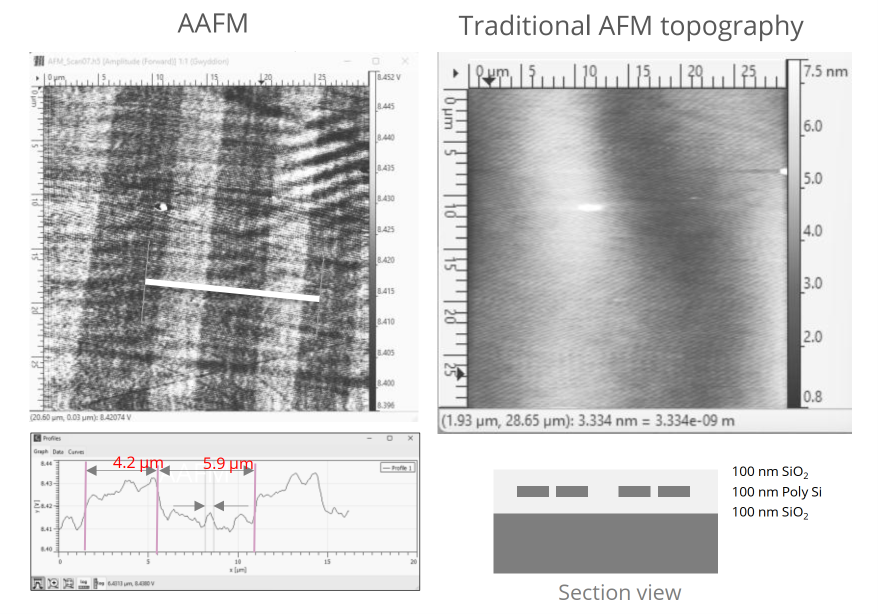
A wafer goes through 1,000+ steps inside a fab, and more than half of them exist just to measure what was built. And as chips go 3D, the most critical structures are buried where today's inline tools can't see them.
We recently announced our ₹9.2 Cr investment in Makr Microsystems, which is building an Acoustic AFM that uses ultrasound to see beneath the surface. It's exactly the kind of deep IP India's semiconductor ecosystem needs.
Read my thesis below:
https://t.co/wx2gv59Aqc
@BluehillVC IN/AIF1/24-25/1513
Hear from Manu Iyer, Co-Founder & General Partner, https://t.co/9fzDDsnpYW, as he reflects on the journey of Bengaluru Tech Summit and the incredible energy for BTS 2026.
From a strong focus on DeepTech to bringing together the technology and innovation ecosystem, BTS 2025 set the stage for what’s next. And with an exciting lineup of experiences planned for BTS 2026, the journey is only getting bigger!
Be part of #BTS2026 and experience what’s next in technology, innovation and beyond.
#BengaluruTechSummit #AIAndBeyond #DeepTech #Technology #Innovation @kiranshaw
1. In 2006,the Sonia Gandhi-led UPA decided to strengthen the humanities depts in #IITs in order to introduce the Ambedkarite-Periyarite trojan within the IIT System.This trojan has been steroidally strengthened,not weakened,by the panoramic hyper Ambedkarism of NDA since 2014.