https://t.co/h0s2THLZDu
This incident took place in F-1 Block Sunder Nagri. During the heavy rainfall the area became severely waterlogged and rainwater flooded several homes. One resident's house was completely filled with water and sadly he lost his life.Who is responsible?
I am at Safdarjung hospital in Delhi where @Wangchuk66 has been admitted. Nothing should be administered to him orally or intravenous without take consent from me, his family and his doctors who have been monitoring his health for the past 20 days.
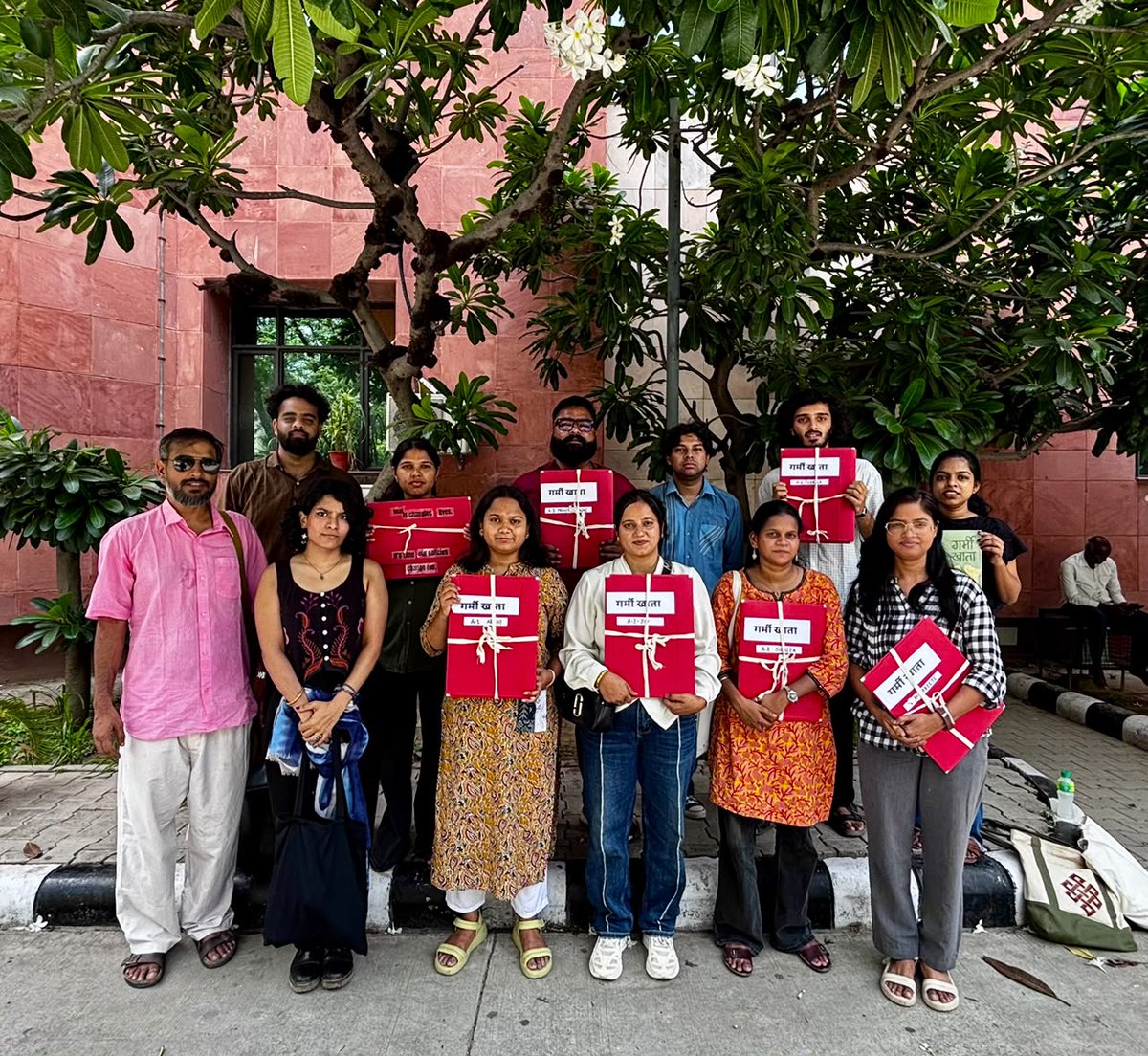
This summer, some households in Delhi decided to record what heat actually does to their lives, loss of income, missed work, dehydration cases, reduced mobility, water access, and more. Not with just ambient temperature, but through their own lived experiences.
They recorded sleepless nights. They documented how rising temperatures increased stress, frustration, and conflict at home. They wrote about losing work and income because it became impossible to work outdoors. They described children struggling to study or complete homework in unbearably hot homes. They kept record of increasing electricity bills, medical expenses, and the many invisible impacts of heat that rarely appear in research papers or policy discussions.
These stories, testimonies, and records became Garmi Khata, a community led people’s registry that aims to translate lived experience into evidence. What makes it powerful is its ownership. It is not a survey conducted from outside. It is a community maintained record that turns everyday experience into documented climate evidence.
Yesterday, these households submitted their Garmi Khata to the NHRC, calling on it to acknowledge the human rights impacts of extreme heat and to recognise heat as a human rights issue that demands urgent action.
I feel this opens up a larger discourse on how climate impacts are measured, whose data counts, and how communities are already building their own systems of accountability when official frameworks fall short.
"street vendors were not responsible for pedestrian deaths in the city, blaming instead the encroachment of public spaces by malls, large residential complexes and unscientific traffic management. It said that instead of adopting planned road development measures to accommodate Bengaluru’s growth, authorities were targeting street vendors who contribute significantly to the city’s economy."
https://t.co/5rCYTscMz7
The print at Sunder Nagri , Delhi's hottest area where people are suffering a lot also , they lost their education and work due to extreme heat. Now they documented their loss and damages in Grami khata.
For more information , click on The link
https://t.co/292xLgdzcZ
Proud to share Heatwave Rising, a powerful community song by Mahi G, created through a participatory process with community from Sundar Nagari, Delhi.
https://t.co/7WfWU1OiMC
I don't see this cockroach janta party led protests as some broad democratic awakening. They largely reflect the frustrations of upper-caste and urban middle-class youth whose faith in competitive exams and meritocracy has been shaken by administrative failures.
For the state, these protesters are still seen as "good students" pursuing success within the existing system. They are not challenging the political order itself.
Where was this awakening when students who protested discrimination, violence or state policies affecting minorities faced arrests, surveillance, criminal charges, and prolonged imprisonment. Those struggles rarely received the same level of sympathy from the broader middle class.
Where was this widespread concern for democracy and justice when minorities were (and still are) being dehumanized, when communal violence occurred, or when students speaking about these issues were being punished?
What is being presented as an awakening often looks more like anger at inefficiency within a system that has historically benefited socially privileged groups. The outrage is not necessarily against exclusion or inequality itself, but against the failure of the meritocratic machinery they depend on.
26°c temperatures inside the metro don't always mean comfort. The suffocation says otherwise.
Humidity 61% images tell the story of how people are changing their travel patterns to escape the heat, only to face new risks in overcrowded spaces.
#Heatwave#DelhiHeat#RightToCool
At least till last year, this water ATM was functional. Today, it stands abandoned.
At a time when Delhi urgently needs more public water access points to cope with extreme heat, it feels like nothing is actually being done on the ground.
Last year, the government announced 3000 water ATMs under the Heat Action Plan. But where have they been installed? Nobody seems to know!.
Delhi may officially read 43°C, but on the streets, it can feel much hotter. Thermal heat mapping by Greenpeace India has recorded temperatures crossing 50°C in urban hotspots, revealing a harsher reality behind the numbers
#DelhiHeatwave#ClimateChange#UrbanHeat
Midnight in New Delhi.
Date: 21 May 2026
Air temperature: 31°C
Surface temperature: 39.3°C
The ground beneath us was still over 8°C hotter than the surrounding air after midnight
This is why I focus on surface temperatures rather than just air temperatures. Concrete and asphalt dominate our cities. We walk on them, wait on them, drive over them, and live around them. They absorb enormous amounts of heat during the day and continue releasing it at night.
This is the urban heat island effect in action and one reason why nights are getting warmer in our cities.
This was recorded today around 9 PM in Delhi. The temperature is 32.5°C with 45.8% humidity and a dew point of 19.3°C.
This means that the city is no longer cooling down at night.
Both the humidity and dew point make the heat feel much more uncomfortable. The feels like temperature would be around 36-38°C.
Now, think about outdoor workers..construction workers, street vendors, delivery wrkers, sanitation workers, and people living in tin roof homes with poor ventilation.
Their bodies, which have already spent the entire day exposed to extremes heat without any cooling, never get to recover.
The heatwave has now become a public health and urban planning crisis.
Picture @vichitrvichar
Clicked these thermal images during an auto ride today in Delhi. The ambient temperature today was 43 degrees celsius today but thermal images of different surfaces both within and outside the auto was reached upto 60 degrees celsius.
We seriously underestimate what extreme heat does to the human body. We should start asking who is responsible for this rising heat and are those more vulnerable and exposed to extreme heat responsible for rising heat.
What is wrong with our cities. What can save our cities now. How better public mobility systems is the solution for the crisis our cities are in.
Listen to one of the best minds in mobility planning