Glucocorticoid Tapering in SLE
Dr. Yuz Yusof discusses abstract POS1224 presented at the 2025 EULAR meeting in Barcelona, Spain.
https://t.co/oI992YLvnB
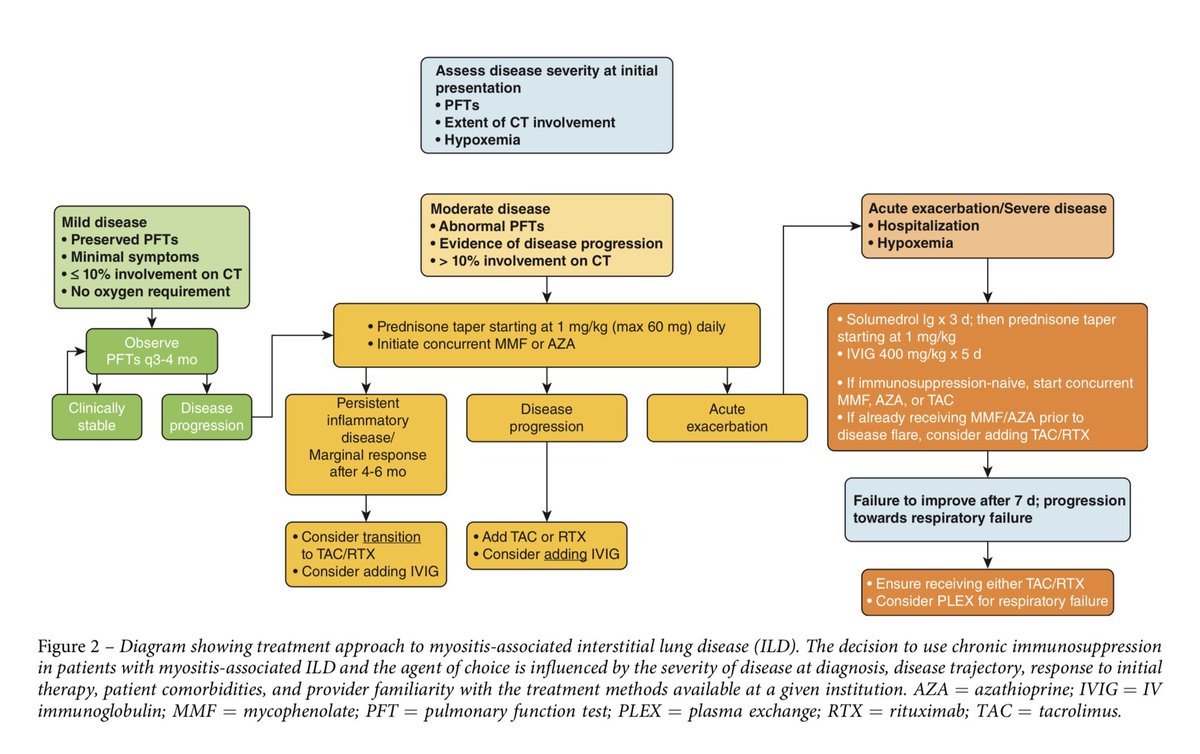
Strategy for treatment of #myositis-associated interstitial lung disease based on disease severity
*From: Hallowell RW, Danoff SK. Diagnosis and Management of Myositis-Associated Lung Disease. Chest. 2023;163(6):1476-1491.
🔗https://t.co/uMv6LKn9JR
As of today, there is now an FDA approved treatment for #IgG4RD! Such an exciting time for patients living with IgG4-related disease.
https://t.co/HugYssW2lT
Avacopan Versus Prednisone Taper in Patients With ANCA-Associated Vasculitis Without Kidney Involvement in a Phase 3 Trial
Sponsored by Amgen
https://t.co/R7HA8NWJPa
2025 ACC/AHA/ACEP/NAEMSP/SCAI
Guideline for the Management of Patients
With Acute Coronary Syndromes: @CircAHA@JACCJournals
🥸Here are class 1 recommendations from the document; Massive effort - congratulations to the authors: @SVRaoMD
😱 Below
👇👇👇
Clinical trials confirm the efficacy of combining Janus kinase inhibitors (JAKis) with methotrexate (MTX) for rheumatoid arthritis (RA) treatment outcomes, but the low number of major adverse cardiovascular (CV) events prevents definitive conclusions on CV risks. Indirect evidence suggests MTX may have cardioprotective effects through mechanisms like reduced inflammation, adenosine monophosphate-activated protein kinase (AMPK) activation, increased cholesterol efflux, and adenosine accumulation. These findings suggest that, in the absence of contraindications and when MTX is tolerated, the concomitant use of MTX and JAKis should be the preferred option for optimizing CV protection in patients with RA treated with JAKis.
📸 Potential mechanisms of action involved in MTX CV protection.
*Taylor, P.C., Balsa, A., Mongey, AB. et al. Does Concomitant Use of Methotrexate with JAK Inhibition Confer Benefit for Cardiovascular Outcomes? A Commentary. Rheumatol Ther 11, 1425–1435 (2024).
🔗https://t.co/OuevKwqAjx
Thank you @LupusLA for a wonderful conference today. Hearing various patients concerns today provided great insight into one’s experiences living with lupus. As an IM resident, I now have so much information to talk to my lupus patients about from diagnosis, treatment options, CAR-T trials and renal transplant and take examples from patient experiences mentioned today. I see myself learning more about CAR-T to find how it is compared over Rituxan. Truly enjoyed every presentation. Thank you again Dr Sheetal Desai, @vksandhumd and Dr Uttam Reddy.
Thank you Dr Itchhaporia for an insightful talk today. The stats on the high risk of heart disease in women is unbelievable. While patients are battling the autoimmune disease in itself, education and screening appropriately for CVD risk is crucial as mentioned today.
@ditchhaporia
#shastaregionalmedicalcentre #GoRedding
Mapping the effectiveness and risks of GLP-1 receptor agonists | Nature Medicine. Interesting read! However, upcoming research suggests improvements in arthritis with GLP-1, this article is on the contrary. https://t.co/90iXA3u0zm
British Association of #Dermatologists and British Society
for #Rheumatology living guideline for managing people
with #Behçets 2024
🔗https://t.co/TvPsD5CxHk
Screening for Osteoporosis to Prevent Fractures - USPSTF Recommendations
The US Preventive Services Task Force (USPSTF) has done a systematic review on osteoporosis screening to prevent fractures and put forth its recent recommendations. These recommendations pertain to adults 40 years or older with no known diagnosis of osteoporosis or history of fragility fracture.
https://t.co/Jd89z2gQ0e
Patients with interstitial lung disease (#ILD) and #autoimmune features are often referred for #rheumatological evaluation for the exclusion of rheumatic disease (RD) diagnoses, a critical step for the treatment algorithm of an ILD patient. #Rheumatologists are instrumental in the correct classification of patients with ILD due to their perspective and experience with reviewing multiple systems and accurately examining the patient in accordance with ACR or EULAR criteria.
If the rheumatological evaluation excludes a defined RD, ILD can be classified as interstitial pneumonia with autoimmune features (IPAF), defined as ILD patients who have features suggesting an autoimmune-mediated process, but do not fulfill current RD criteria. The suggested approach in these cases includes a comprehensive clinical history to evaluate for joint pain and swelling, polyarticular morning stiffness, Raynaud’s phenomenon, and other features of limited systemic sclerosis, unexplained rash, and pleuritic chest pain. A family history suggesting accelerated aging such as premature graying, bone marrow failure syndromes, and lung and liver fibrosis are important questions to suggest possible genetic mutations or shortened telomeres, a potential marker of accelerated aging. The physical exam should be detailed and particularly evaluated for evidence of inflammatory arthritis, digital tip ulcerations or pitting, roughening of fingers and hands on radial surfaces (“mechanic’s hands”), rash or papules on digital extensor surfaces (“Gottron sign” and “Gottron papules,” respectively), palmar telangiectasias, or digital edema (“puffy fingers”).
Recommended laboratory testing includes evaluation for subclinical #myositis by checking aldolase and creatine kinase at baseline and periodically every 6–12 months, particularly in patients with positive anti-synthetase, anti-MDA-5, or anti-PM-Scl antibodies. Elevated acute phase markers (erythrocyte sedimentation rate or C-reactive protein) have been shown to be prognostically relevant in various RD associated-ILDs in IPAF.
*From: Joerns, E.K., Adams, T.N., Sparks, J.A. et al. Interstitial Pneumonia with Autoimmune Features: What the Rheumatologist Needs to Know. Curr Rheumatol Rep 24, 213–226 (2022).
🔗https://t.co/lYhUMdMKmL