You can start building on Bellscoin, Dogecoin, or Pepecoin in a language you already know.
The Nintondo API is public, its public endpoints need no API key, and it ships with client examples for five languages:
→ Shell / cURL
→ Ruby
→ Node.js
→ PHP
→ Python
No signup, no key to manage. You point a request at the API and you're reading current indexed chain data. (Fair-use limits may apply, so build responsibly.)
The simplest call - the current chain tip - is a single request to /blocks/tip/hash. One line, in whatever language you already reach for.
From there:
→ Look up a block by height or hash
→ Pull a transaction, its raw hex, or its confirmation status
→ Get an address's balance, transaction history, or UTXOs
→ Broadcast a signed transaction when you're ready to send
Once that first call works, the rest is the same pattern - read what you need, broadcast when you're ready, all from public data and no permission required to start.
Under the hood, it's an efficient Rust-based reimplementation of Electrum Server, built for speed, because reading chain data shouldn't be the slow part of your project.
The full docs cover every endpoint, with copy-paste examples in all five languages.
If you've been meaning to build on a UTXO chain, the barrier is lower than you think.
Pick your language. Make the first call. See what's there.
A proof-of-work chain isn't just a payment rail.
It's a public memory system - and the memory is paid for.
Here's the idea.
Every confirmed transaction on a PoW chain is recorded in a block. On inscription chains like Bellscoin, Dogecoin, and Pepecoin L1, the transaction data can include inscription content - bytes that indexers interpret as images, text, HTML, or other files. The chain commits to the history; explorers and indexers make that history readable.
What makes that history hard to rewrite? Cost.
Miners spend real energy to add blocks. To change old history, an attacker would have to redo that work and outpace everyone still building on the honest chain. The deeper a record is buried under later blocks, the more expensive it gets to rewrite.
The ongoing incentive behind that defense has a name: the security budget — the value the network pays miners (block rewards plus fees) to keep doing the work. A larger, steadier miner incentive can help attract or retain honest hashpower, which makes rewriting history more expensive - and the record more durable.
This is where merged mining comes in. $BELLS, $DOGE, and $PEP can be secured by participating LTC/Scrypt merged miners, not only standalone miners - they mine the auxiliary chains alongside LTC using the same hash work, earning separate rewards for each. Not all LTC hashpower automatically protects every auxiliary chain; participation matters. When miners and pools participate, it can back the record with more hashpower than these chains would likely attract on their own.
So when you inscribe something, you're not just attaching bytes to a transaction. You're writing into a record whose durability is paid for, block after block, by people running machines.
A blockchain doesn't remember for free. The security budget is the price of not forgetting.
Not every mineable coin can say this:
✅ No VC backing
✅ No team allocation
✅ Community driven
✅ Scrypt PoW
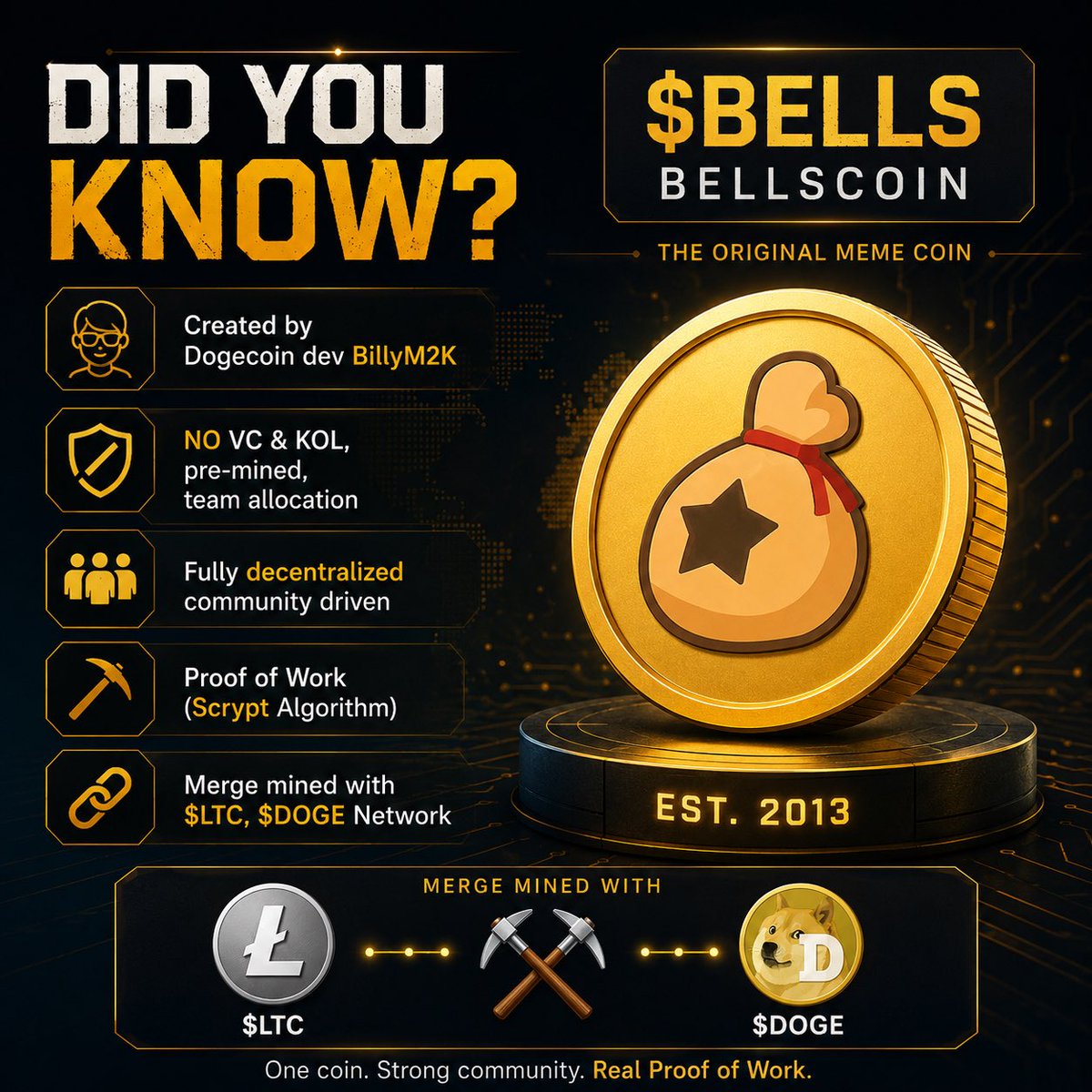
✅ Merge-mined with LTC & DOGE
Are you already earning BELLS with your Scrypt miners? 👇
Did you know? 🔔
$BELLS was launched by BillyM2K, the developer who later co-created Dogecoin.
Today, BELLS is a community-driven Proof-of-Work coin that can be merge-mined alongside $LTC and $DOGE, letting Scrypt miners earn extra rewards from the same hashpower.
Crypto's quietest renaissance is happening on UTXO chains.
While most of crypto Twitter argues about L2s, modular stacks, and account abstraction, one of the most overlooked places where real new work is happening is the Scrypt UTXO stack.
The signal is not one coin.
It is the stack forming around Scrypt UTXO chains:
→ Revived chains: Bellscoin came back and now has BEL-20 / Bellinals activity
→ Established chains: Dogecoin has AuxPoW security and Doginals / DRC-20
→ New chains: Pepecoin chose native Scrypt PoW instead of becoming another token contract
→ Mining layer: LTC merged-mining pools are becoming the hashpower layer for DOGE, BELLS, PEP and more
→ App layer: wallets, marketplaces, inscribers, APIs and indexers are being built for these assets
This is not the usual "next chain" story.
It is old architecture getting used in new ways.
What is actually shipping on these chains right now:
→ Inscriptions: on-chain content without smart contracts
→ Inscription-based token standards: BEL-20, DRC-20, PRC-20
→ Wallet UX for inscription-aware UTXO flows
→ Marketplaces and indexers for native PoW assets
→ Merged mining as a working security model
→ A builder scene taking Scrypt UTXO chains seriously again
The flash is somewhere else.
The work is here.
@coingecko $BELLS aka #BELLSCOIN special made by @BillyM2k 8 days before $DOGE created. (This #Memecoin PoW potential up 24400x)
Study at https://t.co/mY5y2yYPa9