We are an international company of developers that specializes in creating FinTech, Blockchain, RWA and startups from the zero stage.
MBA #00735-1-11563
Welcome to our world of innovative solutions!
Today we decided to show you a little bit of the inner workings and talk about the key development steps that will help turn your idea into a successful project. 📈
Ready? 🚀
Read more in the cards
Tokenization is not a blockchain problem.
It's a system design problem.
And most projects fail because they start from the wrong side.
Recently we worked with a client designing a Web3 investment platform built around real-world financial assets.
At first glance, the idea looked simple.
Bring traditional investment opportunities into a blockchain ecosystem.
Add a token.
Add liquidity.
Add a dashboard.
Done.
Except it doesn’t work like that.
The real challenge
When traditional finance meets Web3, you are suddenly dealing with two completely different systems.
On one side:
• legal ownership structures
• operational partners
• regulatory constraints
• real-world financial data
On the other:
• smart contracts
• token liquidity
• DeFi users
• on-chain transparency
You can’t simply “put assets on chain”.
You need to design the bridge between these two worlds.
Our approach
Instead of starting with the token, we started with the architecture.
The system was designed as three connected layers:
Asset layer
Real-world assets managed through operational structures.
Legal layer
Corporate entities coordinating capital flows and compliance.
Web3 layer
Smart contracts, token infrastructure and investor dashboards.
Only when these layers align does tokenization actually work.
The key insight
Tokenization is not about issuing tokens.
It’s about building the infrastructure that connects real assets with digital markets.
Without aligning:
• the asset model
• the legal structure
• the blockchain architecture
even the best tokenomics will eventually fail.
The real work in tokenization doesn’t start with the token.
It starts with system architecture.
And this is where most tokenization projects break.
What do you think is the hardest part of RWA today?
#Tokenization #RWA #Web3Infrastructure #DeFi #Blockchain
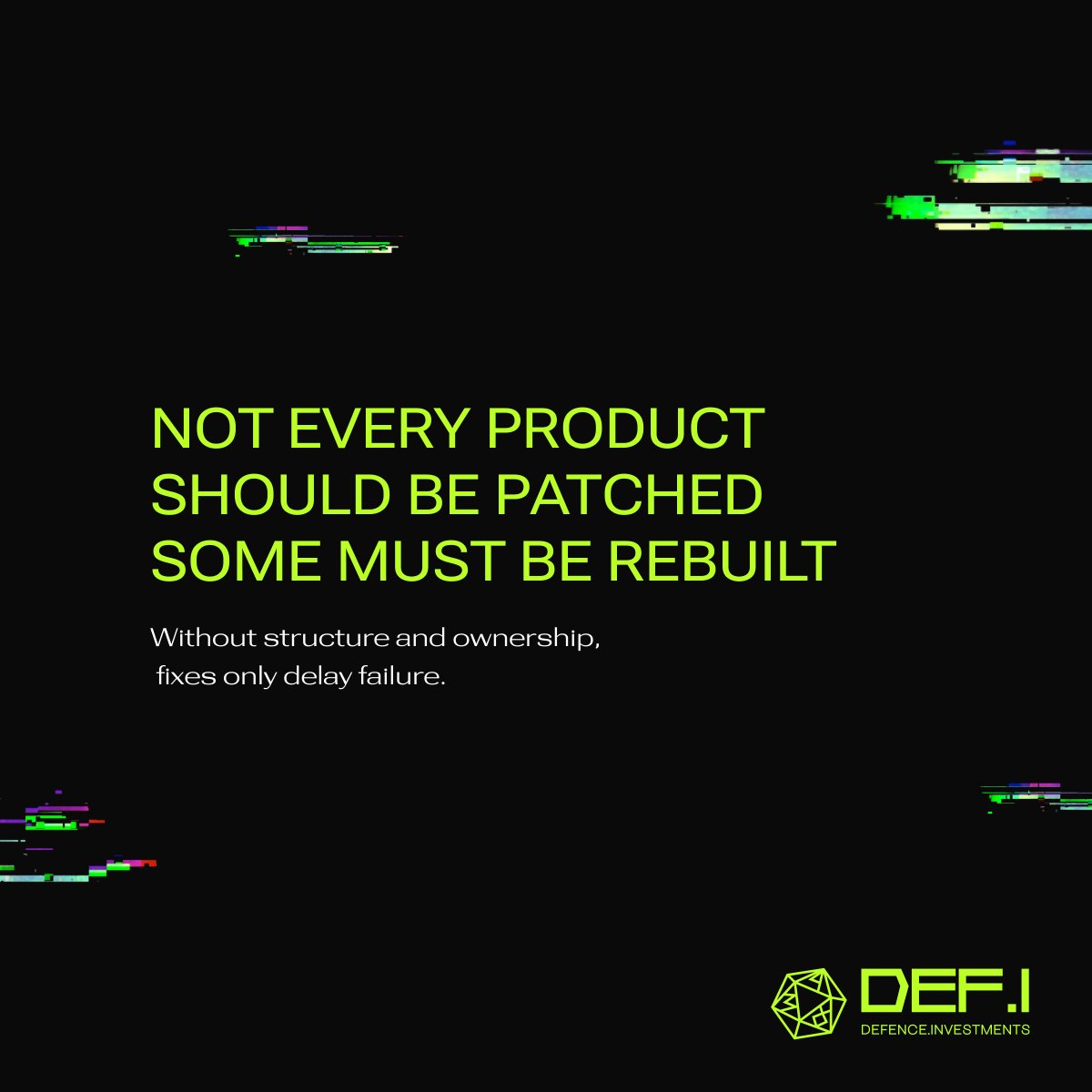
NOT EVERY PRODUCT SHOULD BE PATCHED.
SOME MUST BE REBUILT.
When a project is already in crisis, adding more developers rarely solves the problem.
More code doesn’t fix broken foundations.
Rebuilding starts with clarity, not manpower.
Our typical reboot process looks like this:
1. Audit reality
What actually works? What’s demo-only? What can’t be maintained?
2. Define the business golden path
The smallest flow that proves value and can be measured.
3. Cut over-engineering
If the market isn’t validated, complexity is a liability.
4. Re-architect for evolution
Simple structure first. Scalable path later.
5. Stabilize ownership
So the product doesn’t depend on one person.
And yes, sometimes we say no.
If a system was built without structure, without transferability, and without clear ownership, patching it only delays the inevitable.
Rewriting from scratch can be the cheaper decision.
For founders and investors:
Would you rather spend weeks auditing properly — or months trying to fix something that was never designed to scale?
Some projects don’t fail in production. They fail before launch.
We regularly see teams coming to us with a product that is “almost ready” but stuck for months. No release. No traction. Just rising costs and growing frustration.
In most cases, the issue is not a single bug or a missing feature.
It’s a pattern:
- Delivery is driven by tasks, not by business outcomes
- Teams build for “perfect” instead of “real”
- Architecture is over-engineered before the market is even validated
- Development becomes the goal, not a tool
This creates the first real death valley: you invest heavily, but you still haven’t tested distribution, pricing, or retention. You don’t even know if the product should exist.
Our rule is simple: early-stage software must be business-first. Clean, safe, but not overbuilt.
If you’re building right now, what blocks you more today: tech decisions or business clarity?
#Web3 #Tokenization #DeFi #ProductStrategy #StartupExecution
Most digital asset initiatives don’t fail at the pilot stage.
Pilots usually work.
Demos look good.
Everyone is aligned while the scope is small.
Problems start when teams try to move from pilot to production.
That transition exposes things the pilot was never designed for.
From what we see working inside tokenization, RWA, and investment platforms, projects usually break in the same places:
• Pilots built without a real operating model
• No clear ownership between tech, ops, risk, and compliance
• MVP decisions that block scalability, security, or reporting later
None of this feels critical during a pilot.
All of it becomes critical the moment real assets, real users, and real responsibility appear.
This is exactly the point where teams often need more than development capacity.
They need a partner who understands how digital asset systems are operated, governed, and defended in production.
Someone who designs architecture around accountability, lifecycle management, and long-term cost, not just around features and speed.
Production is not “the next phase”.
It’s a different design problem.
That’s why moving from pilot to production is the hardest part of digital assets.
And why many projects stall exactly there.
If you’ve already been through a pilot,
what was the first thing that broke when you tried to scale it into production?
Everyone talks about regulation when it comes to tokenization.
But in real projects, regulation is rarely what breaks things.
Execution does.
We’ve seen tokenized products fail not because the rules changed,
but because systems were built for demos, not for long term operation.
Architecture that looks clean on slides but can’t be maintained.
Tokens launched before roles, processes, and accountability are defined.
“MVP-first” decisions that feel cheap early, then quietly explode total cost of ownership.
None of this shows up in pitch decks.
All of it shows up months later.
Rewrites.
Security gaps.
Downtime.
Lost momentum.
Expensive fixes that could have been avoided with better design upfront.
Reliability, economic efficiency, and scalability don’t appear later by magic.
They are either designed into the system, or paid for over time.
That’s why in tokenization, execution risk is the real risk.
Everything else just amplifies it.
If you’re building or restructuring a tokenized product,
ask yourself one simple question:
Are you optimizing for launch,
or for operating this system when the hype is gone?
Tokenized public-market RWAs grew from $5.6B to $16.7B in 2025.
US Treasuries alone reached ~$9B, becoming the dominant on-chain asset class.
That doesn’t signal maturity.
It signals how early this market still is.
Most RWA initiatives stop at issuance. Assets get tokenized, but liquidity is thin, yield is fragmented, and capital efficiency remains low. Issuance without markets. Tokens without secondary liquidity. Assets that sit on-chain instead of working as capital.
At Secura, we believe tokenization is only step one.
Our focus is not only tokenizing assets, but building a full market around them — where tokenized public-market and real-world assets can be issued, acquired, and deployed as productive, yield-generating capital. A marketplace with integrated yield and DeFi mechanisms, designed from day one for LP-scale capital.
As RWAs move from tens of billions to hundreds of billions, value won’t be captured by tokenization alone. It will sit with platforms that turn assets into markets and capital into performance.
$16.7B proves the market exists.
We’re building for what comes next.
As we step into 2026, we want to say thank you — first of all to our clients.
To the founders, teams, and partners who trusted us not just with tasks, but with real responsibility for outcomes.
Execution, architecture, and clarity matter more than noise or promises.
We’re open to new conversations in 2026 — with teams and partners focused on long-term results.
— Defence Investments
CEO QUESTION #1
What’s the difference between task-based development
and an architectural approach?
It’s not about code.
It’s about responsibility.
Executing tasks solves today’s problem.
Architecture takes responsibility for what happens next.
That difference defines whether a product scales — or gets rewritten.
Defence Ventures is opening a new startup intake.
We’ll select up to 5 early-stage startups and invest execution first — not cash at the beginning.
What we provide:
• production-ready infrastructure
• development team
• MVP product design
• controlled scope & predictable delivery
The goal:
launch a working product, test the market, reach traction — and move to the next funding stage.
On later rounds, we cash out part of our execution investment and keep exposure in equity or tokens.
If execution is your main bottleneck:
👉 Drop a short intro + link to your startup in the replies.
We’ll review and reach out in DM if it’s a fit.
Most early-stage startups don’t fail because of ideas.
They fail because execution burns capital before traction appears.
That’s why fundraising feels harder today.
Investors don’t avoid innovation — they avoid execution risk.
At Defence Ventures, we help founders cross the gap between idea and traction by investing with execution first, not cash.
If you’re building early-stage and feel stuck before fundraising, let’s talk.
Most “tokenization” today is just a digital wrapper.
Real tokenization is infrastructure.
Legal → financial mechanics → architecture → custody → UX.
If one layer breaks, the product fails.
At Defence Investments we use an architecture-first approach to tokenizing financial assets, RWA and structured products — designing legal, technical and economic logic before code.
Done right, tokenization unlocks scalable, compliant capital flows.
Which layer do you think is the hardest to get right — legal, financial, or technical?
Most teams spend 9–12 months building investment infrastructure and still end up with something they can’t scale.
The real bottleneck isn’t demand. It’s architecture.
DEF.I lets asset managers launch investment products in weeks, not years — with modular, institutional-grade rails.
For those who want the details:
DEF.I provides a ready investment infrastructure that asset managers can customize without rebuilding the core.
Core modules include:
• multi-asset wallet
• investment product marketplace
• yield, staking & structured strategies
• portfolio dashboards
• admin panel for product & client management
Optional institutional modules:
• RWA tokenization rails
• custom liquidity pools
• launchpad & fundraising tools
• DeFi integrations for automated yield
DEF.I gives teams a scalable architecture from day one — so they can focus on products, not engineering.
Ethereum’s Fusaka upgrade isn’t about new features — it’s about stronger foundations.
Higher data capacity, lower node load (PeerDAS) and more efficient L2 operations mean one thing:
the infrastructure is finally aligning with institutional needs.
For RWA, tokenization and DeFi products this unlocks:
— more reliable architectures
— lower operating costs
— scalable multi-asset rails
— stronger transparency for compliance-heavy environments
Quiet upgrades shape the future more than loud narratives.
At Defence Investments, we build where these shifts matter most —
at the architecture layer.
@ethereum
@ethereum Ethereum keeps scaling and this upgrade matters for builders.
Lower DA costs + more predictable L2 fees = better RWA, DeFi and institutional products.
We’re already designing next-gen platforms on top of these rails.
RWA isn’t about tokenizing assets.
It’s about aligning three worlds: legal, architecture, and UX.
Most failures happen when these layers are built in isolation:
– Legal sets rules the tech can’t implement
– Architecture doesn’t match real risk and value flows
– UX tries to serve Web2 and Web3 users with the same interface
The right sequence: legal → architecture → UX → development.
At Defence Investments, we design RWA products by:
• Making legal constraints implementable
• Building stable, transparent financial logic
• Hiding Web3 complexity (wallet abstraction, gasless UX)
• Giving users trust through clear on-chain visibility
RWA products succeed when complexity becomes invisible — and the system behaves exactly as users expect.
CZ believes that DEX trading volumes will eventually surpass CEX 📈
He highlighted the potential of RWA but warned about challenges with regulation, KYC, and liquidity.
In his view, the next major breakthrough in crypto may come from AI, RWA, and stablecoins 💲
@cz_binance@BNBCHAIN@yzilabs
We received an MBA license from @BoredApeYC
We also have excellent Quills! Why doesn't @Somnia_Network create its own MBA = (MBS/MBQ) equivalent to increase the significance of the main blockchain collection?! We would be the first to apply!
gSomnia
Stay with Quills! @quillsadventure
We are officially licensed Made by Apes 🎉
https://t.co/T9GzZbJzqF is a team of specialists with 10 years of experience in fintech, blockchain and AI. We have 100+ projects under our belt and 500+ million TVL in clients.
We offer services such as:
- Creating NFTs collections, NFT platforms and marketplaces
- Fintech and blockchain development (DeFi, RWA asset tokenization, investment platforms).
- White-label solutions: exchanges, wallets, marketplaces, crowdinvesting.
- Market making, listings, tokenization.
- AI-solutions and business process automation.
- Secure communication channels.
MBA license - another step to new projects and opportunities. 🚀
https://t.co/0yBtPxJlrS
@BoredApeYC@yugalabs