$SYRUP is down over 17% in the last 7 days.
The fact is, the market generally has been bearish, but price only tells part of the story.
To understand what’s happening on-chain, I pulled Ethereum and Base DEX data to see trader behavior during the selloff.
Here’s what the numbers say:
Over the last 7 days,
• 170 unique traders traded $SYRUP on-chain
• 3,547 transactions were executed
• $894.6K worth of $SYRUP was bought
• $429K worth of $SYRUP was sold
At first glance, the price decline suggests sellers were in control.
But trading activity suggests otherwise.
Despite the drawdown, buy volume was more than 2x sell volume, with buyers accumulating nearly $465K more $SYRUP than sellers distributed.
The busiest day saw:
• 68 unique traders
• 812 transactions
• Nearly $200K in buy volume
That’s not what a disappearing market looks like.
Based on the observed trading behavior, here’s what the data suggests:
1.Traders remained engaged throughout the correction.
2.Buyers continued accumulating despite market weakness.
3.Trader participation levels suggest sustained interest in $SYRUP.
Of course, one week doesn’t define a trend.
But if trader participation continues to hold while buy volume consistently outpaces sell volume, it could signal growing confidence on @maplefinance’s solid fundamentals beneath the surface.
Link to dashboard:
https://t.co/7wQdIjdF60
@cryptopanda_01@max_great58394@maplefinance This is a clear indication that onchain analysis gives a clear picture of what is going on than price action alone.
Still bullish on $SYRUP
Lately, the crypto market has been stalling.
More like ranging.
One moment it looks like we’re about to break resistance, the next we’re staring at red candles again.
So the big question on everyone’s mind is:
Are we witnessing the early stages of a bull run, or just another bull trap?
At the same time, the crypto industry has its eyes locked on the CLARITY Act bill — legislation many believe could become one of the biggest catalysts for institutional adoption and fresh capital inflow into crypto.
With talks of trillions potentially entering the market over time, sentiment is heating up again.
But what does all of this actually mean for the market right now?
Join us this Friday as we break down:
• Current market direction
• Bull trap vs bull run signals
• The impact of the CLARITY Act bill
• Narratives worth paying attention to
• @maplefinance weekly alpha and key ecosystem updates
📍 X Space
🗓 Friday, 22/05
⏰ 6PM UTC+1
Hosted by myself and @Badmus2121, with seasoned speakers and analysts like @Pharmkev, @Bouyantflames and many more
Set your reminders, bring your hot takes, and come ready for real conversations and alpha 🫱🏽🫲🏾
Link in comments 👇🏽
GM legends.
Happy new week 🫱🏽🫲🏾
A new week always seems to come with fresh energy, hope, and new opportunities.
I pray you hold on to that all through the week.
Rooting for you.
Maple’s yield product just found a new home!
For a long time, access to reliable, high-quality yield was mostly limited to large financial players.
Everyday onchain users were largely left out.
But guess that is changing now with @maplefinance’s latest update.
Maple’s yield-bearing dollar product, syrupUSDT, just went live to over 10million users on @inkonchain.
Now, users and builders on Ink can access Maple’s yield product directly inside the apps they already use.
Making it easier to:
• Earn passive yield on their USDT
• Use that yield across DeFi apps and strategies
• Access institutional-grade yield in a simpler way
And this is bigger than just another deployment.
It shows how syrupUSDT is evolving beyond a simple yield product into infrastructure developers can build with.
From day one, builders on Ink can integrate it into lending, borrowing, and other DeFi applications.
And the best part?
A dedicated incentives and rewards program will also be launching soon to celebrate the integration.
🗣️I wouldn’t miss this for anything. You shouldn’t too.
Start here 🔗 https://t.co/KFnoV1MMIQ
On July 18, 2025, the GENIUS Act was signed into law, opening up endless possibilities for stablecoin yields.
But with the CLARITY Act now underway, we’re about to witness an entirely different phase of growth.
Because the next evolution of DeFi won’t just be about launching more stablecoins.
It’ll be about making yield-bearing stablecoins actually usable across the onchain economy.
And while most people are still focused on price action and narratives, some protocols are already building for that future.
One of them is @maplefinance .
Maple just rolled out a new integration framework for builders.
With this new feature, Maple is making syrupUSDC and syrupUSDT easier to use across different DeFi apps, instead of being stuck in just one place.
Developers can now integrate Maple’s institutional yield rails directly into:
•wallets
•lending markets
•treasury platforms
•aggregators
•and other DeFi protocols
The bigger unlock here is capital efficiency.
And with this update, maple is determined to retain the lead as the largest institutional onchain asset managers.
This past few weeks have been a handful for me.
Family. Life. Work (building my own martial arts brand) and a lot more.
But what really pushed me to make this tweet was realizing I was almost getting comfortable with mediocrity.
God forbid bad thing!
That changes this week though.
I’m showing up and showing out.
In between all the chaos, I still managed to write a report for my upcoming @AnalyticSages Cohort 7 Demo Day - more like a project defense day - focused on the state of Aave V3 over a one-year timeframe.
Looking back on my journey in blockchain data analytics,
I’m reminded that with the right mindset, guidance, and mentorship, achieving anything becomes possible.
Data tribe: @AnalyticSages
🔗 https://t.co/qdwOxeVMgs
If the Bitcoin whitepaper started with “trust me,” would anyone have even cared?
Probably not.
That is because transparency is what blockchain technology was built for - one of the reasons Bitcoin was made open source.
Yet today, many DeFi projects still ask users for blind trust without real transparency.
But certainly not @maplefinance.
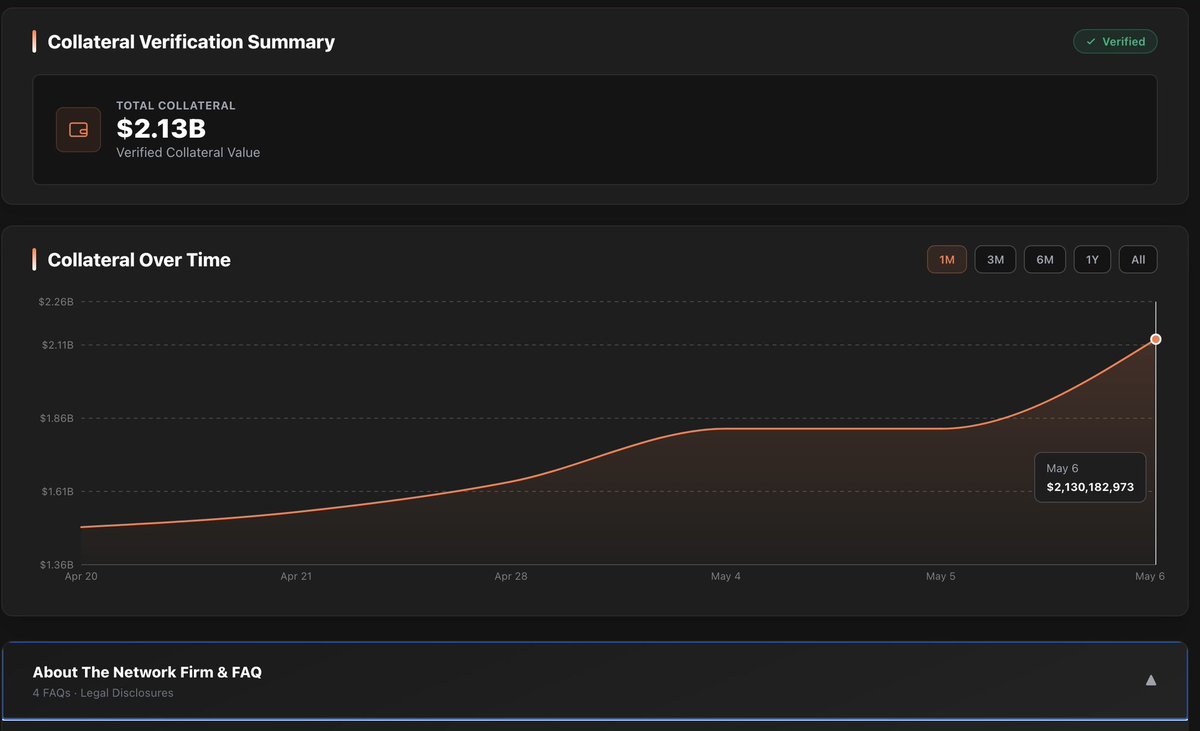
Maple just launched Proof of Reserves for syrupUSDC and syrupUSDT, giving users a way to independently verify that the assets backing these products are actually there.
JSYK, Proof of Reserves simply means you no longer have to rely only on claims.
You can verify:
• loans are fully overcollateralized
• assets are held with approved custodians
• reserves are being checked in real time by a third party
And the best part is that it’s publicly accessible directly on the Maple app.
If you’re looking for a trustworthy DeFi platform for sustainable yields, this is the kind of update worth paying attention to.
Most DeFi yields look flashy at first glance until the question of sustainability and risk management is raised.
That’s usually where things start to separate.
Because behind a lot of high APYs are token emissions, looping strategies, and structures built not to last.
For @maplefinance , it’s different.
It’s credit yield structure.
Instead of positioning yield around incentives that eventually fade out,
Maple is doubling down on something more fundamental:
real credit activity powered solely by institutional borrowers.
In simple terms, the yield comes from institutional borrowers paying for access to capital — not from protocols printing rewards to keep liquidity around.
And that distinction is how Maple has been consistent through thick and thin.
GM legends.
Happy new week.
Don’t stop showing up and believing, your big win is just a step away.
God will crown your efforts with success.
Let’s win this week 🫱🏽🫲🏾.
$175M entered @maplefinance from lenders in a single day!
But the bigger picture makes it even more interesting.
Over the past year, Maple’s lending deposits climbed aggressively, peaking above $5B.
Even with recent market volatility and capital rotation, the protocol has managed to hold onto billions in deposited liquidity.
The latest inflow suggests lenders are still comfortable parking serious capital inside Maple’s ecosystem,
especially as demand grows for structured, transparent onchain yield products.
Maple’s positioning is starting to look very intentional now:
➺ build during uncertainty,
➺ focus on sustainable credit markets,
➺ become one of the few DeFi platforms institutions can actually size into comfortably.
If these deposit trends continue, Maple won’t just be seen as another lending protocol,
it’ll keep strengthening its place as core onchain financial infrastructure!
Less than a year ago, @maplefinance made a bold move onto Solana.
No one saw that coming.
It was a simple bet:
Expanding its product to a high-performance low-cost L1 chain.
For syrupUSDC, Solana’s strengths mean:
➥ capital can move quickly
➥ yields can be accessed without high costs
➥ users can interact more frequently without friction
Today, that bet crossed a milestone:
$2B+ in bridge volume on syrupUSDC.
Maple didn’t reinvent anything for Solana.
They brought what already worked:
a yield-bearing dollar asset backed by real lending activity.
No incentive gimmicks. No complexity.
Just yield the way institutions love it.🥞🥞
Maple is trending, again!
Just last week, @maplefinance hit the timeline with a $1B total inflow milestone.
While most protocols are slowing down because markets conditions are getting shaky,
Maple seems to lean in - quietly stacking progress in places most people aren’t even watching.
And now a new milestone achievement!
First, it was the $1B+ inflows through syrupUSDC and syrupUSDT into @aave — a number that was achieved from sustained capital choosing Maple’s stable yields.
Then almost immediately after, another update drops:
A new $100M institutional loan backed by Bitcoin.
moments like this don’t just happen overnight.
Instead of disappearing when things get bad, Maple refines how they operate, tighten risk, and focus on borrowers that can actually hold up under pressure.
Now you’re seeing the outcome of that:
→ Yield products scaling into the largest DeFi lending markets
→ Institutional-sized loans being issued consistently
→ Capital flowing in large sums
For what it’s worth, Maple has firmly established itself as a leading institutional credit platform,
and it’s not just leading, it’s sustaining that position.