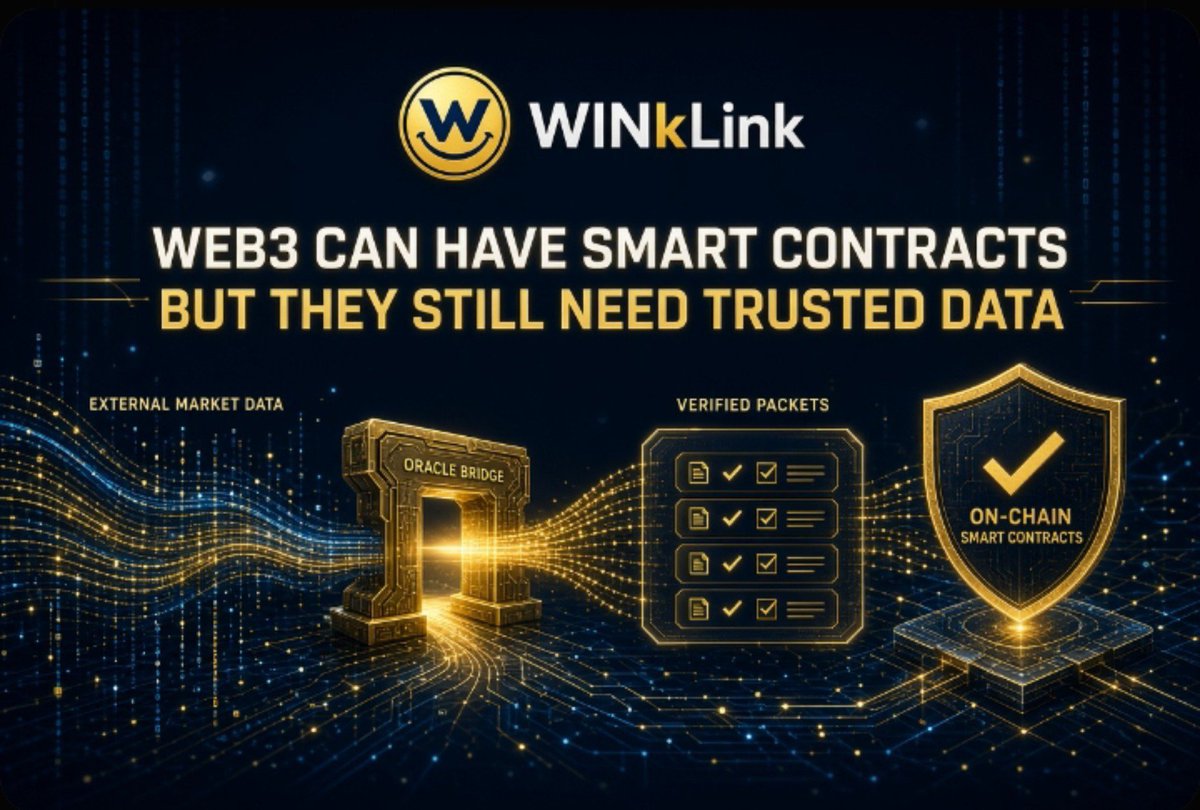
🔗 𝗪𝗲𝗯𝟯 𝗖𝗮𝗻 𝗛𝗮𝘃𝗲 𝗦𝗺𝗮𝗿𝘁 𝗖𝗼𝗻𝘁𝗿𝗮𝗰𝘁𝘀 𝗕𝘂𝘁 𝗧𝗵𝗲𝘆 𝗦𝘁𝗶𝗹𝗹 𝗡𝗲𝗲𝗱 𝗧𝗿𝘂𝘀𝘁𝗲𝗱 𝗗𝗮𝘁𝗮
When people think about blockchain infrastructure, they usually think about networks, smart contracts, wallets, and applications.
But underneath many of those applications is another critical layer:
𝗗𝗮𝘁𝗮.
A DeFi protocol can execute its rules perfectly, but those rules are only as useful as the information being fed into them.
Consider a lending protocol.
To determine collateral value, borrowing limits, or whether a position should be liquidated, the smart contract needs current market information.
The contract itself cannot simply browse an exchange, read an external API, or check what is happening in the real world.
It needs a reliable way to bring that information on-chain.
📡 𝗧𝗵𝗶𝘀 𝗜𝘀 𝗪𝗵𝗲𝗿𝗲 𝗢𝗿𝗮𝗰𝗹𝗲𝘀 𝗖𝗼𝗺𝗲 𝗜𝗻
Oracle infrastructure acts as a connection between information outside the blockchain and applications operating on-chain.
For example:
External Information → Oracle Layer → Smart Contract → On-Chain Action
That connection can support applications involving:
🔹 Asset and market data
🔹 Lending and borrowing
🔹 Stablecoins
🔹 Automated smart contracts
🔹 Gaming and randomness
🔹 External API integrations
🔹 AI-powered applications
Within the TRON ecosystem, WINkLink provides this type of oracle infrastructure, helping blockchain applications access data beyond what is natively available on-chain.
🛡️ 𝗗𝗮𝘁𝗮 𝗖𝗼𝗻𝗻𝗲𝗰𝘁𝗶𝘃𝗶𝘁𝘆 𝗜𝘀𝗻’𝘁 𝗘𝗻𝗼𝘂𝗴𝗵
Getting information onto a blockchain is only part of the challenge.
The bigger question is:
𝗖𝗮𝗻 𝗧𝗵𝗲 𝗔𝗽𝗽𝗹𝗶𝗰𝗮𝘁𝗶𝗼𝗻 𝗥𝗲𝗹𝘆 𝗢𝗻 𝗧𝗵𝗮𝘁 𝗜𝗻𝗳𝗼𝗿𝗺𝗮𝘁𝗶𝗼𝗻?
If a financial application receives inaccurate or manipulated inputs, even flawless smart-contract code can produce an undesirable outcome.
That is why decentralized oracle infrastructure matters.
The goal isn't merely to transport data.
It is to provide applications with a more reliable connection to external information without making a single centralized source the entire point of dependence.
🤖 𝗔𝗜 𝗠𝗮𝗸𝗲𝘀 𝗧𝗵𝗶𝘀 𝗣𝗿𝗼𝗯𝗹𝗲𝗺 𝗘𝘃𝗲𝗻 𝗠𝗼𝗿𝗲 𝗜𝗺𝗽𝗼𝗿𝘁𝗮𝗻𝘁
As AI and blockchain become increasingly interconnected, the data layer becomes even more significant.
AI systems can analyze and make decisions.
Smart contracts can execute predefined rules.
But both depend on the information available to them.
This creates an increasingly important infrastructure stack:
🧠 AI → Intelligence
🔗 WINkLink → Data Connectivity
⛓️ TRON → On-Chain Execution
Each layer solves a different problem.
Together, they can enable applications that don't operate solely on information generated inside the blockchain, but can respond to external conditions as well.
🌐 𝗧𝗵𝗲 𝗜𝗻𝗳𝗿𝗮𝘀𝘁𝗿𝘂𝗰𝘁𝘂𝗿𝗲 𝗨𝘀𝗲𝗿𝘀 𝗥𝗮𝗿𝗲𝗹𝘆 𝗦𝗲𝗲
Most users won't think about oracle infrastructure when they swap tokens, deposit collateral, or interact with an automated application.
That is often the sign of infrastructure doing its job.
The user sees the application.
Behind it are networks, smart contracts, data sources, validators, and infrastructure working together to make that experience possible.
As Web3 becomes more automated and increasingly connected to AI and real-world information, trusted data becomes a foundational requirement rather than an optional feature.
Smart contracts provide execution.
Oracles provide connectivity.
Reliable data gives decentralized applications the context they need to act.
@WinkLink_Oracle@justinsuntron@trondao
#TRONEcoStar #TRON #WINkLink #Oracles #DeFi #AI #Web3 #Blockchain
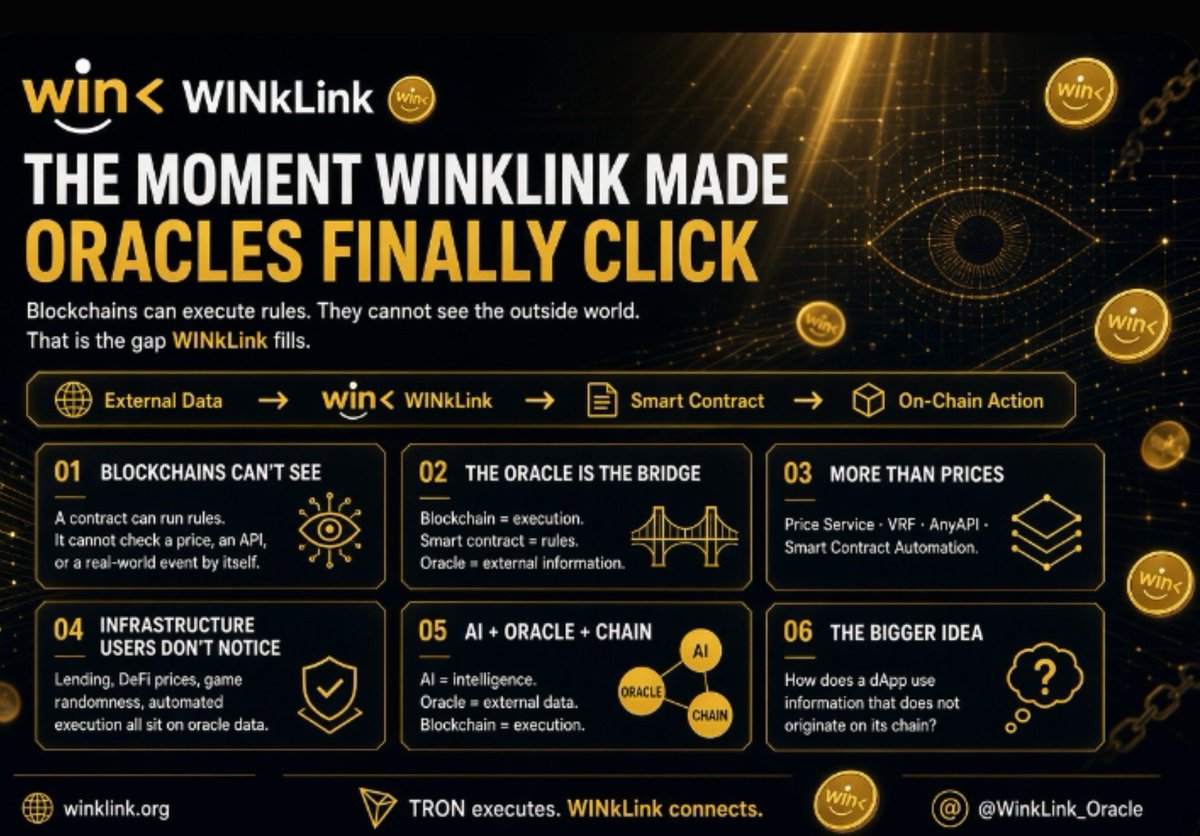
𝗧𝗛𝗘 𝗠𝗢𝗠𝗘𝗡𝗧 𝗪𝗜𝗡𝗞𝗟𝗜𝗡𝗞 𝗠𝗔𝗗𝗘 𝗢𝗥𝗔𝗖𝗟𝗘𝗦 𝗙𝗜𝗡𝗔𝗟𝗟𝗬 𝗖𝗟𝗜𝗖𝗞 𝗙𝗢𝗥 𝗠𝗘 🔗👁️
When I first came across crypto oracles, they sounded more complicated than they really were.
Then one simple idea made everything click:
Blockchains can execute rules, but they don't naturally know what is happening outside the blockchain.
A smart contract can follow its instructions perfectly, but it cannot independently check a market price, retrieve information from an external API, or generate verifiable randomness.
It needs a connection to external information.
That is where @WinkLink_Oracle fits into the TRON ecosystem. 🧵👇
🔹 𝟭. 𝗔 𝗕𝗟𝗢𝗖𝗞𝗖𝗛𝗔𝗜𝗡 𝗖𝗔𝗡 𝗘𝗫𝗘𝗖𝗨𝗧𝗘 — 𝗕𝗨𝗧 𝗜𝗧 𝗖𝗔𝗡'𝗧 𝗡𝗔𝗧𝗜𝗩𝗘𝗟𝗬 𝗦𝗘𝗘
Think of a smart contract as a highly precise machine.
Give it the required input, and it executes its programmed rules.
But the blockchain itself cannot simply reach outside its environment and ask:
➠ What's the current asset price?
➠ Did a particular real-world event happen?
➠ What does an external API report?
➠ Can I generate a verifiable random outcome?
WINkLink is designed to bridge that gap by connecting smart contracts with off-chain data through decentralized oracle infrastructure.
🔹 𝟮. 𝗧𝗛𝗘 𝗢𝗥𝗔𝗖𝗟𝗘 𝗕𝗘𝗖𝗢𝗠𝗘𝗦 𝗧𝗛𝗘 𝗖𝗢𝗡𝗡𝗘𝗖𝗧𝗜𝗢𝗡
The basic flow becomes much easier to understand:
External Data → WINkLink → Smart Contract → On-Chain Action
The contract still controls the rules.
WINkLink provides a way for relevant external information to reach that contract.
That distinction is important:
Blockchain = execution
Smart contract = rules
Oracle = external information
🔹 𝟯. 𝗜𝗧'𝗦 𝗡𝗢𝗧 𝗝𝗨𝗦𝗧 𝗔𝗕𝗢𝗨𝗧 𝗣𝗥𝗜𝗖𝗘𝗦
Oracle infrastructure has applications beyond basic price feeds.
WINkLink currently describes four core services:
➠ Price Service — financial data from multiple sources
➠ VRF — verifiable random numbers
➠ AnyAPI — connections to custom external data sources
➠ Smart Contract Automation — execution when predefined conditions are met
That opens the door to applications across DeFi, gaming, automation and other smart-contract systems.
🔹 𝟰. 𝗧𝗛𝗘 𝗜𝗡𝗙𝗥𝗔𝗦𝗧𝗥𝗨𝗖𝗧𝗨𝗥𝗘 𝗨𝗦𝗘𝗥𝗦 𝗗𝗢𝗡'𝗧 𝗡𝗢𝗧𝗜𝗖𝗘
Users usually see the application, not the infrastructure underneath it.
A lending protocol updates collateral conditions.
A DeFi application references a market price.
A blockchain game needs a random outcome.
An automated contract executes after a predefined condition is satisfied.
The experience looks simple.
Behind it, however, the application may depend on external information being delivered into the on-chain environment.
That's why oracle infrastructure can be easy to overlook while still being fundamental to how many Web3 applications function.
🔹 𝟱. 𝗧𝗛𝗜𝗦 𝗕𝗘𝗖𝗢𝗠𝗘𝗦 𝗘𝗩𝗘𝗡 𝗠𝗢𝗥𝗘 𝗜𝗡𝗧𝗘𝗥𝗘𝗦𝗧𝗜𝗡𝗚 𝗪𝗜𝗧𝗛 𝗔𝗜
AI agents can analyze information and make decisions.
But intelligent decisions still depend on the information being available to the system.
That creates an interesting architecture:
AI → Intelligence
Oracle → External Data
Blockchain → Execution
An AI agent could determine what action should happen, an oracle layer could provide relevant external information, and a smart contract could execute according to predefined rules.
That is one possible building block for more autonomous Web3 applications.
🔹 𝟲. 𝗧𝗛𝗘 𝗕𝗜𝗚𝗚𝗘𝗥 𝗜𝗗𝗘𝗔
The important thing about WINkLink isn't simply that it "provides data."
It helps solve a fundamental limitation:
How does a decentralized application interact with information that doesn't originate on its blockchain?
TRON provides the execution environment.
@WinkLink_Oracle@justinsuntron
#WINkLink #WIN #Oracle #AI #DeFi #SmartContracts #Web3 #Blockchain #TRON #TRONEcoStar
⚙️ 𝗧𝗥𝗢𝗡’𝘀 𝗥𝗲𝘀𝗼𝘂𝗿𝗰𝗲 𝗠𝗼𝗱𝗲𝗹 𝗖𝗵𝗮𝗻𝗴𝗲𝘀 𝗛𝗼𝘄 𝗬𝗼𝘂 𝗧𝗵𝗶𝗻𝗸 𝗔𝗯𝗼𝘂𝘁 𝗧𝗿𝗮𝗻𝘀𝗮𝗰𝘁𝗶𝗼𝗻 𝗖𝗼𝘀𝘁𝘀
When people use a blockchain, they usually focus on the transaction itself.
Send TRX.
Swap tokens.
Stake.
Interact with a DeFi protocol.
Transfer a stablecoin.
But underneath every interaction, the network is consuming resources to process what you asked it to do.
TRON approaches this through two important resource types:
Bandwidth and Energy.
Understanding the difference can help users make better decisions about how they interact with the network.
𝗕𝗮𝗻𝗱𝘄𝗶𝗱𝘁𝗵 = 𝗧𝗿𝗮𝗻𝘀𝗮𝗰𝘁𝗶𝗼𝗻 𝗗𝗮𝘁𝗮
Bandwidth is primarily associated with the data contained in a transaction.
This matters for activities such as:
➜ Sending TRX
➜ Voting
➜ Certain staking actions
➜ Basic on-chain transactions
Rather than treating every basic transaction as a simple cash fee, TRON's resource model allows users to think about the amount of network resources their transaction consumes.
TRON also provides mechanisms for obtaining Bandwidth, including through staking, which can reduce the need to pay a separate fee for every basic transaction when sufficient resources are available.
𝗘𝗻𝗲𝗿𝗴𝘆 = 𝗦𝗺𝗮𝗿𝘁 𝗖𝗼𝗻𝘁𝗿𝗮𝗰𝘁 𝗖𝗼𝗺𝗽𝘂𝘁𝗮𝘁𝗶𝗼𝗻
Energy serves a different purpose.
It represents the computational resources required to execute smart contracts.
That makes Energy particularly relevant when interacting with:
➜ TRC-20 tokens
➜ DeFi protocols
➜ DEXs and swaps
➜ Lending and borrowing markets
➜ NFT applications
➜ Other smart-contract-based dApps
A simple transfer and a complex smart-contract interaction aren't necessarily equivalent from the network's perspective.
The computational work required can differ significantly.
𝗪𝗵𝘆 𝗧𝗵𝗶𝘀 𝗠𝗮𝘁𝘁𝗲𝗿𝘀 𝗙𝗼𝗿 𝗨𝘀𝗲𝗿𝘀
This distinction changes the way transaction costs can be understood.
Instead of asking only:
“How much will this transaction cost?”
Users can ask:
➜ What type of transaction am I making?
➜ Does it require smart-contract execution?
➜ How much Bandwidth is needed?
➜ How much Energy could the interaction consume?
➜ Should I obtain resources through staking?
➜ Would renting Energy make more sense for my usage?
That turns transaction management into a resource-allocation decision.
𝗪𝗵𝗲𝗿𝗲 𝗘𝗻𝗲𝗿𝗴𝘆 𝗥𝗲𝗻𝘁𝗮𝗹 𝗙𝗶𝘁𝘀 𝗜𝗻
For users who interact with smart contracts frequently, Energy requirements can become an important part of their operating costs.
This is where Energy rental solutions such as those available through @DeFi_JUST can provide another option.
Instead of acquiring all the required Energy through staking, users can rent resources when they need them.
For someone making occasional transactions, that distinction may not matter much.
For users regularly interacting with DeFi, transferring TRC-20 tokens, or running repeated on-chain operations, resource management can become much more meaningful.
𝗧𝗵𝗲 𝗕𝗶𝗴𝗴𝗲𝗿 𝗜𝗱𝗲𝗮
TRON's resource model separates two different types of network demand:
Bandwidth → transaction data
Energy → smart-contract computation
That separation gives users a clearer framework for understanding where their network resources are being consumed.
And it creates multiple ways to manage those resources depending on how they use the network.
For casual users, that may simply mean understanding why different transactions behave differently.
For active users and applications, it can become part of broader cost and capital management.
As blockchain usage grows, scalability isn't only about processing more transactions.
It's also about making network resources understandable, accessible, and efficiently managed.
On TRON, understanding Bandwidth and Energy is therefore more than a technical detail.
It's part of learning how to use the network efficiently.
@DeFi_JUST@TronDao@justinsuntron
#TRONEcoStar #TRON #DeFi #Energy #Bandwidth #Web3 #Blockchain
🔐 𝗧𝗼𝗻𝗸𝗲𝗲𝗽𝗲𝗿 𝗕𝗲𝗰𝗼𝗺𝗲𝘀 𝗞𝗲𝗲𝗽𝗲𝗿 — 𝗔 𝗦𝗶𝗻𝗴𝗹𝗲 𝗪𝗮𝗹𝗹𝗲𝘁 𝗙𝗼𝗿 𝗠𝘂𝗹𝘁𝗶𝗽𝗹𝗲 𝗖𝗵𝗮𝗶𝗻𝘀
Tonkeeper is evolving into Keeper, expanding from a TON-focused self-custodial wallet into a broader multichain wallet.
With more than 77 million downloads, Keeper now supports assets across:
🔹 $TON
🔹 $BTC
🔹 $ETH
🔹 $TRX
🔹 $ARB
🔹 $BNB
🔹 USDT and other supported assets
And more networks are expected to follow.
➠ 𝗧𝗢𝗡 𝗥𝗘𝗠𝗔𝗜𝗡𝗦 𝗧𝗛𝗘 𝗛𝗢𝗠𝗘
The transition doesn't remove what made Tonkeeper useful on TON.
Jettons, NFTs, staking, TON DNS, and the in-wallet browser remain part of the experience.
The difference is that users can now access additional networks from the same wallet environment.
➠ 𝗪𝗵𝘆 𝗧𝗵𝗲 𝗡𝗲𝘄 𝗪𝗮𝗹𝗹𝗲𝘁?
TON uses a different key-generation scheme from the BIP-39/44 standards commonly used across EVM networks and other blockchain wallets.
That means TON and the newly supported networks cannot simply share one universal recovery phrase under the existing architecture.
Keeper therefore provides separate wallet functionality while bringing the supported networks together inside one application.
➠ 𝗖𝗿𝗼𝘀𝘀-𝗖𝗵𝗮𝗶𝗻 𝗦𝘄𝗮𝗽𝘀 𝗪𝗶𝘁𝗵𝗼𝘂𝘁 𝗧𝗵𝗲 𝗘𝘅𝘁𝗿𝗮 𝗙𝗿𝗶𝗰𝘁𝗶𝗼𝗻
Keeper also introduces cross-chain swaps directly inside the wallet.
Users can select the asset they have, choose the asset they want, and complete the swap without separately managing a bridge or installing another application.
The feature is built with @moonpay.
➠ 𝗧𝗥𝗢𝗡 𝗚𝗮𝘀 𝗕𝗲𝗰𝗼𝗺𝗲𝘀 𝗟𝗲𝘀𝘀 𝗢𝗳 𝗔 𝗕𝗮𝗿𝗿𝗶𝗲𝗿
One particularly useful feature for TRON users is gas handling.
Keeper says its Battery system can cover network fees on supported TON and TRON transactions.
That means users holding USDT on TRON can move their USDT without needing to separately hold TRX for transaction fees, subject to the wallet's supported Battery conditions.
For newcomers, this can remove one of the common friction points of using blockchain networks.
➠ 𝗠𝘂𝗹𝘁𝗶𝗰𝗵𝗮𝗶𝗻 𝗜𝘀 𝗕𝗲𝗰𝗼𝗺𝗶𝗻𝗴 𝗧𝗵𝗲 𝗡𝗼𝗿𝗺
The broader shift is important.
Crypto users increasingly interact with multiple networks rather than staying inside one ecosystem.
A wallet that can bring different chains, assets, swaps, and network-fee management into one interface can make that experience considerably simpler.
Keeper's multichain rollout is now live on iOS and Android, with web, desktop, and browser-extension support expected afterward.
There are also 0% fees on cross-chain swaps until September 22, according to the announcement.
The evolution from Tonkeeper to Keeper reflects a larger change in crypto:
Users may choose different chains, but they shouldn't necessarily need a different wallet experience for each one.
One wallet. Multiple networks. More interoperability.
Be a Keeper. 💙
🔗 https://t.co/ARNHcWmCGk
@tonkeeper @trondao@justinsuntron@moonpay
#TRONEcoStar #TRON #TON #Keeper #Crypto #Web3 #Multichain
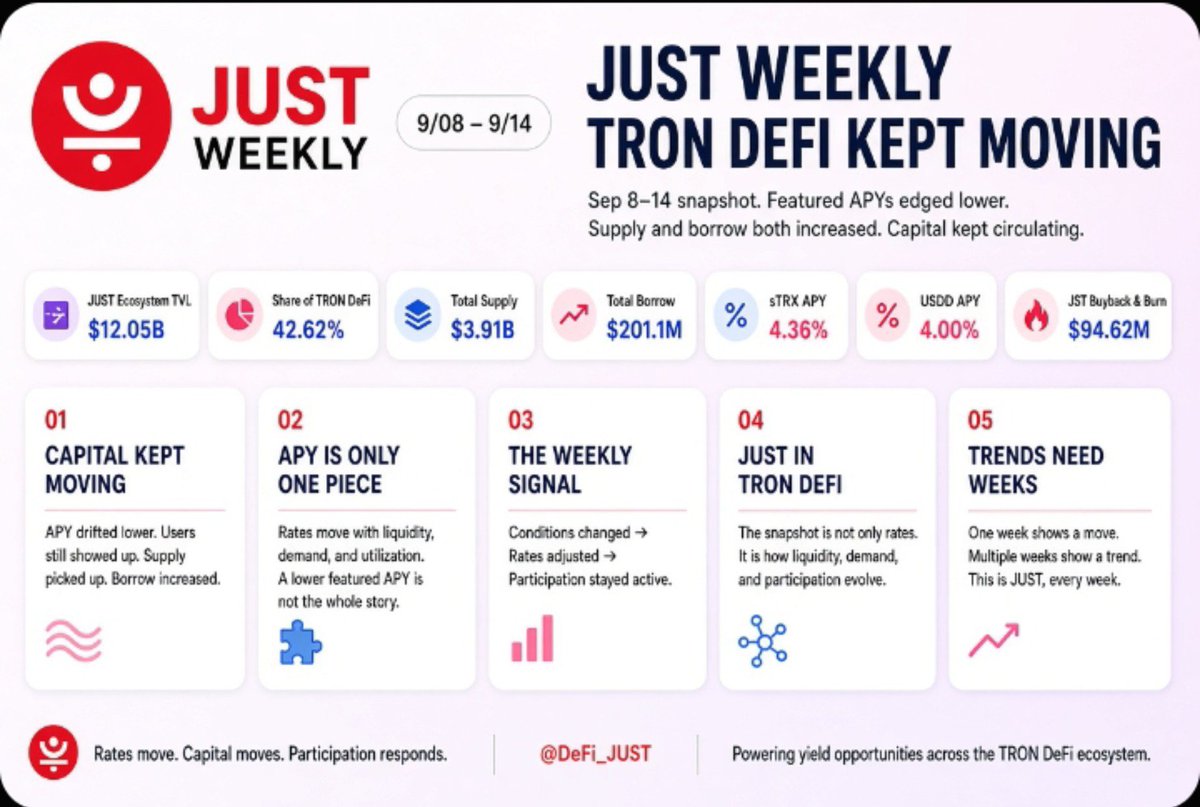
𝗝𝗨𝗦𝗧 𝗪𝗘𝗘𝗞𝗟𝗬: 𝗧𝗥𝗢𝗡 𝗗𝗘𝗙𝗜 𝗞𝗘𝗣𝗧 𝗠𝗢𝗩𝗜𝗡𝗚 📊
The latest JUST Weekly snapshot for Sep 8–Sep 14 shows an active market despite some changes in featured APYs.
Supply and Borrow activity both increased, highlighting continued participation across the JUST ecosystem.
🧵👇
🔹 𝗖𝗔𝗣𝗜𝗧𝗔𝗟 𝗖𝗢𝗡𝗧𝗜𝗡𝗨𝗘𝗗 𝗧𝗢 𝗠𝗢𝗩𝗘
Featured APYs edged lower during the week, but that didn't stop users from interacting with the markets.
Instead, both sides of the lending ecosystem saw stronger activity:
➡️ Supply picked up
➡️ Borrow activity increased
➡️ Capital continued circulating through the protocol
🔹 𝗔𝗣𝗬 𝗜𝗦 𝗢𝗡𝗟𝗬 𝗢𝗡𝗘 𝗣𝗜𝗘𝗖𝗘 𝗢𝗙 𝗧𝗛𝗘 𝗧𝗜
Changing APYs are a normal part of DeFi markets.
Rates can move as liquidity, borrowing demand, utilization, and market conditions change.
That means a lower featured APY doesn't necessarily tell the entire story.
Participation and capital movement provide additional context.
🔹 𝗧𝗛𝗘 𝗪𝗘𝗘𝗞𝗟𝗬 𝗦𝗜𝗚𝗡𝗔𝗟
The Sep 8–14 snapshot points to a simple trend:
Conditions changed → Rates adjusted → Participation remained active
That's an important part of understanding DeFi.
Markets aren't static. Users respond to changing conditions, and those responses influence the markets in return.
🔹 𝗝𝗨𝗦𝗧 𝗜𝗡 𝗧𝗥𝗢𝗡 𝗗𝗘𝗙𝗜
As activity continues across lending and borrowing markets, JUST remains an important part of the broader TRON DeFi ecosystem.
The weekly snapshot isn't just about individual APYs.
It's about observing how liquidity, borrowing demand, and participation evolve over time.
🔹 𝗧𝗛𝗘 𝗕𝗜𝗚𝗚𝗘𝗥 𝗣𝗜𝗖𝗧𝗨𝗥𝗘
One week can show changing rates.
Multiple weeks reveal trends.
That's why recurring ecosystem snapshots matter: they make it easier to follow how capital and user activity evolve rather than looking at DeFi conditions at only one point in time.
Rates move.
Capital moves.
Participation responds.
This is JUST, every week. 📈
@DeFi_JUST@justinsuntron
#JustLendDAO #JST #TRON #DeFi #Lending #Borrowing #Crypto #Web3 #TRONEcoStar
🔗 𝗪𝗲𝗯𝟯 𝗖𝗮𝗻 𝗛𝗮𝘃𝗲 𝗦𝗺𝗮𝗿𝘁 𝗖𝗼𝗻𝘁𝗿𝗮𝗰𝘁𝘀 𝗕𝘂𝘁 𝗧𝗵𝗲𝘆 𝗦𝘁𝗶𝗹𝗹 𝗡𝗲𝗲𝗱 𝗧𝗿𝘂𝘀𝘁𝗲𝗱 𝗗𝗮𝘁𝗮
When people think about blockchain infrastructure, they usually think about networks, smart contracts, wallets, and applications.
But underneath many of those applications is another critical layer:
𝗗𝗮𝘁𝗮.
A DeFi protocol can execute its rules perfectly, but those rules are only as useful as the information being fed into them.
Consider a lending protocol.
To determine collateral value, borrowing limits, or whether a position should be liquidated, the smart contract needs current market information.
The contract itself cannot simply browse an exchange, read an external API, or check what is happening in the real world.
It needs a reliable way to bring that information on-chain.
📡 𝗧𝗵𝗶𝘀 𝗜𝘀 𝗪𝗵𝗲𝗿𝗲 𝗢𝗿𝗮𝗰𝗹𝗲𝘀 𝗖𝗼𝗺𝗲 𝗜𝗻
Oracle infrastructure acts as a connection between information outside the blockchain and applications operating on-chain.
For example:
External Information → Oracle Layer → Smart Contract → On-Chain Action
That connection can support applications involving:
🔹 Asset and market data
🔹 Lending and borrowing
🔹 Stablecoins
🔹 Automated smart contracts
🔹 Gaming and randomness
🔹 External API integrations
🔹 AI-powered applications
Within the TRON ecosystem, WINkLink provides this type of oracle infrastructure, helping blockchain applications access data beyond what is natively available on-chain.
🛡️ 𝗗𝗮𝘁𝗮 𝗖𝗼𝗻𝗻𝗲𝗰𝘁𝗶𝘃𝗶𝘁𝘆 𝗜𝘀𝗻’𝘁 𝗘𝗻𝗼𝘂𝗴𝗵
Getting information onto a blockchain is only part of the challenge.
The bigger question is:
𝗖𝗮𝗻 𝗧𝗵𝗲 𝗔𝗽𝗽𝗹𝗶𝗰𝗮𝘁𝗶𝗼𝗻 𝗥𝗲𝗹𝘆 𝗢𝗻 𝗧𝗵𝗮𝘁 𝗜𝗻𝗳𝗼𝗿𝗺𝗮𝘁𝗶𝗼𝗻?
If a financial application receives inaccurate or manipulated inputs, even flawless smart-contract code can produce an undesirable outcome.
That is why decentralized oracle infrastructure matters.
The goal isn't merely to transport data.
It is to provide applications with a more reliable connection to external information without making a single centralized source the entire point of dependence.
🤖 𝗔𝗜 𝗠𝗮𝗸𝗲𝘀 𝗧𝗵𝗶𝘀 𝗣𝗿𝗼𝗯𝗹𝗲𝗺 𝗘𝘃𝗲𝗻 𝗠𝗼𝗿𝗲 𝗜𝗺𝗽𝗼𝗿𝘁𝗮𝗻𝘁
As AI and blockchain become increasingly interconnected, the data layer becomes even more significant.
AI systems can analyze and make decisions.
Smart contracts can execute predefined rules.
But both depend on the information available to them.
This creates an increasingly important infrastructure stack:
🧠 AI → Intelligence
🔗 WINkLink → Data Connectivity
⛓️ TRON → On-Chain Execution
Each layer solves a different problem.
Together, they can enable applications that don't operate solely on information generated inside the blockchain, but can respond to external conditions as well.
🌐 𝗧𝗵𝗲 𝗜𝗻𝗳𝗿𝗮𝘀𝘁𝗿𝘂𝗰𝘁𝘂𝗿𝗲 𝗨𝘀𝗲𝗿𝘀 𝗥𝗮𝗿𝗲𝗹𝘆 𝗦𝗲𝗲
Most users won't think about oracle infrastructure when they swap tokens, deposit collateral, or interact with an automated application.
That is often the sign of infrastructure doing its job.
The user sees the application.
Behind it are networks, smart contracts, data sources, validators, and infrastructure working together to make that experience possible.
As Web3 becomes more automated and increasingly connected to AI and real-world information, trusted data becomes a foundational requirement rather than an optional feature.
Smart contracts provide execution.
Oracles provide connectivity.
Reliable data gives decentralized applications the context they need to act.
@WinkLink_Oracle@justinsuntron@trondao
#TRONEcoStar #TRON #WINkLink #Oracles #DeFi #AI #Web3 #Blockchain
🔗 𝗪𝗲𝗯𝟯 𝗖𝗮𝗻 𝗛𝗮𝘃𝗲 𝗦𝗺𝗮𝗿𝘁 𝗖𝗼𝗻𝘁𝗿𝗮𝗰𝘁𝘀 𝗕𝘂𝘁 𝗧𝗵𝗲𝘆 𝗦𝘁𝗶𝗹𝗹 𝗡𝗲𝗲𝗱 𝗧𝗿𝘂𝘀𝘁𝗲𝗱 𝗗𝗮𝘁𝗮
When people think about blockchain infrastructure, they usually think about networks, smart contracts, wallets, and applications.
But underneath many of those applications is another critical layer:
𝗗𝗮𝘁𝗮.
A DeFi protocol can execute its rules perfectly, but those rules are only as useful as the information being fed into them.
Consider a lending protocol.
To determine collateral value, borrowing limits, or whether a position should be liquidated, the smart contract needs current market information.
The contract itself cannot simply browse an exchange, read an external API, or check what is happening in the real world.
It needs a reliable way to bring that information on-chain.
📡 𝗧𝗵𝗶𝘀 𝗜𝘀 𝗪𝗵𝗲𝗿𝗲 𝗢𝗿𝗮𝗰𝗹𝗲𝘀 𝗖𝗼𝗺𝗲 𝗜𝗻
Oracle infrastructure acts as a connection between information outside the blockchain and applications operating on-chain.
For example:
External Information → Oracle Layer → Smart Contract → On-Chain Action
That connection can support applications involving:
🔹 Asset and market data
🔹 Lending and borrowing
🔹 Stablecoins
🔹 Automated smart contracts
🔹 Gaming and randomness
🔹 External API integrations
🔹 AI-powered applications
Within the TRON ecosystem, WINkLink provides this type of oracle infrastructure, helping blockchain applications access data beyond what is natively available on-chain.
🛡️ 𝗗𝗮𝘁𝗮 𝗖𝗼𝗻𝗻𝗲𝗰𝘁𝗶𝘃𝗶𝘁𝘆 𝗜𝘀𝗻’𝘁 𝗘𝗻𝗼𝘂𝗴𝗵
Getting information onto a blockchain is only part of the challenge.
The bigger question is:
𝗖𝗮𝗻 𝗧𝗵𝗲 𝗔𝗽𝗽𝗹𝗶𝗰𝗮𝘁𝗶𝗼𝗻 𝗥𝗲𝗹𝘆 𝗢𝗻 𝗧𝗵𝗮𝘁 𝗜𝗻𝗳𝗼𝗿𝗺𝗮𝘁𝗶𝗼𝗻?
If a financial application receives inaccurate or manipulated inputs, even flawless smart-contract code can produce an undesirable outcome.
That is why decentralized oracle infrastructure matters.
The goal isn't merely to transport data.
It is to provide applications with a more reliable connection to external information without making a single centralized source the entire point of dependence.
🤖 𝗔𝗜 𝗠𝗮𝗸𝗲𝘀 𝗧𝗵𝗶𝘀 𝗣𝗿𝗼𝗯𝗹𝗲𝗺 𝗘𝘃𝗲𝗻 𝗠𝗼𝗿𝗲 𝗜𝗺𝗽𝗼𝗿𝘁𝗮𝗻𝘁
As AI and blockchain become increasingly interconnected, the data layer becomes even more significant.
AI systems can analyze and make decisions.
Smart contracts can execute predefined rules.
But both depend on the information available to them.
This creates an increasingly important infrastructure stack:
🧠 AI → Intelligence
🔗 WINkLink → Data Connectivity
⛓️ TRON → On-Chain Execution
Each layer solves a different problem.
Together, they can enable applications that don't operate solely on information generated inside the blockchain, but can respond to external conditions as well.
🌐 𝗧𝗵𝗲 𝗜𝗻𝗳𝗿𝗮𝘀𝘁𝗿𝘂𝗰𝘁𝘂𝗿𝗲 𝗨𝘀𝗲𝗿𝘀 𝗥𝗮𝗿𝗲𝗹𝘆 𝗦𝗲𝗲
Most users won't think about oracle infrastructure when they swap tokens, deposit collateral, or interact with an automated application.
That is often the sign of infrastructure doing its job.
The user sees the application.
Behind it are networks, smart contracts, data sources, validators, and infrastructure working together to make that experience possible.
As Web3 becomes more automated and increasingly connected to AI and real-world information, trusted data becomes a foundational requirement rather than an optional feature.
Smart contracts provide execution.
Oracles provide connectivity.
Reliable data gives decentralized applications the context they need to act.
@WinkLink_Oracle@justinsuntron@trondao
#TRONEcoStar #TRON #WINkLink #Oracles #DeFi #AI #Web3 #Blockchain
🔐 𝗧𝗼𝗻𝗸𝗲𝗲𝗽𝗲𝗿 𝗕𝗲𝗰𝗼𝗺𝗲𝘀 𝗞𝗲𝗲𝗽𝗲𝗿 — 𝗔 𝗦𝗶𝗻𝗴𝗹𝗲 𝗪𝗮𝗹𝗹𝗲𝘁 𝗙𝗼𝗿 𝗠𝘂𝗹𝘁𝗶𝗽𝗹𝗲 𝗖𝗵𝗮𝗶𝗻𝘀
Tonkeeper is evolving into Keeper, expanding from a TON-focused self-custodial wallet into a broader multichain wallet.
With more than 77 million downloads, Keeper now supports assets across:
🔹 $TON
🔹 $BTC
🔹 $ETH
🔹 $TRX
🔹 $ARB
🔹 $BNB
🔹 USDT and other supported assets
And more networks are expected to follow.
➠ 𝗧𝗢𝗡 𝗥𝗘𝗠𝗔𝗜𝗡𝗦 𝗧𝗛𝗘 𝗛𝗢𝗠𝗘
The transition doesn't remove what made Tonkeeper useful on TON.
Jettons, NFTs, staking, TON DNS, and the in-wallet browser remain part of the experience.
The difference is that users can now access additional networks from the same wallet environment.
➠ 𝗪𝗵𝘆 𝗧𝗵𝗲 𝗡𝗲𝘄 𝗪𝗮𝗹𝗹𝗲𝘁?
TON uses a different key-generation scheme from the BIP-39/44 standards commonly used across EVM networks and other blockchain wallets.
That means TON and the newly supported networks cannot simply share one universal recovery phrase under the existing architecture.
Keeper therefore provides separate wallet functionality while bringing the supported networks together inside one application.
➠ 𝗖𝗿𝗼𝘀𝘀-𝗖𝗵𝗮𝗶𝗻 𝗦𝘄𝗮𝗽𝘀 𝗪𝗶𝘁𝗵𝗼𝘂𝘁 𝗧𝗵𝗲 𝗘𝘅𝘁𝗿𝗮 𝗙𝗿𝗶𝗰𝘁𝗶𝗼𝗻
Keeper also introduces cross-chain swaps directly inside the wallet.
Users can select the asset they have, choose the asset they want, and complete the swap without separately managing a bridge or installing another application.
The feature is built with @moonpay.
➠ 𝗧𝗥𝗢𝗡 𝗚𝗮𝘀 𝗕𝗲𝗰𝗼𝗺𝗲𝘀 𝗟𝗲𝘀𝘀 𝗢𝗳 𝗔 𝗕𝗮𝗿𝗿𝗶𝗲𝗿
One particularly useful feature for TRON users is gas handling.
Keeper says its Battery system can cover network fees on supported TON and TRON transactions.
That means users holding USDT on TRON can move their USDT without needing to separately hold TRX for transaction fees, subject to the wallet's supported Battery conditions.
For newcomers, this can remove one of the common friction points of using blockchain networks.
➠ 𝗠𝘂𝗹𝘁𝗶𝗰𝗵𝗮𝗶𝗻 𝗜𝘀 𝗕𝗲𝗰𝗼𝗺𝗶𝗻𝗴 𝗧𝗵𝗲 𝗡𝗼𝗿𝗺
The broader shift is important.
Crypto users increasingly interact with multiple networks rather than staying inside one ecosystem.
A wallet that can bring different chains, assets, swaps, and network-fee management into one interface can make that experience considerably simpler.
Keeper's multichain rollout is now live on iOS and Android, with web, desktop, and browser-extension support expected afterward.
There are also 0% fees on cross-chain swaps until September 22, according to the announcement.
The evolution from Tonkeeper to Keeper reflects a larger change in crypto:
Users may choose different chains, but they shouldn't necessarily need a different wallet experience for each one.
One wallet. Multiple networks. More interoperability.
Be a Keeper. 💙
🔗 https://t.co/ARNHcWmCGk
@tonkeeper @trondao@justinsuntron@moonpay
#TRONEcoStar #TRON #TON #Keeper #Crypto #Web3 #Multichain
𝗝𝗨𝗦𝗧 𝗪𝗘𝗘𝗞𝗟𝗬: 𝗧𝗥𝗢𝗡 𝗗𝗘𝗙𝗜 𝗞𝗘𝗣𝗧 𝗠𝗢𝗩𝗜𝗡𝗚 📊
The latest JUST Weekly snapshot for Sep 8–Sep 14 shows an active market despite some changes in featured APYs.
Supply and Borrow activity both increased, highlighting continued participation across the JUST ecosystem.
🧵👇
🔹 𝗖𝗔𝗣𝗜𝗧𝗔𝗟 𝗖𝗢𝗡𝗧𝗜𝗡𝗨𝗘𝗗 𝗧𝗢 𝗠𝗢𝗩𝗘
Featured APYs edged lower during the week, but that didn't stop users from interacting with the markets.
Instead, both sides of the lending ecosystem saw stronger activity:
➡️ Supply picked up
➡️ Borrow activity increased
➡️ Capital continued circulating through the protocol
🔹 𝗔𝗣𝗬 𝗜𝗦 𝗢𝗡𝗟𝗬 𝗢𝗡𝗘 𝗣𝗜𝗘𝗖𝗘 𝗢𝗙 𝗧𝗛𝗘 𝗧𝗜
Changing APYs are a normal part of DeFi markets.
Rates can move as liquidity, borrowing demand, utilization, and market conditions change.
That means a lower featured APY doesn't necessarily tell the entire story.
Participation and capital movement provide additional context.
🔹 𝗧𝗛𝗘 𝗪𝗘𝗘𝗞𝗟𝗬 𝗦𝗜𝗚𝗡𝗔𝗟
The Sep 8–14 snapshot points to a simple trend:
Conditions changed → Rates adjusted → Participation remained active
That's an important part of understanding DeFi.
Markets aren't static. Users respond to changing conditions, and those responses influence the markets in return.
🔹 𝗝𝗨𝗦𝗧 𝗜𝗡 𝗧𝗥𝗢𝗡 𝗗𝗘𝗙𝗜
As activity continues across lending and borrowing markets, JUST remains an important part of the broader TRON DeFi ecosystem.
The weekly snapshot isn't just about individual APYs.
It's about observing how liquidity, borrowing demand, and participation evolve over time.
🔹 𝗧𝗛𝗘 𝗕𝗜𝗚𝗚𝗘𝗥 𝗣𝗜𝗖𝗧𝗨𝗥𝗘
One week can show changing rates.
Multiple weeks reveal trends.
That's why recurring ecosystem snapshots matter: they make it easier to follow how capital and user activity evolve rather than looking at DeFi conditions at only one point in time.
Rates move.
Capital moves.
Participation responds.
This is JUST, every week. 📈
@DeFi_JUST@justinsuntron
#JustLendDAO #JST #TRON #DeFi #Lending #Borrowing #Crypto #Web3 #TRONEcoStar
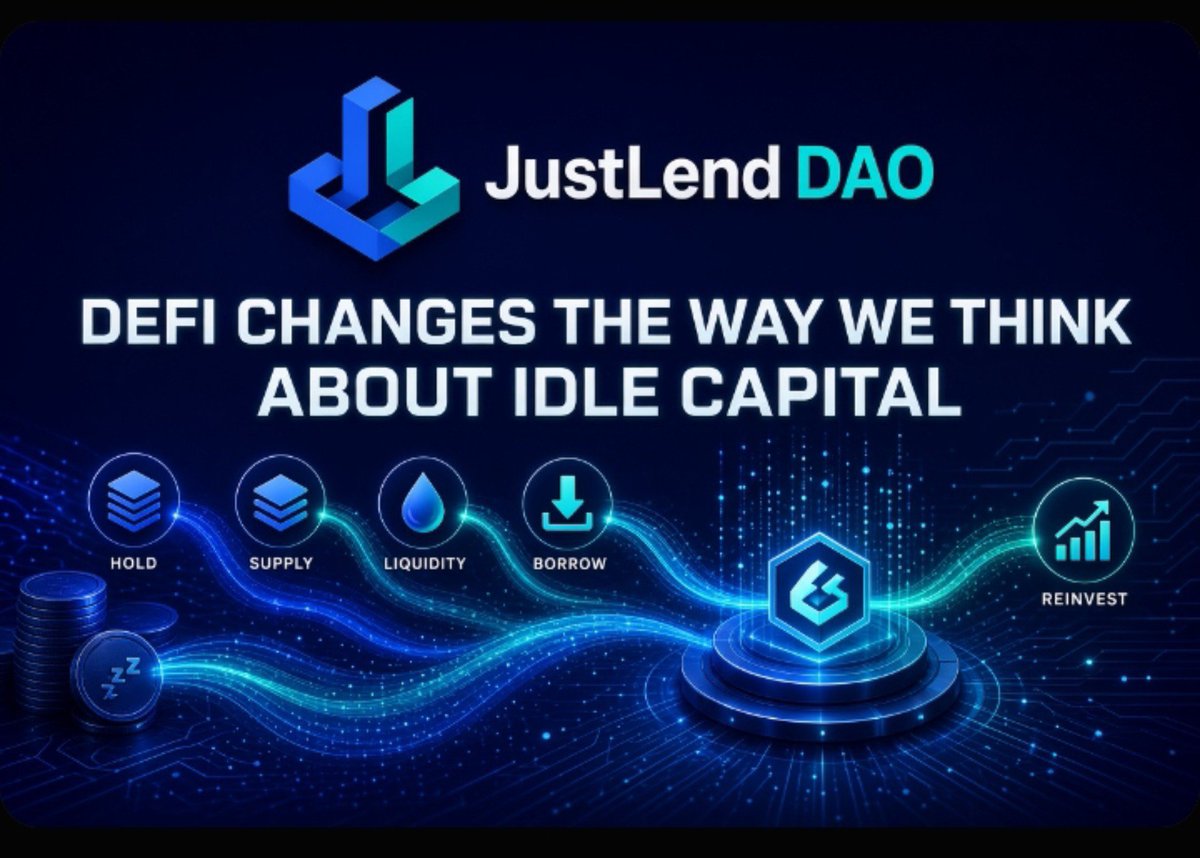
𝗗𝗘𝗙𝗜 𝗖𝗛𝗔𝗡𝗚𝗘𝗦 𝗧𝗛𝗘 𝗪𝗔𝗬 𝗪𝗘 𝗧𝗛𝗜𝗡𝗞 𝗔𝗕𝗢𝗨𝗧 𝗜𝗗𝗟𝗘 𝗖𝗔𝗣𝗜𝗧𝗔𝗟 💰
Holding an asset gives you exposure to it.
But DeFi introduces another question:
Can that capital also participate in the financial system while you hold it?
That is where protocols like @DeFi_JUST become relevant. 🧵👇
🔹 𝗙𝗥𝗢𝗠 𝗛𝗢𝗟𝗗𝗜𝗡𝗚 𝗧𝗢 𝗣𝗔𝗥𝗧𝗜𝗖𝗜𝗣𝗔𝗧𝗜𝗡𝗚
In a traditional wallet, assets can remain inactive until you decide to use them.
DeFi creates programmable markets where supported assets can potentially be:
➡️ Supplied
➡️ Borrowed against
➡️ Used as liquidity
➡️ Deployed across other protocols
The asset doesn't necessarily have to remain passive.
🔹 𝗖𝗔𝗣𝗜𝗧𝗔𝗟 𝗘𝗙𝗙𝗜𝗖𝗜𝗘𝗡𝗖𝗬
The broader idea is capital efficiency.
Instead of simply asking:
“What assets do I own?”
DeFi allows users to also consider:
“How can these assets participate productively?”
For example, supplying an asset to a lending market can provide liquidity to borrowers while potentially earning supply interest, depending on the market and conditions.
🔹 𝗟𝗘𝗡𝗗𝗜𝗡𝗚 𝗖𝗢𝗡𝗡𝗘𝗖𝗧𝗦 𝗦𝗨𝗣𝗣𝗟𝗬 𝗔𝗡𝗗 𝗗𝗘𝗠𝗔𝗡𝗗
DeFi lending works by connecting two sides of the market:
Suppliers → Provide Liquidity → Borrowers
Suppliers can potentially earn interest.
Borrowers gain access to liquidity without necessarily selling their existing assets.
This creates a market where capital can move toward users who need it.
🔹 𝗟𝗜𝗤𝗨𝗜𝗗𝗜𝗧𝗬 𝗜𝗦 𝗔𝗡𝗢𝗧𝗛𝗘𝗥 𝗟𝗔𝗬𝗘𝗥
Beyond lending, liquidity is fundamental to DeFi markets.
Liquidity allows users to trade, borrow, and interact with protocols more efficiently.
That means participation can extend beyond simply holding an asset.
It can involve contributing capital to the infrastructure that enables on-chain markets to function.
🔹 𝗧𝗛𝗘 𝗧𝗥𝗔𝗗𝗘-𝗢𝗙𝗙 𝗠𝗔𝗧𝗧𝗘𝗥𝗦
Putting assets to work doesn't mean risk disappears.
Users still need to consider:
⚠️ Smart-contract risk
⚠️ Market volatility
⚠️ Liquidation risk when borrowing
⚠️ Changing interest rates
⚠️ Liquidity conditions
Potential yield should always be evaluated alongside the risks involved.
🔹 𝗧𝗛𝗘 𝗕𝗜𝗚𝗚𝗘𝗥 𝗜𝗗𝗘𝗔
DeFi changes the relationship between ownership and participation.
Instead of capital simply sitting idle, programmable financial markets can give users more ways to deploy it.
Hold → Supply → Provide Liquidity → Borrow → Reinvest
The goal isn't simply to own assets.
It's to understand how those assets can participate within an on-chain financial ecosystem.
Because in DeFi, the important question isn't only:
“What do you hold?”
It can also be:
“What is your capital doing?”
@DeFi_JUST@justinsuntron
#JustLendDAO #JST #TRON #DeFi #Lending #Liquidity #CapitalEfficiency #Web3 #Crypto #TRONEcoStar
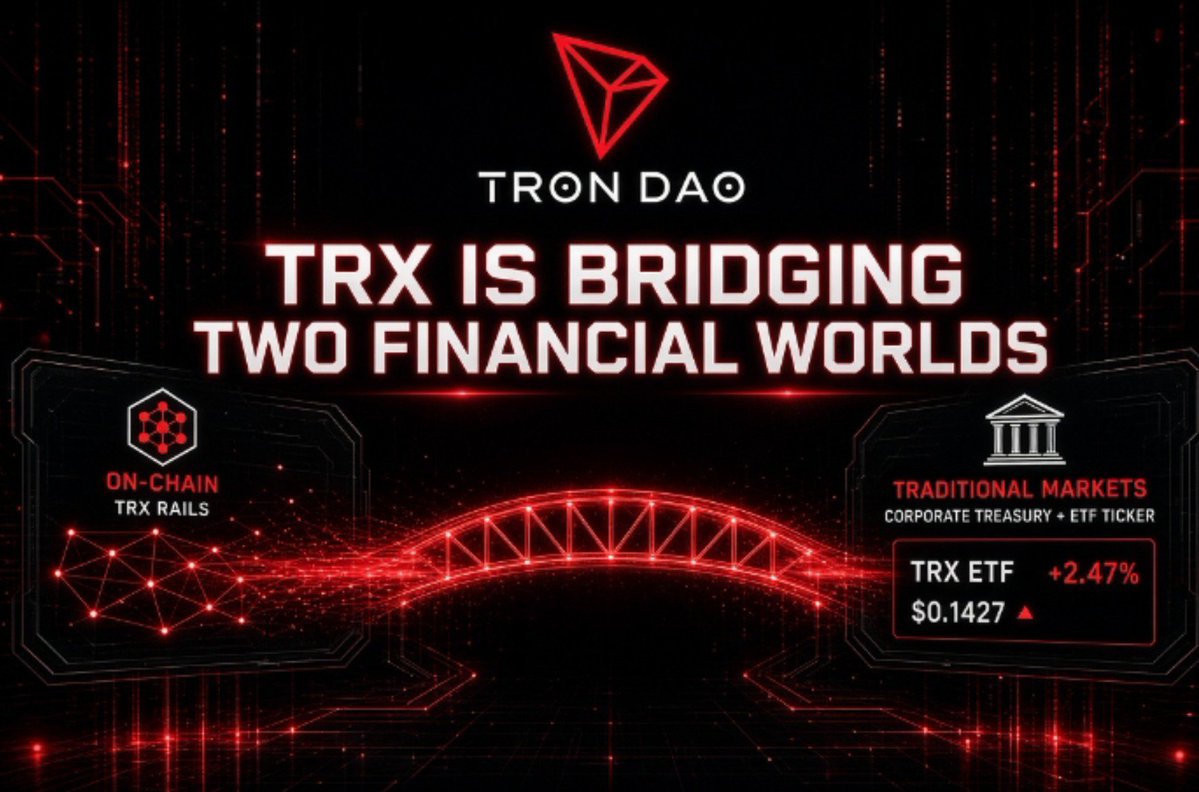
𝗧𝗥𝗫 𝗜𝗦 𝗕𝗥𝗜𝗗𝗚𝗜𝗡𝗚 𝗧𝗪𝗢 𝗙𝗜𝗡𝗔𝗡𝗖𝗜𝗔𝗟 𝗪𝗢𝗥𝗟𝗗𝗦
TRON's connection to traditional finance is becoming more visible as new structures create different routes for investors to gain exposure to TRX.
Two developments stand out:
🏢 TRON Inc. — a publicly traded company building a TRX-focused treasury strategy.
📈 Canary Staked TRX ETF ($TRXS) — an exchange-traded structure providing TRX exposure through traditional market infrastructure.
These aren't the same product, but they point toward the same broader trend.
🧵👇
𝟭️⃣ 𝗧𝗪𝗢 𝗣𝗔𝗧𝗛𝗦 𝗧𝗢 𝗧𝗥𝗫 𝗘𝗫𝗣𝗢𝗦𝗨𝗥𝗘
A corporate treasury and an ETF serve different purposes.
But conceptually:
Public Company → TRX Treasury
ETF → TRX Exposure → Brokerage Account
The first gives investors exposure through ownership of a company with a substantial TRX position.
The second provides a more direct exchange-traded vehicle tied to TRX itself.
Together, they demonstrate how crypto assets can increasingly connect with established financial markets.
𝟮️⃣ 𝗧𝗥𝗫𝗦 𝗔𝗗𝗗𝗦 𝗔 𝗦𝗧𝗔𝗞𝗜𝗡𝗚 𝗟𝗔𝗬𝗘𝗥
The interesting part of $TRXS isn't only the ETF structure.
It's the staking component.
Cboe says the fund's primary objective is to provide exposure to the price of TRX held by the Trust, while its secondary objective is to earn additional TRX through participation in TRON's DPoS validation process.
So the structure connects:
TRX → ETF → Staking → Traditional Market Infrastructure
That is a notable combination.
𝟯️⃣ 𝗧𝗛𝗘 𝗣𝗥𝗢𝗗𝗨𝗖𝗧 𝗜𝗦 𝗡𝗢 𝗟𝗢𝗡𝗚𝗘𝗥 𝗝𝗨𝗦𝗧 “𝗣𝗥𝗢𝗣𝗢𝗦𝗘𝗗”
This is an important update to the original framing.
The Canary Staked TRX ETF began trading on Cboe on September 9, 2026, under the ticker TRXS. Cboe's official listing confirms the September 9 listing date.
So the story has moved from:
Proposed ETF → Expected listing
to:
Listed ETF → Live traditional-market access
𝟰️⃣ 𝗪𝗛𝗬 𝗧𝗛𝗜𝗦 𝗠𝗔𝗧𝗧𝗘𝗥𝗦
Crypto-native users already have multiple ways to interact with TRX:
➝ Wallets
➝ DeFi
➝ Payments
➝ Staking
➝ On-chain applications
Now there is another route:
Traditional brokerage infrastructure → TRXS → TRX exposure
That doesn't replace on-chain access.
It creates another financial access point around the same underlying asset.
𝟱️⃣ 𝗧𝗛𝗘 𝗕𝗜𝗚𝗚𝗘𝗥 𝗧REND
TRON's financial ecosystem is increasingly developing across multiple layers.
On-chain:
TRX → DeFi → Staking → Payments
Corporate:
TRON Inc. → TRX Treasury
Traditional markets:
TRXS → Cboe → TRX exposure
These structures are different, but they all create additional connections between TRX and capital outside the native blockchain environment.
𝟲️⃣ 𝗧𝗛𝗘 𝗜𝗡𝗧𝗘𝗥𝗘𝗦𝗧𝗜𝗡𝗚 𝗣𝗔𝗥𝗧 𝗜𝗦 𝗪𝗛𝗔𝗧 𝗖𝗢𝗠𝗘𝗦 𝗡𝗘𝗫𝗧
The significance of TRXS isn't simply the existence of another ticker.
It's the continued expansion of the financial infrastructure surrounding TRX.
As blockchain assets become accessible through:
Networks → Treasury strategies → ETFs → Traditional exchanges
the boundary between crypto-native finance and traditional finance becomes increasingly connected.
TRX is no longer only an asset people encounter inside the TRON blockchain.
It is becoming an asset with multiple financial pathways around it.
@CanaryFunds@trondao@justinsuntron
#TRON #TRX #TRXS #CanaryCapital #ETF #Crypto #TradFi #DigitalAssets #Staking #Blockchain #TRONEcoStar
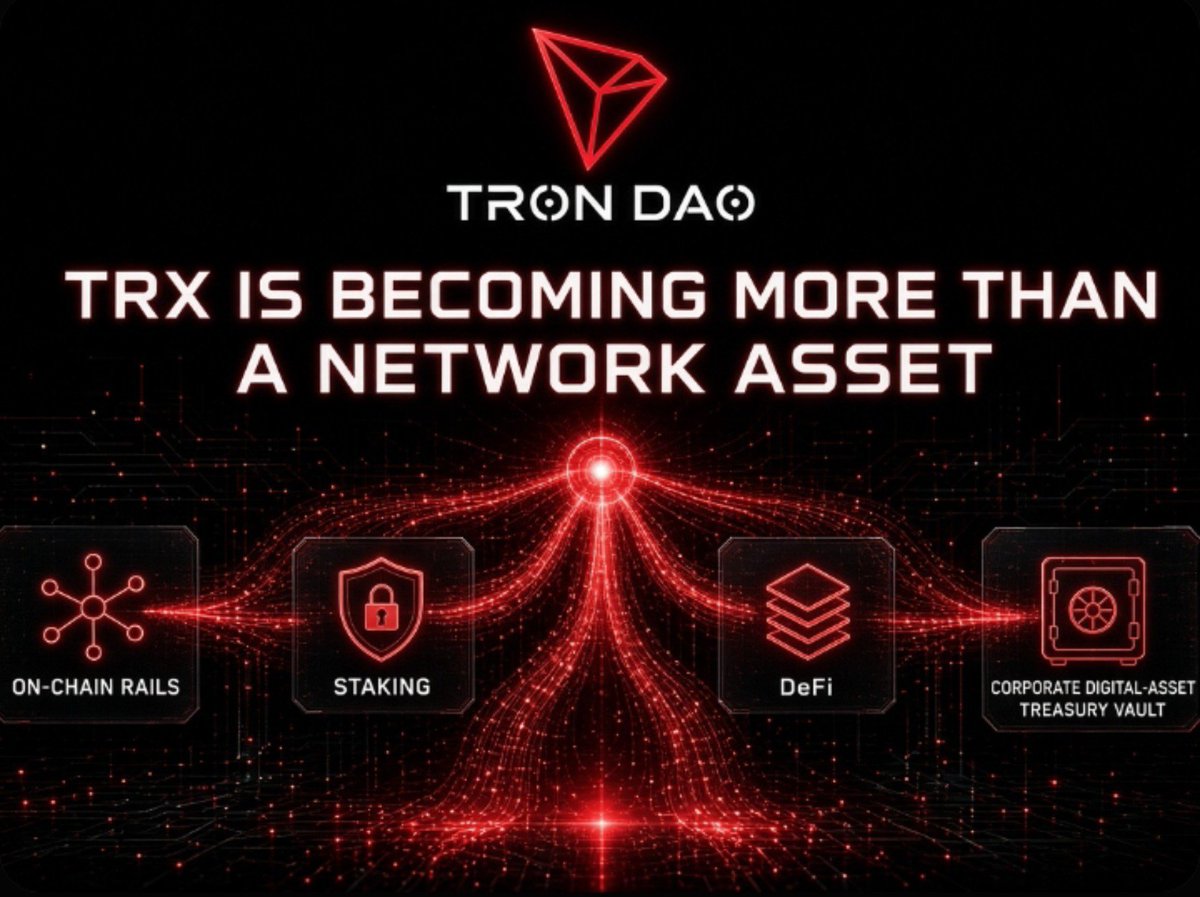
𝗧𝗥𝗫 𝗜𝗦 𝗕𝗘𝗖𝗢𝗠𝗜𝗡𝗚 𝗠𝗢𝗥𝗘 𝗧𝗛𝗔𝗡 𝗔 𝗡𝗘𝗧𝗪𝗢𝗥𝗞 𝗔𝗦𝗦𝗘𝗧
TRX is increasingly appearing in a different kind of financial strategy:
A corporate digital-asset treasury.
TRON Inc. (NASDAQ: $TRON) recently reported another TRX purchase, acquiring 148,461 TRX at an average price of $0.3368, taking its reported treasury holdings above 713.4 million TRX.
That makes the strategy worth watching.
🧵👇
𝟭️⃣ 𝗧𝗛𝗘 𝗣𝗨𝗥𝗖𝗛𝗔𝗦𝗘 𝗜𝗦 𝗣𝗔𝗥𝗧 𝗢𝗙 𝗔 𝗟𝗔𝗥𝗚𝗘𝗥 𝗦𝗧𝗥𝗔𝗧𝗘𝗚𝗬
The interesting part isn't simply another 148,461 TRX.
It's the continued accumulation.
TRON Inc. has previously stated that its digital-asset treasury strategy is focused on buying and holding TRX, without hedging, while using excess cash to accumulate the asset.
So the broader picture is:
➝ Corporate capital
➝ TRX accumulation
➝ Treasury growth
➝ Long-term exposure to the TRON ecosystem
𝟮️⃣ 𝗧𝗛𝗜𝗦 𝗖𝗥𝗘𝗔𝗧𝗘𝗦 𝗔 𝗗𝗜𝗙𝗙𝗘𝗥𝗘𝗡𝗧 𝗣𝗔𝗧𝗛 𝗜𝗡𝗧𝗢 𝗧𝗥𝗫
Most users encounter TRX through wallets, transactions, DeFi, staking and other on-chain applications.
A public-company treasury introduces another structure:
Traditional capital markets → Corporate treasury → TRX
That creates an interesting connection between public equities and a blockchain-native asset.
TRON Inc. itself describes its strategy as a blockchain-integrated treasury strategy and identifies its TRX holdings as the largest among publicly traded companies.
𝟯️⃣ 𝗧𝗛𝗘 𝗧𝗥𝗘𝗔𝗦𝗨𝗥𝗬 𝗖𝗔𝗡 𝗕𝗘𝗖𝗢𝗠𝗘 𝗣𝗔𝗥𝗧 𝗢𝗙 𝗧𝗛𝗘 𝗕𝗨𝗦𝗜𝗡𝗘𝗦𝗦
This is where the strategy becomes more interesting.
TRON Inc. isn't simply holding TRX as a passive corporate asset.
The company has also reported staking-related income and has described its TRX treasury as an important component of its broader financial strategy.
That means the treasury can potentially interact with the underlying network rather than existing completely outside it.
𝟰️⃣ 𝗧𝗛𝗘 𝗦𝗖𝗔𝗟𝗘 𝗠𝗔𝗧𝗧𝗘𝗥𝗦
A single purchase doesn't fundamentally change TRX.
Repeated accumulation does something different.
It can gradually transform the treasury from a relatively small crypto allocation into a significant component of corporate balance-sheet positioning.
And TRON Inc.'s reported holdings have grown from 681.2M+ TRX in February to 713.4M+ TRX by the latest reported purchase.
That's the trend worth watching.
𝟱️⃣ 𝗧𝗛𝗘 𝗕𝗜𝗚𝗚𝗘𝗥 𝗤𝗨𝗘𝗦𝗧𝗜𝗢𝗡
What happens if this accumulation continues?
A larger TRX treasury could increase the company's financial exposure to TRX while creating another bridge between traditional capital markets and the TRON ecosystem.
But this is still an investment strategy, which means it carries market and execution risks.
Future purchases, returns, and outcomes are not guaranteed.
𝟲️⃣ 𝗧𝗛𝗘 𝗕𝗜𝗚𝗚𝗘𝗥 𝗣𝗜𝗖𝗧𝗨𝗥𝗘
TRX is increasingly occupying multiple roles:
Network asset → DeFi asset → Staking asset → Corporate treasury asset
That evolution is significant because it expands the ways traditional companies and investors can gain exposure to the TRON ecosystem.
The question is no longer simply how much TRX is being used on-chain.
It's also how much financial infrastructure is beginning to form around it.
@TRON_INC@trondao@justinsuntron
#TRON #TRX #TronInc #DigitalAssets #Crypto #Blockchain #Treasury #DeFi #TRONEcoStar
𝗧𝗥𝗫 𝗜𝗦 𝗕𝗥𝗜𝗗𝗚𝗜𝗡𝗚 𝗧𝗪𝗢 𝗙𝗜𝗡𝗔𝗡𝗖𝗜𝗔𝗟 𝗪𝗢𝗥𝗟𝗗𝗦
TRON's connection to traditional finance is becoming more visible as new structures create different routes for investors to gain exposure to TRX.
Two developments stand out:
🏢 TRON Inc. — a publicly traded company building a TRX-focused treasury strategy.
📈 Canary Staked TRX ETF ($TRXS) — an exchange-traded structure providing TRX exposure through traditional market infrastructure.
These aren't the same product, but they point toward the same broader trend.
🧵👇
𝟭️⃣ 𝗧𝗪𝗢 𝗣𝗔𝗧𝗛𝗦 𝗧𝗢 𝗧𝗥𝗫 𝗘𝗫𝗣𝗢𝗦𝗨𝗥𝗘
A corporate treasury and an ETF serve different purposes.
But conceptually:
Public Company → TRX Treasury
ETF → TRX Exposure → Brokerage Account
The first gives investors exposure through ownership of a company with a substantial TRX position.
The second provides a more direct exchange-traded vehicle tied to TRX itself.
Together, they demonstrate how crypto assets can increasingly connect with established financial markets.
𝟮️⃣ 𝗧𝗥𝗫𝗦 𝗔𝗗𝗗𝗦 𝗔 𝗦𝗧𝗔𝗞𝗜𝗡𝗚 𝗟𝗔𝗬𝗘𝗥
The interesting part of $TRXS isn't only the ETF structure.
It's the staking component.
Cboe says the fund's primary objective is to provide exposure to the price of TRX held by the Trust, while its secondary objective is to earn additional TRX through participation in TRON's DPoS validation process.
So the structure connects:
TRX → ETF → Staking → Traditional Market Infrastructure
That is a notable combination.
𝟯️⃣ 𝗧𝗛𝗘 𝗣𝗥𝗢𝗗𝗨𝗖𝗧 𝗜𝗦 𝗡𝗢 𝗟𝗢𝗡𝗚𝗘𝗥 𝗝𝗨𝗦𝗧 “𝗣𝗥𝗢𝗣𝗢𝗦𝗘𝗗”
This is an important update to the original framing.
The Canary Staked TRX ETF began trading on Cboe on September 9, 2026, under the ticker TRXS. Cboe's official listing confirms the September 9 listing date.
So the story has moved from:
Proposed ETF → Expected listing
to:
Listed ETF → Live traditional-market access
𝟰️⃣ 𝗪𝗛𝗬 𝗧𝗛𝗜𝗦 𝗠𝗔𝗧𝗧𝗘𝗥𝗦
Crypto-native users already have multiple ways to interact with TRX:
➝ Wallets
➝ DeFi
➝ Payments
➝ Staking
➝ On-chain applications
Now there is another route:
Traditional brokerage infrastructure → TRXS → TRX exposure
That doesn't replace on-chain access.
It creates another financial access point around the same underlying asset.
𝟱️⃣ 𝗧𝗛𝗘 𝗕𝗜𝗚𝗚𝗘𝗥 𝗧REND
TRON's financial ecosystem is increasingly developing across multiple layers.
On-chain:
TRX → DeFi → Staking → Payments
Corporate:
TRON Inc. → TRX Treasury
Traditional markets:
TRXS → Cboe → TRX exposure
These structures are different, but they all create additional connections between TRX and capital outside the native blockchain environment.
𝟲️⃣ 𝗧𝗛𝗘 𝗜𝗡𝗧𝗘𝗥𝗘𝗦𝗧𝗜𝗡𝗚 𝗣𝗔𝗥𝗧 𝗜𝗦 𝗪𝗛𝗔𝗧 𝗖𝗢𝗠𝗘𝗦 𝗡𝗘𝗫𝗧
The significance of TRXS isn't simply the existence of another ticker.
It's the continued expansion of the financial infrastructure surrounding TRX.
As blockchain assets become accessible through:
Networks → Treasury strategies → ETFs → Traditional exchanges
the boundary between crypto-native finance and traditional finance becomes increasingly connected.
TRX is no longer only an asset people encounter inside the TRON blockchain.
It is becoming an asset with multiple financial pathways around it.
@CanaryFunds@trondao@justinsuntron
#TRON #TRX #TRXS #CanaryCapital #ETF #Crypto #TradFi #DigitalAssets #Staking #Blockchain #TRONEcoStar
𝗕𝗢𝗥𝗥𝗢𝗪𝗜𝗡𝗚 𝗛𝗘𝗟𝗣𝗦 𝗞𝗘𝗘𝗣 𝗦𝗕𝗠 𝗩𝟮 𝗠𝗢𝗩𝗜𝗡𝗚 🔄
Borrowing isn't only about accessing liquidity.
Within JustLend SBM V2, borrowing activity contributes to market utilization, and utilization is one of the factors that influences the Supply APY available to depositors.
Here's how the cycle works 👇 🧵
🔹 𝗦𝗨𝗣𝗣𝗟𝗬 𝗣𝗥𝗢𝗩𝗜𝗗𝗘𝗦 𝗟𝗜𝗤𝗨𝗜𝗗𝗜𝗧𝗬
Users supply supported assets to the market.
That liquidity becomes available for borrowers while suppliers can earn interest based on the market's conditions.
Supply → Available Liquidity
🔹 𝗕𝗢𝗥𝗥𝗢𝗪𝗜𝗡𝗚 𝗨𝗦𝗘𝗦 𝗧𝗛𝗔𝗧 𝗟𝗜𝗤𝗨𝗜𝗗𝗜𝗧𝗬
When borrowers take liquidity from the market, utilization increases.
In simple terms:
More Borrowing → Higher Utilization
The market's interest-rate model responds to changes in utilization.
🔹 𝗨𝗧𝗜𝗟𝗜𝗭𝗔𝗧𝗜𝗢𝗡 𝗖𝗢𝗡𝗡𝗘𝗖𝗧𝗦 𝗕𝗢𝗥𝗥𝗢𝗪𝗘𝗥𝗦 𝗔𝗡𝗗 𝗦𝗨𝗣𝗣𝗟𝗜𝗘𝗥𝗦
This creates an important relationship:
Suppliers provide liquidity → Borrowers use liquidity → Utilization changes → Rates adjust
So borrowing activity doesn't exist separately from the supply side.
It is part of the mechanism connecting both sides of the market.
🔹 𝗪𝗛𝗬 𝗧𝗛𝗜𝗦 𝗠𝗔𝗧𝗧𝗘𝗥𝗦
For borrowers, liquidity provides access to capital.
For suppliers, borrowing demand helps create the activity that drives market utilization and influences supply-side rates.
That makes the lending market more than simply a place to deposit assets.
It's a two-sided financial system where both participants contribute to the overall activity.
🔹 𝗧𝗛𝗘 𝗦𝗕𝗠 𝗩𝟮 𝗖𝗬𝗖𝗟𝗘
Think of it as:
Supply → Borrow → Utilization → Rate Adjustment → Market Activity
The exact outcome depends on market conditions, so Supply APY can change over time.
But the underlying relationship remains important.
🔹 𝗧𝗛𝗘 𝗕𝗜𝗚𝗚𝗘𝗥 𝗣𝗜𝗖𝗧𝗨𝗥𝗘
Borrowers aren't simply taking liquidity out of the system.
Their activity becomes part of the market mechanism that connects liquidity demand with supplier returns.
That's what makes utilization such an important concept in DeFi lending.
Liquidity needs users.
Users create activity.
Activity influences the market.
Discover SBM V2 👇
🌐 https://t.co/iawVbrOGtP
@DeFi_JUST@justinsuntron
#JustLendDAO #SBMV2 #JST #TRON #DeFi #Lending #Borrowing #Web3 #TRONEcoStar
𝗪𝗛𝗘𝗡 𝗔𝗜 𝗧𝗨𝗥𝗡𝗦 𝗜𝗗𝗘𝗔𝗦 𝗜𝗡𝗧𝗢 𝗗𝗜𝗚𝗜𝗧𝗔𝗟 𝗘𝗫𝗣𝗘𝗥𝗜𝗘𝗡𝗖𝗘𝗦
AI is changing creativity in a way that goes beyond simply producing content faster.
One of its biggest advantages is reducing the distance between having an idea and actually exploring it.
An idea can move from:
Thought → Experiment → Creation → Iteration
in far less time.
When that creative process connects with Web3 infrastructure, the possibilities become even broader.
➠ 𝟭️⃣ 𝗔𝗜 𝗘𝗫𝗣𝗔𝗡𝗗𝗦 𝗧𝗛𝗘 𝗖𝗥𝗘𝗔𝗧𝗜𝗩𝗘 𝗖𝗔𝗡𝗩𝗔𝗦
Creators can use AI to explore concepts, characters, visual styles, stories, designs, and entirely new digital experiences.
The important part isn't necessarily letting AI create everything.
It is giving creators a faster way to experiment.
Instead of abandoning an idea because testing it takes too much time, creators can explore multiple directions and quickly learn what works.
That makes AI less of a replacement for creativity and more of a tool for increasing creative iteration.
➠ 𝟮️⃣ 𝗪𝗘𝗕𝟯 𝗔𝗗𝗗𝗦 𝗔 𝗡𝗘𝗪 𝗗𝗜𝗠𝗘𝗡𝗦𝗜𝗢𝗡
A creative output doesn't have to remain a file stored on a device.
Web3 introduces infrastructure for digital assets, ownership, communities, and on-chain interaction.
This creates a different path for digital creations:
Create → Represent → Own → Connect → Participate
AINFT sits at an interesting intersection of these ideas, connecting AI-driven creativity with digital assets and Web3 culture.
➠ 𝟯️⃣ 𝗧𝗛𝗘 𝗖𝗥𝗘𝗔𝗧𝗢𝗥 𝗦𝗧𝗜𝗟𝗟 𝗗𝗥𝗜𝗩𝗘𝗦 𝗧𝗛𝗘 𝗩𝗜𝗦𝗜𝗢𝗡
The most important part of the creative process isn't the tool.
It's the person using it.
AI can generate possibilities, but creators decide what deserves to be developed, refined, and turned into something meaningful.
That makes the relationship more collaborative:
▫️ AI accelerates experimentation
▫️ Creators provide direction and judgment
▫️ Web3 provides digital infrastructure
▫️ AINFT connects creativity with an emerging on-chain ecosystem
➠ 𝟰️⃣ 𝗧𝗛𝗘 𝗥𝗘𝗔𝗟 𝗔𝗗𝗩𝗔𝗡𝗧𝗔𝗚𝗘 𝗜𝗦 𝗜𝗧𝗘𝗥𝗔𝗧𝗜𝗢𝗡
Creative breakthroughs rarely come from the first attempt.
They often come from repeatedly testing an idea, learning from the result, and trying again.
Create → Test → Learn → Improve → Repeat
AI can make that loop faster.
And when digital creations can also become part of programmable, connected ecosystems, the creative process doesn't necessarily end when the content is finished.
The creation can become an experience.
An asset.
A community touchpoint.
Or a component of a broader digital ecosystem.
That is what makes the intersection of AI + creativity + Web3 worth watching.
The tools are becoming more accessible.
The creative loop is becoming faster.
And the digital canvas is becoming increasingly programmable.
The technology can accelerate the process.
The creator still decides what is worth creating.
So the question isn't just what AI can generate.
It's what you can imagine, build, and bring to life with it.
@AINFTcom@justinsuntron
#AINFT #TRON #TRONEcoStar #AI #Web3 #DigitalCreativity #NFT
💵 𝗨𝗦𝗗𝗗 𝗜𝘀 𝗡𝗼𝘁 𝗝𝘂𝘀𝘁 𝗔 𝗦𝘁𝗮𝗯𝗹𝗲𝗰𝗼𝗶𝗻 — 𝗜𝘁 𝗖𝗮𝗻 𝗕𝗲 𝗔𝗻 𝗘𝗻𝘁𝗿𝘆 𝗣𝗼𝗶𝗻𝘁 𝗜𝗻𝘁𝗼 𝗧𝗥𝗢𝗡 𝗗𝗲𝗙𝗶
A stablecoin can do more than sit in a wallet.
Within the TRON ecosystem, USDD can be used across different DeFi strategies, ranging from relatively simple yield opportunities to more advanced lending and yield-market positions.
The important distinction is that different strategies come with different levels of complexity and risk.
➠ 𝟭️⃣ 𝗦𝗜𝗠𝗣𝗟𝗘𝗥 𝗪𝗔𝗬𝗦 𝗧𝗢 𝗗𝗘𝗣𝗟𝗢𝗬 𝗨𝗦𝗗𝗗
Campaigns such as TRON DeFi Summer S2 have featured USDD opportunities through Binance Wallet, with advertised yields around 6.44% APY.
Another USDD strategy has shown approximately 7.12% APY.
These numbers are campaign- and market-dependent, however. APY can change, incentives can expire, and advertised yields should never be interpreted as guaranteed returns.
The key lesson:
Yield is an opportunity, not a promise.
➠ 𝟮️⃣ 𝗝𝘂𝘀𝘁𝗟𝗲𝗻𝗱 𝗗𝗔𝗢 𝗖𝗮𝗻 𝗔𝗱𝗱 𝗔𝗻𝗼𝘁𝗵𝗲𝗿 𝗟𝗮𝘆𝗲𝗿
For users looking beyond straightforward earning strategies, lending markets introduce another way to put USDD to work.
A more advanced structure could look like:
Supply USDD → Borrow → Supply Again
This type of recursive strategy can increase exposure to the lending market and potentially amplify returns when the economics are favorable.
But it also amplifies the things that can go wrong.
Borrowing costs, utilization, liquidity, changing incentives, collateral requirements, and protocol parameters can all affect the result.
More capital efficiency doesn't automatically mean lower risk.
➠ 𝟯️⃣ 𝗬𝗶𝗲𝗹𝗱 𝗠𝗮𝗿𝗸𝗲𝘁𝘀 𝗔𝗱𝗱 𝗠𝗼𝗿𝗲 𝗙𝗹𝗲𝘅𝗶𝗯𝗶𝗹𝗶𝘁𝘆
USDD can also participate in more sophisticated DeFi environments such as Pendle.
These markets can introduce different positions and strategies involving PT, YT, and LP, allowing users to take different approaches to yield exposure.
This is where understanding the underlying mechanics becomes increasingly important.
Two strategies may both advertise a yield, while having completely different risk profiles and outcomes.
➠ 𝗙𝗥𝗢𝗠 𝗛𝗢𝗟𝗗𝗜𝗡𝗚 𝗧𝗢 𝗗𝗘𝗣𝗟𝗢𝗬𝗜𝗡𝗚
The broader USDD DeFi journey can be viewed as a progression:
Hold → Earn → Lend → Borrow → Optimize
Each additional step can potentially improve capital efficiency, but it also introduces additional variables to manage.
That's why the most important question isn't simply:
“How much APY can I get?”
It's:
“What am I taking on to earn that APY?”
USDD can serve as an entry point into multiple layers of the TRON DeFi ecosystem.
The opportunity is in having different ways to deploy stablecoin liquidity.
The responsibility is understanding the strategy before deploying capital.
@USDDecentralize@DeFi_JUST@justinsuntron
#USDD #TRON #DeFi #JustLendDAO #Stablecoins #Web3 #TRONEcoStar
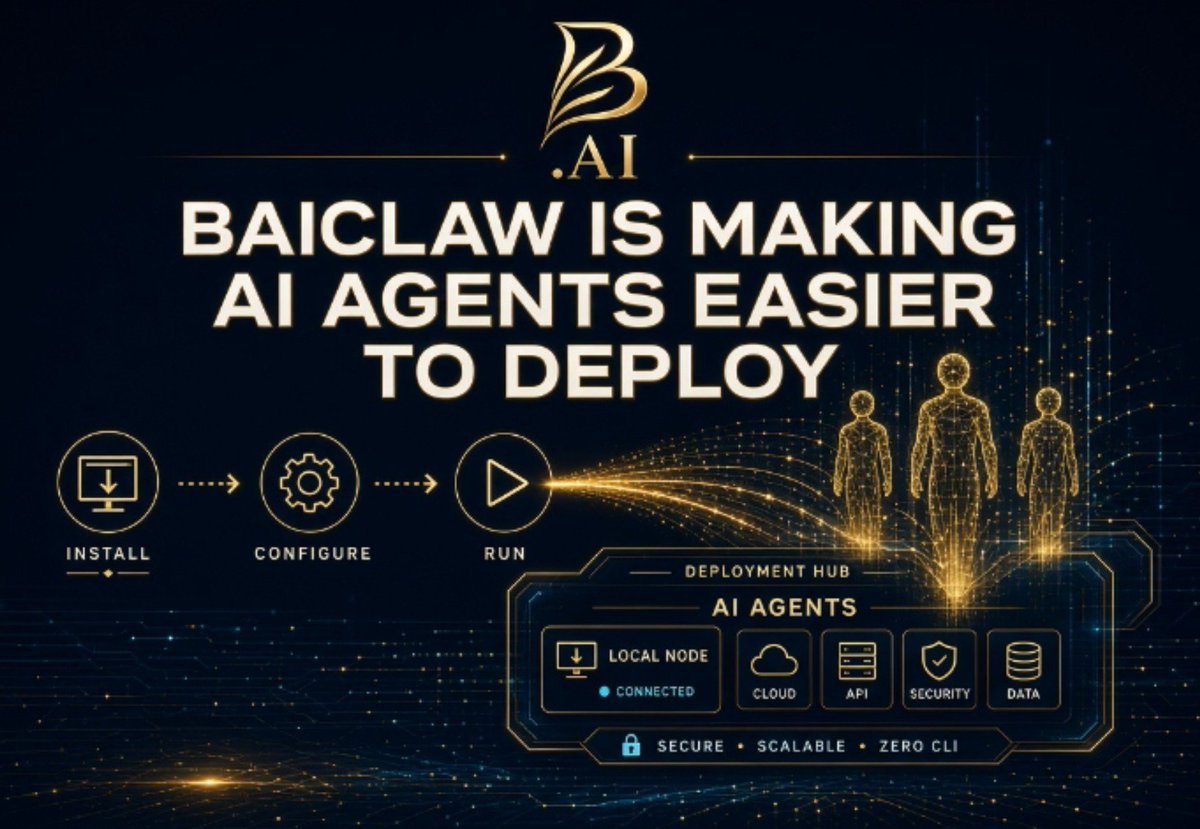
𝗕𝗔𝗜𝗖𝗟𝗔𝗪 𝗜𝗦 𝗠𝗔𝗞𝗜𝗡𝗚 𝗔𝗜 𝗔𝗚𝗘𝗡𝗧𝗦 𝗘𝗔𝗦𝗜𝗘𝗥 𝗧𝗢 𝗗𝗘𝗣𝗟𝗢𝗬
AI agents are becoming more capable, but capability alone isn't enough.
If users still need command-line tools, configuration files, and complicated workflows just to get an agent running, adoption remains limited.
That's the problem BAIclaw is designed to address.
It combines an agent runtime with a graphical interface so users can configure and operate AI agents without writing code or manually editing configuration files.
🧵👇
𝟭️⃣ 𝗙𝗥𝗢𝗠 𝗖𝗢𝗠𝗣𝗟𝗘𝗫 𝗦𝗘𝗧𝗨𝗣 𝗧𝗢 𝗚𝗥𝗔𝗣𝗛𝗜𝗖𝗔𝗟 𝗖𝗢𝗡𝗧𝗥𝗢𝗟
Traditional agent deployments can involve:
➝ Command-line configuration
➝ Manual setup
➝ Multiple tools
➝ Technical dependencies
BAIclaw puts these functions behind a visual interface.
The goal is straightforward:
Install → Configure → Create Agent → Run
No coding knowledge is required for the basic experience.
𝟮️⃣ 𝗜𝗧'𝗦 𝗡𝗢𝗧 𝗝𝗨𝗦𝗧 𝗢𝗡𝗘 𝗖𝗛𝗔𝗧𝗕𝗢𝗧
BAIclaw supports multiple specialized agents.
Each agent can have its own instructions and context, allowing different agents to handle different tasks.
For example:
➝ Research agent
➝ Content agent
➝ Coding agent
➝ Data-processing agent
Users can switch between agents instead of forcing one assistant to handle every workflow.
𝟯️⃣ 𝗔𝗚𝗘𝗡𝗧𝗦 𝗖𝗔𝗡 𝗖𝗢𝗡𝗡𝗘𝗖𝗧 𝗧𝗢 𝗧𝗛𝗘 𝗢𝗨𝗧𝗦𝗜𝗗𝗘 𝗪𝗢𝗥𝗟𝗗
The bigger difference is what happens beyond the chat window.
BAIclaw supports external communication channels including Telegram, Discord and other platforms, allowing agents to interact through connected accounts.
It also supports skills that extend what an agent can do, including document processing and search.
That changes the model from:
Ask AI → Get Answer
toward:
Give AI a task → Let the agent perform parts of the workflow
𝟰️⃣ 𝗔𝗨𝗧𝗢𝗠𝗔𝗧𝗜𝗢𝗡 𝗜𝗦 𝗔 𝗞𝗘𝗬 𝗣𝗔𝗥𝗧
BAIclaw includes scheduled tasks that allow agents to execute predefined workflows automatically according to configured triggers and intervals.
That can support workflows such as:
➝ Scheduled research
➝ Recurring reports
➝ Monitoring
➝ Content workflows
➝ Automated information collection
The important shift is from interactive AI toward persistent AI workflows.
𝟱️⃣ 𝗟𝗢𝗖𝗔𝗟-𝗙𝗜𝗥𝗦𝗧 𝗖𝗛𝗔𝗡𝗚𝗘𝗦 𝗧𝗛𝗘 𝗠𝗢𝗗𝗘𝗟
BAIclaw is designed as a desktop application with its agent environment running locally.
That gives users a different architecture from cloud-only AI assistants, while still allowing the agent to connect to external services when configured.
It's an important distinction:
Local agent environment + external capabilities
rather than simply sending every workflow to a centralized web interface.
𝟲️⃣ 𝗧𝗛𝗘 𝗕𝗜𝗚𝗚𝗘𝗥 𝗜𝗗𝗘𝗔
AI agents don't become useful merely because models become smarter.
They become more useful when people can actually deploy them into everyday workflows.
That's why reducing technical friction matters.
Less configuration → More experimentation → More workflows → More practical agent usage
BAIclaw is essentially trying to make that transition easier.
The future of AI agents isn't only about building more powerful models.
It's also about making autonomous workflows accessible to more people.
Install. Configure. Connect. Automate.
That's the direction BAIclaw is pushing toward.
@BAI_AGI@justinsuntron
#BAIclaw #BAI #AI #AIAgents #ArtificialIntelligence #Automation #Web3 #TRON #TRONEcoStar
🏦 𝗧𝗥𝗢𝗡 𝗜𝘀 𝗖𝗿𝗲𝗮𝘁𝗶𝗻𝗴 𝗔 𝗡𝗲𝘄𝗲𝗿 𝗟𝗶𝗻𝗸 𝗕𝗲𝘁𝘄𝗲𝗲𝗻 𝗖𝗿𝘆𝗽𝘁𝗼 𝗔𝗻𝗱 𝗧𝗿𝗮𝗱𝗶𝘁𝗶𝗼𝗻𝗮𝗹 𝗠𝗮𝗿𝗸𝗲𝘁𝘀
TRON's growth story is increasingly extending beyond on-chain activity.
The addition of TRON Inc. (Nasdaq: $TRON) to the Russell 2000, Russell 2500, and Russell 3000 indexes adds another layer to the relationship between the TRON ecosystem and traditional capital markets.
TRON Inc. is pursuing a $TRX treasury strategy through a publicly traded corporate structure.
That creates an interesting bridge between two very different financial environments.
➠ 𝗪𝗵𝗮𝘁 𝗧𝗵𝗲 𝗧𝗵𝗿𝗲𝗮𝗱 𝗟𝗼𝗼𝗸𝘀 𝗟𝗶𝗸𝗲
🔹 TRON → the blockchain network and ecosystem
🔹 $TRX → the native asset powering the network
🔹 TRON Inc. → a publicly traded company pursuing a $TRX treasury strategy
🔹 Russell Indexes → a major part of the traditional equity-market infrastructure
These aren't the same thing, but their connection creates an increasingly interesting intersection between blockchain infrastructure and public markets.
➠ 𝗪𝗵𝘆 𝗜𝗻𝗱𝗲𝘅 𝗜𝗻𝗰𝗹𝘂𝘀𝗶𝗼𝗻 𝗠𝗮𝘁𝘁𝗲𝗿𝘀
Russell indexes are widely followed by institutional investors and are used as benchmarks for a range of investment products.
Index inclusion can therefore increase a company's visibility among traditional investors and funds that track or benchmark against these indexes.
It doesn't automatically mean that every index-tracking fund will buy the stock.
But it does place the company within a broader institutional investment framework.
That distinction matters.
➠ 𝗧𝗵𝗲 𝗕𝗶𝗴𝗴𝗲𝗿 𝗣𝗶𝗰𝘁𝘂𝗿𝗲
This development is interesting because crypto and traditional finance don't necessarily have to meet through a single product.
The connection can happen through multiple layers:
Blockchain → Digital asset → Public company → Equity markets → Institutional capital
Each layer creates another potential point of interaction between traditional financial participants and the broader blockchain economy.
And this is an important part of how adoption can develop.
Not every step needs to look like a major crypto launch.
Sometimes adoption happens through public markets, corporate treasury strategies, institutional visibility, and established financial infrastructure.
TRON's ecosystem is increasingly participating across both on-chain and traditional financial environments.
The bigger question now is how far that connection can develop.
@justinsuntron@trondao
#TRONEcoStar #TRON #TRX #Crypto #TradFi #DeFi #Web3
💵 𝗧𝗵𝗲 𝗨𝗦𝗗𝗗 𝗗𝗲𝗙𝗶 𝗘𝗰𝗼𝘀𝘆𝘀𝘁𝗲𝗺 𝗢𝗳𝗳𝗲𝗿𝘀 𝗠𝗼𝗿𝗲 𝗧𝗵𝗮𝗻 𝗝𝘂𝘀𝘁 𝗬𝗶𝗲𝗹𝗱
There isn't a single correct way to use stablecoins in DeFi.
For one user, keeping things simple may be the priority. Another may want lending exposure, while a more experienced participant may be comfortable with structured yield strategies.
The important question isn't simply:
“What APY can I get?”
It's:
“What role does my USDD play, and what risks am I taking to achieve the return?”
🔹 𝗦𝘁𝗮𝗿𝘁 𝗪𝗶𝘁𝗵 𝗦𝗶𝗺𝗽𝗹𝗲𝗿 𝗨𝘀𝗲 𝗖𝗮𝘀𝗲𝘀
Newer DeFi users don't necessarily need to begin with complicated strategies.
Stablecoin earning opportunities available through platforms such as Binance Wallet can provide a simpler way to become familiar with putting USDD to work.
The focus at this stage is understanding the basics:
Deposit → Participate → Earn → Monitor
No complex strategy is required to begin learning how stablecoin capital can be deployed.
🔹 𝗟𝗲𝗻𝗱𝗶𝗻𝗴 𝗢𝗽𝗲𝗻𝘀 𝗔 𝗗𝗶𝗳𝗳𝗲𝗿𝗲𝗻𝘁 𝗣𝗮𝘁𝗵
Once users become more comfortable with DeFi, lending markets introduce another possibility.
On platforms such as JustLend DAO, supported USDD can be supplied as liquidity and participate in the lending economy.
More advanced strategies can go further by combining borrowing with redeployment:
Supply → Borrow → Deploy → Manage
But this isn't simply a more advanced version of earning.
Borrowing introduces another layer of exposure.
Interest costs, collateral requirements, liquidation risk, liquidity, utilization, incentives, and market movements can all affect the outcome.
🔹 𝗦𝘁𝗿𝗮𝘁𝗲𝗴𝗶𝗲𝘀 𝗖𝗵𝗮𝗻𝗴𝗲 𝗔𝘀 𝗨𝘀𝗲𝗿 𝗘𝘅𝗽𝗲𝗿𝗶𝗲𝗻𝗰𝗲 𝗚𝗿𝗼𝘄𝘀
Experienced participants may look beyond basic lending and explore specialized yield markets such as Pendle and other DeFi protocols.
At that point, the objective becomes less about simply holding a stablecoin and more about deciding how capital should be allocated.
A user's progression might look like:
Hold → Learn → Earn → Lend → Build Strategies → Diversify
But progression doesn't automatically mean taking more risk.
Sometimes the better strategy is the one that is easier to understand, easier to monitor, and better aligned with the user's objectives.
🔹 𝗔𝗣𝗬 𝗜𝘀 𝗡𝗼𝘁 𝗧𝗵𝗲 𝗪𝗵𝗼𝗹𝗲 𝗦𝘁𝗼𝗿𝘆
A large number on a DeFi dashboard can attract attention, but the percentage alone doesn't explain where the return comes from.
Before deploying USDD, users should consider:
• Where does the yield originate?
• Is the rate variable or sustainable?
• What smart contracts are involved?
• How liquid is the strategy?
• Is leverage being used?
• What happens if market conditions change?
The highest displayed APY isn't automatically the best opportunity.
Risk-adjusted understanding matters more than headline yield.
🔹 𝗢𝗻𝗲 𝗦𝘁𝗮𝗯𝗹𝗲𝗰𝗼𝗶𝗻. 𝗗𝗶𝗳𝗳𝗲𝗿𝗲𝗻𝘁 𝗦𝘁𝗿𝗮𝘁𝗲𝗴𝗶𝗲𝘀.
That's what makes a growing DeFi ecosystem useful.
USDD can have different roles depending on the user's objectives, experience, and risk tolerance.
The real advantage isn't that everyone has to follow the same strategy.
It's that users can choose how they want their stablecoin liquidity to participate.
@USDDecentralize@DeFi_JUST@justinsuntron
#USDD #TRON #DeFi #Stablecoins #Web3 #TRONEcoStar
𝗧𝗛𝗘 𝗠𝗢𝗠𝗘𝗡𝗧 𝗪𝗜𝗡𝗞𝗟𝗜𝗡𝗞 𝗠𝗔𝗗𝗘 𝗢𝗥𝗔𝗖𝗟𝗘𝗦 𝗙𝗜𝗡𝗔𝗟𝗟𝗬 𝗖𝗟𝗜𝗖𝗞 𝗙𝗢𝗥 𝗠𝗘 🔗👁️
When I first came across crypto oracles, they sounded more complicated than they really were.
Then one simple idea made everything click:
Blockchains can execute rules, but they don't naturally know what is happening outside the blockchain.
A smart contract can follow its instructions perfectly, but it cannot independently check a market price, retrieve information from an external API, or generate verifiable randomness.
It needs a connection to external information.
That is where @WinkLink_Oracle fits into the TRON ecosystem. 🧵👇
🔹 𝟭. 𝗔 𝗕𝗟𝗢𝗖𝗞𝗖𝗛𝗔𝗜𝗡 𝗖𝗔𝗡 𝗘𝗫𝗘𝗖𝗨𝗧𝗘 — 𝗕𝗨𝗧 𝗜𝗧 𝗖𝗔𝗡'𝗧 𝗡𝗔𝗧𝗜𝗩𝗘𝗟𝗬 𝗦𝗘𝗘
Think of a smart contract as a highly precise machine.
Give it the required input, and it executes its programmed rules.
But the blockchain itself cannot simply reach outside its environment and ask:
➠ What's the current asset price?
➠ Did a particular real-world event happen?
➠ What does an external API report?
➠ Can I generate a verifiable random outcome?
WINkLink is designed to bridge that gap by connecting smart contracts with off-chain data through decentralized oracle infrastructure.
🔹 𝟮. 𝗧𝗛𝗘 𝗢𝗥𝗔𝗖𝗟𝗘 𝗕𝗘𝗖𝗢𝗠𝗘𝗦 𝗧𝗛𝗘 𝗖𝗢𝗡𝗡𝗘𝗖𝗧𝗜𝗢𝗡
The basic flow becomes much easier to understand:
External Data → WINkLink → Smart Contract → On-Chain Action
The contract still controls the rules.
WINkLink provides a way for relevant external information to reach that contract.
That distinction is important:
Blockchain = execution
Smart contract = rules
Oracle = external information
🔹 𝟯. 𝗜𝗧'𝗦 𝗡𝗢𝗧 𝗝𝗨𝗦𝗧 𝗔𝗕𝗢𝗨𝗧 𝗣𝗥𝗜𝗖𝗘𝗦
Oracle infrastructure has applications beyond basic price feeds.
WINkLink currently describes four core services:
➠ Price Service — financial data from multiple sources
➠ VRF — verifiable random numbers
➠ AnyAPI — connections to custom external data sources
➠ Smart Contract Automation — execution when predefined conditions are met
That opens the door to applications across DeFi, gaming, automation and other smart-contract systems.
🔹 𝟰. 𝗧𝗛𝗘 𝗜𝗡𝗙𝗥𝗔𝗦𝗧𝗥𝗨𝗖𝗧𝗨𝗥𝗘 𝗨𝗦𝗘𝗥𝗦 𝗗𝗢𝗡'𝗧 𝗡𝗢𝗧𝗜𝗖𝗘
Users usually see the application, not the infrastructure underneath it.
A lending protocol updates collateral conditions.
A DeFi application references a market price.
A blockchain game needs a random outcome.
An automated contract executes after a predefined condition is satisfied.
The experience looks simple.
Behind it, however, the application may depend on external information being delivered into the on-chain environment.
That's why oracle infrastructure can be easy to overlook while still being fundamental to how many Web3 applications function.
🔹 𝟱. 𝗧𝗛𝗜𝗦 𝗕𝗘𝗖𝗢𝗠𝗘𝗦 𝗘𝗩𝗘𝗡 𝗠𝗢𝗥𝗘 𝗜𝗡𝗧𝗘𝗥𝗘𝗦𝗧𝗜𝗡𝗚 𝗪𝗜𝗧𝗛 𝗔𝗜
AI agents can analyze information and make decisions.
But intelligent decisions still depend on the information being available to the system.
That creates an interesting architecture:
AI → Intelligence
Oracle → External Data
Blockchain → Execution
An AI agent could determine what action should happen, an oracle layer could provide relevant external information, and a smart contract could execute according to predefined rules.
That is one possible building block for more autonomous Web3 applications.
🔹 𝟲. 𝗧𝗛𝗘 𝗕𝗜𝗚𝗚𝗘𝗥 𝗜𝗗𝗘𝗔
The important thing about WINkLink isn't simply that it "provides data."
It helps solve a fundamental limitation:
How does a decentralized application interact with information that doesn't originate on its blockchain?
TRON provides the execution environment.
@WinkLink_Oracle@justinsuntron
#WINkLink #WIN #Oracle #AI #DeFi #SmartContracts #Web3 #Blockchain #TRON #TRONEcoStar