The intelligent economy demands secure custody 🌐
@BosonProtocol is reshaping how value moves between humans and AI, enabling verifiable, trustless exchange for any agent.
$BOSON, the protocol’s core token, stays fully under your control with @GuardaWallet.
Google, OpenAI, Visa, and Stripe are all building payment rails for AI agents but they’re centralized. 💥💯
That’s the problem.
When both sides are software, unknown, high-frequency, even adversarial, you need guarantees, not trust. Centralized escrow puts one party in control of outcomes. That’s not neutral infrastructure.☑️✅
Verifiable fair exchange changes that: either the item is delivered, or funds are returned, no counterparty risk, no subjective rulings, no platform cuts.🤔🤔
@BosonProtocol delivers this with trust-minimized escrow for agent-driven commerce—at ~0.5% fees, not 20–30%.
What happens when the parties you’re dealing with aren’t people, but software agents you don’t know, acting fast, and possibly against your interests?
What can you really trust in that kind of environment? 🤔🤔
Not reputation.
Not legal contracts.
Not “we’ll sort it out later.”
This is the core problem behind agent-driven commerce.😎😎
As machines begin to buy, sell, and negotiate on our behalf, we need a new kind of trust, one that works instantly, automatically, and without relying on human systems.💯🔥
That’s the idea behind @BosonProtocol building a decentralized commerce layer designed for an intelligent, automated economy.💥💯
Commerce isn’t just evolving, it’s being reshaped.
Autonomous AI agents will soon trade real-world assets nonstop, at speeds humans can’t match.
To scale this agent-driven economy, foundational infrastructure is essential, and @BosonProtocol provides exactly that.
Thread 🧵👇
The idea that you must trade usability for decentralization is often a sign of poor system design.😎😎
Look at ERC-8183:
Relies on an external party to finalize transactions
Control over dispute resolution sits with the buyer
Incentives aren’t clearly aligned
Leads to delays and weaker reliability ✅🚀
Now compare that to @BosonProtocol:
No central authority in normal operation
Transactions complete automatically in most cases
Lower friction through efficient design choices
Built to integrate with broader on-chain systems. 💯🚀
Incentives are structured to encourage honest outcomes
The difference comes down to design logic.
When incentives are engineered properly, you don’t have to sacrifice user experience for decentralization ; you can achieve both at the same time.💥😁
AI agents are becoming more independent ; with enough training, they can think and act very much like you.💯✅
But the real challenge isn’t the agents themselves. It’s the marketplaces they operate in. Even on familiar platforms like Jumia, trusting an unknown seller can still be risky.🤔🤔
Adding AI into these systems doesn’t fix that.
@BosonProtocol focuses on something deeper ,making exchanges between strangers work without relying on trust at all. 🚀😎
Blockchains already allow digital transactions without trust. The problem starts when physical goods are involved.
Boson solves this by structuring deals so neither side is exposed.
The trade either completes as agreed, or it simply doesn’t go through without unfair loss on either end.
That means fewer risks like paying and not receiving, or getting something below expectation.
In this setup, both people and AI agents can transact with confidence, because the system enforces the outcome, not trust.
It’s a different way to think about commerce: not hoping the other party is honest, but ensuring the transaction itself is fair by design.
Instead of asking, “How do we protect funds?” it asks, “What is a transaction at its core?” 🤔🤔
A transaction is a commitment
someone promises to deliver, and someone else has the right to receive.
That promise has value even before anything is fulfilled. 💯💯
So rather than locking money away, @BosonProtocol turns that promise into a tradable asset. The buyer gets an NFT that represents their right to redeem. And that NFT isn’t static , it can be held, sold, transferred, or even used in other financial activities.
The transaction doesn’t pause. It keeps moving. 🚀🚀
Most deals complete without issues, and disputes become the exception, not the norm. Because these commitments are tokenized, they can connect with the wider ecosystem , marketplaces, lending systems, DAOs.
In simple terms:
One model treats commerce like money waiting in a vault for a decision.
The other treats it like a living agreement that can move, adapt, and create value across the system.
The starting perspective changes everything. ✅✅
Reputation doesn’t really protect you in agent-based systems it can actually be used against you. ✅✅
Agents don’t hold a fixed identity. They can create one, build trust quickly, use it, and then vanish all at high speed.
Then they just start again with a new identity.😎😎
When identities are cheap and easy to reset (like sybils), reputation stops being a strong defense. Instead, it becomes part of the trap, something used to gain trust before exploiting it.
If your system is focused on identifying “good actors,” you’re solving the wrong problem.💯💥
The real issue is this: can an agent cheat and still make profit?
That’s the standard that matters.
That’s the direction @BosonProtocol is pushing building systems where cheating isn’t profitable in the first place. And standards like ERC-8183 haven’t fully reached that level yet.
$BOSON is positioning itself at the front of secure, agent-driven commerce.
🚨 New AI listing on MEXC with a 75,000 USDT reward pool is live.
A new AI-focused project FORU AI (FORU) has officially been listed in the MEXC Innovation Zone (one of the most active exchanges when it comes to early listings and incentive campaigns) and to celebrate the listing, @MEXC_Official has launched a massive 75,000 USDT reward campaign 🔥
Here is why this Campaign is worth paying attention to 👇
🧠FORU AI is building an AI-powered reputation Platform designed to track real contributions, credibility, and User's activity across digital platforms which makes the Project Unique.
💰75,000 USDT up for grabs; So we have different tasks which includes the New User Tasks, Advanced and Achievement Tasks. Participants can earn rewards through activities such as:
• Trading FORU
• Completing campaign tasks
• Participating in platform Activities
⚡ Up to 300% APR for new users; One of the biggest highlights of the campaign is the APR booster for new users which means they can unlock APR boosters of up to 300% through flexible savings rewards tied to the campaign.
📊Available for both new & active traders; Whether you're joining MEXC for the first time or already trading there, the event rewards activity meaning deposits, trading participation, and completing tasks can all increase your chances of earning from the prize pool.
The Campaign runs from the 11th to 18th of March which means you have just 5 days left to join
If this Sounds like what interest you, then head to the Campaign Page and Register then complete the tasks to earn rewards: https://t.co/4GShpCu0Uc
Today’s global economy still runs on slow processes like email approvals, paperwork, and having it processed on weekdays like the usual 😁😁
For small, simple transactions, that system works.
But once things become complex, the friction starts to show.
What @BosonProtocol is pointing toward with the Computable Economy, this goes far beyond the smart contracts people usually talk about. 😎😎
The core idea is simple and easy to understand;
What if agreements didn’t depend on trust, office hours, or manual approval but instead executed automatically as code?
We’re already seeing the early version of this shift: 🤔🤔
✅ DeFi loans operating 24/7
✅ On-chain markets settling instantly
✅Stablecoins moving billions without traditional banking rails
This isn’t just faster finance.
It’s programmable coordination where economic activity can run automatically through code.
And that changes the structure of the economy itself.
We’re gradually moving toward a world where agreements aren’t only signed…
They’re compiled and executed.
That’s a future worth watching.💥💥
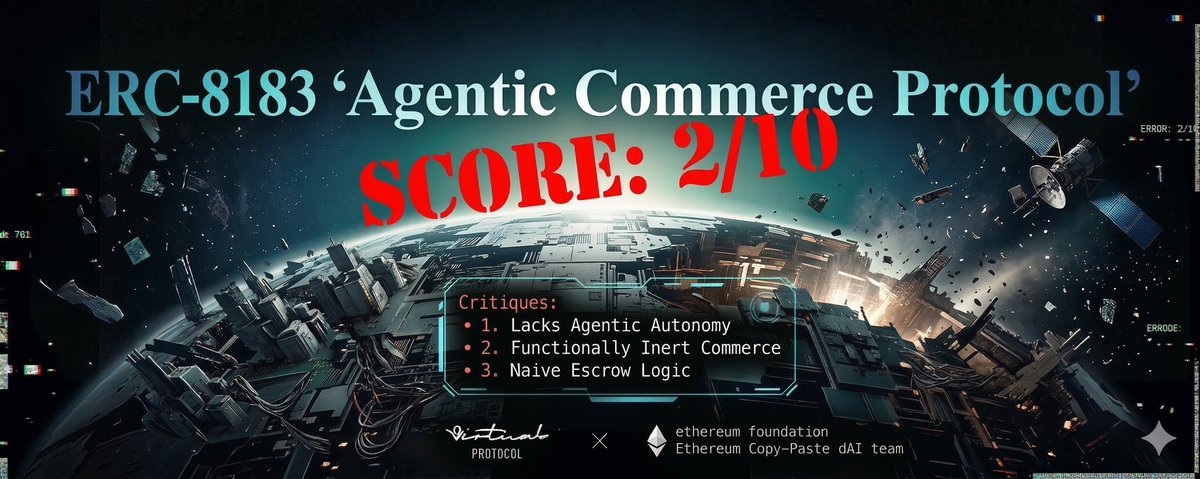
Let's look at @virtuals_io ERC-8183 “Agentic Commerce Protocol”
Score: 2/10
Despite the name, it’s neither truly agentic nor a real commerce protocol.
There’s nothing agent-specific in the design ;
It functions mostly as a simple three-party escrow. It also lacks core commerce logic at the protocol level, leaving most of the real work to implementers.
The result is a naive structure with major game-theoretic weaknesses.
Below are the top 6 issues 👇
✅Evaluator inaction
✅Evaluator selection
✅No payment for the evaluator
✅No optimistic fulfillment
✅Capital lockup griefing
✅Reputation as the only defense
At @BosonProtocol these are exactly the problems we set out to solve building a protocol designed for decentralized agentic commerce in the Intelligent Economy.