Over the past year leading Product at @DriftProtocol, we’ve spent most of our time shipping in production and learning from real usage rather than theory. This piece captures a snapshot of what we’ve built so far and the principles guiding those decisions.
I’m proud of the progress the team has made across areas like capital efficiency, composability, and execution quality, and of a number of concrete improvements we’ve shipped along the way. That includes SWIFT for gasless trading, our JIT auction mechanism, custom leverage per market, and other upgrades that came directly from observing real user activity and market edge cases onchain.
Supporting multiple liquidity models under one protocol has been a pragmatic choice for us. Different flows behave differently, and we’ve found that flexibility at the protocol level matters if you want to serve them well.
We’ve also stayed closely aligned with Solana as the underlying infrastructure continues to improve on latency and performance, and we expect those improvements to keep showing up in Drift’s trading outcomes over time as well.
That said, Drift is very much still a work in progress. There’s a long way to go, and plenty of things we can always do better to further improve user experience. Drift's loyal trading community has been the lifeblood of the platform through thick and thin. We’re keen to keep learning from users, builders, and market participants, and would genuinely welcome feedback as we continue iterating.
Our DMs are always open for support, feedback and suggestions.
Back to keeping our heads down and shipping.
Introducing: Drift v3
Drift has built through bull and bear to deliver one thing: a better trading experience.
Today, Drift v3 goes live. A modern redesign with 10x faster execution.
Built to outperform.
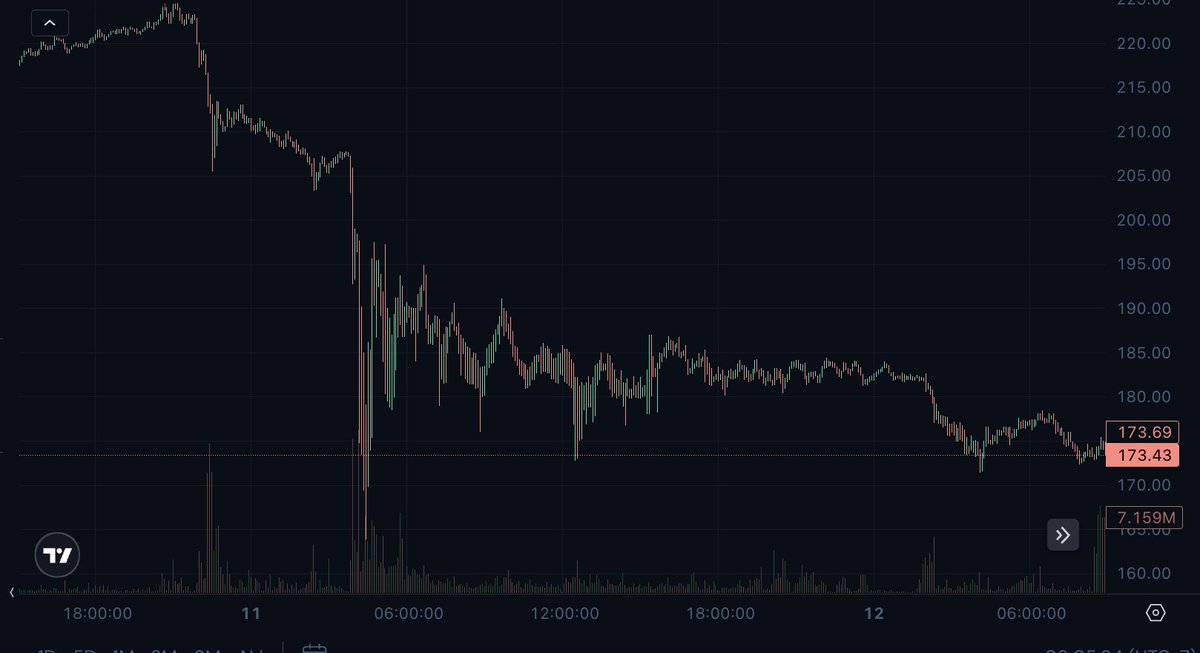
Crypto markets suffered a $20B drawdown yesterday after Trump's surprise tariff announcement, which spiralled into one of the most severe 1-day drawdowns in all of crypto's history
Many have asked how @DriftProtocol's risk engines performed, and I want to highlight how Drift has always puts users first and handles risk and liquidations differently from other exchanges:
1. Drift does not have an ADL (auto-deleveraging system) - it has a risk waterfalling system to socialize losses among everyone remaining in positions pro rata by size.
Yesterday, the vAMM reserves and insurance fund successfully covered all user losses, so no positions were deleveraged
2. Drift also has one of the largest Insurance Fund to Open Interest ratios across all Perp DEXes with $50m to support $500m+ in open interest, giving a huge buffer for the protocol to support bad debt
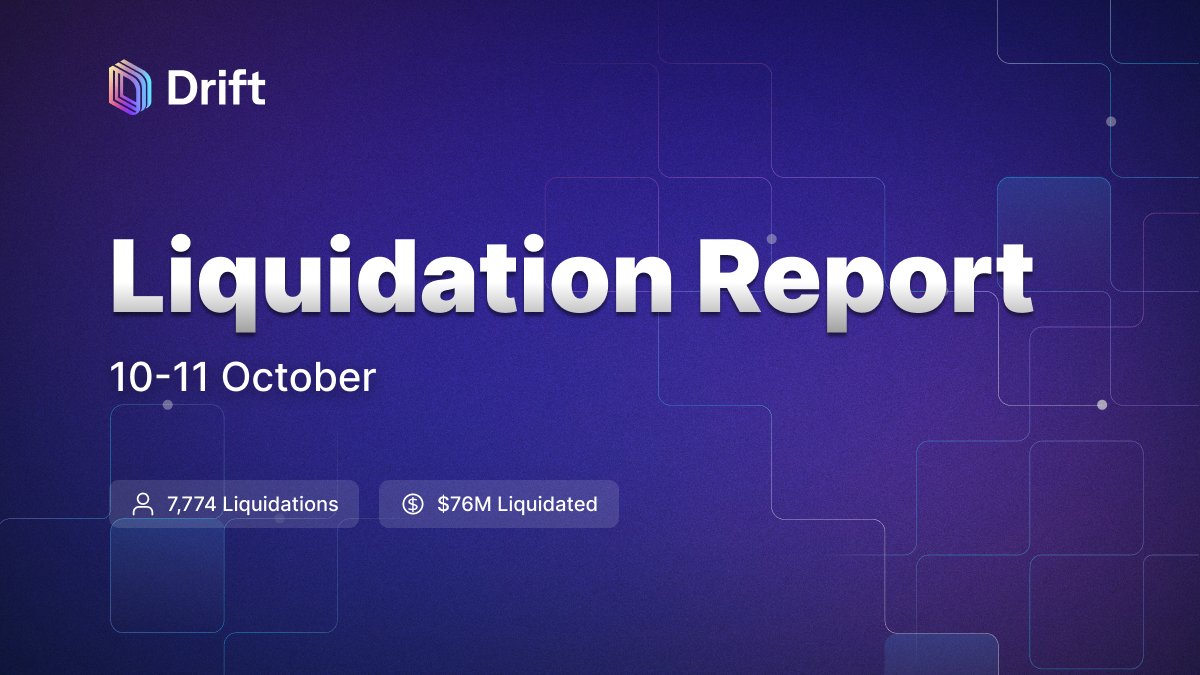
3. Even though we are a cross-collateralised exchange, our risk engine managed to do $76m in liquidations with no user losses
4. Solana and Drift experienced zero downtime, with Solana crushing it with record TPS yesterday of 3200+.
5. Drift's fee pools covered all losses, and there was no bad debt incurred for users.
It’s been a challenging day for the industry, but moments like this underscore the importance of robust design for exchanges that always puts users first
Up
Correction: The previously cited $18K in socialized losses was inaccurate. In reality, all uncovered payments were absorbed by Drift’s vAMM fee pools with no users exposed.
In the past 24 hours, crypto markets experienced one of the largest flushes in recent history. This was a true stress test for risk systems across the ecosystem, including Drift.
Amid this extreme volatility, Drift processed over $76 Million in liquidations across both perpetual and spot markets, incurring just $18K (~0.02%) in socialised losses and maintaining zero downtime throughout.
Drift’s risk engine ensured orderly markets and user protection through prudent liquidation parameters, a robust Insurance Fund, and multiple loss-mitigation mechanisms.
Insurance Fund (IF) depositors earned $600K from the liquidation activity. The IF continues to reinforce protocol stability while providing sustainable yield opportunities for participants underwriting protocol risk.
Drift is in full growth mode.
In Asia, there’s a saying about bamboo: it spends 4 years building roots underground, then in the 5th year, it shoots up almost a meter a day, reaching 25m tall.
Real growth takes time. Foundations come first, then explosive results.
2025 Q2: sharpened trade execution + app performance
2025 Q3: shipping CEX-grade trading UX (two major features highlighted here: https://t.co/BJaTrIzIma
2025 Q4: Expansion. Growing user base
So far, most of the volume growth came from existing traders. Next, it's about scaling users.
More users → more volume → deeper liquidity → less slippage → more users. And the cycle goes on.
Coincidentally, Drift is in its 4th year (v1 + v2). Foundation is getting stronger day by day. Soon, we will shoot up a meter a day.
Hey @solanasapien sorry to hear that you experienced this. Drift's UI could have been written clearer with what's going on instead of just throwing an error code to you.
I'll walk you through what exactly happened.
AUSD's total deposit has been quite thin and unfortunately when you attempted to withdraw your deposits, Total AUSD Deposit - Your requested withdrawal was smaller than the Total AUSD Borrowed, and hence the system prevented you from withdrawing.
This issue is isolated to AUSD only, and other markets (e.g. USDC, SOL) have thick book and buffers in place to prevent this from happening.
We will be improving UI and explanation more explicitly to prevent this from happening in the future and have a more systematic way to manage markets with small deposit amount.
🚨 Drift is hiring a QA engineer 🚨
You'll work with our dev/product team to make sure we maintain a an world-class trading experience while we aggressively iterate on product
Potentially a great way for a junior dev to earn full time role
Link below 👇 dm me 📨
@oladanx@oladanx We are working on many more exciting updates -- faster deposit, faster transactions, completely skipping transactions signing (not just for 24hr). Stay tuned 👀