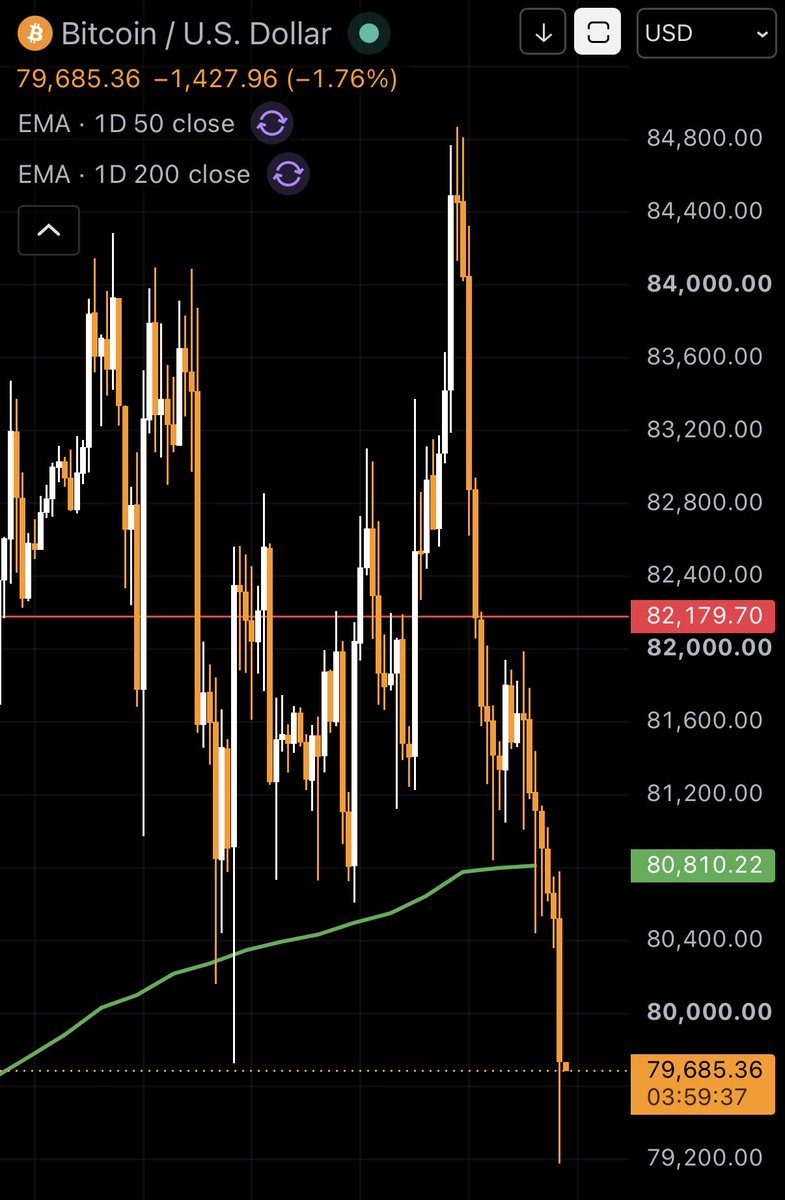
In 2025, I would get so stressed over the market dumping because I was just so overexposed to so many different kinds of risk assets
I was dabbling heavily in covered-call stocks, MSTR and Base alts
No index funds
No BTC
No Majors
Low Savings
Lost around $10,000 that year and at one point I actually broke down
This year, I told myself to manage risks better, and as of this month, my allocations are:
> Savings and Stable/Yield: 45%
> Index Funds: 29%
> BTC: 14%
> Trading: 9.5%
> Others: 2.5%
Yes it still sucks to see market go down and my trading port lose a lot but I can weather the storm better now because I know I'm not going to 0
As @ProofOfTravis once told me, "in this industry, making money isn’t as hard as people think, it’s sitting on your hands and avoiding distractions that is the hardest part."
So I size into few conviction bets with whatever I can afford to and wait while the boring DeFi yield and index funds grows the rest of my stack
do you feel stressed watching this?
if your financial situation depends on short term price movements then you must be
learn skills > make money > invest with a long term strategy
@thetrackk yes sir 🫡 for me mainly it's $ANSEM that made me feel like selling
for my SOL and xSOL position I am not selling anytime soon
but also I can handle the dump because most of my assets are still growing(ish) just slowly
Some thoughts I had regarding the recent market moves (June-Oct)
Markets are forward-looking
Price reflects expectations of future growth, demand and risk
not just current fundamentals
A network can grow while its token underperforms
Here's what I'm watching when analysing a potential pump or dump:
1. Macro & geopolitics
Wars and supply shocks can push energy prices higher, adding inflationary pressure reducing chance for rate cuts
Tighter financial conditions can reduce demand for risk assets regardless of how strong crypto fundamentals look
2. Network growth & token value accrual
More users and protocol activity don't automatically translate into token pamp
more importantly: how does that activity create demand for the token or reduce its supply?
Solana Ecosystem can grow, but how much do token holders benefit off that activity?
but at the same time, something like HYPE having 97% buyback also doesn't guarantee token pamp
Value acrrual matters, but it's just one piece of the puzzle
3. Social sentiment & capital rotation
Sentiment helps us understand where we are in a narrative cycle
Early interest can precede wider adoption
Insane bullposting can signal crowded expectations
Doomposting can indicate capitulation or deteriorating fundamentals
Example: The $ANSEM cycle
ANSEM launching revived the memecoin trenches
As newer launches ($PONS, $STONK) attracted attention, capital rotated between plays
Eventually, narratives weakened and previously strong tokens began retracing
My hypothesis: narrative exhaustion and profit-taking, compounded by trash macro, contributed to the dumping in ANSEM and SOL (and also the fact Ansem stopped talking about it)
4. Derivatives positioning
OI, funding and liquidations help reveal leverage and trader positioning
but derivatives alone don't tell us whether long-term fundamentals have changed
Ultimately, no single metric predicts the next move
My framework for the next cycle:
> Macro & geopolitics
> Network growth & token value accrual
> Social sentiment & capital flows
> Derivatives positioning
> Valuation and expectations already priced in
Tbh, I think I'm finally starting to be able to observe these patterns after being caught up with the market the whole year
Hope to nail some good profits on the next mini cycles
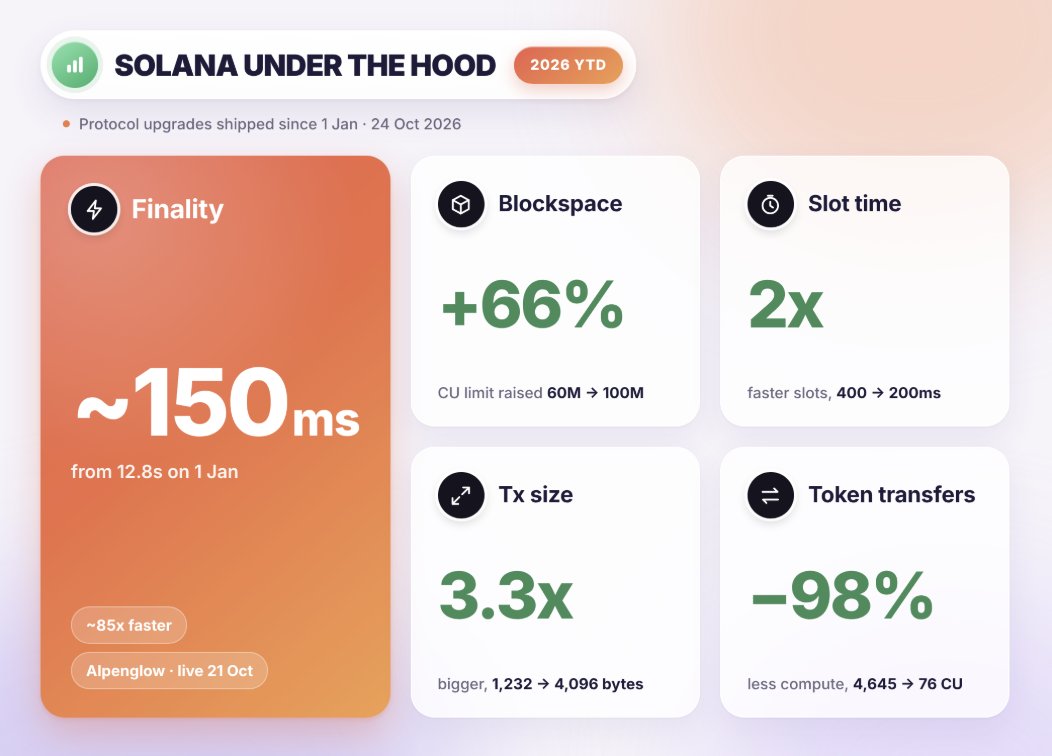
🚨SOLANA'S 2026 SO FAR, BY THE NUMBERS:
Protocol upgrades:
- Slot times halved from 400ms to 200ms
- Max tx size raised from 1,232 to 4,096 bytes
- Token transfer compute cut 98% with P-Token
- Finality cut from 12.8s to ~150ms with Alpenglow
- Block compute limit raised from 60M to 100M CUs
Adoption:
- RWA holders grew from 126K to 831K
- RWA value grew from $873M to $4.87B
- Tokenised stocks grew from 115 to 2,036
- Spot ETF inflows grew from $766M to $1.6B