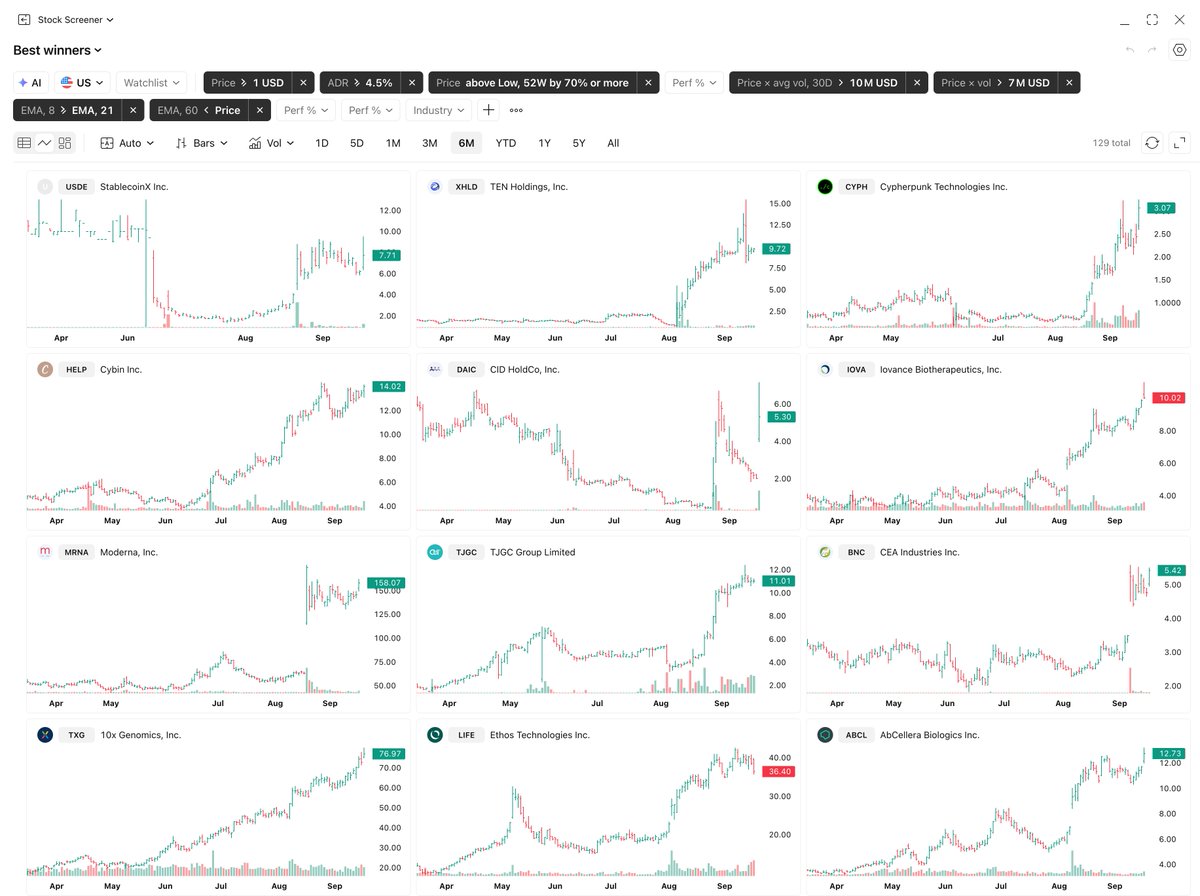
This is the ONLY stock screener in @TradingView I use to find my next big winners.
And it’s surprisingly simple.
I’m not trying to find hundreds of stocks. I want a small hunting ground of exceptional growth and momentum stocks that deserve a deeper look.
From there, I look for:
1. Exceptional relative strength
I want stocks that have already proven themselves. One of my key filters: at least 70% above the 52-week low.
2. Clean, tight price action
VCPs, flags, tight bases, higher lows. I want contraction and control—not wide, erratic price action.
3. Strong volume characteristics
I look for signs of accumulation and unusually strong volume when the stock advances.
4. Exceptional growth
My minimum: 20%+ sales growth and 50%+ EPS growth. The strongest leaders often show much more.
5. A powerful theme or catalyst
I want to understand WHY institutions could become interested in the company. The chart gets my attention. Research gives me context.
6. Asymmetric opportunities
I’m looking for stocks capable of becoming major winners. If I can’t see substantial upside relative to my defined risk, I’m not interested.
🔗 Here is the exact TradingView screener I use: https://t.co/FfuBt33xQb
I run it every day and every weekend.
The screener doesn't find my trades.
It tells me where to start looking.
🚨 ATTENTION : LES GENS REPÈRENT IMMÉDIATEMENT QUAND VOUS UTILISEZ CHATGPT OU CLAUDE.
La structure, le ton, ce texte beaucoup trop travaillé. Tout vous trahit.
6 prompts pour corriger ça :
$ORA ... Ormat Tech signs 20-year PPA with Switch for ~13MW of carbon-free geothermal capacity to power data centers (119.05 +3.70)
Co announces the signing of a 20-year Power Purchase Agreement (PPA) with Switch, the premier provider of AI, cloud and enterprise data centers. This agreement represents Ormat's first direct PPA with a data center operator, highlighting Ormat's leading capabilities in geothermal energy production and the growing demand for sustainable energy solutions to serve the data center industry.
Under the terms of the agreement, Switch will purchase approximately 13MW of clean, renewable energy from Ormat's Salt Wells geothermal power plant located near Fallon, Nevada. As part of the agreement Ormat has the option to further expand the facility's output to Switch by adding an approximately 7MW Solar PV facility, which will serve the auxiliary power needs of the geothermal power plant.
The combined output will help support the power needs of Switch's Nevada data centers, aligning with their commitment to sustainability and carbon reduction. Energy deliveries under the PPA are scheduled to commence in the first quarter of 2030, following the completion of a major upgrade to the Salt Wells power plant, which is expected to be finalized by the second quarter of 2026.
$ORA Q3 2025 earnings: Storage & Product Segments Shine, Offsetting Electricity Headwinds; Guidance Raised.
Ormat delivered a strong quarter driven by impressive growth in its Energy Storage and Product segments. These segments more than compensated for temporary weakness in the core Electricity business, which faced issues from a storm-related grid failure and other headwinds. The company's strategic moves into next-generation geothermal (EGS) and a solid guidance increase paint a positive picture for the future.
🐂 𝗕𝘂𝗹𝗹 𝗰𝗮𝘀𝗲
Bulls will focus on the raised full-year guidance for revenue and Adjusted EBITDA. The explosive growth in Energy Storage (+108%) and Product (+67%) revenues shows the diversification strategy is working well. A growing Product backlog of $295 million and major strategic partnerships with SLB and Sage to accelerate EGS development are significant long-term catalysts.
🐻 𝗕𝗲𝗮𝗿 𝗰𝗮𝘀𝗲
Bears will point to the weakness in the core Electricity segment, where revenue was nearly flat and margins compressed. Despite a 17.9% jump in total revenue, Adjusted EBITDA grew only 0.6%, suggesting profitability challenges. The ongoing nature of one-off issues in the Electricity segment (last quarter it was Puna, this quarter a storm) is a recurring concern.
⚖️ 𝗩𝗲𝗿𝗱𝗶𝗰𝘁
The bull case is more compelling. The issues in the Electricity segment appear temporary and are being successfully offset by outstanding execution in the higher-growth Storage and Product segments. The decision to raise full-year guidance, especially for revenue and EBITDA, demonstrates management's confidence. The new EGS partnerships are a significant step forward, solidifying Ormat's leadership in the future of geothermal energy.
***
𝟮. 𝗧𝗵𝗲𝗺𝗲𝘀, 𝗱𝗿𝗶𝘃𝗲𝗿𝘀, 𝗮𝗻𝗱 𝗰𝗼𝗻𝗰𝗲𝗿𝗻𝘀
🟢 𝗘𝗻𝗲𝗿𝗴𝘆 𝗦𝘁𝗼𝗿𝗮𝗴𝗲 𝗚𝗿𝗼𝘄𝘁𝗵: This segment continues to be a star performer. Revenue more than doubled year-over-year, driven by new facilities coming online, like the Lower Rio project. This theme has materialized strongly and is accelerating.
🟢 𝗣𝗿𝗼𝗱𝘂𝗰𝘁 𝗦𝗲𝗴𝗺𝗲𝗻𝘁 𝗥𝗲𝗰𝗼𝘃𝗲𝗿𝘆: The robust performance from last quarter continued. Revenue grew significantly by 66.6%, and the backlog increased to a healthy $295 million after signing a new contract. This driver is performing ahead of schedule.
🟢 𝗘𝗻𝗵𝗮𝗻𝗰𝗲𝗱 𝗚𝗲𝗼𝘁𝗵𝗲𝗿𝗺𝗮𝗹 𝗦𝘆𝘀𝘁𝗲𝗺𝘀 (𝗘𝗚𝗦) 𝗣𝗿𝗼𝗴𝗿𝗲𝘀𝘀: 𝗡𝗲𝘄 𝗧𝗵𝗲𝗺𝗲. This quarter saw a major strategic leap forward. Ormat announced partnerships with industry leader SLB and Sage Geosystems to fast-track EGS development. This moves EGS from a long-term idea to a tangible, near-term strategic focus.
🟡 𝗘𝗹𝗲𝗰𝘁𝗿𝗶𝗰𝗶𝘁𝘆 𝗦𝗲𝗴𝗺𝗲𝗻𝘁 𝗛𝗲𝗮𝗱𝘄𝗶𝗻𝗱𝘀: A persistent concern. In Q2, the issues were maintenance at Puna and curtailments. This quarter, the segment was hit by a storm-related grid failure in California, ongoing curtailments in Nevada, and lower energy rates at Puna. While the causes change, the segment's results remain pressured, leading to a guidance reduction for this specific segment.
🟡 𝗗𝗮𝘁𝗮 𝗖𝗲𝗻𝘁𝗲𝗿 / 𝗣𝗣𝗔 𝗡𝗲𝗴𝗼𝘁𝗶𝗮𝘁𝗶𝗼𝗻𝘀: The company still expects to finalize new Power Purchase Agreements (PPAs), likely with data centers. However, no deals have been announced yet. This remains a key future catalyst that investors are waiting for.
⚪ 𝗙𝗘𝗢𝗖 & 𝗦𝗮𝗳𝗲 𝗛𝗮𝗿𝗯𝗼𝗿𝗶𝗻𝗴: No significant updates this quarter. The company continues its strategy of "safe-harboring" projects to secure tax credits and mitigate risks associated with sourcing batteries from foreign entities of concern.
***
𝟯. 𝗠𝗮𝗶𝗻 𝗙𝗶𝗻𝗮𝗻𝗰𝗶𝗮𝗹𝘀
Reported numbers for Q3 2025 were strong on the top line but showed some pressure on profitability compared to last year.
* 𝗧𝗼𝘁𝗮𝗹 𝗥𝗲𝘃𝗲𝗻𝘂𝗲𝘀: $249.7M, up 𝟭𝟳.𝟵% YoY. A very strong result.
* 𝗘𝗹𝗲𝗰𝘁𝗿𝗶𝗰𝗶𝘁𝘆 𝗥𝗲𝘃𝗲𝗻𝘂𝗲: $167.1M, up just 𝟭.𝟱% YoY.
* 𝗣𝗿𝗼𝗱𝘂𝗰𝘁 𝗥𝗲𝘃𝗲𝗻𝘂𝗲: $62.2M, up 𝟲𝟲.𝟲% YoY.
* 𝗘𝗻𝗲𝗿𝗴𝘆 𝗦𝘁𝗼𝗿𝗮𝗴𝗲 𝗥𝗲𝘃𝗲𝗻𝘂𝗲: $20.4M, up 𝟭𝟬𝟴.𝟭% YoY.
* 𝗔𝗱𝗷𝘂𝘀𝘁𝗲𝗱 𝗘𝗕𝗜𝗧𝗗𝗔: $138.4M, up 𝟬.𝟲% YoY. Growth was muted, partially because Q3 of last year benefited from higher income from tax benefit sales and a legal settlement.
* 𝗔𝗱𝗷𝘂𝘀𝘁𝗲𝗱 𝗗𝗶𝗹𝘂𝘁𝗲𝗱 𝗘𝗣𝗦: $0.41, down from $0.42 last year.
***
𝟰. 𝗚𝘂𝗶𝗱𝗮𝗻𝗰𝗲
Ormat raised its full-year 2025 guidance, signaling confidence for the remainder of the year. The details show that outperformance in Storage and Product is more than covering for the shortfall in Electricity.
* 𝗧𝗼𝘁𝗮𝗹 𝗥𝗲𝘃𝗲𝗻𝘂𝗲𝘀: Raised to 🟢 💲𝟵𝟲𝟬𝗠 - 💲𝟵𝟴𝟬𝗠 (from $935M - $975M).
* 𝗔𝗱𝗷𝘂𝘀𝘁𝗲𝗱 𝗘𝗕𝗜𝗧𝗗𝗔: Raised to 🟢 💲𝟱𝟳𝟱𝗠 - 💲𝟱𝟵𝟯𝗠 (from $563M - $593M), tightening the range upwards.
* 𝗦𝗲𝗴𝗺𝗲𝗻𝘁 𝗚𝘂𝗶𝗱𝗮𝗻𝗰𝗲 𝗖𝗵𝗮𝗻𝗴𝗲𝘀:
* 𝗘𝗹𝗲𝗰𝘁𝗿𝗶𝗰𝗶𝘁𝘆: Lowered to 🔴 $700M - $705M.
* 𝗣𝗿𝗼𝗱𝘂𝗰𝘁: Raised to 🟢 $190M - $200M.
* 𝗘𝗻𝗲𝗿𝗴𝘆 𝗦𝘁𝗼𝗿𝗮𝗴𝗲: Raised significantly to 🟢 $70M - $75M.
***
𝟱. 𝗠𝗮𝗶𝗻 𝗾𝘂𝗲𝘀𝘁𝗶𝗼𝗻𝘀 𝗳𝗼𝗿 𝘁𝗵𝗲 𝗲𝗮𝗿𝗻𝗶𝗻𝗴𝘀 𝗰𝗮𝗹𝗹
1. Regarding the new EGS partnerships, can you outline the near-term capital requirements and the key milestones investors should monitor over the next 12-18 months?
2. Adjusted EBITDA growth was flat despite strong revenue growth. Can you quantify the year-over-year impact from lower tax benefit sales and the legal settlement to clarify the underlying operational performance?
3. How should we think about the reliability of the Electricity segment going forward? Can you break down the financial impact of the recent storm versus the ongoing curtailments?
4. On the pending data center PPAs, what are the final hurdles in the negotiations, and what is your level of confidence in announcing a signed deal before the end of the year?
$ORA Q4 2025 earnings: Top-Line Momentum Surges, But Core Margins and Impairments Drag Earnings
Ormat finished 2025 with accelerating top-line momentum, driven by a 140% revenue surge in Energy Storage and 59% growth in Products. However, the GAAP bottom line reversed sharply—Net Income fell 23% in Q4 as a $12 million impairment charge and compressing margins in the core Electricity segment took their toll. Management is executing well on securing AI/data center demand, highlighted by new PPAs with Google and Switch, and 2026 guidance projects an accelerating ~15% total revenue growth. Yet, until profitability in the legacy Electricity business stabilizes, earnings quality remains a concern.
Full article with charts https://t.co/6xCVoLwVZQ
$ORA Q1 2026 earnings: Headline Blowout Masked by One-Offs, but Underlying Storage Momentum is Real
Ormat delivered a staggering 75.8% YoY revenue surge in Q1, but investors must separate the noise from the signal. The top-line explosion was heavily distorted by a $105.1 million one-time revenue recognition from the Topp 2 project sale. Adjusted Net Income accelerated by an impressive 93.5% to $80.3 million, filtering out a messy $38 million hit from a $1B convertible note induced conversion and asset impairments. The real standout was the Energy Storage segment, which capitalized on merchant pricing in PJM to print an absurd 59.1% gross margin. However, the core Electricity segment effectively flatlined, requiring monitoring in upcoming quarters.
Full article with charts - link in bio
🐂 𝐁𝐮𝐥𝐥 𝐂𝐚𝐬𝐞
• 𝐄𝐧𝐞𝐫𝐠𝐲 𝐒𝐭𝐨𝐫𝐚𝐠𝐞 𝐢𝐬 𝐚 𝐂𝐚𝐬𝐡 𝐌𝐚𝐜𝐡𝐢𝐧𝐞 — Storage revenue accelerated 153% YoY to $44.9M, driven by high asset availability and elevated merchant pricing. Gross margins essentially doubled YoY to 59.1%.
• 𝐂𝐨𝐦𝐦𝐞𝐫𝐜𝐢𝐚𝐥 𝐏𝐏𝐀 𝐌𝐨𝐦𝐞𝐧𝐭𝐮𝐦 𝐀𝐜𝐜𝐞𝐥𝐞𝐫𝐚𝐭𝐢𝐧𝐠 — Secured ~270MW in new US PPAs since year-end, including high-profile tech customers like Google and Switch, along with lucrative 'blend-and-extend' renegotiations that boost portfolio pricing.
🐻 𝐁𝐞𝐚𝐫 𝐂𝐚𝐬𝐞
• 𝐂𝐨𝐫𝐞 𝐄𝐥𝐞𝐜𝐭𝐫𝐢𝐜𝐢𝐭𝐲 𝐒𝐞𝐠𝐦𝐞𝐧𝐭 𝐒𝐭𝐚𝐥𝐥𝐞𝐝 — The highly predictable, contracted Electricity business grew just 0.8% YoY, dragged down by extreme ambient temperatures in Nevada costing $4.8M and ongoing curtailments.
• 𝐌𝐞𝐬𝐬𝐲 𝐂𝐚𝐩𝐢𝐭𝐚𝐥 𝐒𝐭𝐫𝐮𝐜𝐭𝐮𝐫𝐞 𝐀𝐝𝐣𝐮𝐬𝐭𝐦𝐞𝐧𝐭𝐬 — GAAP Net Income only grew 9.2% despite the massive revenue beat, hampered by $33.7M in induced conversion expenses from restructuring convertible notes and $10.2M in asset impairments.
⚖️ 𝐕𝐞𝐫𝐝𝐢𝐜𝐭: 🟢
Bullish. While the headline revenue growth is an optical illusion from the Topp 2 sale, the 93% surge in Adjusted Net Income and the incredible margin realization in Energy Storage prove the portfolio's operational leverage. The massive PPA pipeline provides long-term downside protection.
𝐊𝐞𝐲 𝐓𝐡𝐞𝐦𝐞𝐬
🟢🟢 𝐄𝐧𝐞𝐫𝐠𝐲 𝐒𝐭𝐨𝐫𝐚𝐠𝐞 𝐌𝐚𝐫𝐠𝐢𝐧 𝐄𝐱𝐩𝐥𝐨𝐬𝐢𝐨𝐧 [NEW]
Energy Storage flipped from a supportive growth pillar to a dominant profit engine. Segment gross margins surged from 30.6% in 25Q1 to an eye-popping 59.1% in 26Q1. Management intentionally optimized the mix between contracted baseload and merchant exposure to capture price spikes in the PJM market. The question is sustainability, as merchant revenues are inherently volatile.
🟢 𝐏𝐫𝐨𝐝𝐮𝐜𝐭 𝐒𝐞𝐠𝐦𝐞𝐧𝐭 𝐅𝐮𝐞𝐥𝐞𝐝 𝐛𝐲 𝐓𝐨𝐩𝐩 𝟐 𝐒𝐚𝐥𝐞
Product segment revenue exploded by 458% YoY to $177.4M. This was driven by a $105.1M revenue recognition from the Topp 2 project in New Zealand after the customer exercised a purchase option. Even stripping out this one-time event, the underlying Product segment grew an impressive 127% YoY to $72.3M, validating strong global EPC demand.
🔴 𝐂𝐨𝐫𝐞 𝐄𝐥𝐞𝐜𝐭𝐫𝐢𝐜𝐢𝐭𝐲 𝐒𝐞𝐠𝐦𝐞𝐧𝐭 𝐒𝐭𝐚𝐠𝐧𝐚𝐭𝐢𝐨𝐧
The biggest red flag in this print is the Electricity segment, which grew a meager 0.8% YoY to $181.6M, sharply decelerating from the double-digit company average. Gross margins dropped to 30.8% (from 33.5% in 25Q1). Management blamed extremely high ambient temperatures in Nevada (a $4.8M hit). If the core business isn't growing, the company is over-reliant on lumpy EPC sales and volatile merchant battery revenues.
🟢 𝐃𝐚𝐭𝐚 𝐂𝐞𝐧𝐭𝐞𝐫 𝐏𝐏𝐀𝐬 𝐒𝐞𝐜𝐮𝐫𝐢𝐧𝐠 𝐭𝐡𝐞 𝐅𝐮𝐭𝐮𝐫𝐞
Ormat is aggressively capturing the AI-driven data center demand for 24/7 clean baseload power. Since year-end, they signed a 15-year PPA for up to 150MW with Google and a 13MW PPA with Switch. They also executed 'blend-and-extend' contracts for the CD4 plant, securing an immediate ~27% pricing increase.
🔴 𝐌𝐞𝐬𝐬𝐲 𝐀𝐝𝐣𝐮𝐬𝐭𝐦𝐞𝐧𝐭𝐬 𝐟𝐫𝐨𝐦 𝐂𝐚𝐩𝐢𝐭𝐚𝐥 𝐄𝐧𝐠𝐢𝐧𝐞𝐞𝐫𝐢𝐧𝐠 [NEW]
GAAP Net Income was severely suppressed by $38M in one-off items. The company closed a $1B convertible note offering, executing an induced conversion to retire old 2027 notes (resulting in a $33.7M charge). Furthermore, they recorded $10.2M in write-offs and asset impairments. While Adjusted Net Income ignores these, the dilutive reality and cash costs of financial re-engineering remain a friction point.
𝐎𝐭𝐡𝐞𝐫 𝐊𝐏𝐈𝐬
𝐀𝐝𝐣𝐮𝐬𝐭𝐞𝐝 𝐄𝐁𝐈𝐓𝐃𝐀 (𝟐𝟔𝐐𝟏): $194.9 million
Accelerating significantly. Grew 29.7% YoY compared to 25Q1 ($150.3M). This was heavily driven by the outsized margins in the Energy Storage segment and the mega-recognition of the Topp 2 project in the Product segment.
𝐏𝐫𝐨𝐝𝐮𝐜𝐭 𝐒𝐞𝐠𝐦𝐞𝐧𝐭 𝐁𝐚𝐜𝐤𝐥𝐨𝐠: $239 million
Stable forward visibility. Despite clearing the massive Topp 2 order off the books, the backlog remained solid, bolstered by $56M across two new contracts signed since the start of 2026.
𝐓𝐨𝐭𝐚𝐥 𝐋𝐢𝐪𝐮𝐢𝐝𝐢𝐭𝐲 & 𝐂𝐚𝐬𝐡: $654.6 million Cash
Cash and equivalents skyrocketed from $147.4M at the end of 2025 to $654.6M in 26Q1. This massive liquidity buffer is the direct result of the $1B convertible senior notes offering, providing dry powder for the 2028 capacity expansion targets and the Hoku acquisition.
𝐆𝐮𝐢𝐝𝐚𝐧𝐜𝐞
𝐅𝐘𝟐𝟔 𝐓𝐨𝐭𝐚𝐥 𝐑𝐞𝐯𝐞𝐧𝐮𝐞𝐬: $1.11B - $1.16B
Midpoint of $1.135B implies ~14.7% YoY growth vs FY25 ($989.5M). Management reiterated this guidance despite the massive Q1 beat, indicating that Q1's Topp 2 sale was heavily front-loaded and the remaining quarters will normalize.
𝐅𝐘𝟐𝟔 𝐄𝐥𝐞𝐜𝐭𝐫𝐢𝐜𝐢𝐭𝐲 𝐒𝐞𝐠𝐦𝐞𝐧𝐭 𝐑𝐞𝐯𝐞𝐧𝐮𝐞𝐬: $715M - $730M
Midpoint implies sluggish ~4% YoY growth. Reversing the 1.2% decline seen in 2025, but still highlighting that the core business is the slowest grower in the portfolio.
𝐅𝐘𝟐𝟔 𝐄𝐧𝐞𝐫𝐠𝐲 𝐒𝐭𝐨𝐫𝐚𝐠𝐞 𝐑𝐞𝐯𝐞𝐧𝐮𝐞𝐬: $95M - $110M
Midpoint implies ~30% YoY growth versus FY25 ($79M). Given Q1 already delivered $44.9M, this implies a sharp deceleration for the rest of the year unless merchant pricing spikes again.
𝐅𝐘𝟐𝟔 𝐀𝐝𝐣𝐮𝐬𝐭𝐞𝐝 𝐄𝐁𝐈𝐓𝐃𝐀: $615M - $645M
Midpoint of $630M implies ~8.2% YoY growth vs FY25 ($582M). Growth is constrained relative to top-line revenue, reflecting the lower structural margin of the Product segment EPC revenues recognized this year.
𝐊𝐞𝐲 𝐐𝐮𝐞𝐬𝐭𝐢𝐨𝐧𝐬
𝐒𝐭𝐨𝐫𝐚𝐠𝐞 𝐌𝐞𝐫𝐜𝐡𝐚𝐧𝐭 𝐕𝐮𝐥𝐧𝐞𝐫𝐚𝐛𝐢𝐥𝐢𝐭𝐲
Energy Storage printed a massive 59% gross margin fueled by PJM merchant pricing. Since you've already hit nearly half of your FY26 segment revenue guidance in Q1 alone, are you assuming merchant pricing collapses for the rest of the year, or is guidance extremely conservative?
𝐄𝐥𝐞𝐜𝐭𝐫𝐢𝐜𝐢𝐭𝐲 𝐒𝐞𝐠𝐦𝐞𝐧𝐭 𝐓𝐮𝐫𝐧𝐚𝐫𝐨𝐮𝐧𝐝
Electricity grew less than 1% YoY despite new capacity coming online. Beyond the $4.8M weather impact in Nevada, what are the structural timelines to get this segment back to steady mid-single-digit volume growth?
𝐈𝐦𝐩𝐚𝐢𝐫𝐦𝐞𝐧𝐭𝐬 𝐈𝐧𝐬𝐢𝐠𝐡𝐭
You took another $10.2M in write-offs and impairment charges this quarter. Which specific assets or exploration sites were impaired, and are we completely cleansed of legacy underperforming assets at this point?
AI compute power is a major growth theme to be involved in.
Here's my 5 favorite picks to ride this AI compute power demand wave 👇
1. Solaris Energy Infrastructure | $SEI
Revenue Growth:
EPS Growth:
PE:
$SEI has been a recent buy for me at an average cost of $37.4.
SEI currently trades ~3.3x NTM sales, and 7.6x NTM EBITDA which appears very cheap considering the growth. Analysts expect 78.1% growth in FY25 and 25% in FY26 (revenue) and 122% growth in EBITDA in FY25 and 56% in FY26.
These growth rates to multiples appear very attractive making SEI potentially quite an undervalued and under the radar play relative to some of the names in the power space such as OKLO for example which trade for very premium multiples.
$IPWR et le B-TRAN : incrémentation technologique ou point de bascule dans l’architecture du power ?
On parle beaucoup d’énergie à l’échelle des réseaux, du stockage $NRGV ou des data centers, mais la vraie transformation est en train de se jouer aussi sur toute la chaîne et le après , et surtout dans ses couches les plus profondes. C’est ce qui m’a amené à m’intéresser à @IdealPower2 (IPWR), et à sa technologie B-TRAN.
Dans un portefeuille déjà exposé à des acteurs comme Navitas Semiconductor $NVTS qui opèrent sur des technologies en phase de déploiement (GaN), $IPWR vient ajouter une dimension différente : celle d’une brique fondamentale encore en phase de transition entre R&D et adoption. On n’est pas sur un produit final, mais sur un composant qui pourrait, s’il tient ses promesses, s’insérer dans une multitude de systèmes véhicules électriques, data centers, infrastructures énergétiques.
Les derniers éléments financiers, notamment les résultats du T4, confirment d’ailleurs cette position intermédiaire. On reste sur une structure encore peu génératrice de revenus, avec une logique de développement technologique et de partenariats.
Mais c’est justement là que le signal devient intéressant : on n’est plus dans une phase purement théorique. La technologie est testée, validée progressivement par des acteurs industriels, et les communications récentes y compris les mises à jour d’avril laissent entrevoir une montée en puissance des discussions avec des partenaires, possiblement à l’international, notamment en Asie dans l’écosystème des semi-conducteurs.
Ce qui ressort, c’est une accumulation de signaux faibles : validation technique, avancées dans les tests, élargissement des cas d’usage, intérêt de potentiels intégrateurs.
Rien d’explosif pris isolément, mais ensemble, cela commence à dessiner une trajectoire crédible vers une phase de bascule.
Et c’est là que se situe toute la réflexion. Le B-TRAN peut-il simplement s’intégrer comme une amélioration incrémentale dans les architectures existantes (en remplacement ou complément des MOSFET et IGBT) ? Ou bien ouvre-t-il la voie à de nouvelles architectures de conversion d’énergie, plus efficaces, plus simples, potentiellement repensées autour de ses propriétés ?
À ce stade, la réponse n’est pas encore tranchée. Mais le fait même que la question se pose montre le potentiel du dossier.
Évidemment, il faut rester lucide. On est encore dans une zone d’incertitude :
- industrialisation à confirmer
- délais d’adoption difficiles à prévoir
- dépendance aux partenaires
- structure financière à surveiller
C’est un dossier qui demande du temps, de la patience, et une acceptation claire de la volatilité.
Mais c’est aussi ce qui crée l’asymétrie. Parce que si la technologie franchit ce cap
que ce soit en tant qu’amélioration significative ou en tant que base d’une nouvelle architecture son potentiel d’impact est transversal. Elle touche toutes les couches de la “stack” énergétique, là où chaque gain d’efficacité est démultiplié à l’échelle des systèmes.
Avec ce que j’ai pu creuser, mon sentiment est qu’on n’est plus très loin de ce point de bascule. Pas encore dans une adoption visible et massive, mais probablement dans les derniers mètres avant que certaines validations industrielles clés viennent clarifier la trajectoire. Un peux comme $POET
celui où le risque existe encore, mais où il commence à être compensé par une visibilité croissante sur le potentiel réel de la technologie.
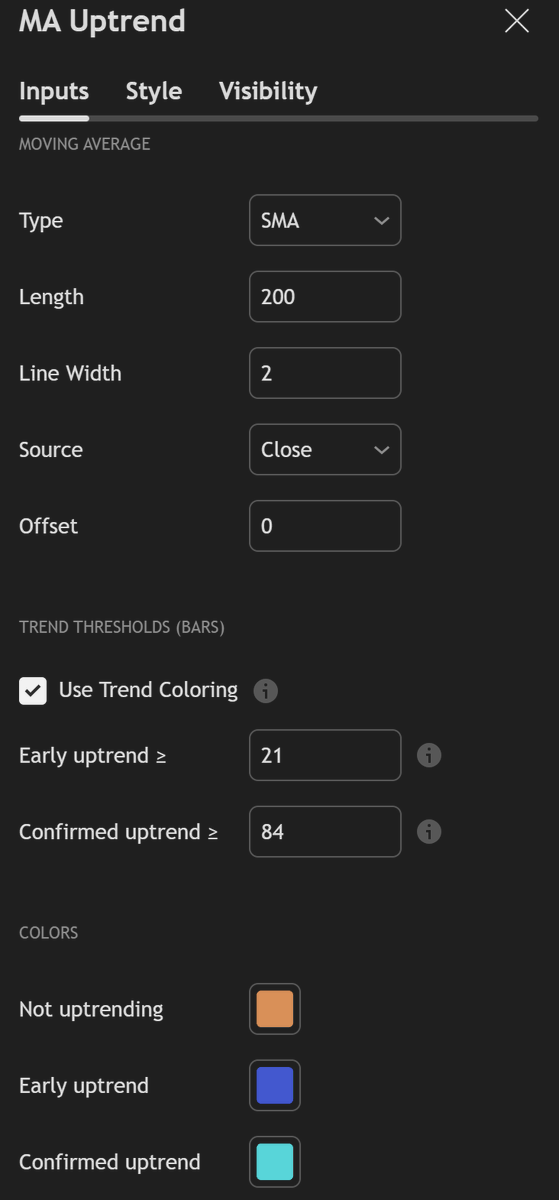
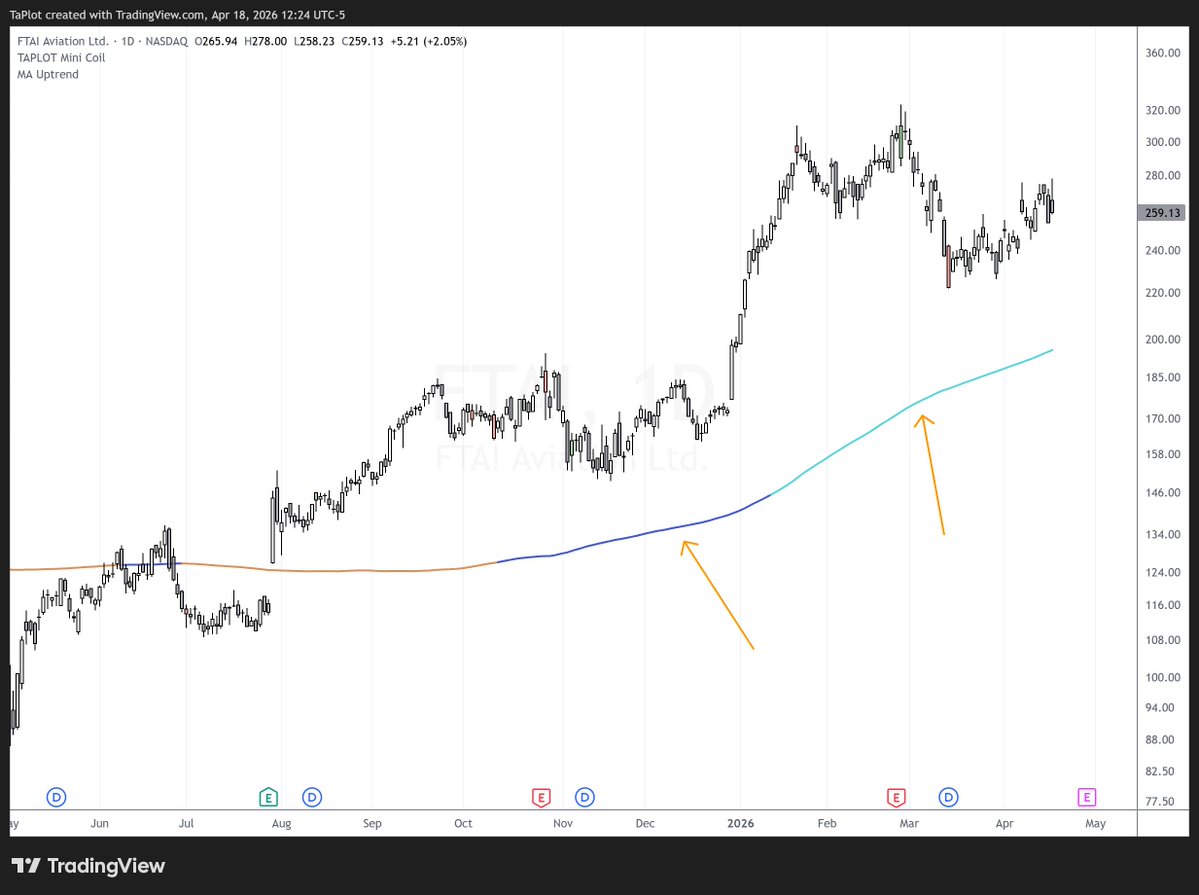
I totally re-wrote my Moving Average Confirmed Uptrend indicator and just updated the script on TradingView.
Better Uptrend detection.
Up-trending 200 MA:
Early Uptrend (1 to 3 months)
Confirmed Uptrend ( >= 4 months)
If you are already using it, Make sure you update it. If not, head on to script page and add it to your charts.
https://t.co/ETVA5zUMlJ
This is literally the most extreme momentum event in 40 years of recorded data. The Nasdaq 100's RSI went from 28 (oversold) on March 30 to 70.5 (overbought) by April 15 — in just 11 sessions. That is the fastest oversold-to-overbought transition in the Nasdaq 100's 40-year recorded history. The previous fastest was 25 sessions after Liberation Day last year. The historical average is 60+ sessions. Benzinga
According to Bespoke Investment Group, this also marks the fastest move from a correction of this size to a new record high since 1928. Yahoo Finance
The forward return data is actually quite bullish long-term. Across all 44 historical episodes where the Nasdaq gained 11% or more in 10 sessions, the 12-month forward return averaged +24%, with a median of +30%, and a win rate of 80%. At 6 months, the win rate is 74%. Benzinga
But the near-term pullback is almost guaranteed. The average maximum drawdown following these signals was −18.39% — meaning while the 12-month destination is historically higher, the journey involves deep, punishing pullbacks that can severely impact over-leveraged portfolios. Ainvest
The key number to watch: Based on the 6 most comparable historical analogues — COVID recovery (−8%), Liberation Day 2025 (−4%), Fed pivot 2018 (−6%), Asian crisis 1997 (−7%) — the most probable near-term pullback is 3-8% within the next 2-4 weeks. The April 22 ceasefire expiry is the most likely trigger. After that consolidation, the historical data overwhelmingly favors a resumption of the bull trend.
The S&P 500 has experienced average intra-year declines of roughly 14% since 1990, even in years that finish strongly positive — and the average correction (10-20% decline) lasts just 17 days. U.S. Bank
A pullback here isn't a disaster; it's the historical norm and historically the best re-entry point.
Wes and I are extremely well positioned in the leaders.
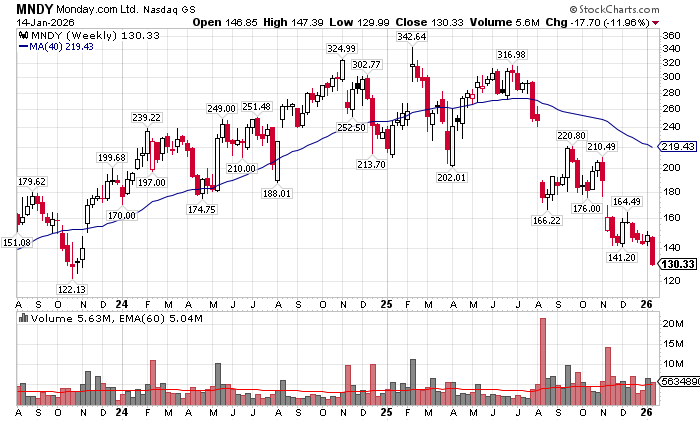
Could $MNDY eventually be headed for a $MDB type recovery, looking at the solid fundamentals...?
Price: $130.33 or 60% off highs.
Hat tip @TicketInsider for bringing the name to my attention.








![Finsee_main's tweet photo. $ORA Q1 2026 earnings: Headline Blowout Masked by One-Offs, but Underlying Storage Momentum is Real
Ormat delivered a staggering 75.8% YoY revenue surge in Q1, but investors must separate the noise from the signal. The top-line explosion was heavily distorted by a $105.1 million one-time revenue recognition from the Topp 2 project sale. Adjusted Net Income accelerated by an impressive 93.5% to $80.3 million, filtering out a messy $38 million hit from a $1B convertible note induced conversion and asset impairments. The real standout was the Energy Storage segment, which capitalized on merchant pricing in PJM to print an absurd 59.1% gross margin. However, the core Electricity segment effectively flatlined, requiring monitoring in upcoming quarters.
Full article with charts - link in bio
🐂 𝐁𝐮𝐥𝐥 𝐂𝐚𝐬𝐞
• 𝐄𝐧𝐞𝐫𝐠𝐲 𝐒𝐭𝐨𝐫𝐚𝐠𝐞 𝐢𝐬 𝐚 𝐂𝐚𝐬𝐡 𝐌𝐚𝐜𝐡𝐢𝐧𝐞 — Storage revenue accelerated 153% YoY to $44.9M, driven by high asset availability and elevated merchant pricing. Gross margins essentially doubled YoY to 59.1%.
• 𝐂𝐨𝐦𝐦𝐞𝐫𝐜𝐢𝐚𝐥 𝐏𝐏𝐀 𝐌𝐨𝐦𝐞𝐧𝐭𝐮𝐦 𝐀𝐜𝐜𝐞𝐥𝐞𝐫𝐚𝐭𝐢𝐧𝐠 — Secured ~270MW in new US PPAs since year-end, including high-profile tech customers like Google and Switch, along with lucrative 'blend-and-extend' renegotiations that boost portfolio pricing.
🐻 𝐁𝐞𝐚𝐫 𝐂𝐚𝐬𝐞
• 𝐂𝐨𝐫𝐞 𝐄𝐥𝐞𝐜𝐭𝐫𝐢𝐜𝐢𝐭𝐲 𝐒𝐞𝐠𝐦𝐞𝐧𝐭 𝐒𝐭𝐚𝐥𝐥𝐞𝐝 — The highly predictable, contracted Electricity business grew just 0.8% YoY, dragged down by extreme ambient temperatures in Nevada costing $4.8M and ongoing curtailments.
• 𝐌𝐞𝐬𝐬𝐲 𝐂𝐚𝐩𝐢𝐭𝐚𝐥 𝐒𝐭𝐫𝐮𝐜𝐭𝐮𝐫𝐞 𝐀𝐝𝐣𝐮𝐬𝐭𝐦𝐞𝐧𝐭𝐬 — GAAP Net Income only grew 9.2% despite the massive revenue beat, hampered by $33.7M in induced conversion expenses from restructuring convertible notes and $10.2M in asset impairments.
⚖️ 𝐕𝐞𝐫𝐝𝐢𝐜𝐭: 🟢
Bullish. While the headline revenue growth is an optical illusion from the Topp 2 sale, the 93% surge in Adjusted Net Income and the incredible margin realization in Energy Storage prove the portfolio's operational leverage. The massive PPA pipeline provides long-term downside protection.
𝐊𝐞𝐲 𝐓𝐡𝐞𝐦𝐞𝐬
🟢🟢 𝐄𝐧𝐞𝐫𝐠𝐲 𝐒𝐭𝐨𝐫𝐚𝐠𝐞 𝐌𝐚𝐫𝐠𝐢𝐧 𝐄𝐱𝐩𝐥𝐨𝐬𝐢𝐨𝐧 [NEW]
Energy Storage flipped from a supportive growth pillar to a dominant profit engine. Segment gross margins surged from 30.6% in 25Q1 to an eye-popping 59.1% in 26Q1. Management intentionally optimized the mix between contracted baseload and merchant exposure to capture price spikes in the PJM market. The question is sustainability, as merchant revenues are inherently volatile.
🟢 𝐏𝐫𝐨𝐝𝐮𝐜𝐭 𝐒𝐞𝐠𝐦𝐞𝐧𝐭 𝐅𝐮𝐞𝐥𝐞𝐝 𝐛𝐲 𝐓𝐨𝐩𝐩 𝟐 𝐒𝐚𝐥𝐞
Product segment revenue exploded by 458% YoY to $177.4M. This was driven by a $105.1M revenue recognition from the Topp 2 project in New Zealand after the customer exercised a purchase option. Even stripping out this one-time event, the underlying Product segment grew an impressive 127% YoY to $72.3M, validating strong global EPC demand.
🔴 𝐂𝐨𝐫𝐞 𝐄𝐥𝐞𝐜𝐭𝐫𝐢𝐜𝐢𝐭𝐲 𝐒𝐞𝐠𝐦𝐞𝐧𝐭 𝐒𝐭𝐚𝐠𝐧𝐚𝐭𝐢𝐨𝐧
The biggest red flag in this print is the Electricity segment, which grew a meager 0.8% YoY to $181.6M, sharply decelerating from the double-digit company average. Gross margins dropped to 30.8% (from 33.5% in 25Q1). Management blamed extremely high ambient temperatures in Nevada (a $4.8M hit). If the core business isn't growing, the company is over-reliant on lumpy EPC sales and volatile merchant battery revenues.
🟢 𝐃𝐚𝐭𝐚 𝐂𝐞𝐧𝐭𝐞𝐫 𝐏𝐏𝐀𝐬 𝐒𝐞𝐜𝐮𝐫𝐢𝐧𝐠 𝐭𝐡𝐞 𝐅𝐮𝐭𝐮𝐫𝐞
Ormat is aggressively capturing the AI-driven data center demand for 24/7 clean baseload power. Since year-end, they signed a 15-year PPA for up to 150MW with Google and a 13MW PPA with Switch. They also executed 'blend-and-extend' contracts for the CD4 plant, securing an immediate ~27% pricing increase.
🔴 𝐌𝐞𝐬𝐬𝐲 𝐀𝐝𝐣𝐮𝐬𝐭𝐦𝐞𝐧𝐭𝐬 𝐟𝐫𝐨𝐦 𝐂𝐚𝐩𝐢𝐭𝐚𝐥 𝐄𝐧𝐠𝐢𝐧𝐞𝐞𝐫𝐢𝐧𝐠 [NEW]
GAAP Net Income was severely suppressed by $38M in one-off items. The company closed a $1B convertible note offering, executing an induced conversion to retire old 2027 notes (resulting in a $33.7M charge). Furthermore, they recorded $10.2M in write-offs and asset impairments. While Adjusted Net Income ignores these, the dilutive reality and cash costs of financial re-engineering remain a friction point.
𝐎𝐭𝐡𝐞𝐫 𝐊𝐏𝐈𝐬
𝐀𝐝𝐣𝐮𝐬𝐭𝐞𝐝 𝐄𝐁𝐈𝐓𝐃𝐀 (𝟐𝟔𝐐𝟏): $194.9 million
Accelerating significantly. Grew 29.7% YoY compared to 25Q1 ($150.3M). This was heavily driven by the outsized margins in the Energy Storage segment and the mega-recognition of the Topp 2 project in the Product segment.
𝐏𝐫𝐨𝐝𝐮𝐜𝐭 𝐒𝐞𝐠𝐦𝐞𝐧𝐭 𝐁𝐚𝐜𝐤𝐥𝐨𝐠: $239 million
Stable forward visibility. Despite clearing the massive Topp 2 order off the books, the backlog remained solid, bolstered by $56M across two new contracts signed since the start of 2026.
𝐓𝐨𝐭𝐚𝐥 𝐋𝐢𝐪𝐮𝐢𝐝𝐢𝐭𝐲 & 𝐂𝐚𝐬𝐡: $654.6 million Cash
Cash and equivalents skyrocketed from $147.4M at the end of 2025 to $654.6M in 26Q1. This massive liquidity buffer is the direct result of the $1B convertible senior notes offering, providing dry powder for the 2028 capacity expansion targets and the Hoku acquisition.
𝐆𝐮𝐢𝐝𝐚𝐧𝐜𝐞
𝐅𝐘𝟐𝟔 𝐓𝐨𝐭𝐚𝐥 𝐑𝐞𝐯𝐞𝐧𝐮𝐞𝐬: $1.11B - $1.16B
Midpoint of $1.135B implies ~14.7% YoY growth vs FY25 ($989.5M). Management reiterated this guidance despite the massive Q1 beat, indicating that Q1's Topp 2 sale was heavily front-loaded and the remaining quarters will normalize.
𝐅𝐘𝟐𝟔 𝐄𝐥𝐞𝐜𝐭𝐫𝐢𝐜𝐢𝐭𝐲 𝐒𝐞𝐠𝐦𝐞𝐧𝐭 𝐑𝐞𝐯𝐞𝐧𝐮𝐞𝐬: $715M - $730M
Midpoint implies sluggish ~4% YoY growth. Reversing the 1.2% decline seen in 2025, but still highlighting that the core business is the slowest grower in the portfolio.
𝐅𝐘𝟐𝟔 𝐄𝐧𝐞𝐫𝐠𝐲 𝐒𝐭𝐨𝐫𝐚𝐠𝐞 𝐑𝐞𝐯𝐞𝐧𝐮𝐞𝐬: $95M - $110M
Midpoint implies ~30% YoY growth versus FY25 ($79M). Given Q1 already delivered $44.9M, this implies a sharp deceleration for the rest of the year unless merchant pricing spikes again.
𝐅𝐘𝟐𝟔 𝐀𝐝𝐣𝐮𝐬𝐭𝐞𝐝 𝐄𝐁𝐈𝐓𝐃𝐀: $615M - $645M
Midpoint of $630M implies ~8.2% YoY growth vs FY25 ($582M). Growth is constrained relative to top-line revenue, reflecting the lower structural margin of the Product segment EPC revenues recognized this year.
𝐊𝐞𝐲 𝐐𝐮𝐞𝐬𝐭𝐢𝐨𝐧𝐬
𝐒𝐭𝐨𝐫𝐚𝐠𝐞 𝐌𝐞𝐫𝐜𝐡𝐚𝐧𝐭 𝐕𝐮𝐥𝐧𝐞𝐫𝐚𝐛𝐢𝐥𝐢𝐭𝐲
Energy Storage printed a massive 59% gross margin fueled by PJM merchant pricing. Since you've already hit nearly half of your FY26 segment revenue guidance in Q1 alone, are you assuming merchant pricing collapses for the rest of the year, or is guidance extremely conservative?
𝐄𝐥𝐞𝐜𝐭𝐫𝐢𝐜𝐢𝐭𝐲 𝐒𝐞𝐠𝐦𝐞𝐧𝐭 𝐓𝐮𝐫𝐧𝐚𝐫𝐨𝐮𝐧𝐝
Electricity grew less than 1% YoY despite new capacity coming online. Beyond the $4.8M weather impact in Nevada, what are the structural timelines to get this segment back to steady mid-single-digit volume growth?
𝐈𝐦𝐩𝐚𝐢𝐫𝐦𝐞𝐧𝐭𝐬 𝐈𝐧𝐬𝐢𝐠𝐡𝐭
You took another $10.2M in write-offs and impairment charges this quarter. Which specific assets or exploration sites were impaired, and are we completely cleansed of legacy underperforming assets at this point?](https://pbs.twimg.com/media/HHqhge8WAAUZ2W1.jpg)