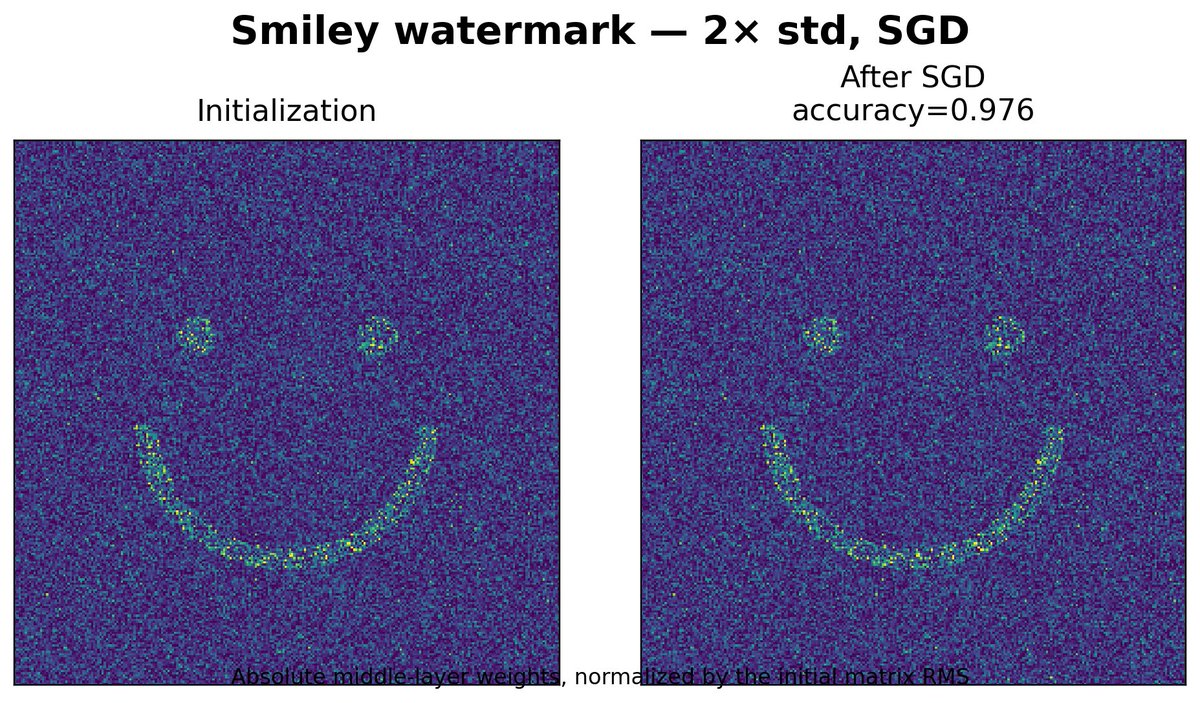
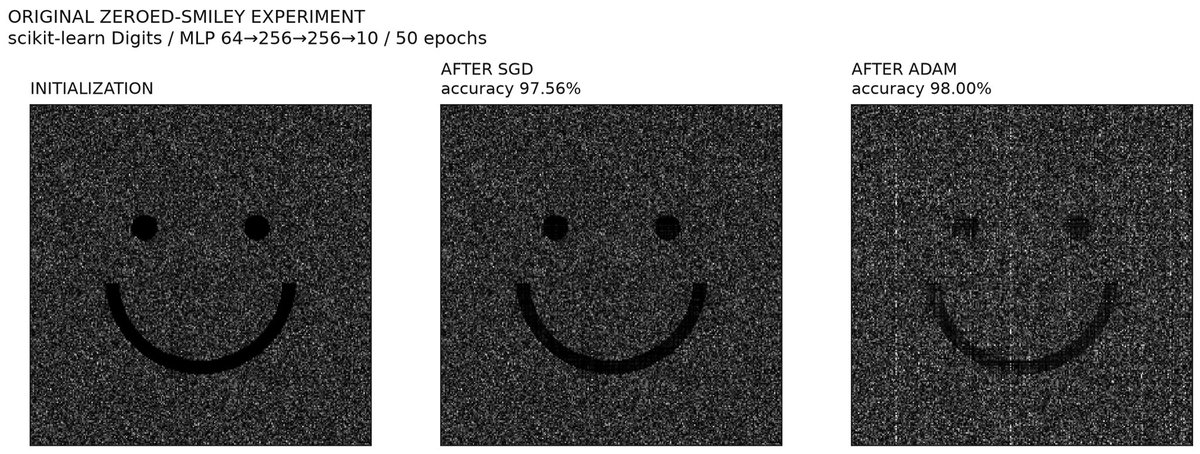
kinda funny you can draw a smiley face in your neural net before training and it’ll be there afterwards
you can also use photos. i trained a MNIST classifier initialized to my face and you can still see me at the end
works across inits, weight decay, LR, optimizers, see below
The TC2 is pleased to invite you to submit your work to S+SSPR 2026, which will be held 24–26 August 2026 in Bern, Switzerland. More info on the event can be found at https://t.co/3jQ8h13fEg
AI efficiency is important. Today, Google is sharing a technical paper detailing our comprehensive methodology for measuring the environmental impact of Gemini inference. We estimate that the median Gemini Apps text prompt uses 0.24 watt-hours of energy (equivalent to watching an average TV for ~nine seconds), and consumes 0.26 milliliters of water (about five drops) — figures that are substantially lower than many public estimates.
At the same time, our AI systems are becoming more efficient through research innovations and software and hardware efficiency improvements. From May 2024 to May 2025, the energy footprint of the median Gemini Apps text prompt dropped by 33x, and the total carbon footprint dropped by 44x, through a combination of model efficiency improvements, machine utilization improvements and additional clean energy procurement, all while delivering higher quality responses.
See the blog or technical paper for more about our methodology and ongoing efforts.
Blog:
https://t.co/CoMm5gV9SR
Link to detailed paper: https://t.co/UBi9rd6gEC
Introducing DINOv3: a state-of-the-art computer vision model trained with self-supervised learning (SSL) that produces powerful, high-resolution image features. For the first time, a single frozen vision backbone outperforms specialized solutions on multiple long-standing dense prediction tasks.
Learn more about DINOv3 here: https://t.co/lQpKhJLTZQ
Say hello to DINOv3 🦖🦖🦖
A major release that raises the bar of self-supervised vision foundation models.
With stunning high-resolution dense features, it’s a game-changer for vision tasks!
We scaled model size and training data, but here's what makes it special 👇
We just released 3 million samples of high quality vision language model training dataset for use cases such as:
📄 optical character recognition (OCR)
📊 visual question answering (VQA)
📝 captioning
🤗 Learn more: https://t.co/zUEiB6ZLZR
📥 Download: https://t.co/JD7dZ73oA6
When it’s a word pattern matcher, it’s a word pattern matcher. You might think it’s intelligence, but it’s a word pattern matcher.
It’s not a belittlement. It’s just what it is.
At #CVPR? Interested in how GNNs can be applied to computational pathology? If so be sure to check out poster 476 during ExHallD Poster Session 2! @amaya_gs is presenting our work BioX-CPath: Biologically-driven Explainable Diagnostics for Multistain IHC Computational Pathology
𝐌𝐲 𝐜𝐨𝐧𝐬𝐭𝐢𝐭𝐮𝐞𝐧𝐭𝐬 𝐰𝐚𝐧𝐭𝐞𝐝 𝐭𝐨 𝐤𝐧𝐨𝐰 𝐰𝐡𝐚𝐭 𝐈 𝐫𝐞𝐚𝐥𝐥𝐲 𝐠𝐨𝐭 𝐮𝐩 𝐭𝐨 𝐢𝐧 𝐏𝐚𝐫𝐥𝐢𝐚𝐦𝐞𝐧𝐭, 𝐬𝐨 𝐈 𝐛𝐮𝐢𝐥𝐭 𝐭𝐡𝐞𝐦 𝐭𝐡𝐢𝐬….
https://t.co/rxJwKI2Z30
KanishkaKloud visualises what MPs talk about most - by collating and filtering data from every word they’ve ever said in Parliament.
It’s part of my All Hands on Tech campaign, highlighting that we can all build and use positive tech in our lives, economy and democracy. How it works + why I built it👇
@TheyWorkForYou@HansardSociety@uklabourdigital@TramshedTech@UKLabour
#AllHandsOnTech #Labour #Tech
RL is not all you need, nor attention nor Bayesianism nor free energy minimisation, nor an age of first person experience. Such statements are propaganda.
You need thousands of people working hard on data pipelines, scaling infrastructure, HPC, apps with feedback to drive benchmarks and data, tons of research and engineering on generative models, data mixtures, ablations, RL/selftraining, etc etc and we will probably need lots of people working hard to figure out safety, causal world models, awareness, models that create abstractions comparable to infinity and zero and use these to predict the existence of things like black holes and suggest experiments to verify such hypothesis, or come up with novel engineering designs to generate energy more efficiently, robotics, etc etc.
It takes thousands of people and many ideas. In the end some simple ideas might become obvious but such obviousness only happens in retrospect. Yes, there is a bitter lesson but if we had followed it, we’d still be doing linear regression with RL. Let’s not oversimplify, but rather honour the research and engineering of thousands of people.
Also, people keep rewriting history. When our language understanding start up (darkbluelabs) was acquired by Google about 10 years ago, we joined DeepMind, where the AGI documents were all about concepts, RL, episodic memories and made it clear that there was no room for language. To be honest, back then such a position wasn’t so crazy. Now it seems silly, but only because of the benefit of hindsight.
There’s no 1 or 10 heroes in the history of AI. There’s many 1000s of hard working students, profs, engineers, operations and support people, product folks, managers, even hedge funds among others. Let’s honour the whole community and not just ceos or the philosophers of Bayes, RL, deep learning, etc. I look forward to learning from the next generation and seeing what they will achieve. To them: Don’t buy the existing narratives blindly, innovate. Remember that just like mathematics, AI will advance one grave at the time.
My new @WIRED piece about arXiv: either 1) the most important website you've never heard of or 2) the platform your entire field depends on
Also had the pleasure of hanging out with its creator, Paul Ginsparg—the Forrest Gump of the Internet age
Our #CVPR2025 work demonstrates a strong link between the structure learnt by the model and the underlying biology. Very happy to share in the development and success of this work with friends and colleagues in @DERI_QMUL
Queen Mary partnered with @turinginst to host the world’s first children’s AI summit.
The summit brought over 100 children together and put their voices at the heart of discussions about how AI impacts them.
👉: https://t.co/AphsOxroPW
The curse of dl: "Maybe the idea was good, you just messed up the initialization / scheduling / nb of epochs / data set size / model dim / non-linearity"
👏Congratulation to DERI Professor, Greg Slabaugh who is part of one of the successful projects, led by Professor Maria Liakata @xrysoflhs focusing on addressing Socio-technical Limitations of Large language models