SEBI has released a study on the profitability of individual traders in the equity derivatives segment.
It would be equally valuable to have a similar study on individual investors in the equity cash market.
1/2
Now sugar has to be imported because all the sugarcane is consumed for Ethanol blending in fuel. Btw blending was done to reduce the import bill irony is that we have to import sugar now.
Penny wise pound foolish policies.
Expiry day, 3:22 PM.
Nifty option settles at today's close. The close is being decided thru CAS right now. And you have no idea where it's landing.
That's trading blind and every options trader has faced this.
Fixed. From today, Kotak Neo shows the live indicative close for Nifty, Banknifty, Sensex & F&O stocks during the Closing Auction (3:15–3:30 PM).
In short IEP as decided thru CAS, is now available on #KotakNeo
There is a very famous fund in India, which is deeply underperforming even FDs.
You still pay 0.5-1% as AUM management fee.
And, get sub-par returns.
But, the fund tells you 2 things:-
1) Equities are for long-term (but hey keep paying me commissions, even in short-term)
2) We had done superbly when our size was 1/50th than it is now.
What they don't tell you is:-
They made solid returns investing in US Stocks in the 2021-2022 cycle. Subsequently, RBI restrictions chipped away the advantage. And, they have abandoned their core strategy.
The fund is basically God for retail investors, so I can't name the fund :)
Similarly GST is charged on merchants not consumers.
TDS is paid by Employers not Employees.
@nsitharaman, country is blessed to have a genius like you as Finance Minister.
Buyers want to buy at lowest possible price. And sellers want to sell at the highest possible price.
So if matching is happening 150/200 points higher, surely we have buyers who are placing bids that high to match the seller. Sellers surely are not the culprits because they will always want to bid higher.
Why would any buyer then bid that high? Most likely because the buyer may have positions which will gain from that higher close. Can’t think of any other answer, in the absence of any specific news post 3:15pm.
As CAS matures, I believe more will participate and the variation happening because of the thin volumes currently may eventually disappear. I am also sure a lot would be happening at the regulators end to identify the reasons of this variation and see how to resolve.
For a retail trader, staying light post 3:15pm is the best. Secondly, higher participation by traders/investors in CAS will only help in better price discovery.
Change is the only constant. There is no point fighting change. What we need to do is adapt to this change.
Surely, markets will find an equilibrium soon. All this will finally get settled. Till then:
a. F&O traders should stay light.
b. Cash Investors/traders should adopt CAS to their advantage and start placing more orders in CAS. (Limit orders and not market).
Thanks to CAS, I'm temporarily unemployed. 😄
Until the regulation becomes fair for all market participants—or I discover opportunities in another market—I'll be enjoying a short retirement.
This chart suggests premium behaviour that is extremely difficult to trade due to CAS.
This CAS would lead to another Jane street kinda highly manipulated phase, especially on 0 DTE.
The only solution is to let 0DTE contracts expire at 3:15 and let everything else go as per the new CAS.
Okay, now I understand that the maximum limit is 3%. But the same 3% move can happen across multiple large-cap index heavyweights.
If a few institutions manage to push several heavyweight stocks higher during that period, they could potentially move the index by 1%, 1.5%, or even 2% and benefit massively from the call options they already hold.
So the original question still stands: theoretically, does the system allow this kind of manipulation to happen?
I genuinely still don’t understand how this system works, so I have a question.
Assume two large institutions. One places a huge buy order for a thousand crore on Reliance at 10% higher during the 15 minute auction period, and another places an equally large sell order at the same price. If both orders match, Reliance closes 10% higher.
Now assume both institutions have already loaded up aggressively on call options worth thousands of crores on expiry day. The jump in Reliance and the index could give them multiplied returns on those calls, while the loss on the Reliance shares may be limited to around 10%.
The next day, they could potentially repeat the same thing on the downside and offset the equity gain and loss, while still keeping the massive profits made in options.
This is purely hypothetical, but does the system practically allow something like this to happen?
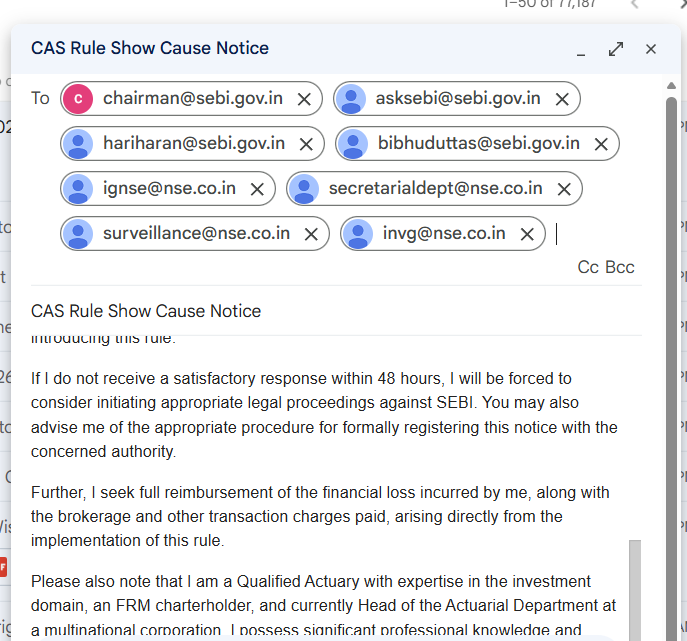
I have sent out a show cause notice to SEBI and NSE. I have given them 48 hours to respond.
At the same time, I am speaking to lawyers but yet to get a good one. Any good finance related lawyer in Mumbai reach out to me or please DM me the contact details
@NSEIndia and @SEBI_India My loss today is because of your CAS. I have recorded this entire video as evidence.
Reach out to me in 48 hours and compensate me of this loss. Otherwise, I will force to take legal steps
@zerodha@adigitalblogger