I am starting a series to demystify some of the recent events in the Russo-Ukrainian war that have become shrouded by intense communication battles. The goal is to examine the bigger picture with a data-driven strategic perspective.
It is important to take a step back and gain a rational view on possible outcomes instead of relying on wishful thinking or overstatements.
The war has entered the last chapter of its current phase. Level-headed analysis is crucial to follow the unfolding events.
Thread of threads 👇
#RussiaUkraineWar #Strategy #Analysis
The volume of strikes is staggering.
The payload impact ratio remains around 15:1, an important factor explaining the €70bn funding gap for Ukraine in 2027.
Projected tax revenues are bound to be much lower than budgeted amounts.
#UkraineRussiaWar
Overview of Reported Damage (+Missiles) for August 2026
Number of events:
Hit + Comb. Strike: 252 (Red)
Hit + Comb. Strike - Geolocation: 370 (Gold)
Missile: 35 (Purple)
Missile - Geolocation: 105 (Cyan)
Map:
While Russian advances across the frontline have slowed this year, their mid-to-long-range strikes have significantly increased.
I estimate Russia averages around 140 individual strikes per day using missiles and drones. Ukraine averages around one-tenth of this, giving us a strike ratio of around 10:1 in favour of Russia.
This figure excludes strikes on logistics, which are usually carried out using cheaper, smaller, and more numerous drones.
Mid and long-range strikes have always been one of Russia's biggest advantages in this war, and has remained a very important component of attrition.
This is one of the footage I was referring to; geolocated Russian soldiers in the forest patch behind the railway, probably second half of August based on vegetation and fields. They are clearing the woods following the infiltration attempts.
https://t.co/WOayfn0Gnv
You must not be looking well because this is referenced on UA control map.
Since 2023, Ukrainians have been much better at making trailers than Russians. (Whose communication has been poorly conducted)
However, the included footage provides no concrete proof the operation was real, especially since the AFU has made no gains on the Kupiansk front in recent months and nothing has been reported.
Ukrainian forces advanced more than 15 km behind Russian lines through underground gas pipelines during a counteroffensive on the Kupiansk front, killing over 100 Russian soldiers and capturing more than 30.
The operation, codenamed Veles, combined the underground advance with coordinated drone strikes and ground assaults, cutting off Russian infiltration routes into the rear of Kupiansk.
Participating units included the Khartiia Brigade, R.U.H. and Lava Regiments, DIU units including the Russian Volunteer Corps and Freedom of Russia Legion, and the Achilles Brigade.
Vous êtes un impertinent qui se permet de venir commenter, sous les publications d'autres analystes exigeant des "preuves", alors que vous n'apportez rien de votre côté. Vous avez eu la même attitude auprès d'autres ces dernières semaines. Toujours avec vos certitudes, jamais avec des éléments probants, le plus souvent sur un ton provocateur et condescendant. Comme sur ces screenshots; sujet Mali Shcherbaky sur lequel une fois encore, vous avez tord.
En réalité, comme je l'ai amplement démontré ci-dessous (toujours sans réaction d'ailleurs), vous invoquez certaines éminences en déformant leurs propos dans de vaines tentatives de convaincre. Cela fonctionne auprès d'une audience profane sur ces sujets, ou naive, mais pas avec moi.
Je pense avoir très largement démontré dans mon post précédent que les avancées datent de Juillet. Donc, lorsque j'écris "not in recent month", je ne pense pas me tromper. Je sais que le temps passe vite, mais nous sommes fin octobre...
Si pour vous, géolocalisations et images satellites ne sont pas des "indices", je vous souhaite bonne chance pour analyser ce conflit. Quoique, les rapports du MoD Ukrainien ou 2 photos de chars semblent vous suffire.
Enfin, afin de vous montrer à quel point votre attitude est contre productive, je vous renvoie l'ascenseur: où sont vos preuves (indices?) que les FAU controlent Zapadne, Mali Shcherbaky, ou que la flotte de char d'assaut comprend toujours des milliers d'unités?
https://t.co/N0LYYnmRSO
Beaucoup d’incohérences dans votre réponse. Je reprends point par point :
1. IISS et IMV
« Selon l’IISS, la flotte d’IMV était quasi inexistante avant 2022 »
C’est parfaitement exact, et je ne retire rien à mes propos.
J’attache ici les captures d’écran des différentes parties concernées.
L’IISS, pour des raisons qui lui sont propres, classe la très grande majorité des Varta et Kozak comme des PPV (Protected Patrol Vehicles), eux-mêmes en sous-catégorie des APC. Autrement dit, ces véhicules sont inclus dans le total APC.
Exemple pour l’armée de terre :
> Total APC = 622, soit la somme des trois sous-catégories :
- APC (T) = 60
- APC (W) = 322
- PPV = 240
Je n’ai donc absolument pas « oublié » la flotte IMV de 2022 dans mes calculs : elle est simplement reflétée dans la catégorie APC, conformément à la taxonomie de l’IISS.
Comme je l’ai précisé depuis longtemps, je n’ai pas effectué de transvasement de catégories par rapport aux sources, car cela affecte le résultat final de moins de 1 %.
Les seuls éléments initialement omis concernaient la catégorie AUV (Armored Utility Vehicle), soit 70 véhicules (Novator), ce qui représente exactement 1 % du total reçu par donation dans cette catégorie.
Dans une première version, afin de tenir compte d’une livraison de 2022, j’avais volontairement arrondi à 100.
Que l’IISS classe les PPV comme APC tout en isolant les AUV peut surprendre, mais c’est un fait.
Afin de rester cohérent avec les pertes sourcées chez Oryx, j’ai conservé la production neuve dans une catégorie IMV distincte qui contient aussi les donations, en acceptant une faible marge d’erreur.
Il est en effet difficile de savoir quel pourcentage des 48 Varta perdus provient de la flotte initiale ou de la production neuve.
Là encore, la marge d’erreur, inférieure à 0,5 %, est sans effet analytique.
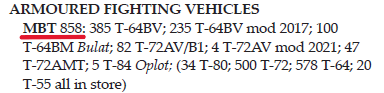
Concernant les 858 chars, la capture jointe montre qu’il s’agit bien de ceux de l’armée de terre ; les 129 chars restants relèvent d’autres branches.
Vos accusations sur ce point sont donc factuellement infondées.
Quant à l’analyse elle-même, elle est disponible depuis des mois sur mon Substack, avec les calculs et les données à jour.
Les conclusions stratégiques sont exactement les mêmes (La flotte de blindés lourd est autour des 35%), car ces petits ajustements sont bien en dessous des marges d’erreurs usuelles.
2. BRICS et alliances
Je suis parfaitement au fait des travaux d’Yves Lacoste (Fascinants d'ailleurs), mais ce n’est pas l’unique référence pertinente en géopolitique.
Le présenter comme tel relève d’une erreur méthodologique.
Plus concrètement, il est désormais communément admis et intégré dans la littérature qu’une alliance peut être formelle ou informelle. Je cite :
👉Encyclopædia Britannica :
“Although alliances may be informal, they are typically formalized by a treaty of alliance, the most critical clauses of which are those that define the casus foederis, or the circumstances under which the treaty obligates an ally to aid a fellow member.”
👉Oxford Dictionary of Politics and International Relations :
“An informal or formal relationship between groups, parties, peoples, states, or organizations for common purpose and mutual strategic and political benefit.”
De nombreux travaux académiques analysent précisément ce type de relations, notamment dans les relations sino-américaines avant la Seconde Guerre mondiale
(voir par exemple: International Organization, Cambridge : “Why are some international agreements informal?”).
Un informal group of states correspond parfaitement à ces définitions, et les BRICS sont de manière générale décrits comme une alliance.
Par ailleurs, les accords bilatéraux entre membres des BRICS ont considérablement augmenté, notamment sur le volet militaire. À titre d’exemple :
https://t.co/JkhbNSvDwx
https://t.co/otixEdDi7e
Les accords relatifs à la NDB ou au CRA sont des instruments communs formalisés dont l’impact potentiel futur est loin d’être négligeable dans la géopolitique mondiale.
Puisque vous invoquez Yves Lacoste, permettez moi de vous rappeler la définition proposée par Stephen Walt, figure majeure du courant néoréaliste et professeur à Harvard mondialement connu en relations internationales, dans The Origins of Alliances :
“An alliance is a formal or informal relationship of security cooperation between two or more sovereign states.”
Je vous conseille ce livre, qui décrit de très nombreux cas d’alliances militaires informelles au XXᵉ siècle.
Vous vous focalisez sur une définition trop restrictive par rapport à la pratique mondiale, alors que les enjeux stratégiques sont bien plus intéressants à analyser, en particulier les implications pour l’Occident d’un point de vue économique et géostratégique, ainsi que les avancées ou échecs réels des pays membres.
D’ailleurs, si l’on revient au point initial concernant la différence de traitement probable entre la Russie et l’Irak, ainsi que d’autres pays dont les avoirs ont été confisqués dans le passé, les faits confirment définitivement cette distinction de statut.
À propos de la Triple-Entente
À l’entrée en guerre, aucun traité multilatéral contraignant n’unissait les trois puissances, seulement des accords bilatéraux, ce qui correspond précisément à la définition d’une alliance informelle.
La terminologie d’Oxford est explicite : la Triple-Entente est qualifiée d’informal alliance jusqu’à sa transformation ultérieure.
In 1907, the Entente Cordiale between Britain and France was supplemented by a series of agreements between Britain and Russia, which itself was a military ally of France. The Triple Entente, though only an informal alliance, confirmed German paranoia about an ‘encirclement’ by these great powers, and thus helped to increase its tendency towards aggressive behaviour which ultimately led to World War I. Ironically, it was only after the outbreak of hostilities in August 1914 that the Triple Entente was transformed into a military alliance.
https://t.co/4oN3sablyH
C’est le rapprochement entre 1907 et 1914, période durant laquelle les trois pays renforcent leurs coopérations navales, militaires et économiques, qui donne sa force à cette alliance informelle
(exemple en illustration : discussions sur le chemin de fer au Moyen-Orient dans Le Petit Journal en 1911).
Par ailleurs, la déclaration commune du 5 septembre 1914, adoptée a posteriori et en urgence (en pleine bataille de la Marne), n’était pas ratifiée, contrairement à un traité classique, point juridique que la Russie utilisera en 1917 pour s’en éloigner.
Si la Russie a subi les conséquences politiques de sa rupture avec ce texte (exclusion des discussions post-guerre et lourdes pénalisations), elle pouvait précisément s’en écarter pour cette raison.
Cet exemple illustre un point central : les alliances informelles existent, fonctionnent et peuvent produire des effets stratégiques majeurs, bien avant toute formalisation juridique complète.
→ Le Royaume-Uni entre en guerre en 1914, alors qu’il n’y est pas contraint par un traité; cette "non formalisation" initiale provoquant une surprise stratégique pour l'Allemagne.
Récapitulons:
- Je vous ai proposé une désescalade depuis longtemps dans ce fil 👇, sans que cela ne semble vous intéresser. https://t.co/mWjxB1Umkb
- Vous avez formulé des accusations factuellement erronées concernant l’IISS et les IMV.
- Vous mobilisez une définition monolithique et incomplète des alliances géopolitiques.
- Vous interprétez de manière juridiquement discutable la déclaration du 5 septembre 1914, en négligeant la dynamique progressive de l’alliance.
Se réclamer d’un statut académique tout en confondant une définition particulière avec un cadre analytique universel, puis en remplaçant l’argumentation par la disqualification personnelle, relève moins de l’enseignement que du dogmatisme.
Le débat est désormais suffisamment documenté pour que chacun puisse se faire son opinion.
À ce stade, je n’ai rien à ajouter.
@stevenQ78611072 I read it, and I did not say it is back to pre war level. i wrote, steadily back. It is still at least 30% under prewar production levels. I made an entire analysis of this during summer.
A brief update on the status of Russian oil refineries. As expected, production is up and now above Russian domestic historical demand.
I used the past 2-3 weeks to review and update my methodology. I found a few new reliable sources. I also included NASA FIRMS data directly into the model. For long time watchers, the net result was about a 0.3 mpd daily increase. Otherwise, little was changed.
The NASA FIRMS data has helped better pinpoint when refineries restart. Usually I can catch the flare, even during the day.
Critical information on Rassvet proceeding according to plan for the first 2 launches. If the 3rd one also proves successful, Russian forces could benefit from some coverage in 2027 relevant to operations. To be monitored closely.
𝗪𝗛𝗘𝗥𝗘 𝗜𝗦 “𝗥𝗔𝗦𝗦𝗩𝗘𝗧”?
From time to time, our ill-wishers spread claims that the deployment of the “Rassvet” low-Earth-orbit satellite constellation has supposedly failed, or is at least facing major problems. The constellation is intended to provide reliable, high-speed internet access to subscribers in remote areas of Russia and around the world.
Meanwhile, judging by data from satellite-tracking channels, its deployment is proceeding more or less according to plan. Not without losses, of course — but everyone experiences losses, including Elon Musk.
As we can see from the chart, practically all the satellites from both launches have reached their operational altitude, currently set at around 508 km.
The exceptions are one satellite from the first batch that burned up (each batch consists of 16 spacecraft), along with two other satellites from that same batch that have not yet reached their designated altitude.
There are also three satellites from the second batch. One of them, “Rassvet-3.17,” will most likely burn up in the upper atmosphere soon. The other two, including “Rassvet-3.23,” which was falling toward Earth just days ago but began raising its flight trajectory at the last moment, are also climbing toward their operational orbit.
Thus, as of today, 26 satellites have successfully reached their designated orbits, while another four or five may still reach them later.
The next launch of another batch, assuming the launch rate remains unchanged, should take place in mid-November this year.
That is the current situation with “Rassvet.”
https://t.co/xYVM9PczTC
This is one of the footage I was referring to; geolocated Russian soldiers in the forest patch behind the railway, probably second half of August based on vegetation and fields. They are clearing the woods following the infiltration attempts.
https://t.co/WOayfn0Gnv
You must not be looking well because this is referenced on UA control map.
(1/3) [INTEL BRIEF] Developing Russian gains in October across three primary directions: Orikhiv, Rai Oleksandrivka, and Dobropillia.
A total of 114 km² controlled and 39 km² grey zone so far this month (excluding Vivaldi reveals) have been added on DeepState.
In Orikhiv, Russian DRG reached Omelnyk, a key village on the fortress’s main supply line. Latest gains are around Hirke after an earlier armored assault this month. Verkhnia Tersa and Huliailpilske have not been under Ukrainian control since summer and should be marked in the greyzone. (Could be under russian control though.)
Hirke lies near the main defensive line (already breached further north). Satellite images from 9 October show combat and fires across the ditch and dragon teeth in this direction and Russian artillery strikes, indicating the assault possibly advanced further than reported and that renewed attempts will target this point. This armored assault likely intended at securing the breach point. (geolocated footage in reply)
Toward Sloviansk, mapped gains are older and under Russian control since summer, but only recently acknowledged. The area between Mykolaivka and Rai Oleksandrivka remains a grey zone with ongoing skirmishes for routes and villages along the Donetsk River, as well as the remainder of the ridge overlooking the strategic cities.
It is now confirmed that #Vivaldi did not significantly slow the Russian tempo in primary directions. Though slower than last year, operations are proceeding; in fact, Dobropillia taken in a pincer shows renewed intensity.
Ukrainian Vivaldi losses were apparently high as demonstrated by a 25% increase in MIA records this summer (details upcoming in an article). The situation must be monitored closely in the coming months to assess if this will be detrimental to the defense of the key Donbas bastions and the road to Zaporijia.
#UkraineRussiaWar #Strategy
« Ce qui s’est passé aujourd’hui c’est un tournant. C’est la première fois qu’il y a un acte terroriste planifié pour tuer nos compatriotes, nos enfants, a raison de leur couleur de peau ou de la religion qu’on leur donne » « Ne baissez pas la tête »
Emmanuel Macron à Trappes.
Non. Il demande des preuves « irréfutables » à une inférence qui, par définition, n’en exige pas. Le tout sans apporter lui-même de preuves du contraire pour soutenir ses accusations. (Vous voyez l’ironie ?)
Cela revient à provoquer en faisant tapis au poker avec un 2 et un 4 en main.
J’ai expliqué mon raisonnement et la base Deepstate que j’utilise comme référentiel pour cette hypothèse. J’ai également partagé des éléments démontrant fraude intellectuelle et mauvaise foi habituelle, en réponse aux commentaires outranciers.
À vous de croire ce que vous voulez.
@Stevius21 "I am referring here to your claims about Ukrainian armored vehicles in 2025, which, unsurprisingly, were proven wrong in 2026."
Proven wrong? How? Did the AFU tank and IFV fleet magically regenerate?
"It is the Deep State map, which you are the one presenting, not me, that you disagree with. But I'm not a representative for Deep State."
This is not my problem. Those woods were marked captured and have been retaken. Hence my point. As usual you came to make an unfounded comment, then try to deflect by saying you use another map source. The world does not live by your referential.
"And in the end, no proof"
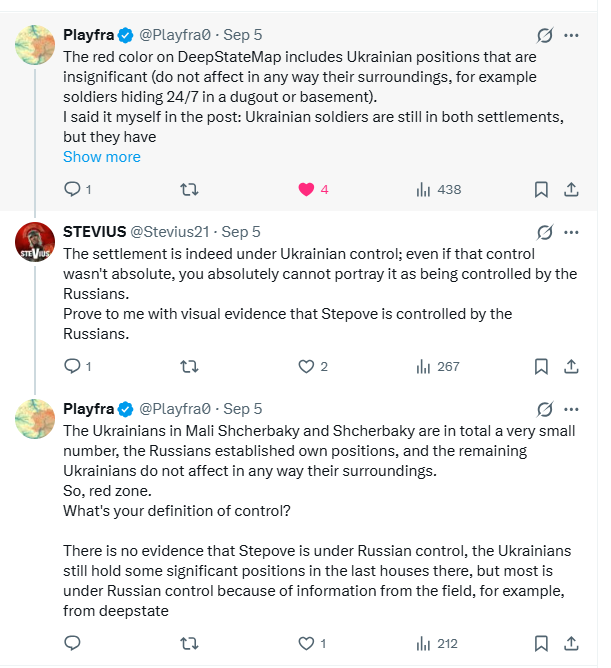
Please do send me proof the AFU control Zapadne.
First, I wrote "appear to be", which expresses uncertainty in English, the equivalent of the French conditionnel. It is therefore an inference, not a categorical assertion, and is not subject to the same burden of proof. Grammar matters.
Second, you have no proof that those forest patches east of the railway were ever captured in the first place. Where is your evidence? Because DeepState certainly marked them as captured on September 3rd.
Now, let me explain how this works.
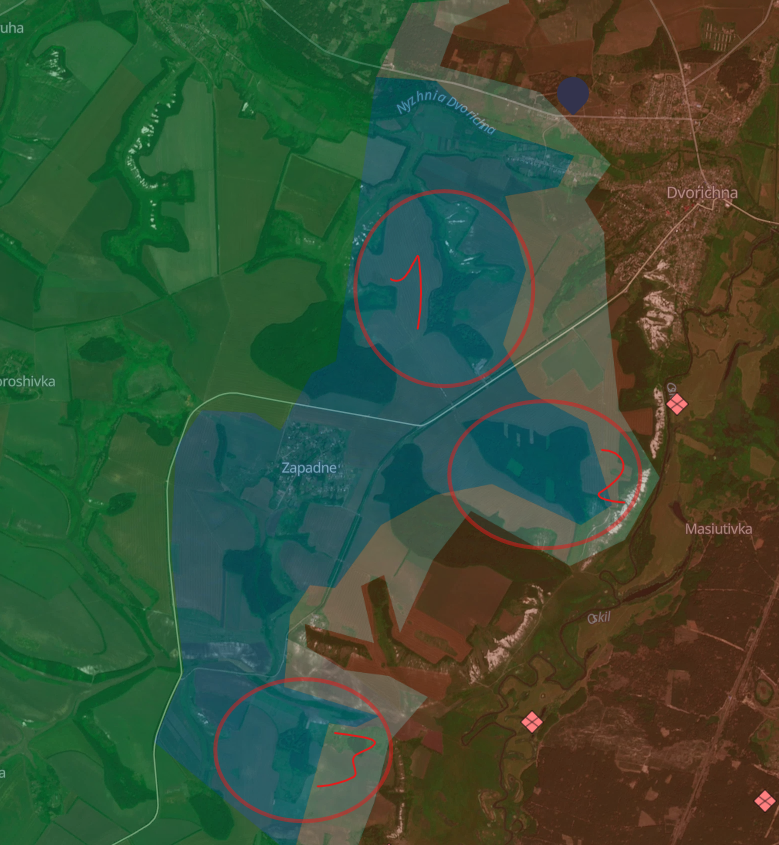
In the forests west of Dvorichna (Area 1), there was an initial approach before June 8 (blue circle), during which roughly a dozen FAB and 203 mm artillery strikes hit the area. Ukrainian forces advanced closer to the village throughout June, and by July 1, multiple FAB craters and evidence of combat were visible in satellite imagery (red circles).
As per the forested area south of Zapadne (area 3), the main fighting occurred around august 10th, when massive ordinance was dropped on it and the connecting treeline.
This is how we can infer that Russian forces lost control of those sectors at some point in June and august.
But for the forest patches across the railway (Area 2), it is different.
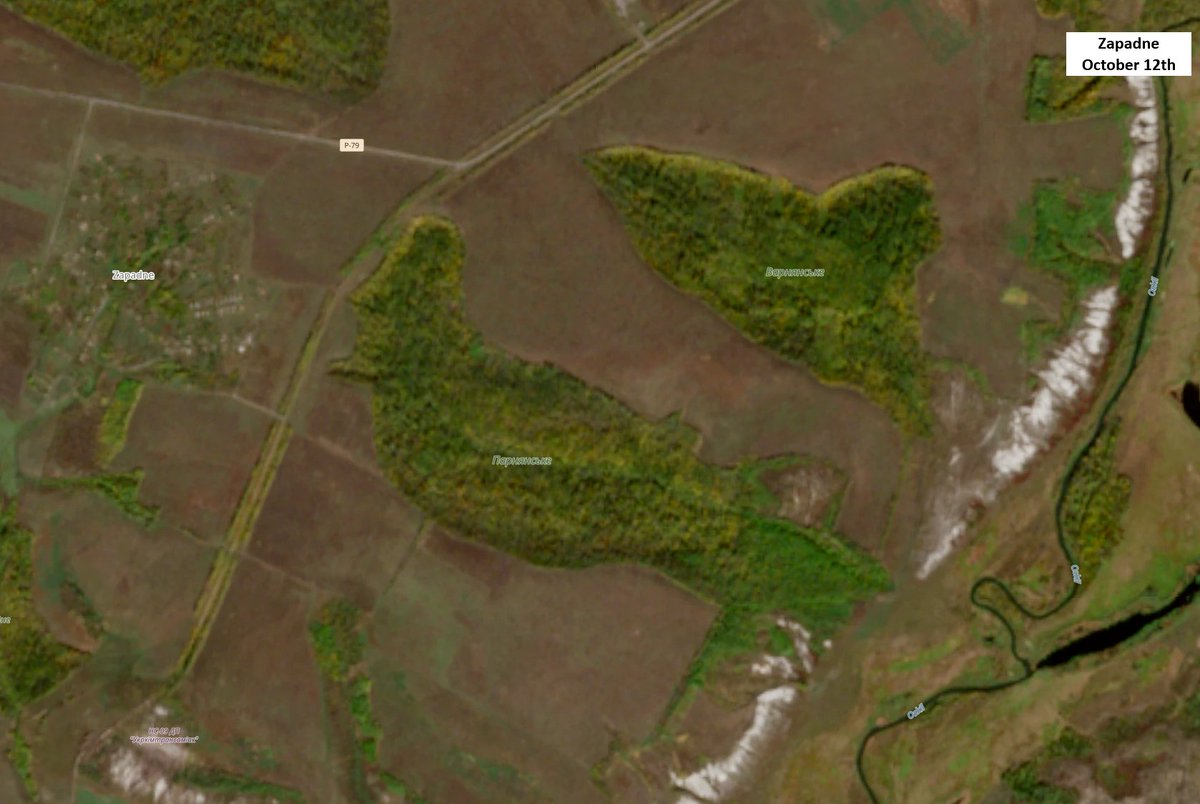
On September 17, the impact of strikes on the Khartia squad that entered the area is visible (at the very edge), but nothing else. On October 12, the situation is identical: absolutely no evidence of airstrikes or combat is visible in satellite imagery.
This does not follow any pattern observed in other sectors of the front.
There are a couple of videos showing South American soldiers entering the area, probably in July (but released in September), and early August, where signs of fighting are visible on images at the very edge.
On Telegram channels associated with Russia's 27th Motor Rifle Brigade, there are also videos showing these soldiers being targeted, followed by Russian infantry clearing the woods.
Since then, nothing… As of October 12, no further evidence of significant fighting ongoing is visible in satellite imagery across this entire area. No bombardment ever took place, no sign of fighting since early august.
So much for the claim that "operations are continuing", because, as a matter of fact, the available evidence points towards no significant activity having taken place there since those initial engagements. Hence my point that what remains are skirmish clashes between light infantry units, in the greyzone.
Therefore, yes, in all likelihood, the forest patches (area 2) were never firmly captured. The squads that entered were immediately engaged by drones and subsequently cleared out by small Russian infantry elements operating from the opposite edge of the woods which reoccupied the area. (All this being documented in geolocated footage)
It is always interesting to see how propagandists, entrenched in their own narratives, demand proof from others while having absolutely none to substantiate their own claims.
Proof is not always a straightforward concept in military analysis. Patterns are identified, hypotheses are formulated, and plausible conclusions are inferred from a variety of sources that are analysed and cross-referenced. The relevant question is not does absolute proof exists, but which scenario is best supported by the observable facts.
First, I wrote "appear to be", which expresses uncertainty in English, the equivalent of the French conditionnel. It is therefore an inference, not a categorical assertion, and is not subject to the same burden of proof. Grammar matters.
Second, you have no proof that those forest patches east of the railway were ever captured in the first place. Where is your evidence? Because DeepState certainly marked them as captured on September 3rd.
Now, let me explain how this works.
In the forests west of Dvorichna (Area 1), there was an initial approach before June 8 (blue circle), during which roughly a dozen FAB and 203 mm artillery strikes hit the area. Ukrainian forces advanced closer to the village throughout June, and by July 1, multiple FAB craters and evidence of combat were visible in satellite imagery (red circles).
As per the forested area south of Zapadne (area 3), the main fighting occurred around august 10th, when massive ordinance was dropped on it and the connecting treeline.
This is how we can infer that Russian forces lost control of those sectors at some point in June and august.
But for the forest patches across the railway (Area 2), it is different.
On September 17, the impact of strikes on the Khartia squad that entered the area is visible (at the very edge), but nothing else. On October 12, the situation is identical: absolutely no evidence of airstrikes or combat is visible in satellite imagery.
This does not follow any pattern observed in other sectors of the front.
There are a couple of videos showing South American soldiers entering the area, probably in July (but released in September), and early August, where signs of fighting are visible on images at the very edge.
On Telegram channels associated with Russia's 27th Motor Rifle Brigade, there are also videos showing these soldiers being targeted, followed by Russian infantry clearing the woods.
Since then, nothing… As of October 12, no further evidence of significant fighting ongoing is visible in satellite imagery across this entire area. No bombardment ever took place, no sign of fighting since early august.
So much for the claim that "operations are continuing", because, as a matter of fact, the available evidence points towards no significant activity having taken place there since those initial engagements. Hence my point that what remains are skirmish clashes between light infantry units, in the greyzone.
Therefore, yes, in all likelihood, the forest patches (area 2) were never firmly captured. The squads that entered were immediately engaged by drones and subsequently cleared out by small Russian infantry elements operating from the opposite edge of the woods which reoccupied the area. (All this being documented in geolocated footage)
It is always interesting to see how propagandists, entrenched in their own narratives, demand proof from others while having absolutely none to substantiate their own claims.
Proof is not always a straightforward concept in military analysis. Patterns are identified, hypotheses are formulated, and plausible conclusions are inferred from a variety of sources that are analysed and cross-referenced. The relevant question is not does absolute proof exists, but which scenario is best supported by the observable facts.


![DelwinStrategy's tweet photo. (1/3) [INTEL BRIEF] Developing Russian gains in October across three primary directions: Orikhiv, Rai Oleksandrivka, and Dobropillia.
A total of 114 km² controlled and 39 km² grey zone so far this month (excluding Vivaldi reveals) have been added on DeepState.
In Orikhiv, Russian DRG reached Omelnyk, a key village on the fortress’s main supply line. Latest gains are around Hirke after an earlier armored assault this month. Verkhnia Tersa and Huliailpilske have not been under Ukrainian control since summer and should be marked in the greyzone. (Could be under russian control though.)
Hirke lies near the main defensive line (already breached further north). Satellite images from 9 October show combat and fires across the ditch and dragon teeth in this direction and Russian artillery strikes, indicating the assault possibly advanced further than reported and that renewed attempts will target this point. This armored assault likely intended at securing the breach point. (geolocated footage in reply)
Toward Sloviansk, mapped gains are older and under Russian control since summer, but only recently acknowledged. The area between Mykolaivka and Rai Oleksandrivka remains a grey zone with ongoing skirmishes for routes and villages along the Donetsk River, as well as the remainder of the ridge overlooking the strategic cities.
It is now confirmed that #Vivaldi did not significantly slow the Russian tempo in primary directions. Though slower than last year, operations are proceeding; in fact, Dobropillia taken in a pincer shows renewed intensity.
Ukrainian Vivaldi losses were apparently high as demonstrated by a 25% increase in MIA records this summer (details upcoming in an article). The situation must be monitored closely in the coming months to assess if this will be detrimental to the defense of the key Donbas bastions and the road to Zaporijia.
#UkraineRussiaWar #Strategy](https://pbs.twimg.com/media/HVTBHwba4AA93zz.jpg)
![DelwinStrategy's tweet photo. (1/3) [INTEL BRIEF] Developing Russian gains in October across three primary directions: Orikhiv, Rai Oleksandrivka, and Dobropillia.
A total of 114 km² controlled and 39 km² grey zone so far this month (excluding Vivaldi reveals) have been added on DeepState.
In Orikhiv, Russian DRG reached Omelnyk, a key village on the fortress’s main supply line. Latest gains are around Hirke after an earlier armored assault this month. Verkhnia Tersa and Huliailpilske have not been under Ukrainian control since summer and should be marked in the greyzone. (Could be under russian control though.)
Hirke lies near the main defensive line (already breached further north). Satellite images from 9 October show combat and fires across the ditch and dragon teeth in this direction and Russian artillery strikes, indicating the assault possibly advanced further than reported and that renewed attempts will target this point. This armored assault likely intended at securing the breach point. (geolocated footage in reply)
Toward Sloviansk, mapped gains are older and under Russian control since summer, but only recently acknowledged. The area between Mykolaivka and Rai Oleksandrivka remains a grey zone with ongoing skirmishes for routes and villages along the Donetsk River, as well as the remainder of the ridge overlooking the strategic cities.
It is now confirmed that #Vivaldi did not significantly slow the Russian tempo in primary directions. Though slower than last year, operations are proceeding; in fact, Dobropillia taken in a pincer shows renewed intensity.
Ukrainian Vivaldi losses were apparently high as demonstrated by a 25% increase in MIA records this summer (details upcoming in an article). The situation must be monitored closely in the coming months to assess if this will be detrimental to the defense of the key Donbas bastions and the road to Zaporijia.
#UkraineRussiaWar #Strategy](https://pbs.twimg.com/media/HVTBHwZa4AAqFNF.jpg)
![DelwinStrategy's tweet photo. (1/3) [INTEL BRIEF] Developing Russian gains in October across three primary directions: Orikhiv, Rai Oleksandrivka, and Dobropillia.
A total of 114 km² controlled and 39 km² grey zone so far this month (excluding Vivaldi reveals) have been added on DeepState.
In Orikhiv, Russian DRG reached Omelnyk, a key village on the fortress’s main supply line. Latest gains are around Hirke after an earlier armored assault this month. Verkhnia Tersa and Huliailpilske have not been under Ukrainian control since summer and should be marked in the greyzone. (Could be under russian control though.)
Hirke lies near the main defensive line (already breached further north). Satellite images from 9 October show combat and fires across the ditch and dragon teeth in this direction and Russian artillery strikes, indicating the assault possibly advanced further than reported and that renewed attempts will target this point. This armored assault likely intended at securing the breach point. (geolocated footage in reply)
Toward Sloviansk, mapped gains are older and under Russian control since summer, but only recently acknowledged. The area between Mykolaivka and Rai Oleksandrivka remains a grey zone with ongoing skirmishes for routes and villages along the Donetsk River, as well as the remainder of the ridge overlooking the strategic cities.
It is now confirmed that #Vivaldi did not significantly slow the Russian tempo in primary directions. Though slower than last year, operations are proceeding; in fact, Dobropillia taken in a pincer shows renewed intensity.
Ukrainian Vivaldi losses were apparently high as demonstrated by a 25% increase in MIA records this summer (details upcoming in an article). The situation must be monitored closely in the coming months to assess if this will be detrimental to the defense of the key Donbas bastions and the road to Zaporijia.
#UkraineRussiaWar #Strategy](https://pbs.twimg.com/media/HVTBHwYaEAAM7rQ.jpg)






![DelwinStrategy's tweet photo. (1/3) [INTEL BRIEF] Developing Russian gains in October across three primary directions: Orikhiv, Rai Oleksandrivka, and Dobropillia.
A total of 114 km² controlled and 39 km² grey zone so far this month (excluding Vivaldi reveals) have been added on DeepState.
In Orikhiv, Russian DRG reached Omelnyk, a key village on the fortress’s main supply line. Latest gains are around Hirke after an earlier armored assault this month. Verkhnia Tersa and Huliailpilske have not been under Ukrainian control since summer and should be marked in the greyzone. (Could be under russian control though.)
Hirke lies near the main defensive line (already breached further north). Satellite images from 9 October show combat and fires across the ditch and dragon teeth in this direction and Russian artillery strikes, indicating the assault possibly advanced further than reported and that renewed attempts will target this point. This armored assault likely intended at securing the breach point. (geolocated footage in reply)
Toward Sloviansk, mapped gains are older and under Russian control since summer, but only recently acknowledged. The area between Mykolaivka and Rai Oleksandrivka remains a grey zone with ongoing skirmishes for routes and villages along the Donetsk River, as well as the remainder of the ridge overlooking the strategic cities.
It is now confirmed that #Vivaldi did not significantly slow the Russian tempo in primary directions. Though slower than last year, operations are proceeding; in fact, Dobropillia taken in a pincer shows renewed intensity.
Ukrainian Vivaldi losses were apparently high as demonstrated by a 25% increase in MIA records this summer (details upcoming in an article). The situation must be monitored closely in the coming months to assess if this will be detrimental to the defense of the key Donbas bastions and the road to Zaporijia.
#UkraineRussiaWar #Strategy](https://pbs.twimg.com/media/HVTBHwbboAExAYH.jpg)





