🤖 Community Question:
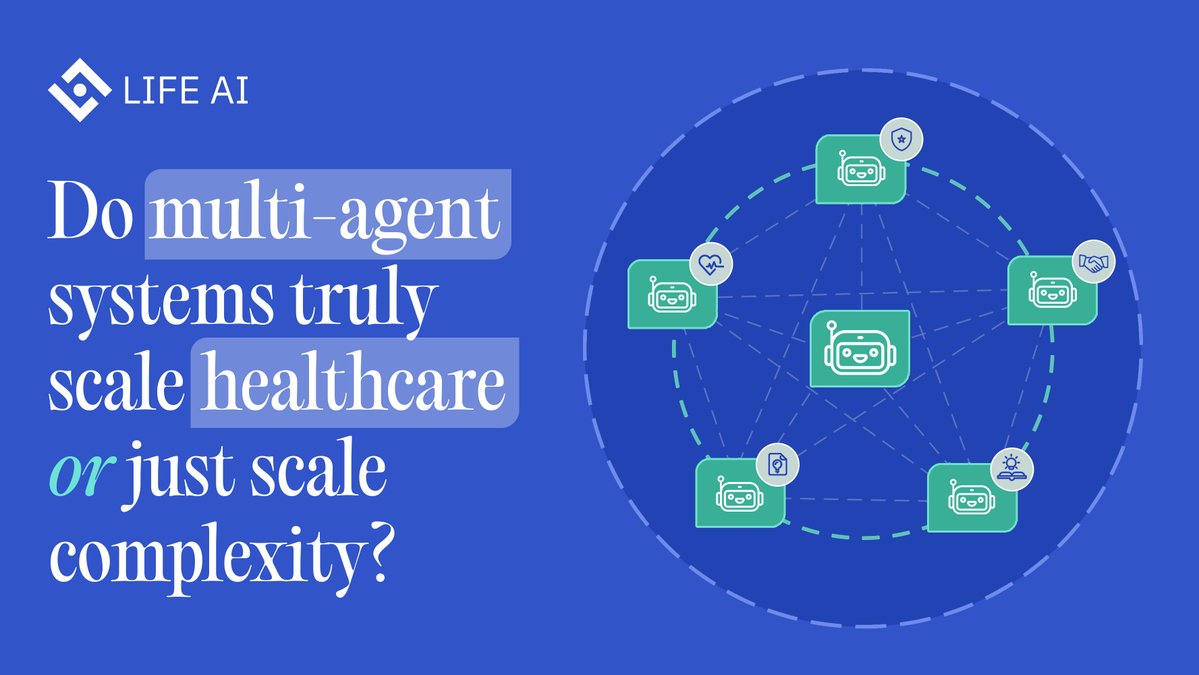
Do multi-agent systems truly scale healthcare or just scale complexity?
Viewpoint A: Scalable Coordination
Healthcare workflows are too complex for a single agent.
Multi-agent systems split tasks, cross-check outputs, and improve efficiency at scale, especially in areas like care coordination and prior authorization. With the right guardrails, they offer a practical path forward.
Viewpoint B: Compounding Risk
More agents also mean more risk.
Errors can cascade, decisions become harder to explain, and accountability gets blurred. As systems grow, governance becomes more difficult and scaling too early increases exposure.
👇 Drop A or B and share your perspective
🤖 Community Question:
Do multi-agent systems truly scale healthcare or just scale complexity?
Viewpoint A: Scalable Coordination
Healthcare workflows are too complex for a single agent.
Multi-agent systems split tasks, cross-check outputs, and improve efficiency at scale, especially in areas like care coordination and prior authorization. With the right guardrails, they offer a practical path forward.
Viewpoint B: Compounding Risk
More agents also mean more risk.
Errors can cascade, decisions become harder to explain, and accountability gets blurred. As systems grow, governance becomes more difficult and scaling too early increases exposure.
👇 Drop A or B and share your perspective
DePIN meets Artificial Intelligence at the data layer.
@PerceptronNTWK
turns your idle internet into structured datasets for AI training,while rewarding participants in real time
This is how we move from data monopolies to a permissionless,community-owned intelligence network
Most blockchains optimize for financial speculation.
Konnex optimizes for physical reality
L1 infrastructure purpose-built for robotics +decentralized AI intelligence marketplace + robotic bonds for institutional capital
autonomous, and unstoppable.@konnex_world
🌐 Community Question: With soaring investment and valuations in AI, is the AI bubble real or a myth?
Viewpoint A: The AI Bubble Is a Myth
Supporters argue that AI reflects a fundamental shift in computing. Demand for AI infrastructure continues to grow rapidly as industries adopt AI across areas such as healthcare, robotics, and digital biology. They also point to falling compute costs, improving reasoning capabilities, and expanding real-world applications as evidence that the growth is driven by genuine technological progress rather than speculation.
Viewpoint B: The AI Bubble Is Real
Critics warn that AI valuations and investment could be driven by hype and expectations of rapid breakthroughs. They argue that spending on infrastructure and startups could outpace real revenue and adoption, creating risks of market correction similar to the Dot-com Bubble.
👇 Drop A or B and share your perspective
🌐 Community Question: With soaring investment and valuations in AI, is the AI bubble real or a myth?
Viewpoint A: The AI Bubble Is a Myth
Supporters argue that AI reflects a fundamental shift in computing. Demand for AI infrastructure continues to grow rapidly as industries adopt AI across areas such as healthcare, robotics, and digital biology. They also point to falling compute costs, improving reasoning capabilities, and expanding real-world applications as evidence that the growth is driven by genuine technological progress rather than speculation.
Viewpoint B: The AI Bubble Is Real
Critics warn that AI valuations and investment could be driven by hype and expectations of rapid breakthroughs. They argue that spending on infrastructure and startups could outpace real revenue and adoption, creating risks of market correction similar to the Dot-com Bubble.
👇 Drop A or B and share your perspective