The founder of an AI-biologics discovery company recently told me that their algorithm designs a trillion new therapeutic proteins per week. And there are dozens of such companies. Drug design is now commoditized.
The current bottleneck for AI to actually improve human health is in the infrastructure needed to make and test the tsunami of new AI-designed drugs that are coming. To address this, the AI companies will need to go beyond understanding biology. They will need to control biology directly. I wrote an essay on why.
https://t.co/w24nyXhilW
Curious to hear your thoughts @elonmusk@DarioAmodei@sama@demishassabis
I think this is spot on. CMC problems are the dirty little secret of the pharma industry.
My team and I have been building new tools to modernize CMC and have fully driverless bioreactors using optogenetic biomanufacturing.
I think our work might be of interest to you, and if so you can read about it here: https://t.co/t7DCN4oOcF
Love this. A liquid handler doesn’t change its metabolism every second. Getting cells to make a protein is one problem. Getting them to keep making it for two weeks gives you plenty of time to discover new ones. Biology is a pain-in-the-ass, and my team and I have been trying to tame it using Optogenetic Biomanufacturing.
You may find our work interesting, and if so you can read about it here: https://t.co/t7DCN4oOcF
In 1987 the first medicine made by putting a human gene into an animal cell was approved. The cell came from a Chinese hamster’s ovary. Yes, really.
Put the gene in, put a viral promoter in front of it, and leave it on. One instruction: keep making this protein.
Nearly forty years later the molecules have got far more complicated but the instruction hasn’t.
That’s what we’re changing at @ProlificMachine
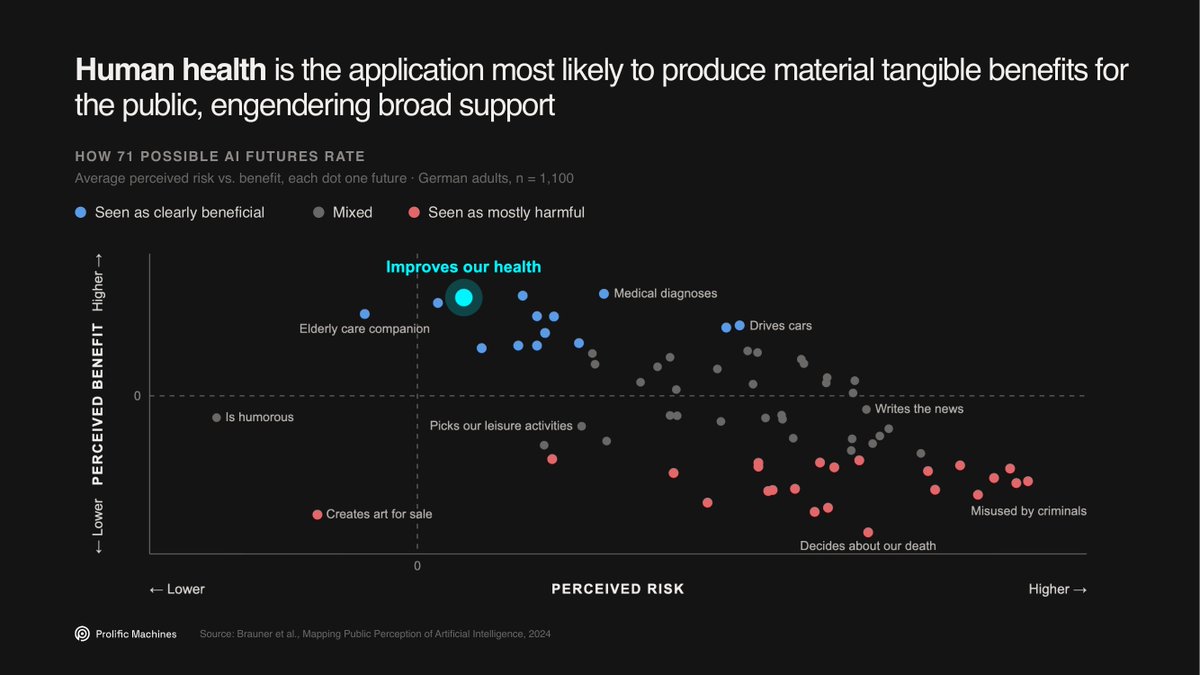
What % of adults are more excited than concerned about AI? I opened a talk last weekend with that question, to a room full of brilliant frontier AI researchers. Hands went up. 70%! 50%! 60%! 80%!
I then shared the data. The answer is 9%, and it's trending down. It caused quite a stir. So, how does public trust come back? When people rank dozens of possible AI futures, the one they see as most beneficial and least risky is AI that improves our health. I went on to explain why current approaches in AI understanding biology are both critical and insufficient. And why AI companies need to integrate their algorithms directly into the cell, using light as a digital actuator. I provided a roadmap for how to use that to make all biological products, and how it could completely transform human and planetary health.
Parts of the deck I presented is attached, and the essay that inspired it is in the comments. Feel free to share with anyone who you think might be interested!
At @prolificmachine we give cells the genetic instructions to attach a light-sensitive protein to a target protein. We then use light to change what the target does, in real-time, inside a scaled bioreactor. This allows any cellular process to be controlled in a manufacturing relevant context.
This youtube video explains how it works in more detail:
https://t.co/1y7WlfkLXg
@sesameandrea Congrats, this is great!
One thing we've found at Prolific Machines is that many good drugs fail due to large scale production issues, especially new formats. We've designed a new toolkit to help with this that might be of interest to you!
More here: https://t.co/mRgbgIZ6Xn
This is great! I agree we are far from a virtual cell, but the toolkits we need to make one are getting close.
At @ProlificMachine we dynamically control any cellular processes with light, so we can perturb and measure biological functions with extreme precision, which will be quite useful for virtual cell modelling.
More here: https://t.co/ORRIil5Bof
Love this, Stephen!
The founder of an AI-biologics discovery company recently told me that their algorithm designs a trillion new therapeutic proteins per week. And there are dozens of such companies. Drug design is now commoditized. The current bottleneck for AI to actually improve human health is in the infrastructure needed to make and test the tsunami of new AI-designed drugs that are coming. To address this, the AI companies will need to go beyond understanding biology. They will need to control biology directly. I wrote an essay on why, which might be of interest to you. https://t.co/HjqmZwsXsb
@KevinKaichuang@befcorreia This is cool. My team and I work on using light to control cells dynamically in a bioreactor context, which may be of interest to you.
More here: https://t.co/VBq0dEF4Cj
@WUFang40615703 I like this, Fang! Congrats!
I recently wrote about why AI will need to go beyond drug design to controlling cells directly if we want to maximize the benefits to human health. It may be of interest to you!
https://t.co/VBq0dEF4Cj
This is awesome, Niko! I really hope he pulls it off.
We’ve been looking into gene therapy at @prolificmachine and it’s a real pain in the ass to produce these medicines using conventional tools. To solve that we’ve been building a light activatable viral gene platform to democratize access to these critical medicines.
I like this, Nicole!
The founder of an AI-biologics discovery company recently told me that their algorithm designs a trillion new therapeutic proteins per week. And there are dozens of such companies. Drug design is now commoditized.
The current bottleneck for AI to actually improve human health is in the infrastructure needed to make and test the tsunami of new AI-designed drugs that are coming. To address this, the AI companies will need to go beyond understanding biology. They will need to control biology directly. I wrote an essay on why, which might be of interest to you.
https://t.co/HjqmZwsXsb
@Anthropic and @citrini used Claude to design proteins that bind scorpion neurotoxins. 318,484 designs in 64 hours, 211 eventually made and tested, 17 bound. Binding isn’t neutralisation yet, but it’s a real result.
The real question is which of those 17 express at high yield, stay stable and purify cleanly at scale? What we’ve seen at @ProlificMachine is that many AI (and human) designed molecules do not get produced well using cells powered with conventional tools. That is why we build an optogenetic biomanufacturing toolkit — it’s the best way to get difficult to produce molecules made.
New on our Science Blog: designing protein binders against scorpion neurotoxins.
Scorpions sting about 1.2m people every year, and antivenoms are often costly or in short supply. Claude has made an early step toward finding new treatments.
https://t.co/l6LgdEqM7I
@SavalarHeel Hey Savalar! Not personally, no. Our focus is the manufacturing layer: using light to control cells, with machine learning to optimize the light patterns, so making biological products gets ridiculously faster and cheaper. Plenty of great teams own the other pieces.
The founder of an AI-biologics discovery company recently told me that their algorithm designs a trillion new therapeutic proteins per week. And there are dozens of such companies. Drug design is now commoditized.
The current bottleneck for AI to actually improve human health is in the infrastructure needed to make and test the tsunami of new AI-designed drugs that are coming. To address this, the AI companies will need to go beyond understanding biology. They will need to control biology directly. I wrote an essay on why.
https://t.co/w24nyXhilW
Curious to hear your thoughts @elonmusk@DarioAmodei@sama@demishassabis
@elonmusk The part that hasn't gone exponential (yet) is actually making products using biology. We can design a trillion protein therapeutics per week, but that doesn't matter unless we have the right infrastructure to manufacture and test them, which we don't. My team is fixing that.
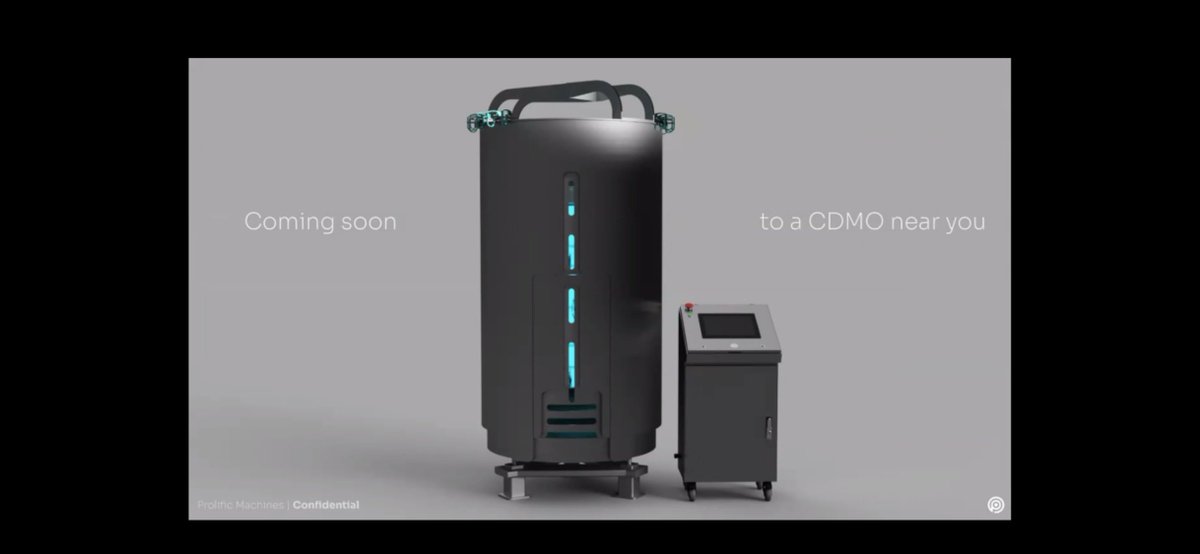
Today we're announcing our partnership with Zylidac, a state-of-the-art CDMO owned by the Pharma giant @ZydusUniverse Group. We're excited to be working with this veteran team that has brought over 30 molecules into the clinic. They understand that the digital control over biology that Prolific uniquely enables is going to be essential for manufacturing the coming wave of new medicines. Zylidac are not the only CDMO we are working with, but they will be the first to receive our GMP 2KL illuminators, due to their extreme proximity to our HQ (5min walk).
For anyone who was curious about trying Optogenetic Biomanufacturing, but was worried about the lack of a GMP scale path, one now exists at Zylidac. And more options will be coming online soon. We have a growing waitlist of deployments scheduled for 2027 and 2028.