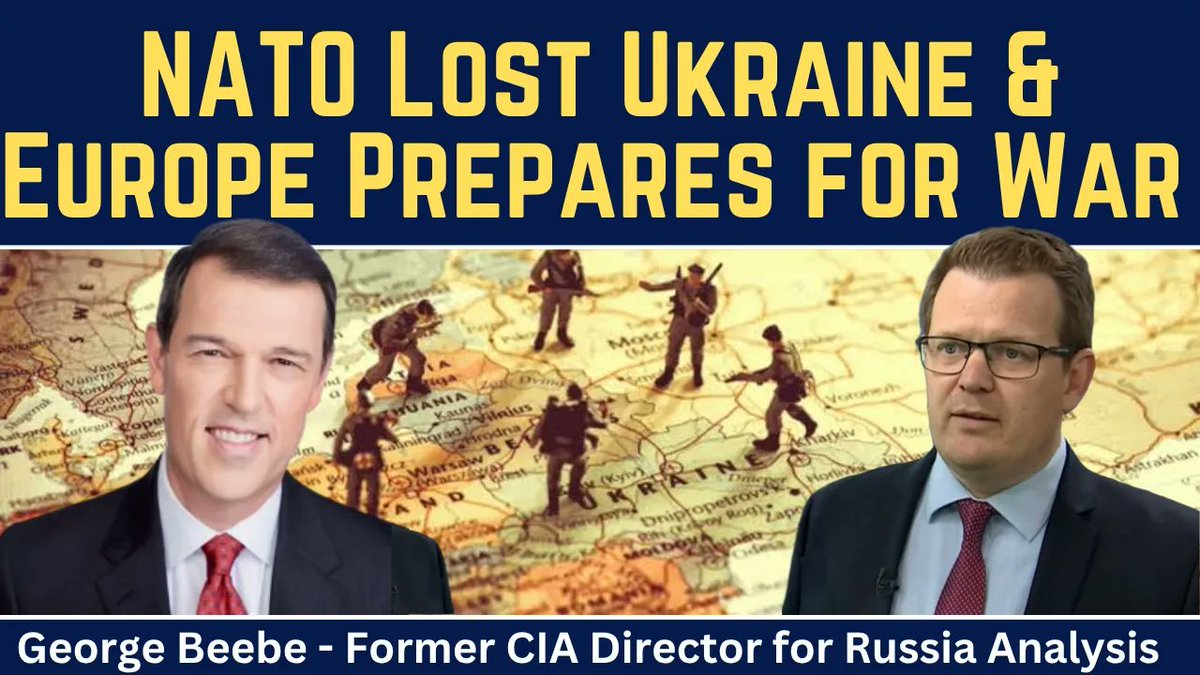
There are two competing hypotheses about Russia's invasion of Ukraine. The first hypothesis is that the invasion was unprovoked, as Russia is another "Hitler" pursuing expansionism, and that the logical response of NATO is therefore to stop Russia and raise the costs. From this perspective, even diplomacy can be viewed as "appeasement." The second, competing hypothesis is that Russia responded to 30 years of NATO expansion, which it considers an existential threat, and thus considers itself to be fighting a defensive war. If the second hypothesis is correct, then NATO deepening its direct involvement and rejecting negotiations will only result in the destruction of Ukraine while taking further steps toward nuclear war.
George Beebe, the former Director of Russia Analysis at the CIA, argues that the second hypothesis is clearly correct: Russia sees this as a war for its survival and therefore cannot back down. One does not need to agree with the analysis of Beebe, but this should really be at the center of the debate in the West, as our survival depends on it. My great concern is that we are not even permitted to discuss or debate these two competing hypotheses, because the narrative must be protected and all dissent is smeared as repeating Russian propaganda. https://t.co/TPlLpZlAzg
@BhBDeutschland@ZentraleV Jup stimme zu, was das Geld angeht, aber der Kokser trifft die Entscheidungen für sein Land, die Ukraine. Er ist hier der Verantwortliche, nicht Dritte.
Almost all citizen of the global South, including in the dictatorship of Russia, China, Iran, etc envy our political system that produces, an even rewards, people with extraordinary intellectual capabilities, long-term vision, and extreme knowledge of economics, geography, geopolitics, and international relation
The leaders of European Union and of many member states are the envy of the whole world who desperately wishes their countries to have leaders of similar standing
Here a small sample of their outstanding qualities
The President of the European Commission — ten years in office, ten years of calamity — tells us that Russians steal washing machines because they desperately need the semiconductors inside them. My Chinese friends had one rather obvious question: “How come they don’t have semiconductors? We’re selling them plenty. What are they doing with them, throwing them away?”
The European Commissioner for Competition from 2019 to 2024 invited us to tell our children to take cold showers — and, while standing under the cold water, to give Putin the finger in order to help Ukraine win the war. European strategic thinking at its finest.
Then we have Kaja Kallas, the European Union’s foreign-policy chief — “foreign minister,” so to speak — entertaining the idea of breaking Russia up into a collection of smaller states, which would presumably make them rather easier for us to control. Nothing says “respect for sovereignty” quite like deciding how many countries somebody else’s country ought to become.
The Prime Minister of Poland — a country still apparently trying to decide whether it dislikes Russians, Germans or Ukrainians most — says that instead of prosecuting the people responsible for blowing up Europe’s largest energy infrastructure, we should regard those who built it as the real criminals. An innovative development in criminal law: don’t prosecute whoever blows up the pipeline; prosecute whoever built it.
The Italian Foreign Minister, whose principal contribution to foreign policy over the past four years could perhaps have been achieved by hanging a map of Russia on his office wall, appears to believe that the Russian Federation shares a border with Afghanistan — a border that terrorists conveniently cross at night. A small geographical problem: that border does not exist.
Then there is Italian Prime Minister Giorgia Meloni, who sits down to dinner with Xi Jinping and tells us she ate “spaghetti in broth.” In China. With Xi Jinping. I would genuinely like to know what the Chinese interpreters did with that one.
And finally — I almost forgot — Mario Draghi, with an equation presumably produced after exhaustive economic modeling, geopolitical analysis and impact assessment, which he himself managed to summarize rather elegantly: if we stop buying Russian gas, we will have peace. https://t.co/SSWAqdNPSO