James Webb may have spotted a supernova from more than 12.5 billion years ago
The explosion occurred when the universe was just 1.15 billion years old. Researchers estimate that Webb spotted it within 4-10 days of the explosion
James Webb may have spotted a supernova from more than 12.5 billion years ago
The explosion occurred when the universe was just 1.15 billion years old. Researchers estimate that Webb spotted it within 4-10 days of the explosion
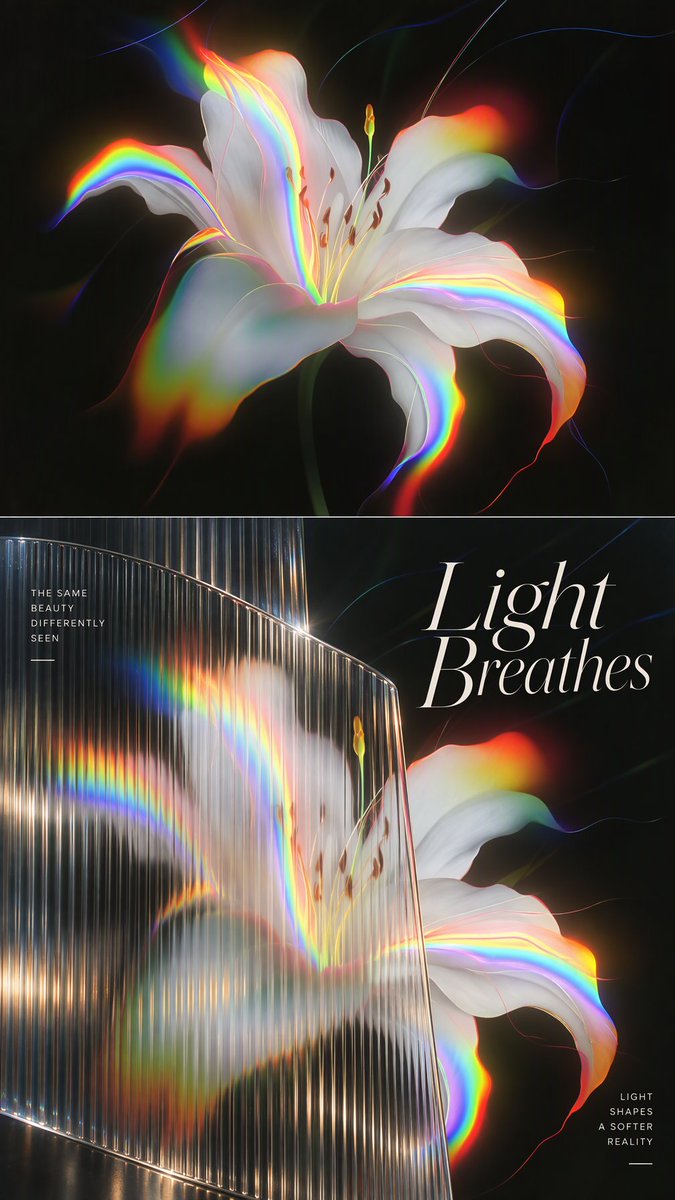
I love this vibe. Below is my prompt, give it a try!
prompt:Create an experimental optical art poster for the uploaded image; no collage work. The canvas is split strictly 1:1 into upper and lower sections, each occupying 50% of the frame.
Upper section: Retain the original photograph in full. For people or animals, preserve identity, facial features, eyes, expressions, fur, clothing, movements and posture without alteration. For flowers, plants, architecture, landscapes, vehicles and still-life subjects, keep outlines, structures, positions, materials, perspective, surroundings, depth of field, natural lighting and color relationships unchanged. Only subtle high-end color grading and exposure adjustment, plus natural background extension are permitted. Do not stretch, distort, or replace the main subject, nor add unrelated elements. No text of any kind.
Lower section: Use only the source photograph as reference. Preserve the subject’s identity, facial features, posture, structure, proportions, original color palette and spatial mood. Proportional scaling, proper cropping and positional adjustment are allowed, but identity and core form cannot be altered. Place adaptive transparent fluted glass in front of the subject, integrating it into the scene through partial occlusion, realistic refraction, perspective overlap and directional extension. Areas outside the glass remain sharp photographic content; the glass must not be a floating overlay, and the background cannot be swapped out. The glass may be a single large panel, slender strips, curved sheets, rings, triangles, trapezoids or irregular segmented slices arranged radially. Quantity and scale are determined by composition. For motion shots, use slanted progressive strips with converging offsets. For portraits, use soft curved surfaces with restrained framing. For architecture, align panels along perspective axes. For natural flowers, follow organic curves. For still life, use precise minimal slices. Establish a hierarchy of primary glass, secondary glass and rhythmic accents; avoid random stacking. The glass consists of continuous, uniform, ultra-fine transparent micro-prisms at roughly 3–5 times the density of standard fluted glass. The grating may run vertical, horizontal, diagonal, radial, or bend along curved surfaces. Render realistic thickness, chamfers, Fresnel reflections, soft transmission and gentle specular highlights. Local magnification, compression, offsetting, banded mirroring and textural distortion must derive from the source image. Avoid oversized prisms, metal louvers, plastic textures, plain stripe filters, neon outlines and heavy rainbow dispersion. The glass overlaps the subject intentionally. Key facial features retain roughly 60%–70% clarity; redundant occlusion is forbidden. Edges may extend beyond the subject or canvas, while spatial depth remains convincing. Apply asymmetrical balance, controlled density rhythm and ample negative space; empty areas inherit the original background tone.
For text: Add one thematic English headline in a delicate, high-contrast serif typeface, arranged freely along the subject and visual flow without obscuring focal points. Place 2–3 small text blocks in quiet negative space using minimalist modern sans-serif fonts. No garbled text, pseudo-English, logos or watermarks.