One of the areas we're continuing to develop is the connection between deployment and listing.
A token being created shouldn't mean the creator has to start from scratch when thinking about its market.
Deploy Perps is being designed so that listing can become a natural continuation of the deployment process.
We're working on the infrastructure required to make that transition cleaner and more structured.
The broader objective is to bring token launches and perpetual markets closer together, so creators can think about both sides of the equation from the beginning.
We're continuing to prepare Deploy Perps for a broader multichain environment.
The platform starts with the idea that creators should be able to deploy where their communities already exist rather than being forced into one ecosystem.
That means expanding the infrastructure beyond a single network while maintaining one consistent product experience.
More ecosystems also mean more technical considerations around deployment and market connectivity.
We're working through those pieces now.
The direction is clear: more networks, one platform, and a common path toward perpetual markets.
We're putting more attention into the creator experience.
Deploy Perps is meant to serve people creating new assets, so the platform needs to make the process understandable from the first step.
That means clearer deployment flows, better visibility into what happens after launch, and a more direct path toward perpetual markets.
We don't want creators to need five different tools just to understand where their token stands.
We're refining the token deployment flow.
The objective is to remove unnecessary friction between having an idea for a token and actually getting it deployed.
But deployment is only one part of the system.
We're designing the flow with the next step in mind: connecting the newly created asset to perpetual market infrastructure.
That means the platform needs to handle more than a token creation transaction.
It needs to provide a clean path from deployment toward listing and trading.
Less fragmentation is the direction.
We're continuing work on the multichain side of Deploy Perps.
The goal is to make deploying across
different ecosystems feel consistent without hiding the technical differences between them.
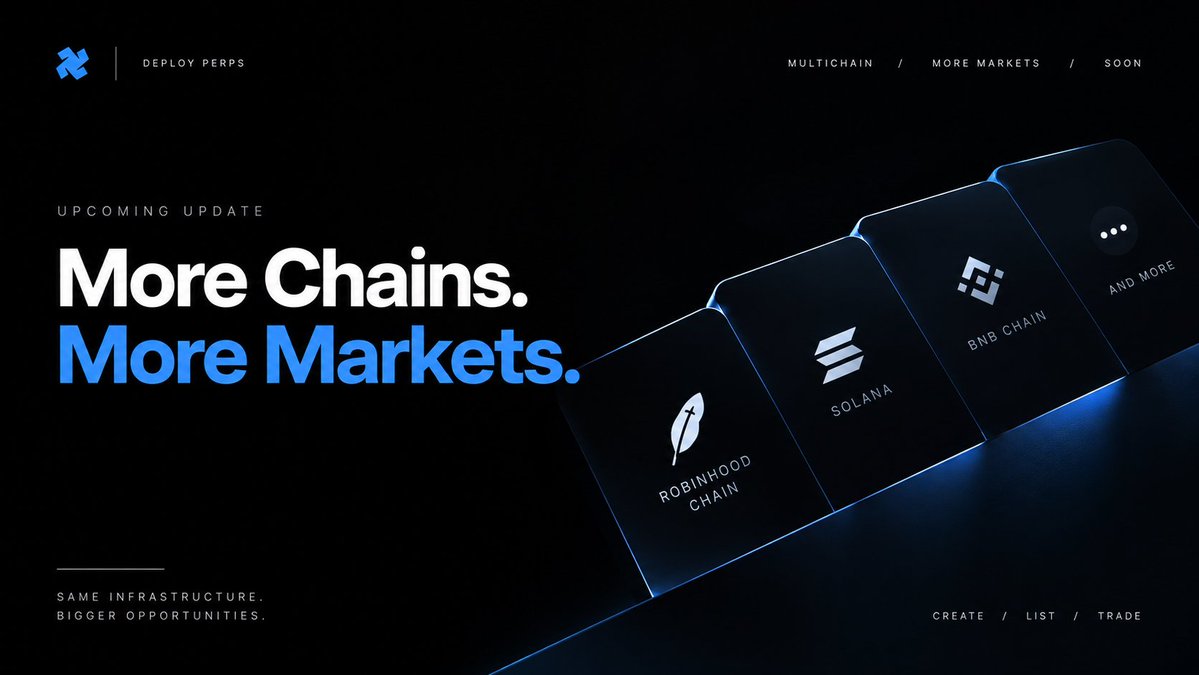
Robinhood Chain, Solana, BNB Chain, and additional networks are part of the broader direction.
Right now, the focus is on building the underlying structure that can support more chains without creating a completely different workflow for every one.
More chain support is useful only if the experience remains simple.
That's what we're wo' 'ng toward.
Permissionless infrastructure changes the question from “who gets listed?” to “what can be built?”
That shift is important.
Instead of treating market access as something that must always happen through a centralized sequence of approvals, Deploy Perps is exploring infrastructure where token creators can move more directly from deployment toward perpetual markets.
There are difficult technical problems behind that idea, from market configuration to risk controls and multichain coordination.
But the principle remains straightforward:
Build infrastructure that expands what creators can do, without making centralized permission the primary bottleneck.
There’s an interesting distinction between creating an asset and creating a market.
Deploying a token answers one question: what exists?
A perpetual market answers another: how can people express a view on it?
We’re building around the connection between those two primitives.
The long-term direction is to make the transition from deployed asset to perpetual market more straightforward, while giving the infrastructure enough flexibility to support different chains and market configurations.
Token launches shouldn’t exist in isolation.
They can be the starting point for market infrastructure.
Multichain infrastructure sounds simple until you actually build it.
Different networks have different execution environments, transaction models, liquidity conditions, and tooling. Making them feel consistent from a user perspective requires much more than adding another chain to a dropdown.
That’s one of the areas we’re working through at Deploy Perps.
The objective is a unified deployment experience that can operate across ecosystems while keeping the underlying network differences intact.
One interface does not mean one chain.
It means the complexity is handled where it belongs.
Token creation has become increasingly accessible, but the infrastructure around what happens next is still fragmented.
A creator can deploy an asset in minutes, yet moving from that deployment toward a functioning market can involve multiple platforms, separate integrations, and different technical assumptions.
That gap is where we’re focused.
Deploy Perps is being built around a tighter connection between token deployment and perpetual markets, with the underlying infrastructure designed to support that transition across multiple ecosystems.
The goal is not more steps. It’s fewer.
There’s a lot happening before a trade ever reaches a screen.
A token has to be deployed. Infrastructure has to recognize the asset. A market has to be configured. Trading needs to become possible.
We’re working on bringing those pieces closer together.
Deploy Perps is built around the idea that token deployment and perpetual markets shouldn’t feel like completely separate worlds.
As the platform develops, we’re focusing on the underlying systems that can make that connection reliable across multiple ecosystems.
No loud promises.
Just infrastructure being built step by step for the markets that come next.
Crypto has made creating tokens dramatically easier.
Now the infrastructure around those tokens needs to evolve.
Deploy Perps is working on the connection between token creation and perpetual trading, creating a permissionless path from deploying an asset to giving traders a market around it.
Our upcoming development is focused on expanding supported ecosystems, improving deployment flows, and strengthening the infrastructure behind market creation.
The bigger picture is simple:
Create the asset.
Connect the market.
Let people trade it.
That’s the direction we’re building toward.
We’re approaching token infrastructure from the creator’s side.
Launching an asset should be straightforward. Getting that asset toward a tradable perpetual market shouldn’t require understanding an entire stack of separate platforms.
Deploy Perps is being developed to bring those steps closer together.
The upcoming improvements are focused on making deployment more intuitive, expanding chain compatibility, and creating a smoother path toward Perps markets.
There is still a lot to build, but the direction is clear.
Give creators better infrastructure.
Give their assets a clearer route to markets.
Let the market handle the rest.
A lot of the work happening at Deploy Perps isn’t visible from the outside.
We’re focused on the infrastructure that makes multichain token deployment and perpetual markets work together reliably.
That includes improving deployment flows, preparing for additional networks, refining market configuration, and making the overall system easier to scale.
The goal is not to add complexity for the sake of features.
It’s the opposite.
We want creators to have a straightforward interface while the underlying infrastructure takes care of the difficult parts.
Build once. Connect the market. Keep moving.
We’re working on making the path from a deployed token to a perpetual market more direct.
Today, token creation and market creation often feel like two completely separate processes. Deploy Perps is being built to connect them.
The upcoming work is focused on improving how assets move through the pipeline, from deployment and configuration to Perps listing and trading.
The interface should stay simple, while the infrastructure underneath handles the complexity.
Less fragmentation.
Fewer unnecessary steps.
A cleaner path from token → market → trade.
We’re building Deploy Perps around a simple idea: token deployment should not be limited by the chain it starts on.
Our next steps are focused on expanding multichain support and making the deployment experience consistent across different ecosystems.
Robinhood Chain, Solana, BNB Chain, and other major networks are part of the direction.
The challenge isn’t simply adding more chains. It’s creating infrastructure that makes moving from deployment to perpetual markets feel like one continuous workflow.
More networks. More assets. More markets.
That’s the layer we’re building
A token launch is an event. A market is a system.
Deploy Perps is focused on connecting those two stages.
We’re building the infrastructure required to move from deploying an asset toward creating a perpetual market where traders can take leveraged positions.
That means thinking beyond the launch transaction itself and focusing on everything that comes after: market configuration, listings, trading infrastructure, and multichain expansion.
As we continue developing the platform, the goal stays consistent: reduce the distance between creating an asset and giving that asset a market to trade in.
The next phase is about expanding the map.
Deploy Perps is being built for a multichain environment, where creators shouldn’t have to rethink their entire workflow every time they move to another network.
More chains mean more places to deploy.
More deployments mean more assets.
More assets create more opportunities for markets.
We’re working toward broader chain support across ecosystems including Robinhood Chain, Solana, BNB Chain, and beyond.
Same core infrastructure. More networks. More markets.
More chains. More markets. Coming soon.
We’re changing the way we think about token launches.
A successful deployment shouldn’t leave creators wondering what comes next. The next step should be clear: connect the asset to a market where people can actually trade it.
That’s the direction we’re taking Deploy Perps.
We’re continuing to build the connection between token creation, Perps listing, and leveraged trading so the entire journey can happen through a more unified platform.
As we roll out new improvements, the focus stays the same: make the distance between launching an asset and creating a market as small as possible.
We’re continuing to improve the infrastructure behind the Perps side of Deploy Perps.
The long-term goal is not simply to offer another place to trade. It’s to create a reliable connection between newly deployed assets and perpetual markets.
That means improving the systems around listings, market configuration, trading flows, and multichain deployment as the platform expands.
There’s a lot happening behind the interface, and we’re focused on making the underlying experience cleaner, more scalable, and easier to use.
The product should feel simple even when the infrastructure underneath it isn’t.
We’re making the deployment experience simpler.
Creating a token should not require navigating a complicated stack of tools, interfaces, and disconnected services just to reach the next stage.
Deploy Perps is being built around a cleaner flow where creators can focus on the asset while the platform handles the path toward Perps listing.
We’re refining the experience from the first deployment step through market creation, with fewer unnecessary decisions and a more direct interface.
The objective is simple: make launching a token feel like the beginning of a market, not the end of a process.