Many systems have one of these qualities but few achieve both.
Apps made by talented designers often offer strong "omakase" opinions, but weak customizability. Locally they're making good decisions: it's true that a million settings sucks.
Meanwhile, many hackable systems are only for nerds who enjoy the setup journey as a hobby. Most people don't care enough or have time for that. Personally I'm not really a setup nerd myself.
It may seem like there is an irreconcilable tension between these poles. But in fact, with the right design philosophy that is not the case!
Rails has a lot of swappable / modular seams, while offering an amazing day 1 experience. (or at least it did back in the 2010s when I was a heavy user.) Mac OS is built around beautiful UNIX primitives but gives an easy entry point. Heroku comes to mind as another example: easy one-click deploy, but deep customizability too.
The key is to not think of it as bolting settings onto an app, or giving users a pile of raw materials. You have to build around a composable set of primitives, but then also do the hard work of giving users awesome, opinionated, preassembled experiences on day 1.
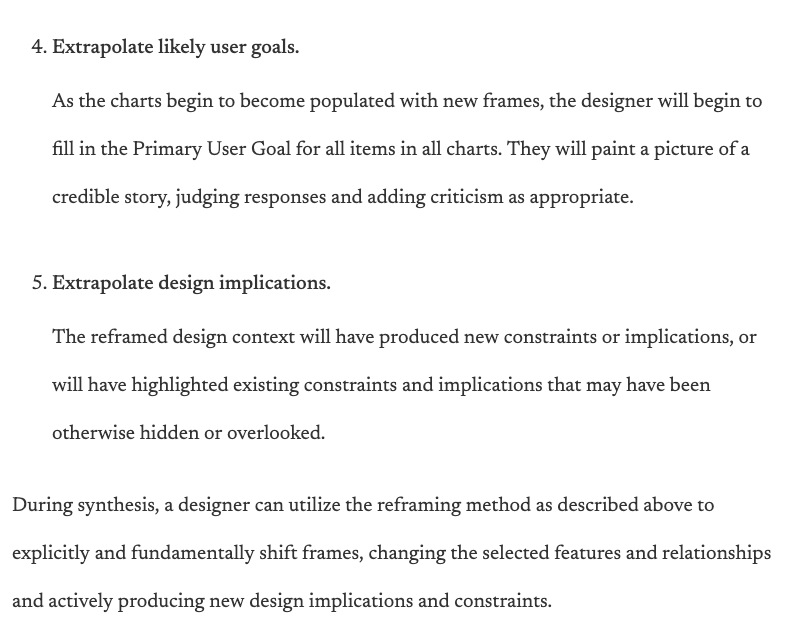
More specifically the skill to make sense of a problem by reframing it and combining it with a similar but different context's solution : Design Abductive thinking skills
Jon Kolko's essay on abductive thinking
https://t.co/iC1sJe5kT2
Kees Dorst's book on reframing
https://t.co/E8sU3gPhZC
If you divorce AI from the paradigm of startups / quick buck / YC / VC and force it to make software which reflects your soul, you will be contributing to a new renaissance. Fuel yourself with the best of what humanity has produced and push ahead in that same spirit, pioneer!
Designer's "invisible jobs" are:
1. Listen through all "ideas" in unstructured way (or poorly structured, like "read my AI summary");
2. Research the real importance vs perceived; multiplied by conviction.
3. Prioritize;
4. Imagine decisions in product to check if the ranking and priority is working correctly;
5. Optimize based on subjective evaluation and unstructured feedback.
There's a high demand for design. I would say "higher than ever been", but it's disguised under other roles and not clearly articulated. People call it "high agency", while looking for someone to bring them clear decisions framework, because they are tired of "abundance of 10 half-cooked ambivalent directions", instead of "1 done well and completely".
It's cheap to generate 11th direction and it's getting more expensive than ever, to complete one.
And of course demand grows if idea generation grows 100x. It does make more available designers busier.
Complexity explodes > supply is scared away by harder complexity > demand sky-rocketed.
funny enough – i'm more bullish than ever on design tooling. the work is changing so our tools must as well. lots of whitespace for companies to solve for the workflows of post-interface designers
I've found myself going through this weird cycle of intensely working on a feature, finishing it, then thinking about it for a week before shipping
I think coding with AI accelerates my building but then I need time to be convinced by what I've built
This little illuminated dragon is very happy about Pretext. He's too busy having fun to care about people's "hot takes" on how "it's not that special."
(This little dragon also only works on desktop right now but maybe I'll do mobile later)
https://t.co/k9FH6p1G0T