@iskander Your time is too valuable; don't fall into the trap of wasting time on this even if it *looks* time / cost inexpensive with AI. Just buy from @pochekailov
Uhhhhh "Minicircle is a gene therapy platform, not a medical provider. All therapies are investigational, have not been reviewed by the FDA, and are administered by licensed clinicians at independent international partner clinics operating under regulatory frameworks outside the United States."
I envision a future where there isn't biologic (e.g. antibody) manufacturing like we have today. Instead, we deliver to the body instructions for endogenous production of biologics, with precise control over expression (somehow). Because at face value, taking the sequence of an antibody (something humans produce) and introducing it into Chinese hamster ovary cells only to then purify, formulate, and deliver the antibody to humans, at great cost in both time and money, seems excessively roundabout. Humans already have a cell type dedicated to the production of antibodies! Engineering challenges abound of course, but the foundations are starting to appear.
Progress in biology has a curious structure that, as far as I know, has never really been explained
Why would we lock in a cell line derived from Chinese Hamster Ovaries and proceed to use it for everything for 60 years?
There is no plausible reality in which this random-ass cell line from the 1950s is the global optimum solution for all of its use-cases
Part of the answer is that biology needs to be cautious in a way that other fields do not. Lives depend on biologics manufacturing. So CHO cells are harder to discard than say, a programming language, when a better option comes along
But if biologists are so cautious that they are unwilling to update a core technology for 6 decades - why has there been any progress at all? Sometimes things move quickly. DNA synthesis, sequencing, gene editors, etc. It isn't the case that biologists globally value caution in all things
Biological caution has a kind of jagged frontier. There is a Warhammer 40k quality to it. The tech-priests enforce orthodoxy on CHO cells. But cult of inertia doesn't extend to every planet in the imperium. In isolated pockets, researchers are free to innovate or to adopt xenos technologies
Every biologist has had the experience of asking themselves "why do we do things in this weird old way?" Finding a satisfying answer to that question is, I believe, the key to building the new kind of AI-powered biotech
https://t.co/4KGy17ueS5
A refreshingly serious effort in the de novo drug discovery space:
1. Actual antibodies
2. With encouraging affinities
3. Against some nontrivial targets
4. Conditioned on human framework sequences
5. That consider developability
6. And are available for download!
Introducing Pythia-1, a frontier generative model for protein design.
In our new study, we used it to rapidly design full-length human agonist and antagonist antibodies for hard-to-drug targets.
We’re sharing complete sequences of all lead antibodies to support independent validation and further research. 1/8
@puercorum@whendrick2009 Somatic hypermutation following administration is not necessarily bad. For example, enabling this facet of adaptive immunity should improve the capacity of an initial broadly neutralizing antibody sequence to evolve against a mutating pathogen e.g. flu, HIV
True, negative selection typically eliminates autoreactive B cells during development, but a number of diseases characterized by autoantibodies serve as interesting counterexamples e.g. Graves'. And why naive B cells necessarily? Perhaps circulating class-switched memory B cells, or plasmablasts, or even existing long-lived plasma cells
@SynBio1 Programming doesn't face GMP equivalents for documentation, process validation, and regulation (which has tradeoffs! we want drugs to be accurately formulated, consistent potency, free of adventitious viruses, demonstrably stable when stored, etc. etc. etc.)
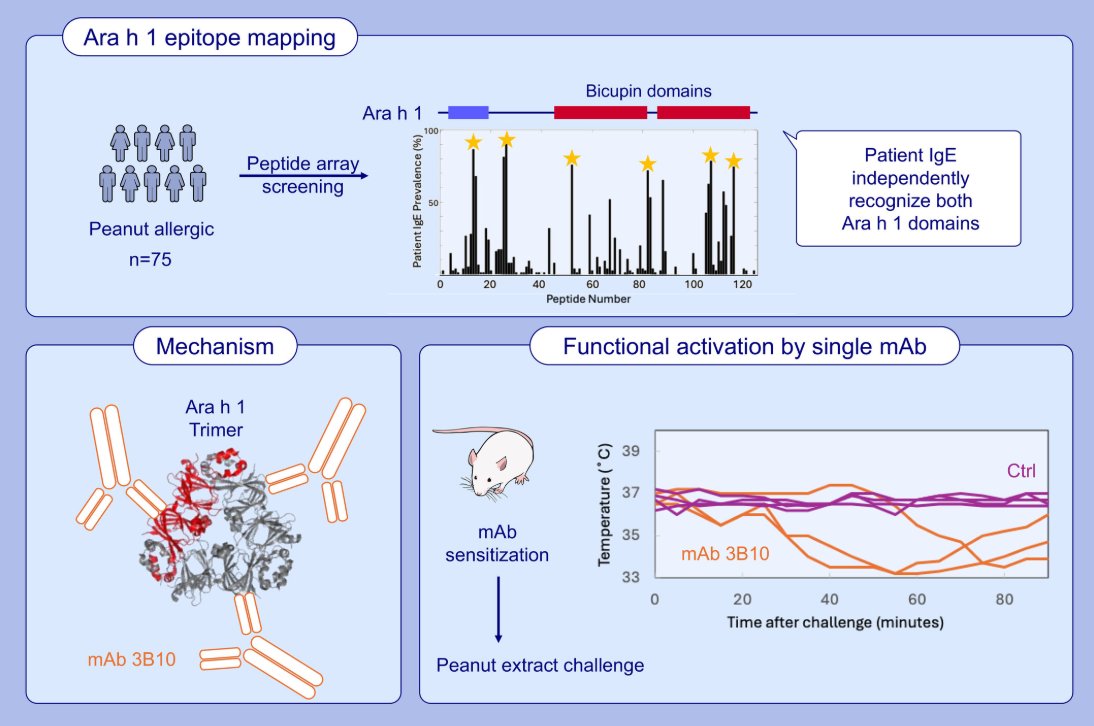
Another example whereby the discovery of monoclonal IgE antibodies from allergic individuals uncovers new facets in the structure and function of allergens! As always, fun for @IgGenix to collaborate with Geoff Mueller and Scott Smith.
Open Access: Human IgE Antibodies Recognize the Vicilin and Alpha-Hairpinin Domains of Peanut Allergen Ara h 1. First author: Taylor M. Cosey; corresponding author: Geoffrey A. Mueller
The ɑ-hairpinin of Ara h 1 contains a dominant epitope that is both frequently recognized and blocks a majority of the IgE against this domain. Including this region in tests may improve diagnosis of peanut allergy. The trimeric structure of the vicilin region explains the ability of Ara h 1 to induce anaphylaxis with a single antibody.
@brad_woolf@ChrisHayduk One thought is transduction of neurons differentiated from patient-derived iPSCs to measure rescue of neuronal firing patterns against isogenic controls
The brutally candid retrospective, "Lessons learned from the fate of AstraZeneca's drug pipeline", is an A+ read for anyone in biotech.
Despite being over a decade old, there are timeless insights from their 5Rs framework: right target, right tissue, right safety, right patients, and right commercial opportunity.
And as if the entire manuscript didn't drive home the challenges of drug development, they leave the reader with this sobering sentence in the concluding paragraph: "Our ambition is to achieve an overall success rate of at least 8% from preclinical GLP toxicology to launch."
Link to the pdf from academia[.]edu below.