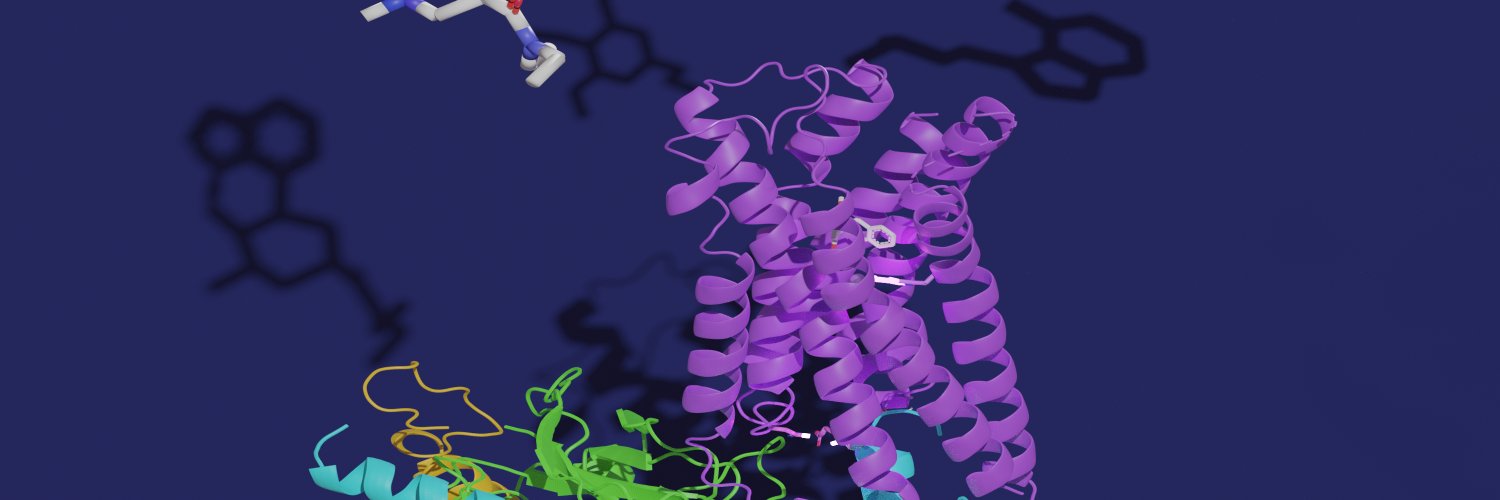
A suite of engineered mice for interrogating psychedelic drug actions
#psychedelics
Congrats to Yi-ting, Ariel, Bill, Gavin, Dewran, Pierre and too many others to mention. A yuuge effort and we hope that folks will find these mice useful
https://t.co/ZVo06gE23C
U.S. Director of National Intelligence: Americans should prepare for "bumps in the road."
Outages may continue while both companies and the government "upgrade their systems," the DNI warned.
CNBC
One thing that I think the "AI will solve biology" people fail to appreciate is that there is nothing like Lean for biology; you just have to literally run the experiments.
And *chemical* space is unfathomably large, let alone complete biological organisms within an environment.
Stimulating Gq-coupled #GPCRs such as the serotonin receptor HTR2B enhances oncogenic signaling by G-alpha-q-Q209L/P in #UvealMelanoma cells and promotes proliferation, suggesting oncogenic mutant G proteins remain connected to their upstream receptors. https://t.co/wnBiSWkMTo
If President Trump wanted to fill a judicial vacancy in Dallas, why did he wait until after the midterms to nominate someone? The seat has been vacant since 2025. Then, without any consultation, he nominates a non-Texan with little connection to the Lone Star State, with no trial court experience, and who has not been appropriately vetted for a lifetime job. The Senate has a constitutional responsibility to provide "advise and consent," which is impossible without consultation.
Last night my father George McClelland Whitesides passed away. He was at home and surrounded by family, and his young granddaughters had just said good night to him.
He was a brilliant scientist, teacher, and entrepreneur. An advocate for basic research, he also believed that science and technology should serve society.
He lived a great, full life, married to his wife Barbara for 57 years. Their two sons had 5 grandchildren, who gave him much joy in his later years.
We'll share more details with friends and colleagues for a rememberance once finalized.
Excited to share our new preprint, co-led with Bart Lodder (@lodder_bart) from the Sabatini lab (@blsabatini)! We study how tonic dopamine regulates motivation and differentially influences PKA in D1R- and D2R-SPNs. Read our preprint here: https://t.co/lHMpxEHE0z .🧵below:
New findings establish how drinking alcohol disrupts anticancer immunity at the molecular level and point to several therapeutic approaches to restore the effectiveness of #immunotherapy. @bgvincentlab@UNC_SOM https://t.co/rAvTBF7CtV
Just heard that George Whitesides passed away. One of the world’s most celebrated scientists, he was that rare creature - a chemical polymath. No branch of chemistry failed to be enriched by his touch: from organometallic chemistry to surface chemistry, enzymes to physical organic chemistry, sensors and wearables to chemically actuated robotics, he left a deep imprint on virtually every chemical or chemistry-adjacent discipline. He was one of those scientists who clearly deserved a Nobel but did not get it (although he did receive pretty much every award for chemistry out there). He also trained hundred of students at Harvard, many of whom now occupy high positions in academia and industry.
But Whitesides was also one of the best writers among chemists that I knew. His papers (and there were almost a thousand) were incisive, pedagogically excellent and often took a bird’s eye view of chemistry that we in the trenches really appreciated. I loved and blogged about several:
Move away from the molecule: https://t.co/TicLxDppNZ
On the responsibility of chemists: https://t.co/OWJ2YSnevO
Who’s afraid of Big Bad Thermodynamics: https://t.co/Q9wdTtqvra
“Chemists…we change the way you live and die”:
Whitesides memorably provided the best one-line description of the importance of chemistry (and chemists) that I know, and that could well be a fitting epitaph for him: https://t.co/heGdmcjaEo
“Let me sketch a conversation I have had on various occasions—in one form or another—at dinner parties and on airplanes. The person next to me says, "What do you do?" I answer "I'm a chemist." S/he responds: "Chemistry was the one course in high school I flunked. What is it that chemists do, anyway?" I have tried two types of answers.
One is: "Well, we make drugs. Like statins. Very useful. They are inhibitors of a protein called HMGA-CoA reductase, and they help to control cholesterol biosynthesis and limit cardiovascular disease." (This answer usually ends the conversation.)
The second is: "We change the way you live and die." The second works better.”
RIP to an extraordinary scientist and mentor.
Yesterday, Usona Institute published a ‘Statement of Principles’ setting out how it would bring its psilocybin to market, if FDA were to approve it. It features six principles.
Among other things, the nonprofit commits to having “no sales representatives, employed or contracted.” It also says that it “will not advertise a product to consumers or run marketing campaigns to create demand for one.”
It will also be open to supplying any setting certified under a REMS, and will offer extra support to rural, safety-net and veterans’ care settings. Sharing outcomes data with Usona will be optional and won’t affect supply. “Usona will publish what it learns in aggregate through peer-reviewed and scientific channels,” it adds.
The principles were adopted by Usona’s board, and it says it will report performance against them annually if approved.
Psychedelics could transform mental health care, but some advocates and researchers say there needs to be more focus on the minority of people with persistent troubles after using these drugs.
https://t.co/IIk8lrJG5b
A microglial succinate-SUCNR1 axis established as a key immuno-metabolic mechanism linking systemic metabolic signals to the hypothalamic control of energy homeostasis.@Cell_Metabolism https://t.co/xJrAVSkJoM
True enough.
Here's my take:
I've witnessed far too many psychedelic casualties (friends, relatives, patients) to not be very concerned when this reaches the general population. As well, I've met many (vets, colleagues) who had remarkable recoveries---though never after 'a single dose of psilocybin'.
As I've mentioned many times before, when I moonlighted in a very busy Northern California psychiatric ER we always knew when the Grateful Dead were in town...and it wasn't because we heard the music.
I'm open to this being 'observer bias' but I would feel a whole lot better if we had trials with 1000's of patients/arm rather than these well-designed (generally) trials with carefully selected patients and superbly trained therapists.
WRT @Helus_Pharma : 3 serious adverse events (SAE) out of a total of 110 patients; (that would be 3% SAE): "two cases of depression and one suicide attempt".
The stock $HELP fell (rather than rose after a 'successful Phase 3'). My concerns are these will be the tip of the iceberg in terms of SAE when these are rolled out to many 100,000's of patients....
Congrats to Leon and the team from @UNC_PHCO
Alcohol use reduces the efficacy of anti-PD1 immunotherapy by disrupting antitumor immunity | Science Signaling https://t.co/jqh7axgYwe