It was not just 'Chhap Tilak', Sufis like Amir Khusrau looted far more from Hindus than is admitted.
Why did Khusrau see 'romance' in an 8-year-old captured Hindu princess, Deval Rani? What is the dark truth behind Khusrau's poem Ashiqa and other Sufi poetry?
Jihadi devastation by the sword and Sufi whitewashing by the pen, @Shh_Shaili tears the veil off this history.
236 years ago, a maths prof. at Edinburgh said: "there had arisen a NEWTON among the Brahmins."
Let us hear that story....
In the 1760s, a French astronomer in Tamil Nadu watched local astronomers compute eclipses.
No telescopes....
The numbers lived inside sentence-phrases called vakyas: each phrase doubled as a precise planetary constant, built to be memorised.
Guillaume Le Gentil copied the tables and they reached Paris, where the astronomer Bailly published them in 1787. Europe started arguing.
3 years later, John Playfair, prof. of mathematics at Edinburgh, took up the tables himself. He began as a skeptic.
The Brahmins, he wrote, had handed Europe "means, almost infallible, of detaching their imposture": modern astronomy could now calculate the sky backwards and test the tables' claim of ancient observations.
Then he ran the test.
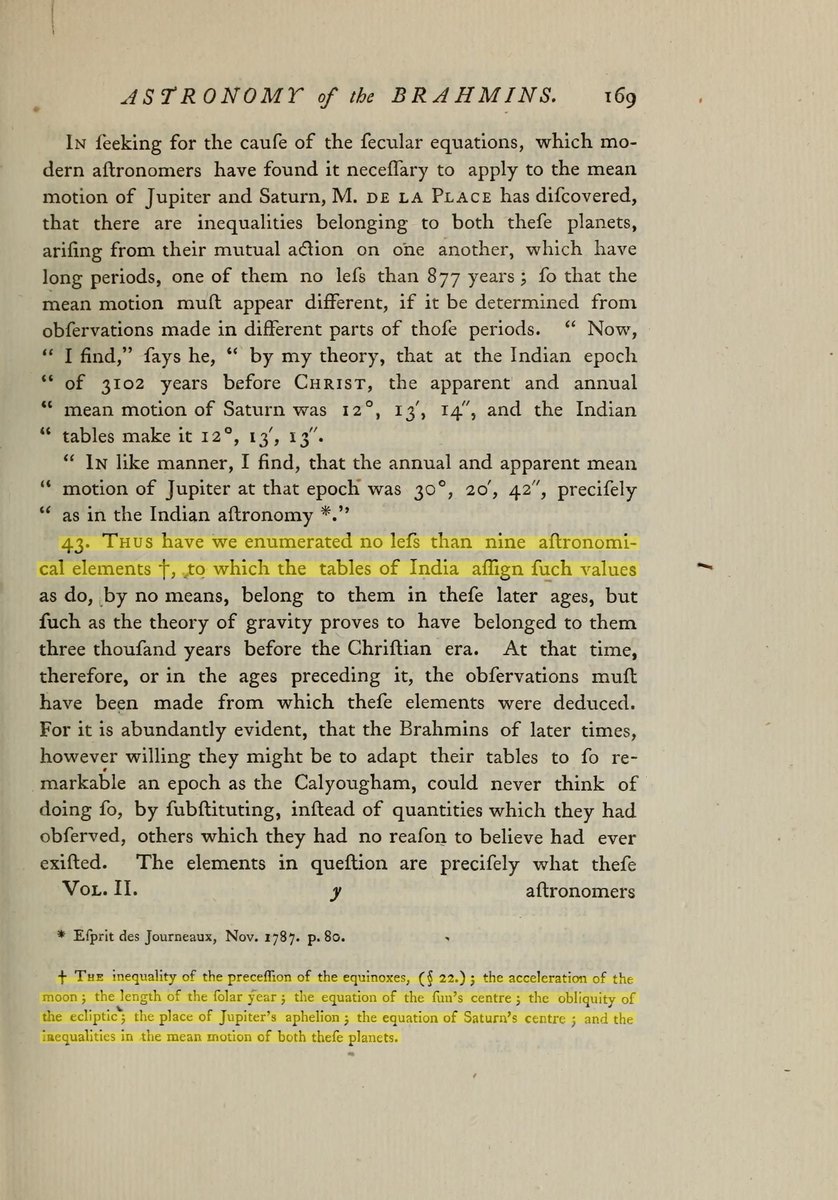
9 elements of the Tamil tables matched Europe's most modern values. The moon's acceleration. The changing rate of precession. Even the ratio of circumference to diameter built into the tables, 3927 to 1250, works out to 3.1416 - the value Aryabhata had given in 499 CE.
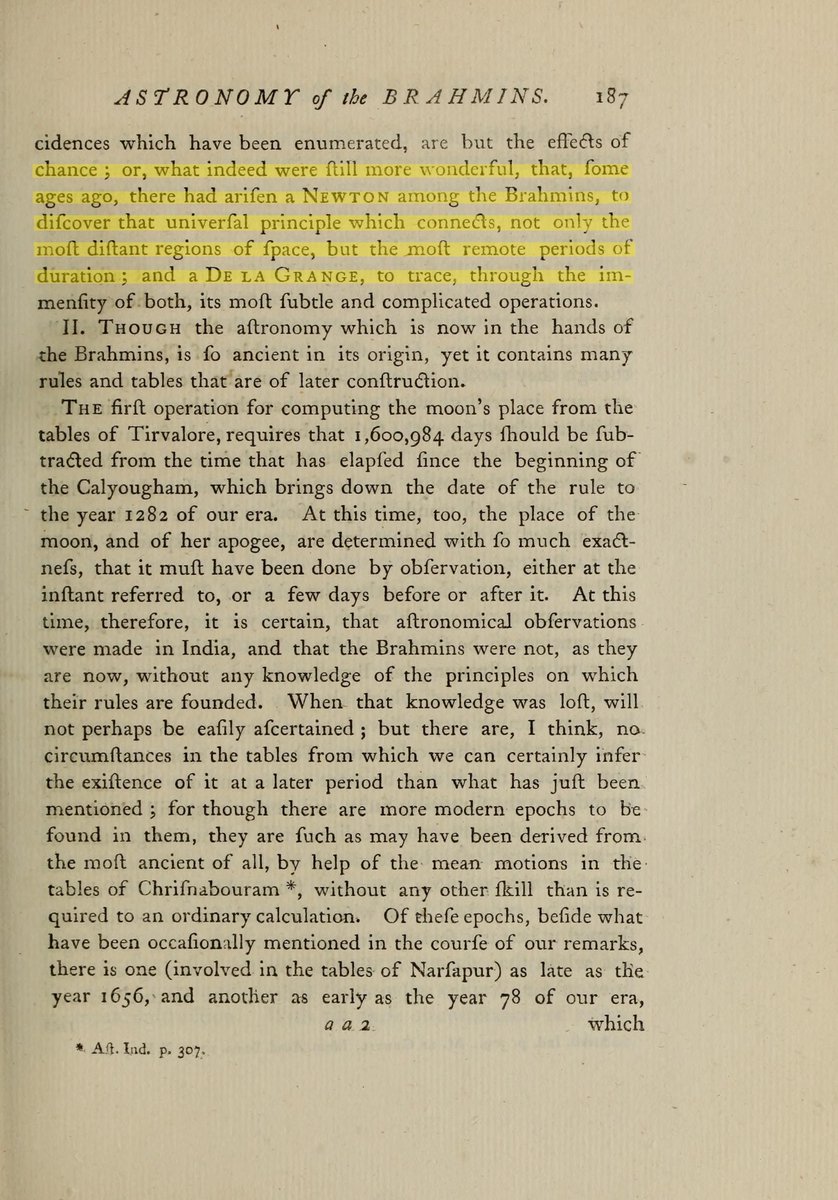
Playfair's verdict: either the observations behind these tables were made more than 3000 years before Christ, "or, what is still more wonderful, some ages ago, there had arisen a Newton among the Brahmins."
The 2nd part never quite went away. The vakya system is a real method: exact planetary constants encoded as poetry, carried intact across centuries. Modern historians of astronomy have reconstructed it and found the mathematics sound.
The vakkiya panchangam in Tamil homes today still runs on it.
Sources: John Playfair, Transactions of the Royal Society of Edinburgh, vol. 2 (1790); J.S. Bailly, Traite de l'astronomie indienne (1787); O. Neugebauer, "Tamil Astronomy", Osiris, vol. 10 (1952); L. Gislen, Journal of Astronomical History and Heritage (2023).
Image Source: Transactions of the Royal Society of Edinburgh, vol. 2 (1790), via Internet Archive. Public domain; highlight added.
Photo 1:Playfair's 1790 paper, p. 152, highlighted: the Brahmins had handed Europe "means, almost infallible, of detecting their imposture"
Photo 2: Page 169, highlighted: "no less than nine astronomical elements" matching - with his footnote listing all nine, including the moon's acceleration and the inequality of precession. Above it, Laplace finding Saturn's and Jupiter's motions at the Indian epoch matching the tables to the arcminute.
Photo 3: Page 187, highlighted: the Newton sentence, exactly as printed - "there had arisen a NEWTON among the Brahmins... and a DE LA GRANGE, to trace... its most subtle and complicated operations."
यह व्यक्ति हामिद अंसारी देश का उपराष्ट्रपति रहा है। जब इससे सवाल पूछा गया कि ज्ञानेश कुमार वोट चोरी के दोषी है ? तो बड़ी बेबाकी से कहा दोषी है।
जब सवाल पूछा गया क्या कि संसद हमले का आरोपी अफ़ज़ल गुरु आतंकवादी था। तो उत्तर दिया मुझे क्या मालूम ।
बताओ किस गुंडे को कांग्रेस ने उपराष्ट्रपति पद पर बैठाया था।
Keep tweeting this video of Neha Bora where she wants India to follow the path of Bangladesh
She shouldn’t be able to divert attention of anyone with new scripted videos now
Liberals have jumped into clearing her name with scripted interviews
So keep this video alive & it is on record
This video has also bursted all their narratives & their true intentions came out
असम या पश्चिम बंगाल का लग रहा है...
गन्ने के जूस की दुकान में एक मजहबी कट्टर तुर्क गन्ने को चीर उसमें गर्भनिरोधक गोली का पाउडर डाल गन्ने का जूस सिर्फ हिंदुओं को दे रहा है..
उसे ध्यान से देख रहे एक व्यक्ति ने उसे वही जूस पीने को कहा..वह पीने से मना किया.. फिर उसने थप्पड़ मारे..
Arab psychiatrist Wafa Sultan exposed Islam’s ☪️ true nature: “Islam is not a religion, it’s a totalitarian, violent extremist ideology and the West should fight it the same way they fought the Nazis.”
Do you support her right to criticize Islam? Yes or No?
Please share and follow if you haven’t already: @TheWesternWatch - @YossiBenYakar and @LizaRosen0000
🙏🙏
24.10.1988- 14 Hindus were killed by Khalistani Sikh terrorists on this day but “छाती पीटना गैंग” will not talk about these killings.
1. Village Ahiyarpur (P.S.Tanda) Hoshiarpur- Khalistani Sikh terrorists resorted to indiscriminate firing on Hindu shopkeepers, with AK 47 rifles, at 5.45 in the evening. At the time of firing, there was lot of rush in the market . 11 shopkeepers were killed on spot and dozens of people were injured.
While escaping, Khalistanis shot dead 2 more persons near village Kotli.
Names of those killed S/Sh. Chaman Lal Sharma, Dharam Pal Sharma, Vinod Marwaha, Kamal Marwaha, Subhash Mahendra, Ram Saini, Natha Tailor, Bittu Tailor, Joginder, Hussan Lal, Dalip Kumar.
5 Hindus S/Sh. Darshan Lal, Ram Lal, Bishan Lal, Subhash, Vijay Kumar & Om Parkash were very critical and what happened to them afterwards is not known.
2. Vill Dugri Rajputan (Hoshiarpur)- A shopkeeper Sh. Banarsi Dass was shot dead.
Homage to 14 Hindu martyrs on their martyrdom day 🙏🏻🙏🏻
In the last 2 weeks, one man in India quietly did what AI labs spend billions chasing. And nobody noticed.
Jitesh Prasad, a physics grad from the University of North Bengal and MBA from IIM Lucknow, runs a one man lab called Udgam. Between Oct 10 and 23, he shipped 5 open AI models and a public benchmark.
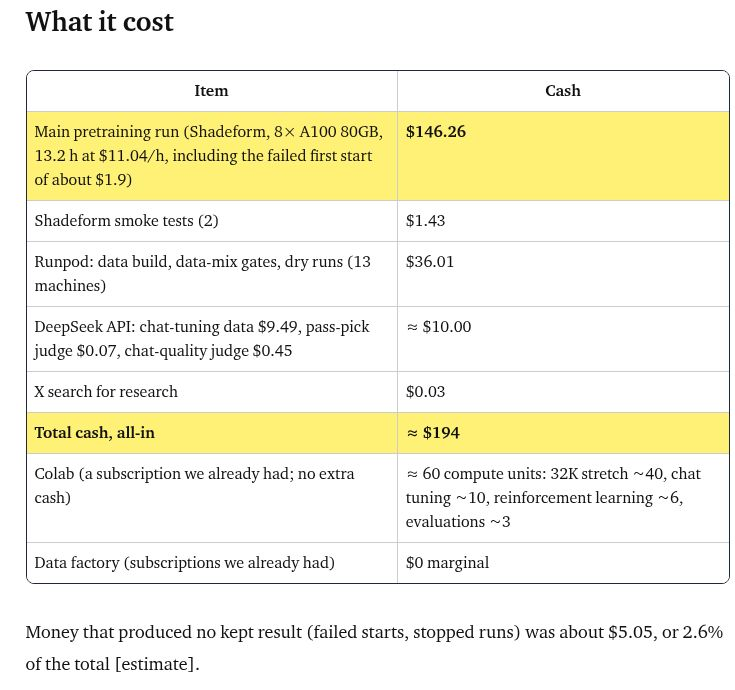
There is Laghu, a chat model trained from scratch for $146. The full cost ledger is public, failures included: 8 rented GPUs, 13.2 hours, all in < $200.
There is Shruti, a Hindi-English-Hinglish speech to text model in a single 29.5 MB file. It runs offline inside a browser tab.
On the same Hindi test clips it makes fewer errors than OpenAI's Whisper large-v3, a file a 100x its size. On English, he tells you plainly, Whisper wins.
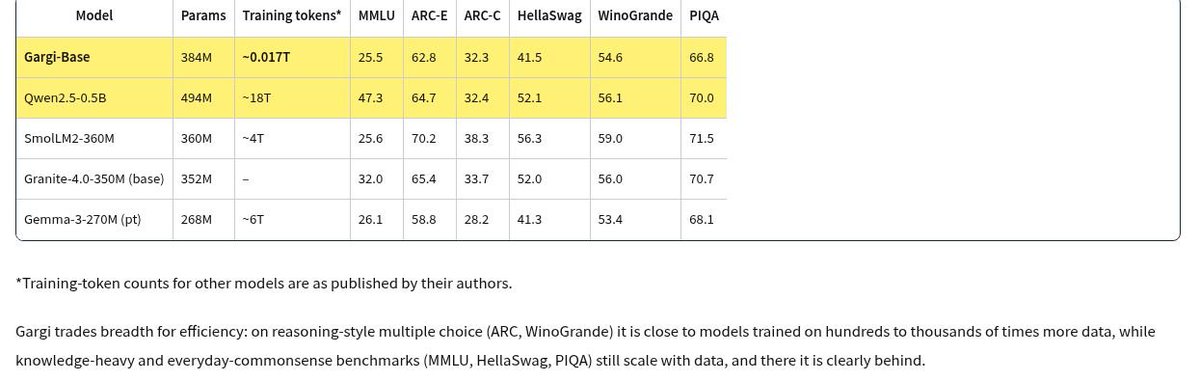
There is Gargi, a 384M reasoning model named after the Vedic philosopher Gargi Vachaknavi. Trained on 17B tokens, about a 1,000x less data than Alibaba's Qwen2.5-0.5B, and within 2 points of it on reasoning tests. On knowledge tests, his own model card admits, it loses badly.
Everything is Apache-2.0 on Hugging Face: weights, code, checkpoints, evaluations, even the $0.45 spent discovering a failed run.
No funding round. No press release. Just one man, thirteen days, and the belief that honest numbers matter more than big ones.
Sources: udgamlabs/blog (link in the comments); Hugging Face model cards udgamlabs/Shruti, udgamlabs/Gargi, udgamlabs/Laghu
Photo 1: Shruti model card WER table - 29.5 MB Shruti beating Whisper large-v3 (3,087 MB) on all three Hindi sets, with Whisper's English wins visible.
Photo 2: Laghu's public cost ledger - $146.26 for the main run, ~$194 all-in, even the $0.03 X search row.
Photo 3: Gargi vs Qwen2.5-0.5B - 384M on ~0.017T tokens vs 494M on ~18T, within 2 points on reasoning, honest MMLU gap in the same rows.
Photo 4: The Hugging Face org page - "Team members 1" next to the full model lineup. The one-man lab in a single screenshot.
Major communities in Western Galicia (primarily Poland today)
• Kraków (Krakau; Yiddish: Kroke) — one of the two largest; major cultural and religious center.
• Tarnów (Tarnau; Yiddish: Torne/Tarnov).
• Rzeszów (Reichshof; Yiddish: Rayshe/Reyshe).
• Przemyśl (Premissel; Yiddish: Pshemishl).
• Nowy Sącz (Neu Sandez; Yiddish: Tsanz) — important Hasidic center.
• Others with significant communities: Jarosław, Sanok, Krosno, Jasło, Bochnia, Gorlice, Dukla, Leżajsk (Lizhensk), Łańcut, Myślenice, Oświęcim (Auschwitz; pre-camp Jewish community), and many smaller towns and villages.
Major communities in Eastern Galicia (primarily Ukraine today)
• Lviv (Lwów/Lemberg; Yiddish: Lemberg/Lemberik) — regional capital and by far the largest Jewish community.
• Ivano-Frankivsk (Stanisławów/Stanislau; Yiddish: Stanislav).
• Ternopil (Tarnopol; Yiddish: Tarnepol).
• Drohobych (Drohobycz; Yiddish: Drubitsh) — notable for oil industry ties.
• Kolomyia (Kołomyja/Kolomea; Yiddish: Kolomay).
• Brody (Brod) — historically a major commercial center with a very high Jewish percentage.
• Buchach (Buczacz; Yiddish: Bitshutsh).
• Belz (Bełz; Yiddish: Beltz) — famous Hasidic dynasty.
• Zhovkva (Żółkiew; Yiddish: Zholkva).
• Stryi (Stryj).
• Sambir (Sambor).
• Others: Rohatyn, Chortkiv (Czortków), Horodenka, Zolochiv (Złoczów), Berezhany (Brzeżany), Bolekhiv (Bolechów), Busk, Halych (Halicz), Husiatyn, Nadvirna (Nadworna), Pidhaitsi (Podhajce), Rava-Ruska, Sokal, Zalishchyky (Zaleszczyki), and many more shtetls.
Jews also lived in numerous smaller towns, villages, and rural areas (estimates suggest up to ~30%+ of Galician Jews were in the countryside in some periods). Many towns had Yiddish names distinct from the official ones, and spellings vary widely in records (Polish, German, Ukrainian, Russian, Yiddish).
Trigger question.
If Rāma and the Pāṇḍavas were real and lived in 1950-1750 BCE, where are their palaces, tombs, and statues?
Why does Egypt have everything intact, while India seems to have nothing?
This question assumes that every civilisation remembers itself the same way. That assumption is wrong.
Egypt built its entire civilisation around the preservation of the dead body. Mummies, tombs, pyramids, wall paintings, even embalmed animals were not art or vanity projects.
They were infrastructure for a belief that the soul would return to the same physical body. Stone, resin, sealed chambers, and the desert climate together froze Egypt in time.
Sanātana Dharma took the opposite position.
The body was never highly valued.
It was described as a worn-out garment, to be discarded through cremation.
If the body itself was impermanent, preserving palaces, houses, or tombs made no philosophical sense. You burn the body. You let the building decay. You move on.
From the Indus Valley onward, India invested permanence not in stone, but in memory. In mantra, genealogy, ritual, geography, and oral transmission.
Cities were rebuilt.
Fire altars were reconstructed.
Rivers shifted.
Capitals moved.
What endured was not masonry, but continuity.
So when people ask, “Where are the artefacts of the Rāmāyaṇa and Mahābhārata era?”, they are asking the wrong question.
They are looking for Mediterranean-style archaeology in a civilisation that never valued tomb culture.
India did not embalm kings.
It did not seal history inside graves.
It encoded history into living traditions.
Greek mythology survives on pottery and temples because Greece wrote late and built in stone.
Indian Itihāsa survived in recitation because it emerged earlier, in a world of wood, brick, ritual renewal, and oral precision.
One preserved objects with stories.
The other preserved stories without objects.
Egypt asked: How do we preserve the body forever?
India asked: How do we escape the cycle of bodies altogether?
Once you understand that difference, the absence of pyramids for Rāma or Yudhiṣṭhira stops looking like a problem.
It starts looking like philosophy successfully lived out in civilisation.
Yet we get chariots and copper, bronze and iron mixed weapons in 1950-1750 BCE reassuring Rama and Pandavas lived in this period.
But we have nothing in 3200-3000 BCE or in 6000-5000 BCE or in 13000-12000 BCE that indicates Rama or Pandavas lived then.
Differentiate between true research and fake research.
@vajrayudha11@jsaideepak Today most Malayalee movies make it a point to include a meaningless beef scene just to taunt remaining Hindus of Kerala ! So much for secularism !
The so called "tiger" of mysore challenged that he would tie his horse in the golden flagpost of Padmanabha perumal temple in thiruvananthapuram.He was defeated and his flag and sword was captured by the travancore forces under the then Maharaja Karthika Thirunal Dharma Raja(1/4)
Tipu’s flag is carried in Lord Padmanabhaswamy’s Arattu procession every year—a reminder of how the so-called “Lion of Mysore” fled with his tail between his legs.
Read the full story here.