Design Arena is excited to introduce the company behind our work: Intelligence.
Over the past year, millions of people have helped us evaluate how well AI models perform on real-world creative tasks - where quality is subjective, outcomes are difficult to verify, and human judgment matters.
Design Arena is only the beginning. Let us know what you want to see next!
Today, we're introducing @Intelligence_ai.
In 6 months, as a team of 10, we scaled from $5M to $60M ARR and 5.5M users across 190+ countries.
We raised a $7.9M seed, led by @IndexVentures with participation from @conviction, @A_StarVC, and @combinator to build DesignArena, a universal interface for accessing and evaluating the world's AI capabilities.
Most evaluations try to simulate the real-world. We believe the real-world is the ultimate verifier.
People come to @DesignArena with a request. Models compete to fulfill the request, and users determine what works best for them.
Their live user behavior evaluates the models, improves how work is routed, and helps people access the right intelligence.
We've helped the world's leading frontier labs break the news on their SOTA capabilities.
What's the limit? Join us and find out.
Ideogram 4.6 by @ideogram_ai is now available on DesignArena!
Ideogram 4.6 is Ideogram’s new image model for precise edits, with more realistic texture, higher consistency, and more accurate color.
On its launch page, Ideogram showed Ideogram 4.6 remaking a toy car in one material after another. We gave Ideogram 4.6 and Ideogram 4.5 a similar test, but with a different kind of change at each step.
Starting from a red tin toy robot, six edits switch the body to brushed copper, change the chest number from 07 to R-9, paint the chest panel a specific shade of blue, make the eyes glow amber, put a tiny yellow umbrella in the robot’s right hand, and turn the light gray backdrop pale pink.
Ideogram 4.6's brushed copper has more texture, while Ideogram 4.5's looks flat. Ideogram 4.6 adds a real umbrella, but Ideogram 4.5's is malformed. On the last edit, Ideogram 4.6 turns the backdrop pale pink, while Ideogram 4.5's introduces a white circular fade.
Congrats to the @ideogram_ai team on the launch!
Introducing Ideogram 4.6: the new frontier of precise editing, now in native 4K.
A new image model with dramatically better realism and texture detail. Significantly less pixel drift outside your edits and much better color accuracy.
BREAKING: MAI-Image-2.7 and MAI-Image-2.7 Flash by @MicrosoftAI are ranked #6 and #8 respectively on Image arena. This would make MAI the #2 Image lab, just behind @OpenAI.
At an average of $0.01 per generation for MAI-Image-2.7 and an average of $0.04 per generation for its Flash version, both models have redefined the Preference vs Price Pareto frontier. MAI-Image-2.7 is also 1 of only 2 models that are both cheap and fast.
Congrats to the @MicrosoftAI team for a top-10 placement for both models!
Gemini 4 Neon by @GoogleDeepMind is now available on DesignArena!
Gemini 4 Neon is Google DeepMind’s fast new model for coding and science, priced at $3 per million input tokens, $15 per million output tokens, and $0.15 per million cached input tokens.
At launch, Google DeepMind showed Gemini 4 Neon building a Mont Blanc ski simulator. We gave Gemini 4 Neon and Gemini 4 Argon a similar setting, asking both to generate a detailed one-shot scene set in the Alps: a wooden hut on a snowy ridge at sunset, with glowing windows, chimney smoke, and skis leaning by the door. A lift climbs up to the hut, a few pine trees stand in the snow below, and jagged mountains rise in the background.
Gemini 4 Neon’s pine trees look more realistic, while Gemini 4 Argon’s snow sits in layers that fit perfectly around its trees. In the background, Gemini 4 Neon’s mountains are sharp and conical, while Gemini 4 Argon’s have more texture. Gemini 4 Neon also adds light snowfall unprompted.
Congrats to the @GoogleDeepMind team on the launch!
🏆 No. 2 Image Lab on @DesignArena !
#SenseNova U1 Pro debuts at No. 6 in both Image Generation and Image Editing, placing #SenseTime second among image AI labs, just behind OpenAI.
U1 Pro also lands on the Pareto frontier of image preference vs. price: strong image quality and aesthetics at a competitive generation cost, built for visual creation at scale.
Thanks to DesignArena for the recognition!
BREAKING: SenseNova U1 Pro by @sensetime_ai makes its debut as the #2 Image lab, just behind @OpenAI.
For image generations, it wins most often on prompts that ask for specific art styles such as an “impressionist painting,” or an image set within a certain time period such as the 1920s art deco era.
For image editing, its strength is in making precise, user-requested edits without creating unintended changes elsewhere in the image.
Congrats to the @sensetime_ai team on achieving a strong result!
BREAKING: Gemini 4 Hydrogen by @GoogleDeepMind has redefined the Preference vs Speed Pareto frontier for 3D Design and is the fastest model in the top-10 with an average generation time of 69s. It is also ranked #10 on 3D Design arena.
For comparison, GPT-6 Astra takes 532s and costs about $1.48 per generation, making Gemini 4 Hydrogen roughly 8× faster at a tenth of the cost. It also joins Muse Ember by @AIatMeta and Gemini 3 Flash Preview by @GoogleDeepMind as models that are both quick and highly rated.
Congrats to the @GoogleDeepMind team on a top-10 placement on the leaderboard and for redefining the Preference vs Speed frontier!
On every board the newest flagships are ahead of open weights, by a little on UI components and 3D scenes and by more on SVG drawings and agentic work. The flagships that have been caught took about three months on agentic work and about two on websites.
We found how long open weight models take to catch up to the frontier.
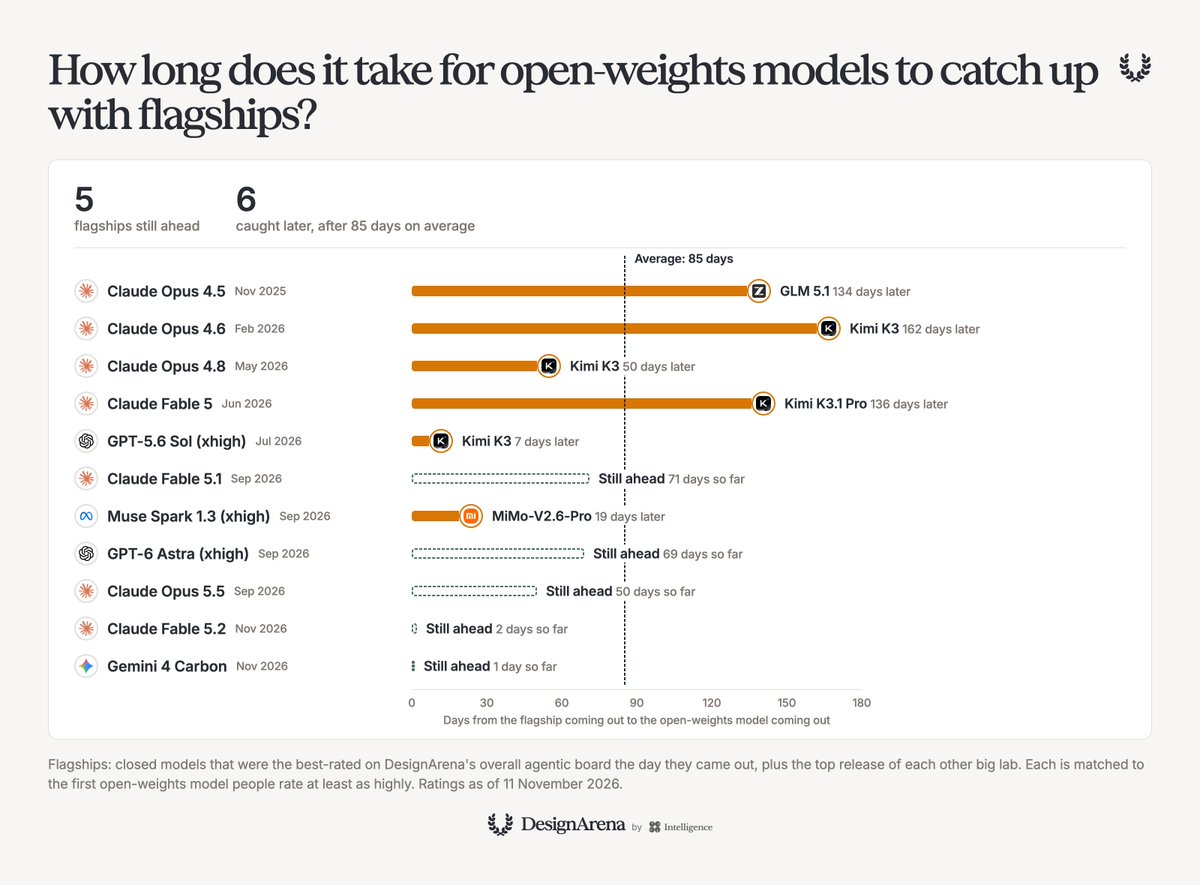
On DesignArena's overall agentic board, 6 of 11 flagship releases have been caught by an open-weights model, after 85 days on average. The other 5 are still ahead.
On one-shot websites, 4 of 7 flagship releases were caught by an open-weights model, after 68 days on average. Kimi K3 caught three of them. Muse Spark 1.3 (xhigh), GPT-6 Astra (xhigh) and Muse Wonder (max) are still ahead.
MAI Image 2.7 by @MicrosoftAI is now available on DesignArena!
MAI Image 2.7 is Microsoft's latest frontier model for generating and editing images, with finer control over color, material, and position at a fraction of the cost, averaging $35 per 1,000 images.
To test that control, we gave MAI Image 2.7 and MAI Image 2.6 the same crowded prompt: a vintage yellow tram with the number 541 painted on its side, stopping on a steep harbor street, with four specific passengers, a flower stall, and a round street cloc reading 7:15.
Only MAI Image 2.7 paints 541 on the tram's side. In MAI Image 2.7, the older woman holds the bunch of sunflowers, whereas in MAI Image 2.6 the sunflowers are placed in a seat. Neither image shows the clock at 7:15.
Congrats to the @MicrosoftAI team on the launch!
GPT-6.2 Astra by @OpenAI is now available on DesignArena!
GPT-6.2 Astra is OpenAI’s most capable model, built for long, hard projects, and OpenAI says it builds better websites, games, and 3D designs. It costs $8 per million input tokens, $40 per million output tokens, and $0.40 per million cached input tokens.
At launch, OpenAI showed GPT-6.2 Astra and GPT-6 Astra each planning a backyard vegetable garden. We stayed in the garden and gave both the same 3D prompt: a Victorian glasshouse on a gravel terrace at dusk.
GPT-6.2 Astra builds a grand glass hall with a tall dome and a long arched wing on each side. The hall features a far wider mix of plants, with palms fittingly placed in the center where the ceiling is highest. GPT-6 Astra builds a simpler glasshouse, and its lighting is more intense. GPT-6.2 Astra was also 3x faster and cost over a third less.
Congrats to the @OpenAI team on the launch!
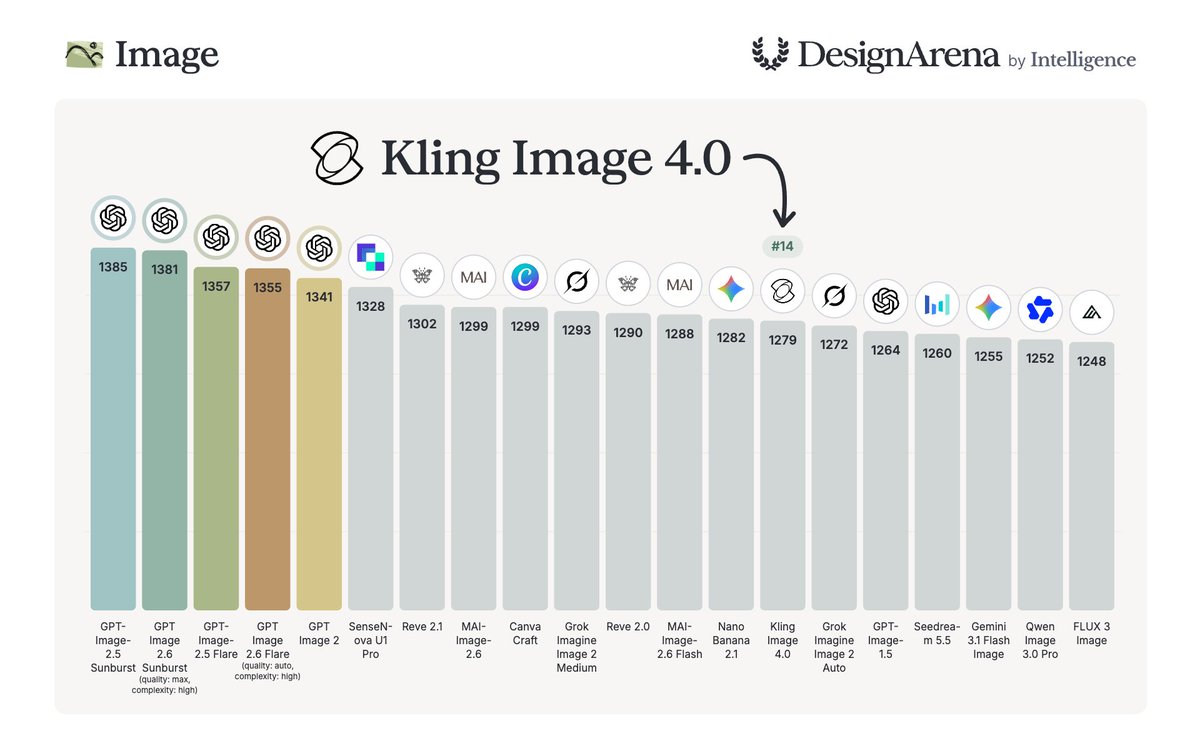
BREAKING: Kling Image 4.0 by @kling_ai debuts at #13 on Image Editing arena with an Elo of 1247 and #14 with an Elo of 1279 on Image arena.
This puts Kling Image 4.0 in the same performance band as models from @OpenAI, @spacexai, and @GoogleDeepMind. At about $0.063 per image generation at 2K resolution, it matches Nano Banana 2.1’s quality for about 20% less per image. Kling also edits at 2K by default, and at about $0.066 per edit, you get 4× the pixels of most 1K editors for a similar price.
Congrats to the @kling_ai team on the launch!
Hy4 Flash by @TencentHunyuan is now available on DesignArena!
Hy4 Flash is Tencent’s new low-cost model for everyday productivity, at $0.070 per million input tokens, $0.281 per million output tokens, and $0.003 per million cached input tokens.
We gave Hy4 Flash and Hy4 the same 3D prompt: a mechanical keyboard that disassembles and reassembles by layer.
Hy4 includes more detail and realistic lighting, with its keyboard casting shadows that reflect its disassembly state.
Hy4 Flash is 8x cheaper and 2x faster. And surprisingly, Hy4 Flash built the mechanical keyboard people expect, with the standard QWERTY layout, whereas Hy4 opted instead for an ortholinear grid of same-size keys.
Congrats to the @TencentHunyuan team on the launch!
Model latency significantly impacts user satisfaction. Surprisingly, @OpenAI's speed decreases noticeably during the work day, while @AnthropicAI's doesn't at all.
Almost all benchmarks measure latency at test time, but few look at how API response time performs live on production.
We looked at 200,000 LLM requests submitted by users on DesignArena, at every hour of the day, sent to each lab's standard API.
OpenAl model speeds decrease significantly during the work day, fluctuating up to 16%. Even more interestingly, Anthropic's models don't seem to be affected at all.
Static benchmarks only measure the time taken at runtime.
That single measurement doesn't reflect how long you wait when you actually use these models, where response time varies by time of day, and day of week.
On DesignArena, latency measured from real people running their own requests on their own time reveals how models hold up over a normal week.
Try making generations of your own and judge for yourself at https://t.co/5Bc9iiaXyc.
Open-source models have a rush hour too, on Beijing time, but surprisingly they speed up briefly at lunch.
We looked at 40,000 requests to @Kimi_Moonshot's Kimi K2.7 Code, @Zai_org's GLM 5.2, and @MiniMax_AI's MiniMax M3, again sent through the lab's own API.
All three are fastest in the early morning and slow down sharply once the work day starts. Around 12:00 pm their speeds partly recover, and then they drop again to their slowest point of the day, around 3-4 pm.
Their swings are also much larger than OpenAl's. On weekdays, MiniMax M3 goes from about 19% above its weekly average speed before dawn to about 23% below it in the mid-afternoon, and Kimi K2.7 Code fluctuates even more, from roughly 47% faster at 5 am to about 25% slower after lunch.
As with OpenAl, weekends soften the dips. GLM 5.2 stays above its weekly average speed for nearly all of Saturday and Sunday.