Design Arena is excited to introduce the company behind our work: Intelligence.
Over the past year, millions of people have helped us evaluate how well AI models perform on real-world creative tasks - where quality is subjective, outcomes are difficult to verify, and human judgment matters.
Design Arena is only the beginning. Let us know what you want to see next!
Today, we're introducing @Intelligence_ai.
In 6 months, as a team of 10, we scaled from $5M to $60M ARR and 5.5M users across 190+ countries.
We raised a $7.9M seed, led by @IndexVentures with participation from @conviction, @A_StarVC, and @combinator to build DesignArena, a universal interface for accessing and evaluating the world's AI capabilities.
Most evaluations try to simulate the real-world. We believe the real-world is the ultimate verifier.
People come to @DesignArena with a request. Models compete to fulfill the request, and users determine what works best for them.
Their live user behavior evaluates the models, improves how work is routed, and helps people access the right intelligence.
We've helped the world's leading frontier labs break the news on their SOTA capabilities.
What's the limit? Join us and find out.
Claude Fable 5.2 by @AnthropicAI is now available on DesignArena!
Claude Fable 5.2 is Anthropic's new model for hard coding, reasoning, and vision work, at 20% less per token than Fable 5.1 ($8/$40 per million tokens, down from $10/$50). It can read up to 1M tokens, write up to 128K, and has a new fast mode that writes up to 2.5× faster.
We gave Fable 5.2 and Fable 5.1 the same two 3D prompts, a brass orrery and a chameleon at twilight, to see what changed.
Fable 5.2's orrery has engraved month and zodiac names, warm reflections that shift across the brass as the camera moves, and a photoreal Jupiter. Fable 5.1's orrery is built from simpler, chunkier parts under even lighting with few reflections, and its Jupiter is a plain striped ball.
Fable 5.2's chameleon has lifelike colors and patterns, moss that glows brightly under the branch, and fireflies that pulse. Fable 5.1's chameleon is made of rough, blocky shapes, its moss gives off only a faint glow, and its fireflies' pulsing barely noticeable.
Congrats to the @AnthropicAI team on the launch!
In the example below, Muse Ember generated an aloe plant with lifelike leaves as requested, whereas Muse Wonder Max generated thin, flat leaves. Muse Ember also added white spines that line the leaves of real aloe and was over 50× cheaper and 4× faster.
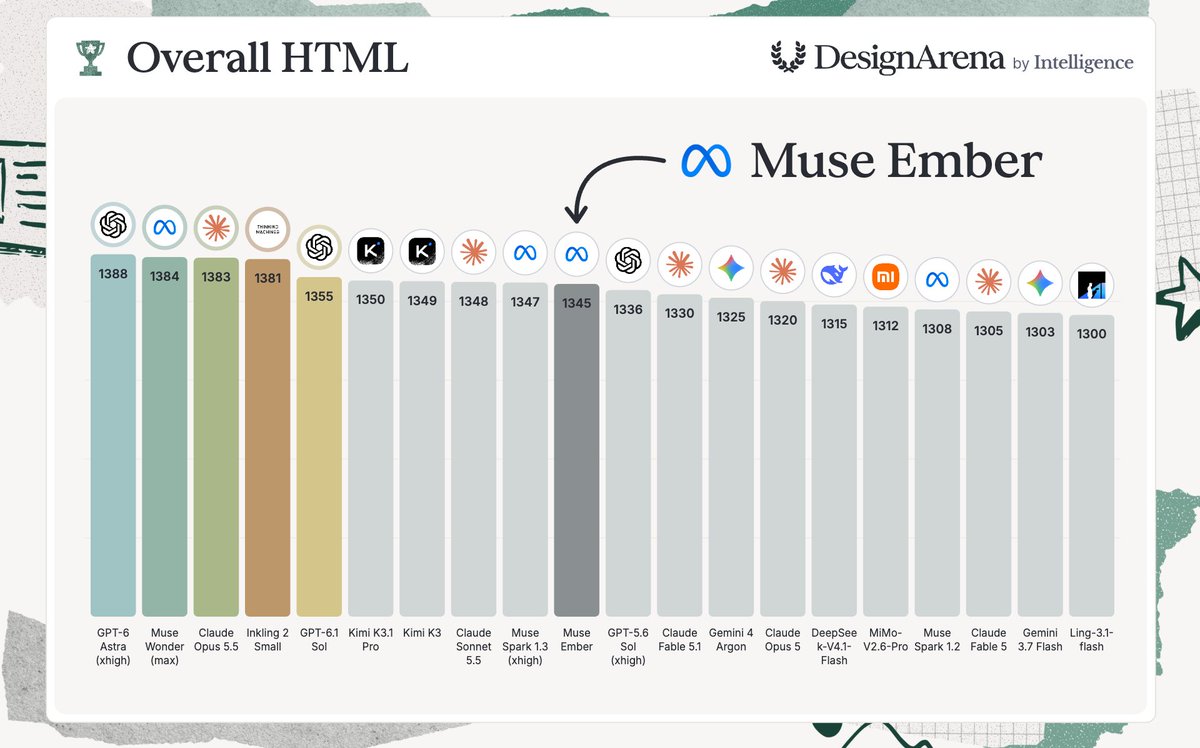
BREAKING: Muse Ember by @AIatMeta has redefined the Preference vs Speed Pareto frontier on Overall HTML, knocking out 10 top models from @GoogleDeepMind, @OpenAI, and @DeepSeek_ai.
At 33s per generation, Muse Ember is 9.5× faster on average than the previous Pareto frontier models. It is also at least 34× cheaper on average than all the previous Pareto frontier models it replaced at $0.10/$0.50 per 1M input/output tokens ($0.004 cache). It is also ranked 10th overall with an Elo of 1345!
A huge congrats to the @AIatMeta team on a top-10 placement on the leaderboard!
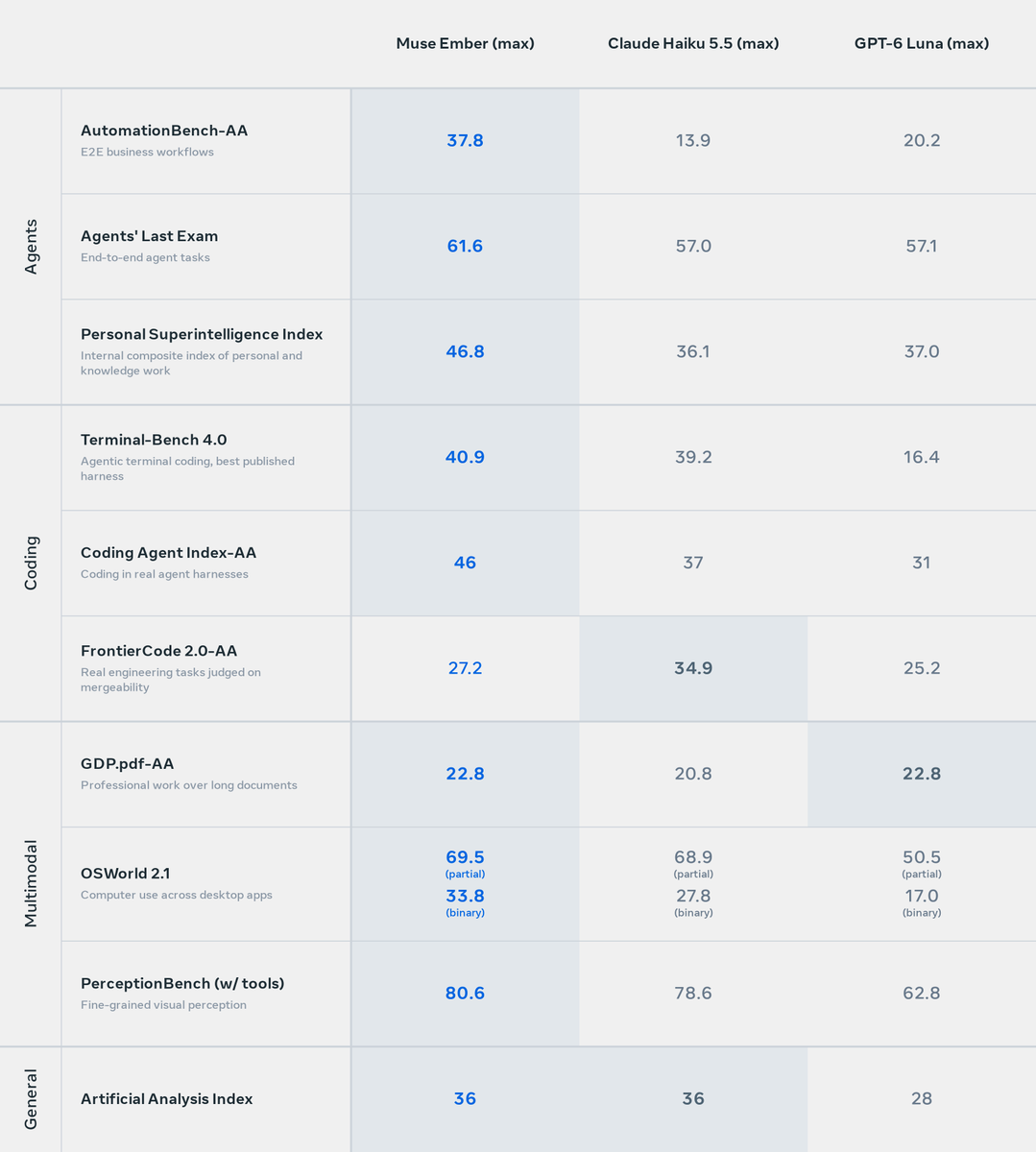
Today we're introducing Muse Ember, our smallest and most efficient model, built for complex reasoning execution and everyday agent work.
Muse Ember can carry workflows across apps, call tools in sequence, run tests and make targeted code fixes. With a 1M-token context window and native understanding of text, images, audio and video, it can also work across large document sets and varied inputs.
In the example below, Muse Ember was 25× faster at generating 5 different tree models at 33 seconds, with each tree getting its own label. Muse Ember also provided more granular details per tree including height, number of polygons, and a wireframe view. Comparatively, Kimi K3.1 Pro took 14 minutes and generated 5 similar looking models.
New on DesignArena: Gemini Omni 1.2 Flash by @GoogleDeepMind is projected to rank #3 on Video arena. That would give Google the top three spots on the leaderboard, dominating the Video generation field!
It trails only Gemini Omni 1.1 Flash and Gemini Omni Flash, and is projected to finish ahead of Wan 3.0 by @Alibaba_Wan and P-Video-2-Pro by @PrunaAI. Official results pending.
Congrats to the @GoogleDeepMind team!
Ultimately, no AI assistant is as good as a human personal assistant yet.
LifeArena is run on Gmail inboxes with 30K unread messages, years of text messages, and hundreds of personal contacts.
More details on methodology coming soon. In the meantime, let us know if there are more agents you'd like us to try!
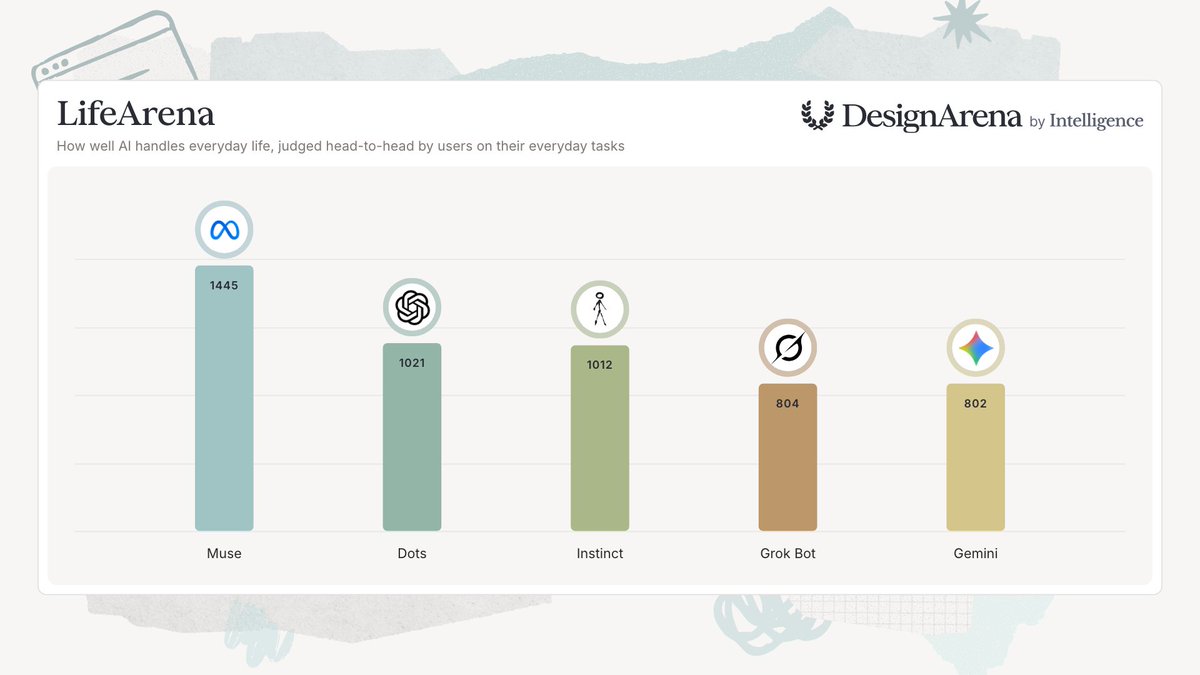
Introducing LifeArena: the world’s first arena for personal assistants, as judged by real users.
As AI assistants become more capable, existing static benchmarks struggle to capture the creative, unthinkable requests of people in their everyday lives.
So, we offered select users the most popular personal assistants: @instinct, @Muse by @AIatMeta, Dots by @OpenAI, Grok Bot by @xai, and Gemini by @GoogleDeepMind.
The results are in: @Muse is #1... by a landslide.
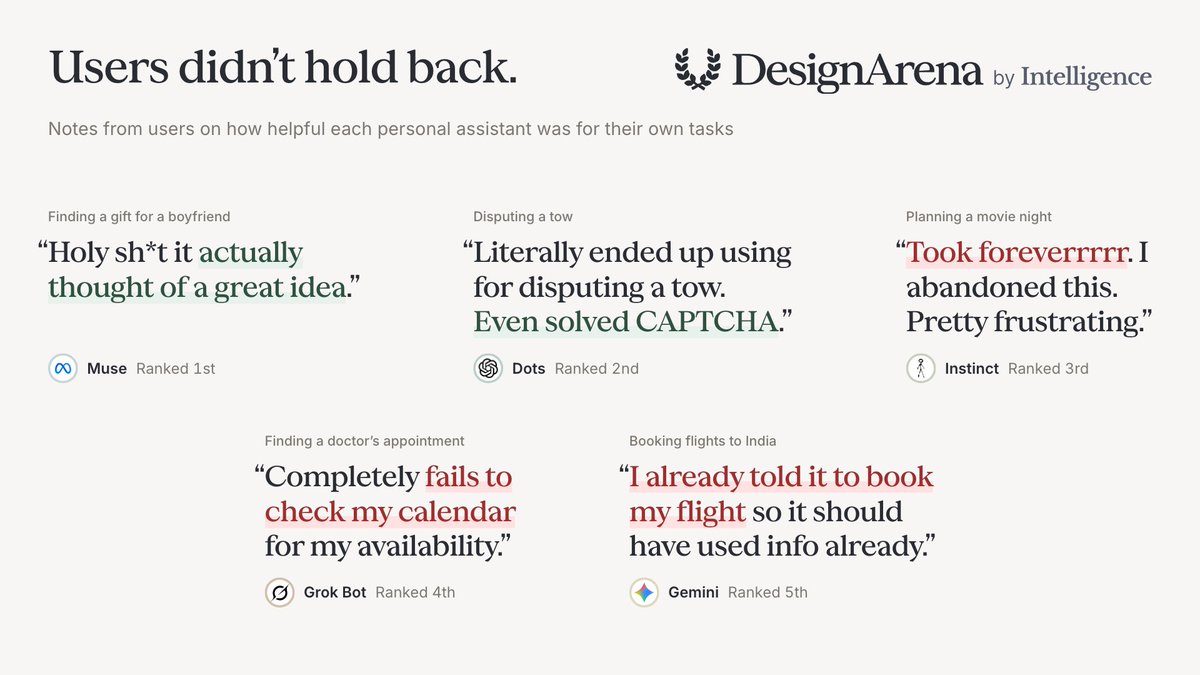
Here's what users said:
People brought their messy problems: breaking a lease shared with a roommate in Seattle, disputing a tow in San Francisco, and orchestrating a $2,500 Christmas trip to Florida (we're jealous).
#1 @Muse by @Meta was the strongest all-around; it was fast, great at displaying images when necessary, and never pestered users with unnecessary follow-up questions.
#2 Dots by @OpenAI was quite strong at computer use and completing tedious admin tasks. It fell short on coming up with thoughtful gifts, enticing vacations, and anything that required depth in user taste.
#3 @instinct was a very convenient form factor. But it was, at times, unbearably slow, an issue that seems to have ballooned with the platform's popularity.
#4 Grok Bot by @spacexai struggled on start. Despite having access to gigabytes of user PII, it failed to build the same depth of personal understanding unprompted as its competitors.
#5 Gemini by @Google was the least autonomous. It requested permissions to the point of becoming infuriating for users, declining to complete purchases even when instructed to do so.
In the example below, the user asks for a gymkhana rally car drifting a continuous donut in the street.
Inkling 2 Small frames the drift with a cinematic chase cam that stays low behind the car as the smoke rolls toward the lens. The street around it is a detailed rally environment, with neon storefronts, string flags, crowds along the course, and traffic cones placed around the tire stack the car circles. LED lights under the car match the neon glow, and four camera angles include a curbside view at road level.
Kimi K3 holds a clean donut, layers its tire marks, and gives its car racing stripes and a number. However, it places the drift in an empty gray plaza, with the cones bunched in the middle of the circle, and its chase cam watches from above.
BREAKING: Inkling 2 Small by @thinkymachines takes 4th place overall on DesignArena and is 1st place among open weights models with an Elo of 1376!
At $0.30/$1.00 per 1M input/output tokens, Inkling 2 Small is 15× cheaper on output than Kimi K3 by @Kimi_Moonshot. This model also places 1st on 2 of our subcategories including General Purpose and Landing Page prompts. Model weights to be released soon.
A huge congrats to the @thinkymachines team on a top-5 placement on the leaderboard!
Introducing Inkling 2 Small. Scoring 31 on the AA Intelligence Index, it's a big jump over its predecessor.
Inkling 2 Small is available for fine-tuning and inference on Tinker today, with full weight release planned soon.
https://t.co/VR02tw73fJ
The majority of the human experience is visual.
Proud to see @DesignArena representing the visual coding capabilities in @thinkymachines' model card.
Excited to see visual coding become an increasingly dominant frontier for AI evaluation!
Inkling 2 Small making waves by becoming the first American open weights model to be #1 on the overall leaderboard (among other open weights giants!).
Congrats to the @thinkymachines team on such an incredible achievement - well deserved!
This is the first-ever American open-weight model to hold the #1 spot on @DesignArena 🇺🇸
It's been remarkable to watch this team work with such intensity and care.
Huge congratulations, @thinkymachines, on a historic launch!
In another example, the user supplies a low-quality reference photo of a gym with fitness equipment.
Instead of using the reference image as is, Ling-3.2-flash opts for a higher quality replacement image for the hero and uses the reference image in a smaller section below, keeping the integrity of the prompt and essence of the photo intact.
Grok 4.6 instead uses the same reference photo three times, once in the hero, again right below it, and finally in the photo gallery near the bottom of the page.
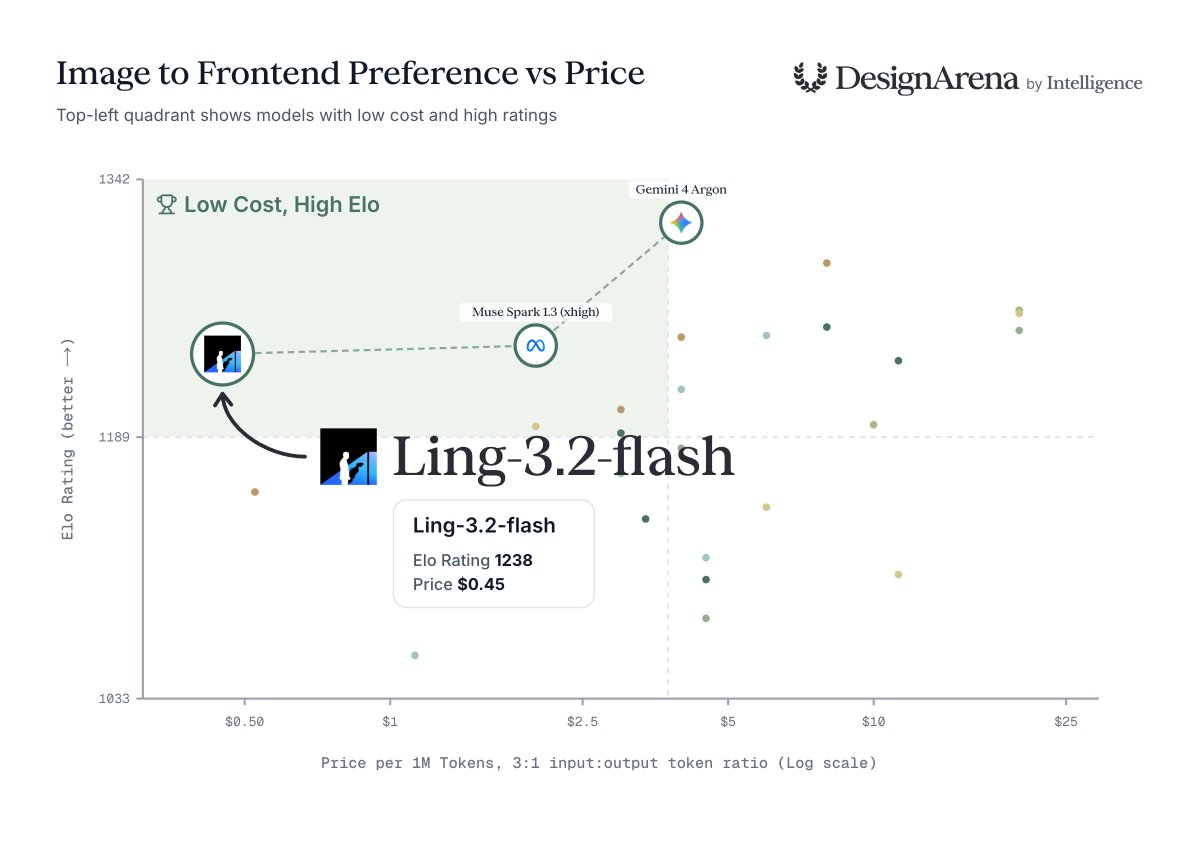
BREAKING: Ling-3.2-flash by @AntLingAGI lands at #10 on Image to Frontend Arena with an Elo of 1238! This model also establishes a new Pareto frontier for Preference vs Price at $0.30 input / $0.90 output per 1M tokens, the cheapest for any model at this performance.
It most often wins on its Portfolio and Corporate builds where it wins around 63% and 60% of its tournaments respectively. This also places Ling-3.2-flash among leading models from @AIatMeta, @AnthropicAI, and @deepseek_ai.
Congrats to the @AntLingAGI team on a Top-10 placement on DesignArena!
Introducing Ling-3.2-flash, Ant Ling's native multimodal model: 560B total / 25B active parameters.
Stronger complex visual understanding, long-horizon multimodal agents, 3D understanding & interaction, and medical intelligence.
Outscores Opus 5 (max) in release evaluations:
- OmniDocBench1.5: 92.21 vs 90.56
- ZEROBench(Sub): 43.71 vs 39.52
- Vision2Web: 85.86 vs 80.20
In the example below, the user supplies a reference photo logo without accompanying website copy.
Ling-3.2-flash adds a compact, tracked “GLOBAL IT & DIGITAL SOLUTIONS” label above a headline about global commerce, giving the new page a clear business identity. Ling-3.2-flash also uses the added label to explain what the company does.
Grok 4.6 also spaces its navigation and brand line, but keeps the tracked text closer to the supplied name.