Claude Fable 5.2 by @AnthropicAI is now available on DesignArena!
Claude Fable 5.2 is Anthropic's new model for hard coding, reasoning, and vision work, at 20% less per token than Fable 5.1 ($8/$40 per million tokens, down from $10/$50). It can read up to 1M tokens, write up to 128K, and has a new fast mode that writes up to 2.5× faster.
We gave Fable 5.2 and Fable 5.1 the same two 3D prompts, a brass orrery and a chameleon at twilight, to see what changed.
Fable 5.2's orrery has engraved month and zodiac names, warm reflections that shift across the brass as the camera moves, and a photoreal Jupiter. Fable 5.1's orrery is built from simpler, chunkier parts under even lighting with few reflections, and its Jupiter is a plain striped ball.
Fable 5.2's chameleon has lifelike colors and patterns, moss that glows brightly under the branch, and fireflies that pulse. Fable 5.1's chameleon is made of rough, blocky shapes, its moss gives off only a faint glow, and its fireflies' pulsing barely noticeable.
Congrats to the @AnthropicAI team on the launch!
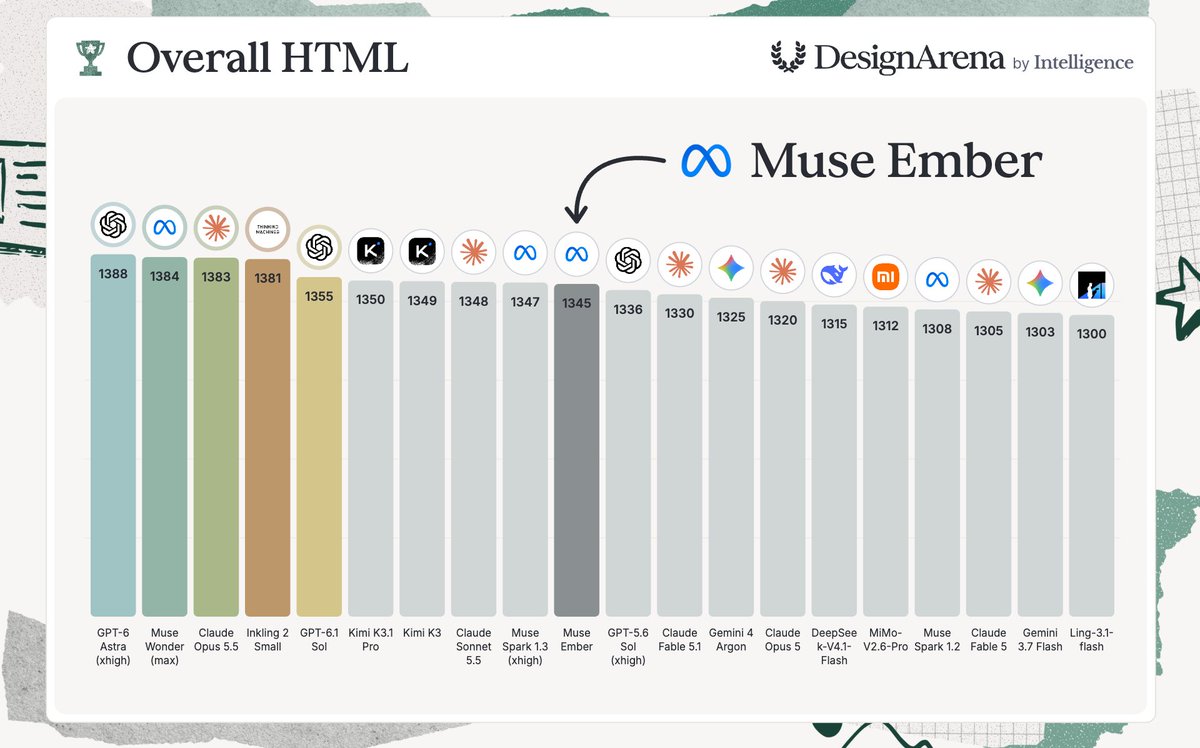
BREAKING: Muse Ember by @AIatMeta has redefined the Preference vs Speed Pareto frontier on Overall HTML, knocking out 10 top models from @GoogleDeepMind, @OpenAI, and @DeepSeek_ai.
At 33s per generation, Muse Ember is 9.5× faster on average than the previous Pareto frontier models. It is also at least 34× cheaper on average than all the previous Pareto frontier models it replaced at $0.10/$0.50 per 1M input/output tokens ($0.004 cache). It is also ranked 10th overall with an Elo of 1345!
A huge congrats to the @AIatMeta team on a top-10 placement on the leaderboard!
Of course, human design taste will remain a key component that can't be automated away, but we're getting very close to having models build AAA-quality games.
Models are currently where they were with coding a year ago, and given the recent acceleration in progress, I'm fairly confident we'll get there in the next one or two rounds of model releases.
AAA games used to take years, millions of dollars, and hundreds of people to build. We're getting to a point where games of comparable quality could be built in months, if not weeks.
New on DesignArena: Gemini Omni 1.2 Flash by @GoogleDeepMind is projected to rank #3 on Video arena. That would give Google the top three spots on the leaderboard, dominating the Video generation field!
It trails only Gemini Omni 1.1 Flash and Gemini Omni Flash, and is projected to finish ahead of Wan 3.0 by @Alibaba_Wan and P-Video-2-Pro by @PrunaAI. Official results pending.
Congrats to the @GoogleDeepMind team!
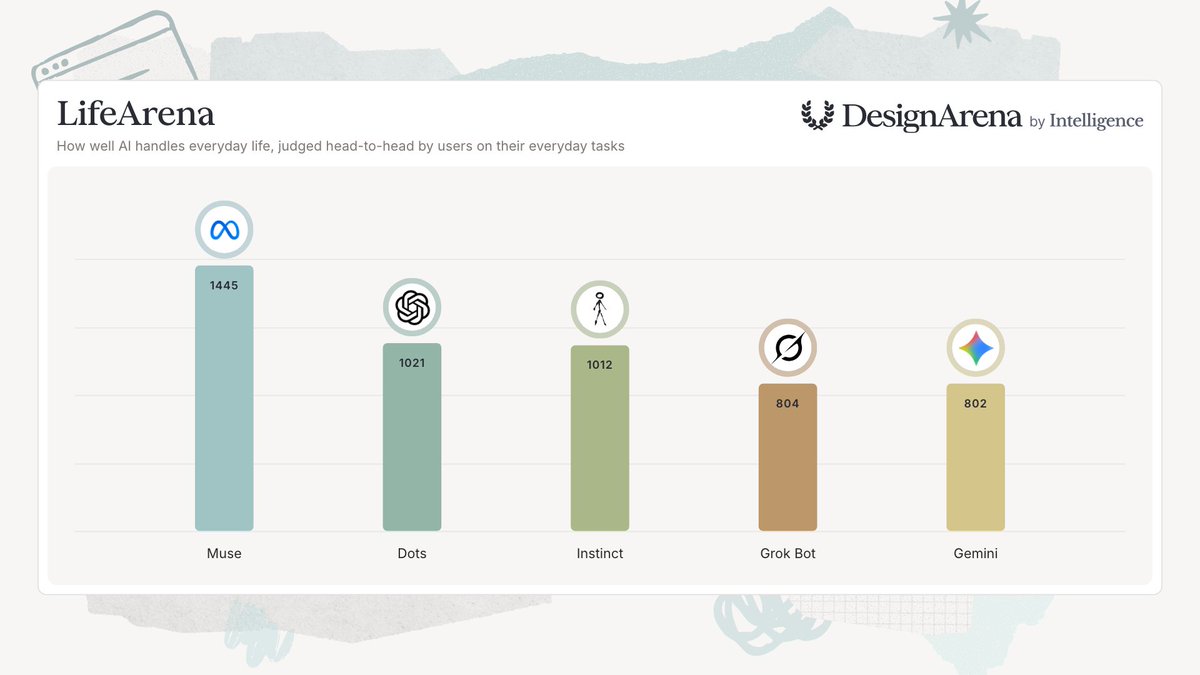
Introducing: LifeArena by @DesignArena - a benchmark built on real human tasks asked by real human users. Unsurprisingly, @Muse by @Meta takes #1, beating out Dots, Instinct, Grok Bot, and Gemini.
It was the strongest all-around; it was fast, great at displaying images when necessary, and never pestered users with unnecessary follow-up questions. To the point and great at its job!
Congrats to the @AIatMeta team and @alexandr_wang!
Happy to see Muse on top! It doesn't pester me with a million follow-up questions and actually reads between the lines.
The world's first arena for personal assistants gets it right.
What is the job of a personal assistant, and how do we measure their success?
As AI becomes increasingly capable of performing human-centered tasks like being a personal assistant, we need to rethink how we evaluate its performance.
People have wildly different lives, preferences, and expectations. And as models become more capable, I think the gap between performance on static benchmarks and actual usefulness in people's lives will only become more apparent.
Excited to introduce LifeArena, where real users evaluate personal assistants based on how well they help them navigate their day-to-day lives.
Congrats to the team @AIatMeta & @alexandr_wang, for creating the best personal assistant!
This is probably the most accurate benchmark I've seen for personal assistants. Muse is my go-to for everything from gift-giving to making hair appointments.
The SF bubble makes it so that every new personal assistant AI that comes out is over-hyped and no one knows which one is actually better.
This one just makes sense.
Introducing LifeArena: the world’s first arena for personal assistants, as judged by real users.
As AI assistants become more capable, existing static benchmarks struggle to capture the creative, unthinkable requests of people in their everyday lives.
So, we offered select users the most popular personal assistants: @instinct, @Muse by @AIatMeta, Dots by @OpenAI, Grok Bot by @xai, and Gemini by @GoogleDeepMind.
The results are in: @Muse is #1... by a landslide.
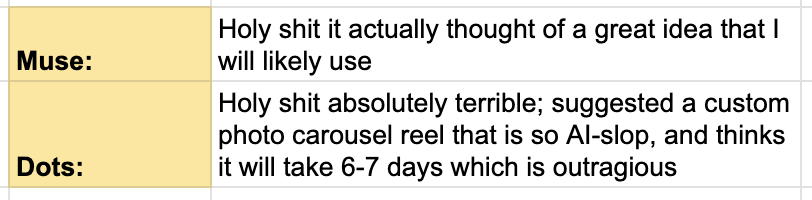
Here's what users said:
The majority of the human experience is visual.
Proud to see @DesignArena representing the visual coding capabilities in @thinkymachines' model card.
Excited to see visual coding become an increasingly dominant frontier for AI evaluation!
BREAKING: Inkling 2 Small by @thinkymachines takes 4th place overall on DesignArena and is 1st place among open weights models with an Elo of 1376!
At $0.30/$1.00 per 1M input/output tokens, Inkling 2 Small is 15× cheaper on output than Kimi K3 by @Kimi_Moonshot. This model also places 1st on 2 of our subcategories including General Purpose and Landing Page prompts. Model weights to be released soon.
A huge congrats to the @thinkymachines team on a top-5 placement on the leaderboard!
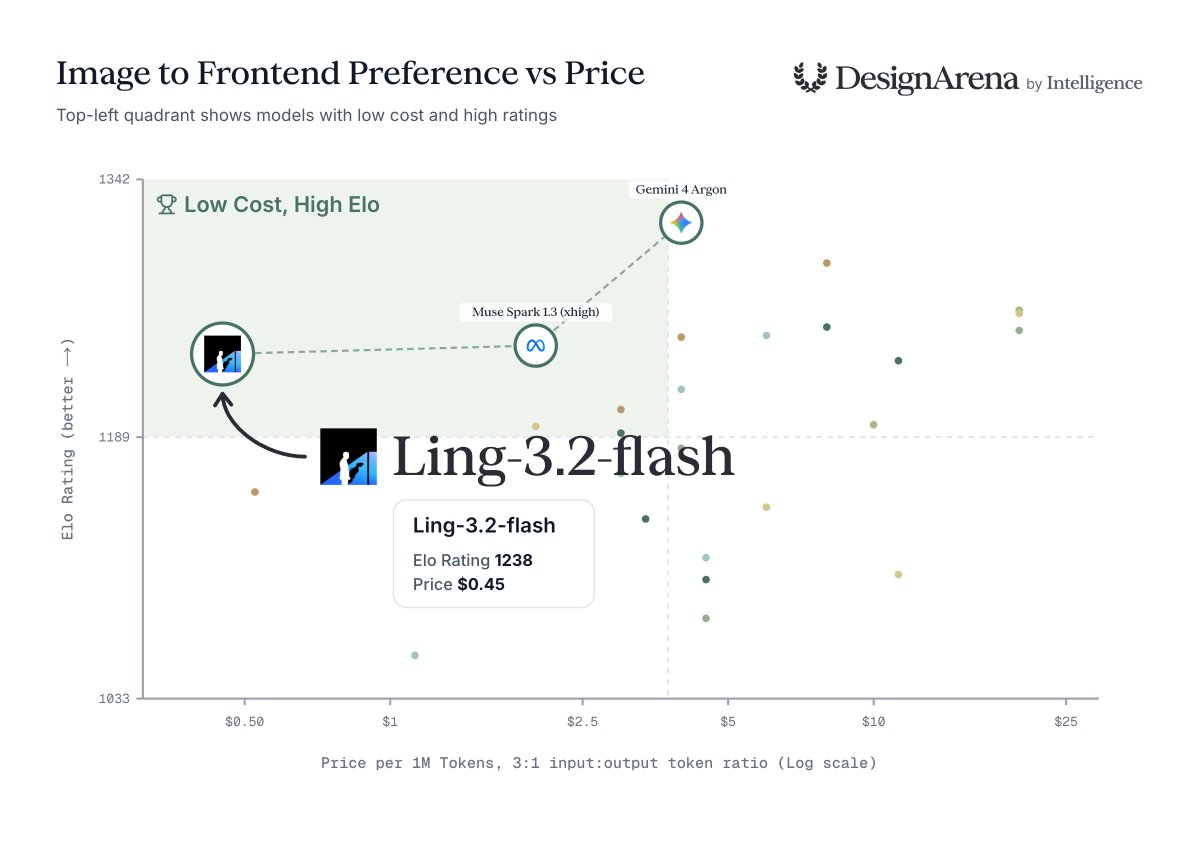
BREAKING: Ling-3.2-flash by @AntLingAGI lands at #10 on Image to Frontend Arena with an Elo of 1238! This model also establishes a new Pareto frontier for Preference vs Price at $0.30 input / $0.90 output per 1M tokens, the cheapest for any model at this performance.
It most often wins on its Portfolio and Corporate builds where it wins around 63% and 60% of its tournaments respectively. This also places Ling-3.2-flash among leading models from @AIatMeta, @AnthropicAI, and @deepseek_ai.
Congrats to the @AntLingAGI team on a Top-10 placement on DesignArena!
Gemini Omni 1.2 Flash is out, and one of @GoogleDeepMind's examples flies an FPV shot through the Pantheon in Rome. We stayed in Rome and flew through the Colosseum.
We gave Omni 1.2 Flash and Omni 1.1 Flash the same cinematic FPV prompt: start in the hypogeum maze, climb the outer arcade, clear the broken attic story, then pull back over the Forum.
Omni 1.2 took longer, 1m 28s vs 53s, at about the same total cost ($1.04 vs $1.01). However, 1.2 now generates up to 15 seconds, up from 1.1's 10-second max, making it 31% cheaper per second.
Here, Omni 1.2 turns through the hypogeum, hugs the outer arches, and pulls back over Rome while holding arch rhythm and wall height largely consistent.
By contrast, Omni 1.1 stays on a more simple zoom. It moves up a higher outer wall, but when the zoom out begins, that wall has seemingly dropped out, before being rebuilt as the pullback continues.
Create generations of your own, and judge for yourself on https://t.co/5Bc9iiaXyc!
Gemini Omni 1.2 Flash by @GoogleDeepMind is now available on DesignArena!
Gemini Omni 1.2 Flash brings native video generation up to 15 seconds, with multi-turn conversational editing and improved reference following. Creators can refine individual details through follow-up edits instead of regenerating entire clips, and upscale finished videos to 1080p or 4K.
Congrats to the @GoogleDeepMind team on the launch!