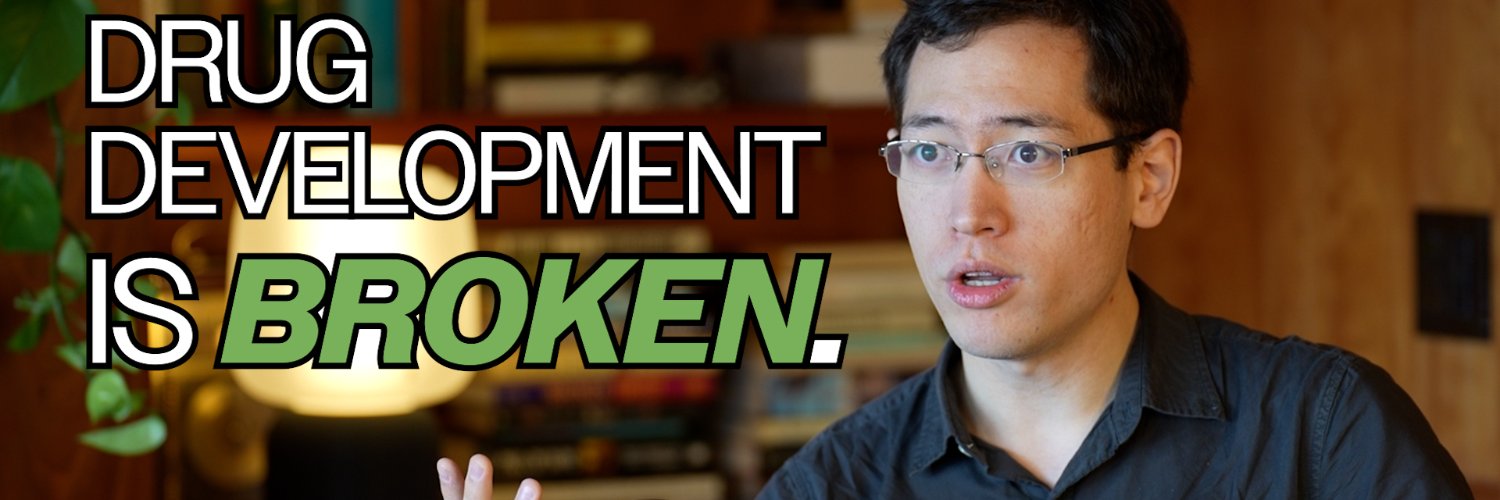
For the final episode of Season 1 of @DevAndResearch, I'm sitting down with Ambassador Mark Dybul—one of the architects of the President's Emergency Plan for AIDS Relief—who argues that America has forgotten the core insight of the Marshall Plan: supporting other countries' economic growth creates markets for American businesses, not competition for American workers.
We talk about drug development, too:
• why many drugs don't work in women and people of color
• how buying HIV drugs for Africa led to improved treatments for Americans
• whether the FDA was wrong to reject MDMA for PTSD
• the changes that could cut drug development expenses by orders of magnitude while producing treatments that actually work for everyone, supporting American geopolitical dominance, and defusing geopolitical instabilities that will “make pandemics looks like child’s play”
01:40 Introduction
02:20 PEPFAR’s systemic legacy
06:48 Why we make drugs that don’t work
10:18 PEPFAR’s legacy in the private sector
12:38 Covid lessons we failed to learn
16:33 MDMA for PTSD: Was the FDA wrong?
23:35 The President: “I want it to be big.”
26:22 A Marshall Plan for the 21st Century
29:00 US companies don’t understand Africa
37:02 Global-first drug development
45:45 What has Covid changed?
50:22 Global-health investment is stuck in the past
52:23 Immunotherapy and the Future of Medicine
58:03 What’s holding back change?
01:01:47 The Way Forward
This week on @DevAndResearch I'm chatting with @JessicaSacher, who has spent more than a decade studying natural viruses that kill bacteria. Oh, and she personally prepared experimental treatments that cured a dozen patients' chronic bacterial infections after all known antibiotics failed.
We get into:
• how Stalin's support for bacteriophage therapy led to a decades-long bias against "commie science"
• convincing doctors to try something new when their patients are out of options
• getting approval to collect clinical data when every patient receives a different treatment (score another point for Australia!)
• how a flaw of clinical trial design sunk the largest phage-therapy efficacy trial to date...
• ...and everything else it'll take to bring a treatment discovered in 1917—and completely outside the modern pharma paradigm—to patients today.
01:36 Introduction
02:14 What are phages?
03:28 What is phage therapy?
04:34 Phages vs antibiotics: A history
07:31 The limits of antibiotics
12:25 Step 1: Test for effective phages
15:45 Step 2: Purify the phage sample
21:12 Step 3: Get per-patient approval
24:13 Step 4: Treat the patient
28:13 Founding Phage Directory
33:09 Toward broader adoption of phages
46:13 What will commercial development (have to) look like?
53:57 Where are phages used today?
57:30 What if you treat, then test?
01:01:11 Why (else) do phage therapy trials keep failing?
01:05:32 Future directions
This week on @DevAndResearch, I sat down with @incredutility to talk about:
• are there profitable investments in global public health? (and are there hundreds of millions of dollars of them?)
• what makes investing in public health is harder (and easier) than conventional biotech VC,
• which clinical trials cost an order of magnitude less than you'd expect,
• which applications FDA reviewers love to see cross their desks,
• the 40% tax credit attracting early-stage clinical trials to Australia,
• and the looming rise of a “less unipolar” biotech world.
Timestamps:
01:03 Introduction
01:27 Why is infectious disease commercially difficult?
05:26 Where do our healthcare dollars go?
07:49 GHIC: the Global Health Investment Corporation
10:07 Alternative business model #1: Selling to pharmaceutical stockpiles
12:59 Alternative business model #2: Priority Review Vouchers
18:06 Alternative business model #3: Making your own investment opportunities
21:10 Portfolio composition: New tech vs known platforms
23:00 Evaluating (counterfactual) impact
26:26 Working with company management
28:55 “Most people are in this business to improve the world”
31:09 More expensive and slower: “We’re in it with everyone else”
38:44 “Burning tens of millions of dollars a year in overhead”
42:06 Can trials cost less?
48:02 Clinical trials outside the US
54:13 The rise of Chinese biopharma
57:41 Ex-US / ex-China drug development
01:01:09 Who should regulate drugs for the world?
01:05:30 The future of global public health
Brian: "These hamster ovary cells, I mean, really, if they had their druthers, I think they'd prefer to grow inside a Chinese hamster's ovary.
"But instead, we have to trick them into growing in a giant steel tank—and that’s not so easy."
"Our goal was to get the cost per gram of protein therapeutic equivalent down by at least one hundredfold, and you *cannot* do that unless your capital expenditures are dramatically lower than on a traditional system."
We're back with @DevAndResearch, where I spoke with @Finrow on:
• why we should grow more drugs in algae, and fewer in Chinese Hamster Ovary cells,
• why "monoclonal antibodies" are particularly safe and effective as drugs—but incredibly expensive to manufacture,
• and whether the fundamental problem of the biotech industry is that everyone just has too much money.
Timestamps:
01:17 What makes a molecule a drug?
04:48 What’s so great about antibody drugs?
05:59 The humble Chinese Hamster Ovary cell
11:27 Introducing: Lumen Biosciences
12:40 Why spirulina?
19:14 Why isn't everyone doing this?
23:53 Going after gut infections
33:44 “Cocktails” of protein drugs
50:25 Other diseases of outside-of-body lumens
01:04:36 How to run a different breed of biotech
01:17:44 “Everyone just has too much money”
01:21:07 Extinction events in the biotech industry…and “little mammals scurrying around”
01:24:28 Speculations about the future (for Lumen and the world of direct-to-consumer drugs)
Meri: “I remember having to download Internet Explorer on my laptop because the website the CRO had built didn’t have an SSL certificate—it was an old Wordpress template and Chrome blocked you from accessing it.
“I was like, wow. They can’t even build a website. This is insane.”
“...you’re any company and your lifetime value of a customer is $30,000—you would spare no expense to make sure that the signup flow and that whole customer journey is perfect.”
For the first episode of Development & Research, I spoke with @meribeckwith on:
• being a patient in an incompetently-run clinical trial,
• how many drug trials fail b/c of bad paperwork,
• who benefits when trials are expensive,
• just how quickly biotech founders lose control to investors,
• why no one is picking up the billion-dollar bills on the sidewalk.
Timestamps:
00:01:51 - "Eroom's Law"
00:03:12 - The gap between new science and new medicine
00:04:51 - Clinical trials: the patient experience
00:08:19 - The lifecycle of a biotech startup
00:10:22 - Clinical Research Organizations
00:13:19 - 10% of trials fail b/c of clerical errors
00:17:27 - Lindus Health (Meri's Series-B startup)
00:19:03 - Recruiting more patients won't save badly-planned trials
00:23:36 - Meri's skepticism of international trials
00:27:04 - Biotech culture vs tech culture
00:32:54 - What'll it take to get biotechs to act like tech companies?
00:35:13 - *Adaptive* clinical trials
00:39:10 - "Sidebar on the FDA..."
00:43:06 - *Decentralized* trials
00:46:13 - *Who* makes clinical trials expensive?
00:48:43 - (Not) picking up the billion-dollar bills on the sidewalk
00:53:22 - What does "better" look like?
00:56:08 - "...a lot of alpha if you're willing to disregard all of this b——..."
00:58:42 - What's changing with AI?
01:00:57 - What's going on with China?
01:03:10 - What's ahead for Lindus?
The way we develop new drugs is broken.
The process costs too much, takes too long, and far too often it simply doesn't work.
I sat down with five leaders in the field—from industry, VC, academia, and government—to hear their takes on how, and why, and what we can do about it.