Yes. All that is also mostly why AI research had to be industrial in scope to get to this point, I think sometimes.
Development economics research will also have to be industrial to get to the next level in impact.
Development economics as science and engineering.
Test.
Measure.
Learn.
Improve.
Scale.
Jojo shows how randomized controlled trials help policymakers learn what truly works before scaling national programs.
Better evidence for better decisions.
Development for all.
Development economics as science and engineering.
Test.
Measure.
Learn.
Improve.
Scale.
Jojo shows how randomized controlled trials help policymakers learn what truly works before scaling national programs.
Better evidence for better decisions.
Development for all.
Today’s episode of ADVENTURES OF IMPACT explores something rarely shown in storytelling:
How countries can learn what actually works before scaling policy nationwide.
In “The Pilot,” Jojo witnesses a randomized controlled trial designed to test different industrial policy interventions - from finance to technical training - and discovers why evidence matters in development.
Because serious progress is not built on guesswork.
It’s built on learning.
Brought to you by .@DevEconX.
The core of your point may well be correct. If economists made that mistake, we did it before electrical engineers—economics is far more technically demanding than even physics, let alone EECS.
There are econ PhD students who fail their comprehensive exams…and then transfer into mathematics PhD programs and pass theirs.
I’d just add: if AI can handle the technical math, it can handle the applied computing, systems thinking and statistics too. One might actually benefit more from the AI revolution with a deeper technical foundation than without one.
—Kweku
Founder @DevEconX@mlxdoing
Former EECS postdoc @ UC Berkeley & CS postdoc @ Cornell Tech.
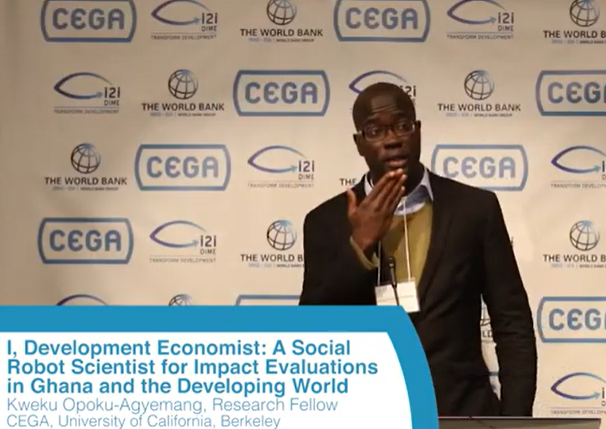
In 2018, I stood on a stage in SF, flanked by the logos you see here, and made a bold prediction: "AI will someday do end-to-end economic research."
The room was deeply skeptical. Some of the sharpest minds told me it was impossible. To be fair, it sounded like sci-fi back then.
Unbeknownst to most of us, Google had just quietly dropped the Transformer paper. The world was about to change.
Today, that "outlandish" vision is becoming reality. AI agents are beginning to formulate hypotheses, run regressions, and draft papers.
Being early can feel lonely, but it’s incredible when the world catches up.
Building on the independent research ideas I explored during my time there, I later founded Machine Learning X Doing and Development Economics X. We aren't waiting for the future: we're building it. 🚀
We use development economics to solve global challenges, yet university administrations supporting that and other departments are left using "intuition" to defend their own budgets.
It’s time to bring this science home. This is our race against time against vibes-based resource allocation:
Vibes don't belong in resource allocation.
Yet, millions are spent simply because someone "felt it would work", only for budgets to be cut based on speculation later.
Get causal clarity. Confidently optimize programs for funding.
Discover your potential outcomes. 👇 #Video
@watchmxunderds Yes. What you call "compliance theater," we mathematically define in our paper as the Technology Diffusion Tax: the hidden, compounding cost burned on bureaucratic alignment rather than real-world productivity. Hence, our Algorithmic Special Economic Zones (ASEZs). Cheers!👋📊
Development economics around the world often stops at analysis.
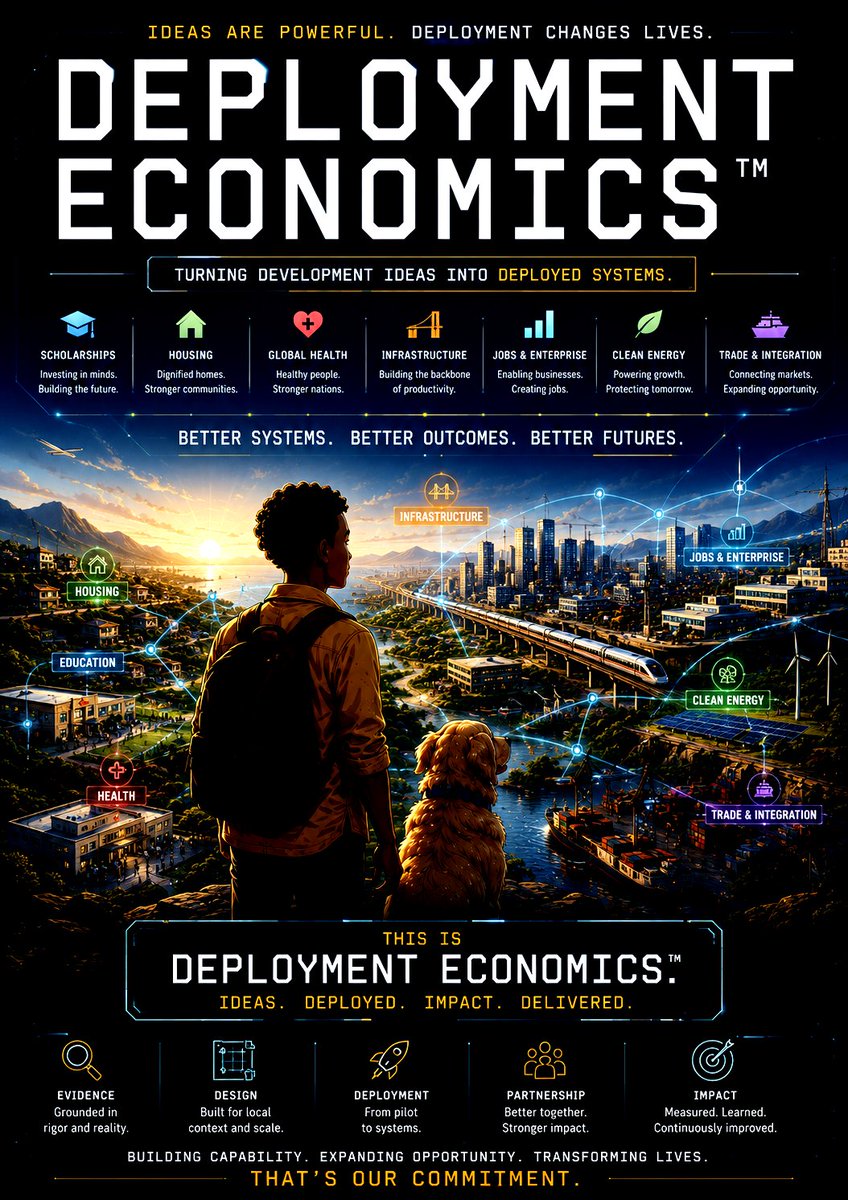
.@DevEconX presents DEPLOYMENT ECONOMICS™ .
We believe that development is ALSO something to deliver, build, coordinate, operationalize, and continuously improve in the real world.
We deliver development.
Stop tracking nominal adoption metrics. It's time for rigorous Causal Inference. Download the full, official paper on Deployment Economics X™ below to see how we map the path to true Productive TFP Realization.🔗 https://t.co/P01DBxy2rv
Trillions of dollars are flooding into advanced AI infrastructure, yet macroeconomic productivity is stubbornly stagnant. Why?
Technology invention is an engineering problem—but technology deployment is an institutional one.
Enter Deployment Economics™ from .@DevEconX 🧵👇
Sovereign nations must transition toward Algorithmic Special Economic Zones (ASEZs): insulated computational sandboxes with data liberalization, private capital protection, and transparent deployment firewalls.