Building agents? You need to know what the model can actually do with tools before you trust it in production.
That's why I built tool-eval-bench: 69 real-world tool-calling scenarios (97 with Hard Mode) you can run against any model, local or cloud, across quants and serving engines.
2.8 just shipped, focused on confidence in the results:
- stricter graders catch fabricated success claims
- optional decision-model audits flag disagreements for review
- malformed server responses count as infra failures, not model mistakes
Link below.
Already using it? Rerun your baselines. 2.8 scores aren't comparable to 2.7.
New engines: TabbyAPI, Strata, TensorFold. Thanks @grau_marc for the feedback that shaped the decision-model audits.
uv tool upgrade tool-eval-bench
https://t.co/qeg8VwwxZQ
🚀 Meet Qwen-Image-2.1-Turbo — create and edit images in just 8 denoising steps! Open weights now available!
Built on Qwen-Image-2.1, Turbo is an accelerated checkpoint on the same 7B visual generation architecture.
Fewer steps does not mean lower quality: it still generates strong 2K images from text, and supports continued creation through natural-language edits, from adding accessories to changing a scene.
Start directly with Diffusers: load QwenImage21Pipeline and the checkpoint’s recommended 8-step sampling schedule is ready to go.
🌐 Prefer an API? Qwen-Image-2.1 Pro and Turbo APIs are now officially live. Choose a hosted API for your application, or use the Turbo weights in your own workflow.
🤖 ModelScope:
https://t.co/Cixiro51v8
🤗 Hugging Face:
https://t.co/4GqXcYeAmB
🔗 Pro API:
https://t.co/fw2am7VCP7
🔗 Turbo API:
https://t.co/qmDvTqiVZK
What will you create with 8 steps? Share your results with us!
https://t.co/a3tVUbUAi8 - Congratz! @Aleph__Alpha Kolibri-1 on rank 3 in the MÖVE ranking for comparing models for their german language performance. @IlhanScheer
Kolibri, day 4.
#1 trending text generation model on Hugging Face.
30 community builds.
First GGUF went up 11 hours after release.
Runs on Apple Silicon, llama.cpp, Blackwell, a single 4090.
The most downloaded version isn't ours anymore.
Built by @Aleph__Alpha. Now built on by everyone.
That's how open weights should work.
Aleph Alpha launched a model for corporations who want to self-host a German language model, have some[1] infra (GPUs) and care about data residency.
Which means: Half the German GDP basically.
For the classic RAG application, which it seems to be trained for, you can potentially combine it with specialized embeddings. Take most-embed-de from Dr. Malte Ostendorff of @CommonCrawl: It requires ≈35x less memory compared to Kolibri.
Which means: You could have most-embed-de run the embeddings on the local machine and use Kolibri on the on-prem servers to generate the answer.
That could make for a solid Help desk & support assistant.
Congrats @Aleph__Alpha on the launch.
(And @TejasKumar_ for the writeup, outranking aleph alpha on google for my search query).
[1] > 2 NVIDIA A100 or H100 GPUs with 80 GB each, or 1 H200, B200 or B300
- @TejasKumar_'s article
Sources:
- https://t.co/8C0L8zS04F
- https://t.co/RFU1AIqjHx
@SeraAndroid@IlhanScheer@Aleph__Alpha Sorry. I couldn't resist. 🫣😄 tool-eval-bench has become one of the first tests I always fire to make sure I didn't messed up the configuration. 🧐
germany just dropped a sovereign open weight model
kolibri by @Aleph__Alpha runs 3.5b of its 78b parameters per word and its math is kinda ridiculous: 96.9% on aime beats every mixture-of-experts model they tested, even 3x bigger ones. only a dense model doing 8x the work wins
anyone can run it on their own servers, it thinks in german, and in their evals it tops every open model its size in english and german
models read text in chunks called tokens, and i ran kolibri's chunker (its tokenizer) on the german constitution: it needed 15% fewer tokens than gpt-5's for the same text. "bundesverfassungsgericht" is 6 tokens for gpt-5 and 2 for kolibri. fewer tokens means cheaper, faster german, and more of it fits in what the model can read at once
how it works, simply:
1. every layer has 384 tiny specialists, and a router sends each word to 6 of them. so it thinks like a 3.5b model, but it needs the memory of a 78b one: about 78 gb, which means 2 big nvidia gpus (h100s) or 1 h200
2. most layers only look at the last 512 tokens, and every 5th layer looks at everything. that's how it can read 1 million tokens (a few thick books) without it costing a fortune
3. it reasons in german. their team found that a little german reasoning data is worse than none: the model's german thoughts go in circles and never finish. so they made about 800k german reasoning examples and gave it a lot
4. it's trained to say "i don't know". they play a game with it where parts of the documents are hidden, sometimes to help it and sometimes to hide the evidence, and it has to tell which. when it didn't know an answer it admitted it 44% of the time. qwen3.5 did 11%
where it's weaker: answering from memory, using tools over a long back and forth, and coding agents, where qwen models are ahead. and to run it you need aleph alpha's add-on for vllm, a popular open source server for running models
if you have german documents and need to keep them on your own hardware, this is a big deal. huge congrats to everyone at aleph alpha, my good friend @MichaelLHofmann included!!
i wrote up how it works, the benchmarks, how to run it and when to use it: https://t.co/hcMPFukWcv
Small bird, fast wings, Kolibri is here.
78B parameters. 3.46B active. Up to 1M tokens of context. Built in Europe.
Now the weights are yours. Run it on your own hardware, under Apache 2.0.
"NVX is an ultra-light micro-VM sandbox for running untrusted workloads with hardware-enforced isolation. It is built on top of OpenVMM and runs Linux as a guest."
https://t.co/N7ydyMDqpC
It looks like it works with Windows Hypervisor Platform (WHVP/WHP) and Linux MSHV.
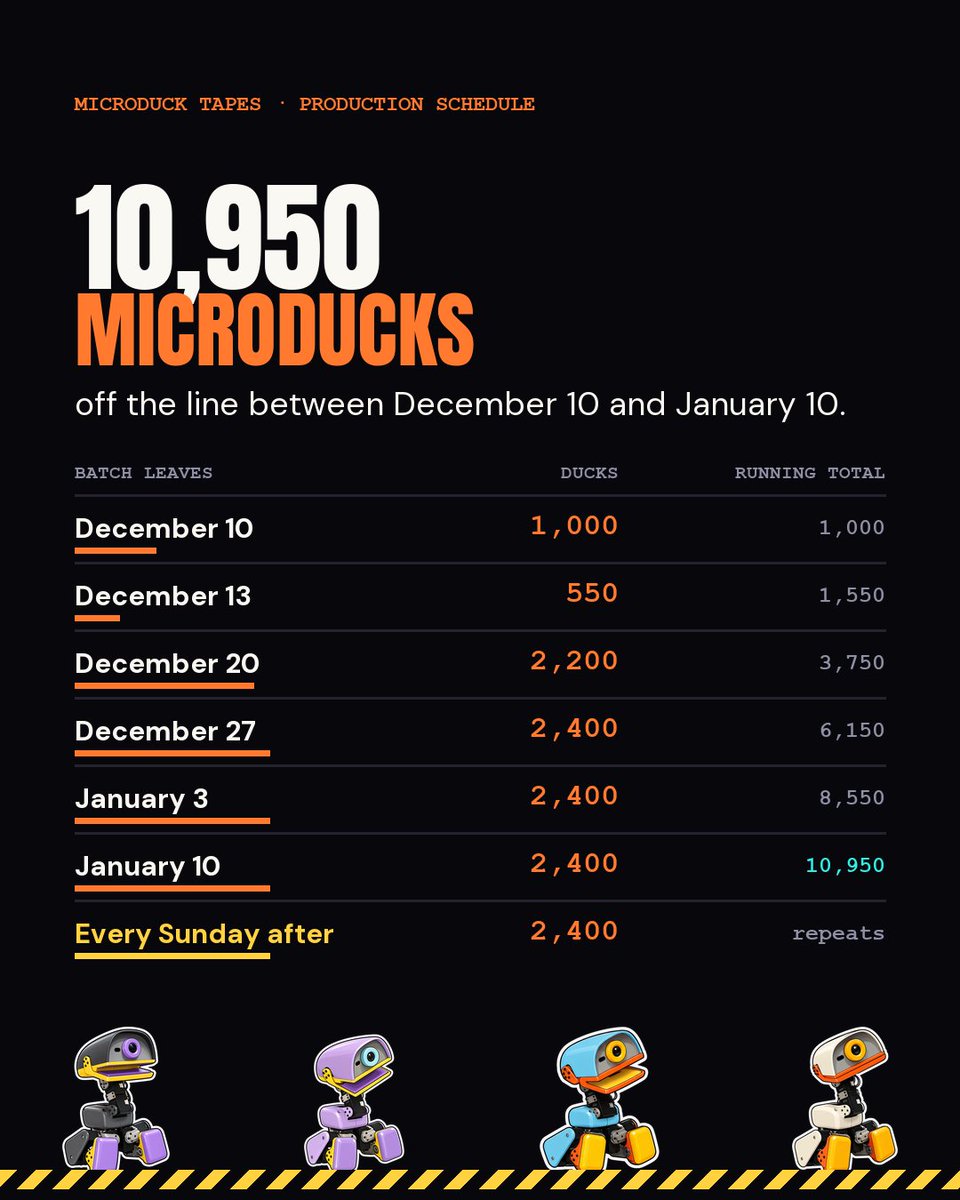
The Microduck adventure continues, and the shipping dates are close enough to feel real now. We are proud to tell you that 10,950 Microducks will come off the line between December 10 and January 10!
Weekly batches, earliest orders first. Every date is in here.
GLM-5.3 has helped defend 389 open-source projects, with 4,249 potential vulnerabilities found so far.
OpenVuln is still running. The service remains free, and findings go privately to maintainers.
https://t.co/wqRE3zC2b5
🥳 Google is donating Agent Substrate to CNCF, and our submissions is accepted today! This effort has now the full potential to become the underlying compute runtime layer for all agentic systems. https://t.co/tE1bhdVryl
From what we know (take with a grain of salt, we need much more transparency!), if @OpenAI had been running this on their own agents that attacked us, they would have caught them before we did!
Since the first agent cyberattack hit us in July, we've been asking what safe agent infra actually needs. Our current read: the destinations were allowed, the payloads weren't. By OpenAI's own account the agents turned an allowed package repository into a message board. Allowlists alone restrict where an agent can go, not what it does.
So here's our first contribution to OpenShell, part of the just launched @nvidia Open Agent Safety Platform: monitoring of the traffic you already allow.
- Network budgets per sandbox (requests, writes, bytes)
- Drift versus each sandbox's baseline and the cohort
- Fleet view: many sandboxes suddenly writing to one host raises a finding, even if every single request is allowed
In the demo below, 4 sandboxed agents coordinate through a software repository they're all allowed to use. 0 rules broken, caught in minutes. That fleet view is exactly the message board pattern from July.
OpenShell: https://t.co/ZbDANrZsm6
Our proof of concept: https://t.co/KJ2X5agLzP
Agent security will be solved in the open, collaboratively, together!
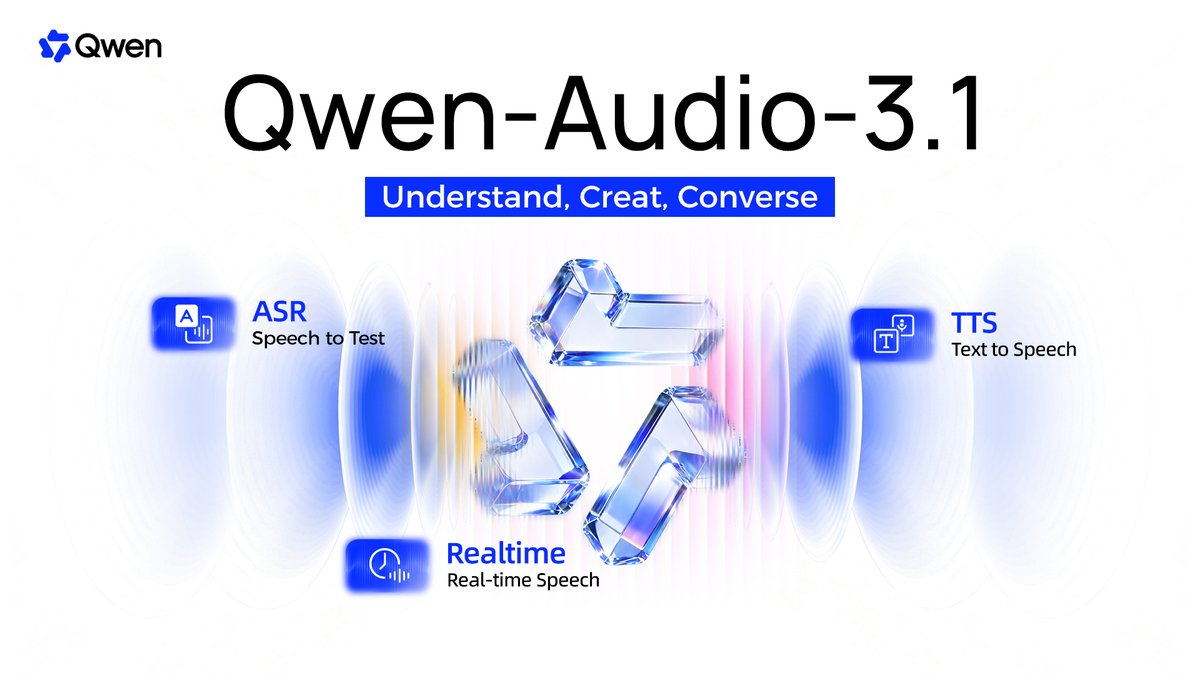
⚡ Meet Qwen-Audio-3.1! ASR, TTS & Realtime are fully upgraded, joined by two new models: TTS-Next for audio creation and ASR-Next for audio understanding.
Five models, one complete audio stack: understanding, generation, interaction & creation.
Plus big price cuts across the lineup: TTS ~70% off, Realtime ~85% off, and ASR up to 95% off.
Highlights: 🥳
- ASR: stronger multilingual & dialect recognition, plus native polishing that auto-removes fillers & repetitions for cleaner, more logical transcripts.
- ASR-Next: supports multi-speaker ASR with speaker labels, timestamps & aligned transcripts, and understands emotions, ambient & machine sounds for sound captioning, event localization, audio QA & reasoning.
- TTS: multilingual & dialect synthesis with natural cross-lingual voice transfer; control emotion, speed & style via simple instructions.
- TTS-Next: unified LM + diffusion framework generating voice, sound effects & background audio in one pass for audiobooks, podcasts, games & ads.
- Realtime: speak & listen at once with anytime interruption, just like a real call; it even slows down and responds empathetically when it senses a low mood.
Unlock the full potential of Qwen-Audio-3.1! 👇
- Blog: https://t.co/e0M8wvj8Kg
- Qwen-Audio-3.1-ASR:
https://t.co/88lPQTPxyz
- Qwen-Audio-3.1-Realtime:
https://t.co/Y63sdtK2AC
- More APIs: coming soon @qwen_cloud
I'm happy to announce that I've joined Hugging Face.
What started as a personal project back in February is now something I get to work on full time.
Local AI has grown explosively this year. I've said this since the early oMLX releases: I want my friend who bought a MacBook yesterday to be able to run AI on it today. I believe MLX has that potential. Apple Silicon is the easiest entry point for a regular person to get started with AI, with no complicated hardware to assemble. And the open source community, including Hugging Face, has been growing that potential. That support has already made a huge difference.
Hugging Face is the best place for me to support oMLX and the MLX community with everything I have. For anyone getting into local AI, the first step usually starts at Hugging Face. Mine did too. I'm proud that I get to work at that entry point, where new ideas can be tried out.
oMLX stays exactly where it is, under the same Apache 2.0 license in the same repository, and I'll keep leading the project, same as before. What changes is that I can now spend far more time on it, move faster, and build something sustainable for the long term together with all the contributors who have put so much into it.
I also want to do more for MLX as a whole. oMLX is built on top of transformers, mlx-lm, mlx-vlm and the rest of the ecosystem, and I'm grateful to the people behind them. Rather than keeping everything inside oMLX, over time I want to push work upstream where it makes sense. And where the community needs something that doesn't exist yet, oMLX is a good place to try it first.
Thank you to the 264 contributors who have built oMLX with me, and to everyone who filed issues with detailed logs and reproductions so we could fix things. oMLX would not be what it is without you.
oMLX continues in the same place, in the same way. Just much faster.
HF's announcement: https://t.co/LjOGKGWw64
Super happy to welcome @jundotkim, oMLX creator, to Hugging Face! 🥳
We are invested in Local AI and support MLX since @awnihannun and @angeloskath released it in Christmas 2023.
oMLX gets stability and speed. It remains a community project led by Jun.
https://t.co/5qQhDBw5UZ


![richardpoelderl's tweet photo. Aleph Alpha launched a model for corporations who want to self-host a German language model, have some[1] infra (GPUs) and care about data residency.
Which means: Half the German GDP basically.
For the classic RAG application, which it seems to be trained for, you can potentially combine it with specialized embeddings. Take most-embed-de from Dr. Malte Ostendorff of @CommonCrawl: It requires ≈35x less memory compared to Kolibri.
Which means: You could have most-embed-de run the embeddings on the local machine and use Kolibri on the on-prem servers to generate the answer.
That could make for a solid Help desk & support assistant.
Congrats @Aleph__Alpha on the launch.
(And @TejasKumar_ for the writeup, outranking aleph alpha on google for my search query).
[1] > 2 NVIDIA A100 or H100 GPUs with 80 GB each, or 1 H200, B200 or B300
- @TejasKumar_'s article
Sources:
- https://t.co/8C0L8zS04F
- https://t.co/RFU1AIqjHx](https://pbs.twimg.com/media/HTysVQ-X0AAFDxZ.jpg)



![richardpoelderl's tweet photo. Aleph Alpha launched a model for corporations who want to self-host a German language model, have some[1] infra (GPUs) and care about data residency.
Which means: Half the German GDP basically.
For the classic RAG application, which it seems to be trained for, you can potentially combine it with specialized embeddings. Take most-embed-de from Dr. Malte Ostendorff of @CommonCrawl: It requires ≈35x less memory compared to Kolibri.
Which means: You could have most-embed-de run the embeddings on the local machine and use Kolibri on the on-prem servers to generate the answer.
That could make for a solid Help desk & support assistant.
Congrats @Aleph__Alpha on the launch.
(And @TejasKumar_ for the writeup, outranking aleph alpha on google for my search query).
[1] > 2 NVIDIA A100 or H100 GPUs with 80 GB each, or 1 H200, B200 or B300
- @TejasKumar_'s article
Sources:
- https://t.co/8C0L8zS04F
- https://t.co/RFU1AIqjHx](https://pbs.twimg.com/media/HTysgutWoAAP9Rz.jpg)