@lugaricano Maybe because inequalities and cut-throat competition among a few hundreds of (relatively extremely well off) footballers does not affect them while free market policies very much concerns them directly?
Nice piece, congrats to the authors
Amazing that for so long the puzzle in the academic economic literature was why to sovereigns pay ... when in reality most countries go to absurd lengths to avoid (or often just postpone) needed restructurings
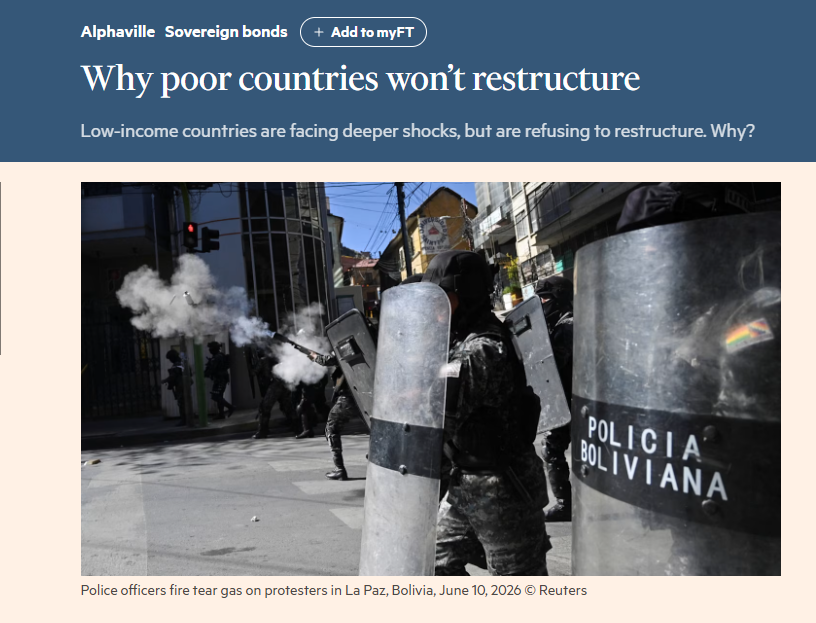
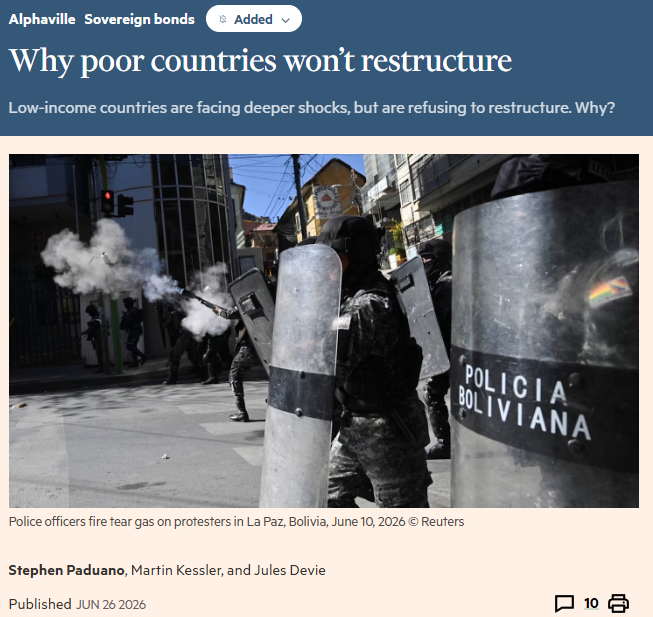
Why poor countries won’t restructure ?
As a devoted reader of the Financial Times, and FT Alphaville in particular, it is an honor to publish, together with my co-authors @mkessler_DC@StephenPaduano, our attempt to answer this question in its pages.
https://t.co/pHx5laLOZD
This week was the annuel Paris Forum, and this year was special because it celebrated the 70 years anniversary of the Paris Club 🎂🎂🎂. In a piece at @FTAlphaville, @StephenPaduano , Jules Devie and I (a @FinDevLab team) ask an old question: why don't countries restructure?
Bolivia’s Reform Agenda Is Moving, but Slowly
Five months after declaring an "economic, financial, energy, and social emergency” in December, Bolivia's President Rodrigo Paz has yet to deliver on its reform agenda.
The administration pledged a three-part stabilization strategy: fiscal consolidation, exchange-rate flexibility, and a new growth agenda.
Analysts Stephen Paduano, Jules Devie and Jean Courtial argue in an essay for Americas Quarterly that to date, only partial progress has been made—and not nearly at the pace required. Fiscal adjustment has been limited, the exchange rate remains rigid, and the future of Bolivia’s growth remains elusive.
Join the regional dialogue at @AmerQuarterly.
@StephenPaduano, @DevieJules , @courtial_jean ,
https://t.co/PxzlHwho9L