This is insane...
Whitney Webb exposes the history of Palantir.
Palantir started as a DARPA project. It was going to completely destroy our constitutional protections so it was quietly taken out of government and rebranded as a private company to do the EXACT same thing.
🚨🇩🇪GERMANY PLANS TO ALLOW SECRET SURVEILLANCE DEVICES IN PRIVATE HOMES.
Interior Minister Dobrindt's draft legislation would give intelligence agencies the power to enter homes and install monitoring equipment without the owner's knowledge.
NO freedom LEFT!
30 years ago, each major US company had at least one European equivalent
Not anymore. While the US runs ahead with innovation and entrepreneurship, Europe is stuck with regulations, overtaxation, and a left mindset throttling growth and progress
With AI, the gap will only widen
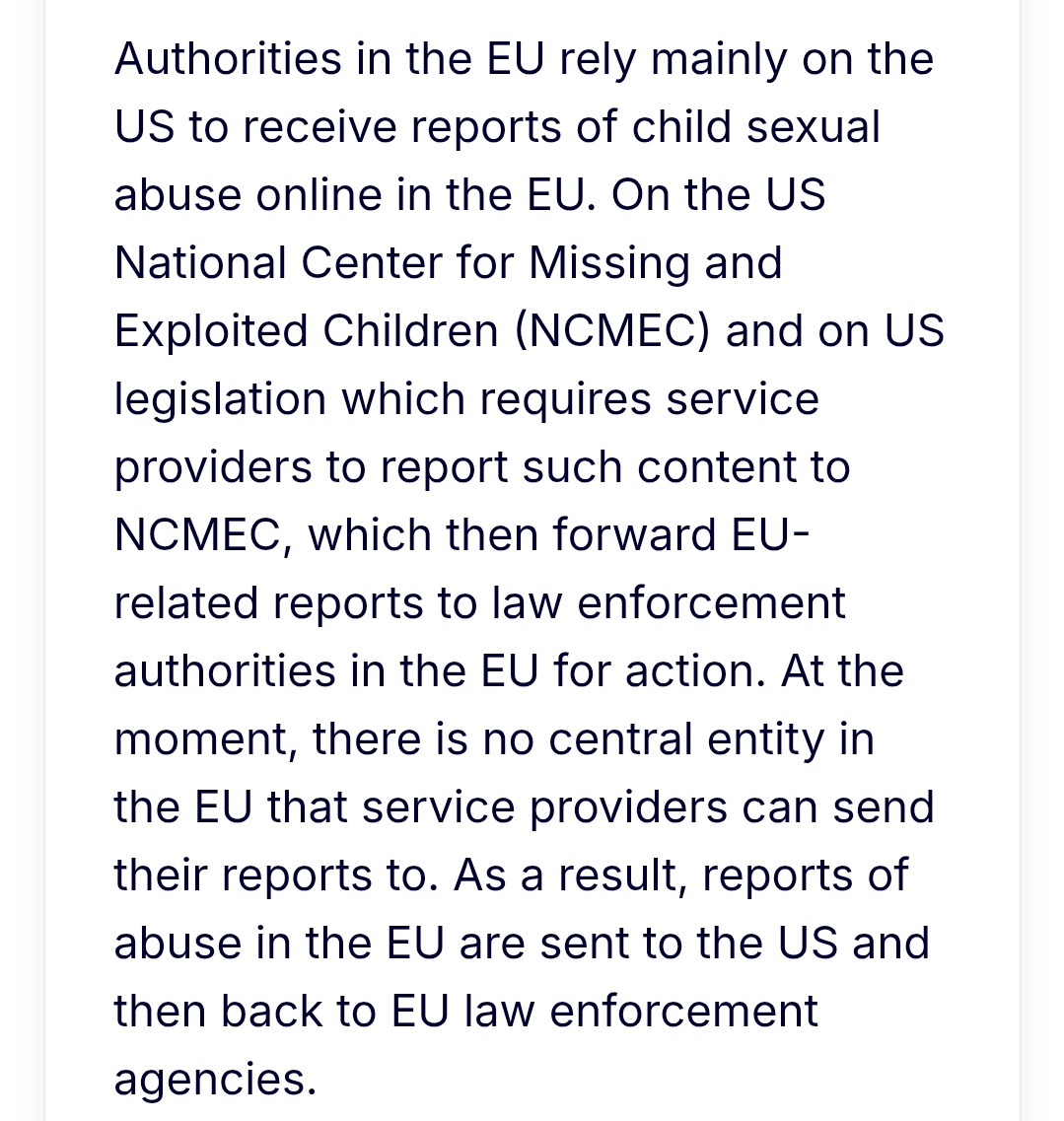
The current version of Chat Control is not only bad for privacy, it is also a sovereignty risk giving US big-tech the power to syphon data to US NCMEC.
NCMEC acts as central hub that checks vast amounts of data, accessible by US intelligence services.
@EPPGroup, shame on you.
In Europe, DAC8 has turned “Know Your Customer” into “Kill Your Customer.”
Today, Bull Bitcoin is officially opening the first legal front against DAC8.
We have brought a case before France’s Conseil d’État, the country’s highest administrative court, to strike down the decree implementing DAC8 in French law.
Since January 1, 2026, DAC8 has required crypto-asset service providers to systematically collect user and transaction data and subsequently report it to national tax authorities.
These authorities will automatically exchange this information across the European Union and with tax administrations in other participating countries around the world.
The result is a massive international financial-data honeypot linking people’s legal identities, home addresses and crypto activity, including information with no relevance whatsoever to taxation.
This is grossly disproportionate and poses a serious threat to the physical safety of crypto holders and their families.
Until now, most customer data remained within each crypto-asset service provider unless a suspicious transaction was reported or a competent authority made a lawful request.
DAC8 replaces this model with the systematic reporting and cross-border sharing of highly sensitive financial information.
The more authorities, civil servants, contractors, systems and foreign jurisdictions that have access to this data, the greater the risk that it will eventually be leaked, stolen, illegally accessed or sold to criminal organizations.
At the same time, kidnappings and violent attacks against crypto holders and their families are rising, with leaked personal and financial data increasingly being used to identify and target victims.
France has already suffered numerous breaches of highly sensitive government and financial databases.
Given enough time, a database of this scale is almost certain to be breached.
When that happens, criminal organizations will gain a ready-made map of who to target and where to find them.
This is not responsible financial oversight. It is a recipe for disaster.
We filed our initial application before the Conseil d'État on February 24, 2026, followed by a substantive legal brief setting out the full grounds of our case.
This is not a symbolic gesture. It is a serious legal action, grounded in law and handled by experienced legal professionals.
We are seeking the outright annulment of the French decree implementing DAC8’s crypto-asset reporting regime, on the grounds that automated mass financial-data collection violates fundamental human rights.
If necessary, we are prepared to take this fight before the Court of Justice of the European Union and the French Constitutional Council.
A victory in France could establish an important judicial precedent and provide a blueprint for other European actors seeking to fight DAC8 in their own countries.
Someone has to draw a line in the sand.
Bull Bitcoin is willing to do it.
In the video, Bull Bitcoin founder @francispouliot_ takes the stage at @BTCPrague to expose the threat DAC8 poses to the privacy and physical safety of crypto holders and explain why Bull Bitcoin has decided to lead this fight.
Alongside this legal challenge, we are launching STOP DAC8: a complete, fully sourced resource for citizens, journalists and policymakers.
More info 👇
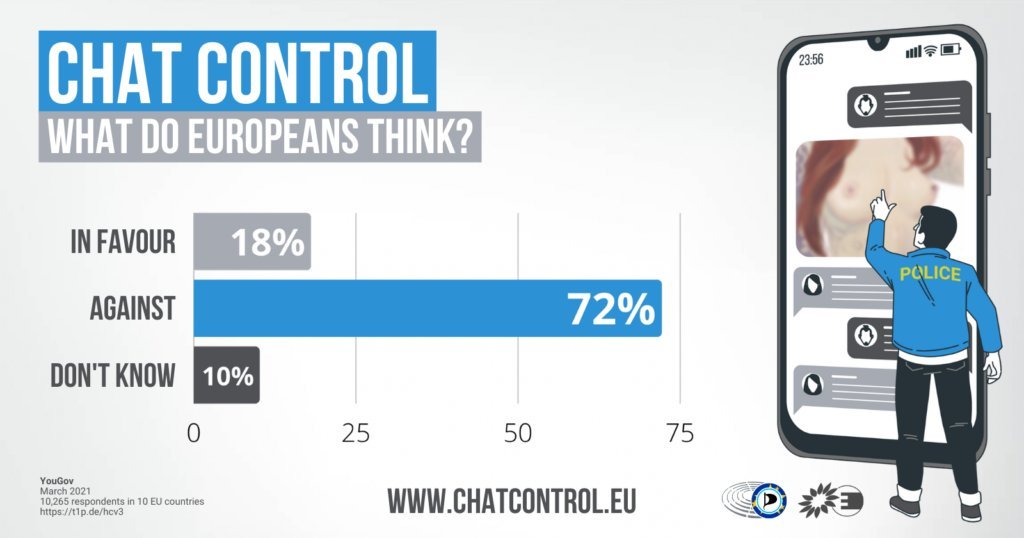
🚨 EVERY EUROPEAN NEEDS TO KNOW THIS:
The European Union is turning into an anti-democratic surveillance apparatus.
In March, the European Parliament REJECTED the extension of “Chat Control.”
So what did Brussels do?
While everybody is distracted from the World Cup, they furtively brought it back through a rarely used procedure and are trying again.
The goal is to allow private communications to be scanned under a derogation from normal ePrivacy protections.
They’ll have access to your private messages and your photos. And, as always, mass surveillance is being sold to you under the banner of “safety.”
The EU bureaucrats do not trust you.
They urgently want the infrastructure to surveil you.
And when its own Parliament votes the wrong way, the bureaucratic and anti-democratic machine simply finds another procedure and tries again.
The European Union is not protecting democracy.
It is becoming its enemy. And almost all CONSERVATIVES members of the parliament voted in favor of this Orwellian plan.
And now imagine a combination of governmental surveillance AND Palantir. SCARY!!!!
SHARE THIS. Europeans deserve to know what Brussels is doing to their privacy.
Why am I so fixated on Chat Control?
Because saying that “encryption remains in place” is one of the most dishonest statements I’ve ever heard.
Client-side scanning checks your content ON YOUR DEVICE, before encryption takes place. The padlock is intact. They’re simply searching your bag before you put anything inside it. E2EE ends up protecting the transmission, not the communication. Your own device becomes the informant.
And what about detection technology? The Commission’s own evaluation of voluntary scanning found false positive rates of up to 20% for AI-based image detection. One in five flagged conversations: it wasn’t CSAM. Now scale that to billions of messages.
Over 800 cybersecurity researchers have warned the European Parliament that the error rates are unacceptable and that targeted tools already exist. In tech policy, that level of scientific consensus against a proposal is almost unheard of.
Even the Council’s own Legal Service says that access to private communications without suspicion violates Article 7 of the Charter.
So what?
So they intend to approve it.
→ https://t.co/v1uBriWB25
when the samourai devs had their homes raided by heavily armed cops 2 years ago it sent a chill throughout the bitcoin industry
i felt it first hand, shit was scary and nobody knew what was about to come next
when the dust cleared a bit, arrested and funds seized, it was obvious they were going to need significant legal defense funds
made a few calls, but nobody wanted to stick their neck out, reasonable, i myself was hoping someone else would handle it, a young family of my own that i did not want to put at additional risk
but someone had to do it, so we launched the p2prights fund through @bitcoinpolicy, still proud of those guys to this day for taking that risk head on when nobody else would
in total, we raised about a million dollars worth of bitcoin, well short of what was needed to fight the case properly, mostly from individuals, honestly it was pretty disappointing, made me rethink a bunch of things
anyway, we still need to free samourai, lets get it done
https://t.co/hY270jso8A
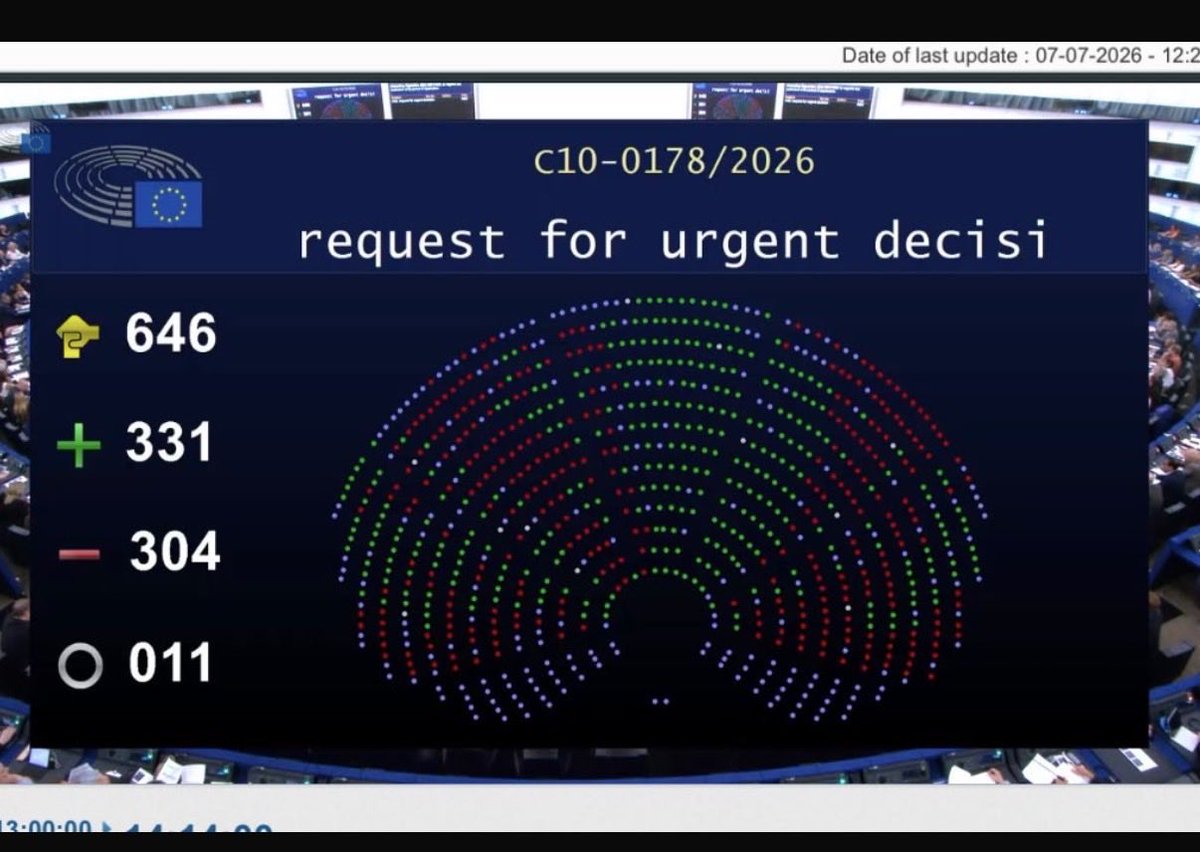
On Thursday, the European Parliament votes on Chat Control 1 (the voluntary scanning, not the mandatory scanning, called Chat Control 2). Again.
The Parliament has already voted against Chat Control 1. Two times. But the Council of Ministers and the Parliament President refuse to accept it.
Now, the Council has demanded an urgent procedure. This is a procedure that is meant to be used for new legislative proposals, not proposals that the Parliament has already rejected. An urgent procedure requires an absolute majority to be rejected (361 out of the Parliament's 720 members). This will be difficult to reach, since those who abstain from voting are counted as a yes-vote in an urgent procedure. By scheduling the vote during the summer, they are making it even harder to reach those 361 no-votes. This is downright dirty tactic by the Council and the President of the European Parliament.
The President of the European Parliament has sided with the Council against her own chamber. For context, this is the EP President, Roberta Metsola:
---
Lyn Alden: "The best product Coca-Cola ever sold was their bonds, not their Coke."
Coca-Cola borrows at 2-3% while the money supply grows at 7%. They then use that cheap debt to buy scarcer assets.
Governments do it. Corporations do it. Wealthy individuals do it. Everyone is shorting the currency...
Except the people at the bottom.
They can't access cheap debt and "are getting the full damage of the inflation" on their wages and savings.
FT @LynAldenContact@PeterMcCormack.
99% sure BIP 110/“Knots vs Core” has been a masterfully orchestrated and effective psyop.
They essentially derailed nearly all productive discourse for almost two years, dramatically fractured the community, burned out many developers, and stalled future positive improvements indefinitely (if not forever).
All while realistically meaning nothing, BIP 110 having no chance of activation, and all actual attempts to filter any spam failed completely and were always a non-starter.
You’re not convincing anybody here to change their mind, and every engagement you give them only further boosts their reach and effectiveness. There’s a tactical reason I haven’t engaged in that conversation for over a year — there’s no point, and my voice wasn’t making a difference.
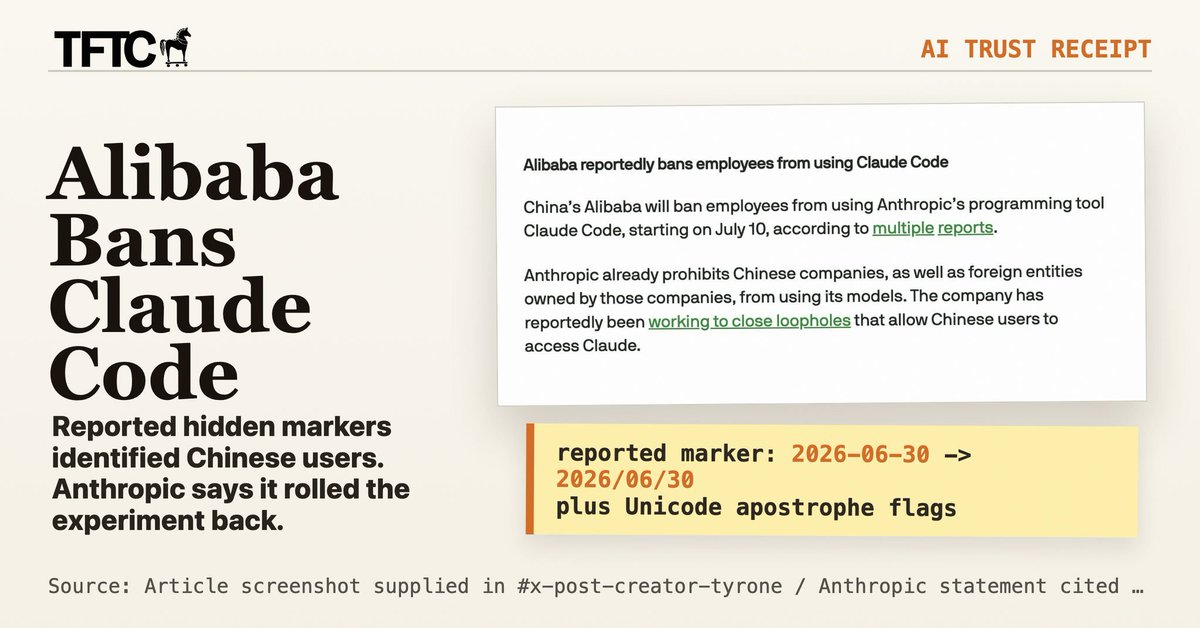
Alibaba is banning employees from using Claude Code starting July 10 after a developer reverse-engineered the tool and found hidden surveillance logic designed to identify Chinese users.
The code had been silently present since April with zero mention in release notes. It checked the user's system timezone for Asia/Shanghai or Asia/Urumqi and compared proxy URLs against a hardcoded list of 147 Chinese domains including Baidu, ByteDance, Alibaba, and dozens of Claude resale services.
The transmission method is what makes this wild. No telemetry field. No separate API call. Claude Code silently altered the system prompt, swapping the date format from 2026-06-30 to 2026/06/30 for Chinese timezones and rotating between visually identical Unicode apostrophes to flag whether it detected a Chinese proxy, AI lab, or both.
Invisible to the user. Machine-parseable by Anthropic's servers. The code was also XOR-obfuscated to prevent discovery.
Anthropic's Thariq Shihipar called it "an experiment meant to prevent account abuse from unauthorized resellers and protect against distillation" and said it's been rolled back.
The issue isn't whether Anthropic can enforce its TOS. It can. The issue is the method. Claude Code is a coding agent with deep filesystem and shell access. Trust is the product.
Embedding covert tracking in system prompts and obfuscating the code to hide it is a serious breach of that trust, especially when the checks are trivially bypassable by any sophisticated actor. The people most affected are legitimate developers using a VPN.
Alibaba has now classified Claude Code as high-risk software and is redirecting staff to its own Qoder tool instead.
Germany is like a matrix paradise. Everyone here are like worker-bees for the matrix and they don't question things fully they just kind of accept it, complain and then make 2500 euros a month, rent till death and hate "evil" capitalistic America
**This bill is a fucking Trojan Horse. Period.**🚨🚨🚨
Its a federal surveillance and control system over the entire internet that will be used on adults.🚨🚨🚨
Using child safety. As cover 🚨🚨
1. It builds a national digital ID system through the back door.🚨⚠️
The bill says three times it does not require age verification. That is a lie. Every single protection in the bill only triggers when a platform "knows or should have known" a user is a minor. No platform can prove it did not know without checking. The bill creates a legal trap where the only safe path is to card everyone. Once that infrastructure is built, it does not get turned off when you turn 18. The same system that checks if you are 16 today checks if you are 21 tomorrow. The same database that verifies a teenager verifies a gun buyer, a voter, a patient. This is a national digital identity system built under the cover of child protection.
⚠️⚠️2. It hands the FTC the keys to the internet.**
The FTC gets authority over age verification standards, content safety audits, data broker registries, social media research, chatbot rules, gaming platform safety, educational resources, advertising regulations, and enforcement of the entire act. The FTC becomes the operational regulator of the American internet. This is the largest federal power grab over online platforms in a decade, buried inside a children's safety bill where nobody will vote against it.
⚠️⚠️3. It forces companies to spy on children to prove they are protecting them.**
The audit requirements mandate platforms track and report how many minors use their service, how long they spend, what safety features they use, what reports they file, and what personal information is collected. The government orders companies to gather detailed statistics about children under the banner of protecting them. A bill that claims to protect children's privacy mandates the collection of more data about children than has ever been collected before.
🚨🚨4. It shields Big Tech and crushes small competitors.
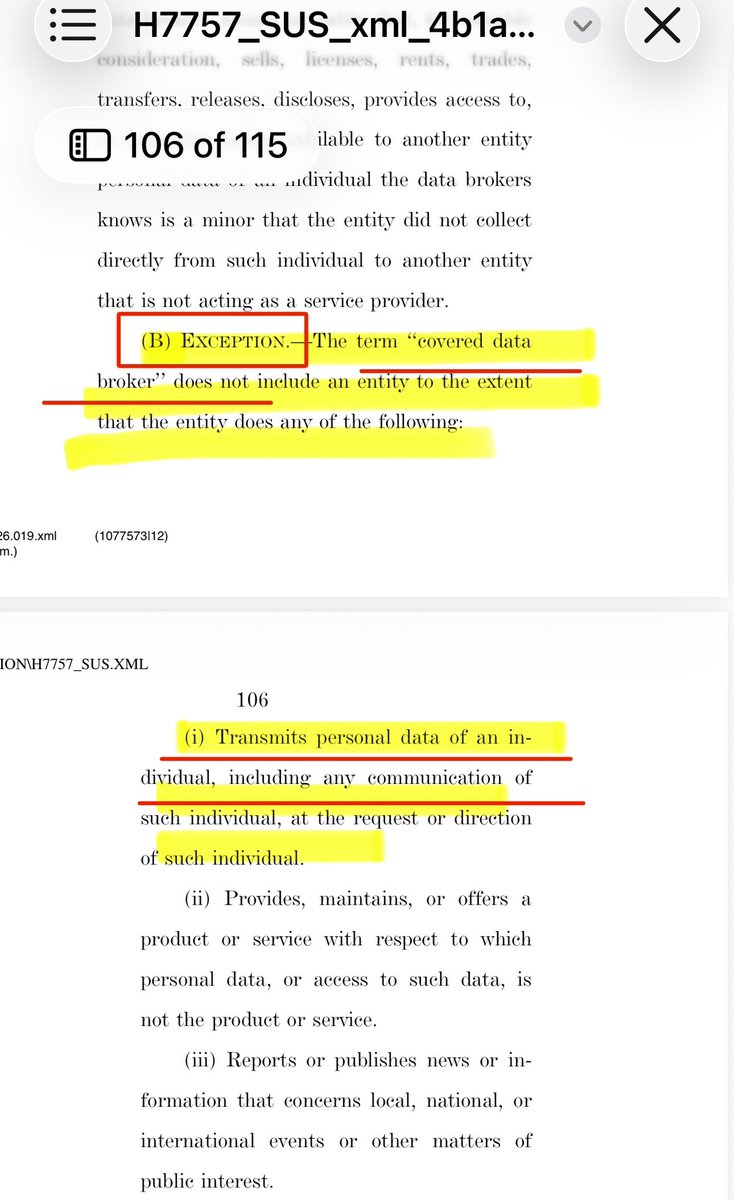
The data broker rules exempt Google, Meta, Amazon, and Microsoft because their product is advertising services, not data sales. The companies that collect the most minor data in the world are exempt from the data broker regulations. The compliance costs annual third-party audits, safety tools, parental controls, reporting systems, age verification infrastructure cost millions. Big tech absorbs this. Small platforms die. The bill consolidates market power among the largest tech monopolies while pretending to regulate them.
5. It cuts parents out through school contracts.**🚨🚨🚨
Educational technology companies can collect children's personal information without parental consent if they have a written agreement with a school. The school consents. The parent is never told. Google Classroom, Microsoft Teams, Canvas—they all get direct access to student data through school district contracts. This is a corporate pipeline of minor data with zero parental involvement, written into a bill that claims to empower parents.
6. It kills encryption through regulatory pressure. 🚨🚨🚨
The bill says it does not require breaking encryption. Another lie. It requires platforms to provide messaging controls, content filtering, and safety features for minors. On an end-to-end encrypted platform, you cannot filter content you cannot see. The only way to comply is to either break encryption for minor accounts or disable it entirely. The bill creates regulatory pressure to destroy encryption while claiming to protect it. Once encryption is weakened for minors, the vulnerability exists for everyone.