Someone who constantly needs enemies, cannot tolerate criticism, and sees entire communities through hatred should never be trusted with unchecked power.
Because when ego occupies the throne, society eventually pays the price.
The way girls simping over rahul gandhi on instagram
Isi jagah agar koi female politician hoti aur launde simp kar rahe hote to kya society hame accept karti?
Unki simping simping
Hamari simping tharak
Yeh bhedbhav kyun?
I have witnessed Modi's rise in 2012 to 2013.
It's was manufactured by whatsapp and tv media back then
Rahul Gandhi's rise is 3× than that rise now and it is organic not manufactured
@SayantikaSays Fun fact is 90% people does not understand what religion is.
If they know true religion we wouldn't have in this message.
They just flex there collective ego in the name of religion.
At least I can say about hinduism
I am not expert in islam
@PatrioticI22814 Duryodhana saw conspiracy where Krishna offered wisdom, because the mind sees the world through its own nature. You saw sycophancy; I saw a parallel.
Shiva does not always give His devotee what he asks for.
Sometimes, He takes away comfort, destroys illusions, lets him walk through loneliness and failure, and makes him endure the fire of struggle.
Perhaps that is how Mahadev has shaped Rahul Gandhi.
@PatrioticI22814 Sycophancy is praising someone for personal gain. I’m drawing a parallel between Mahadev’s character and Rahul Gandhi’s journey. If you can’t tell devotion from flattery, that’s your limitation ,not mine.
It simply looks for a political face.
And that may explain why the “challenger” archetype is increasingly being associated with Rahul Gandhi rather than the BJP.
The deeper cultural vacuum remains: where is the modern Nayak/Rang De Basanti figure who challenges power, questions institutions and gives frustrated youth an emotional language for dissent?
If that archetype is missing from cinema, the demand for it doesn't disappear.
The deeper cultural vacuum remains: where is the modern Nayak/Rang De Basanti figure who challenges power, questions institutions and gives frustrated youth an emotional language for dissent?
If that archetype is missing from cinema, the demand for it doesn't disappear.
A film can reinforce an ideology, glorify nationalism or trigger emotional pride but it cannot manufacture a genuine “anti-establishment hero” when the ruling party itself has become the establishment.
That is the difference between propaganda and political psychology.
One underrated reason behind the changing political mood in India is the disappearance of the “angry citizen vs the system” hero from mainstream cinema.
Psychologically, this combines the underdog effect people often empathise with the one who fights power, bears adversity and refuses to surrender.
In India, perhaps the deepest political currency has never been power alone—it has been the story of struggle before victory.
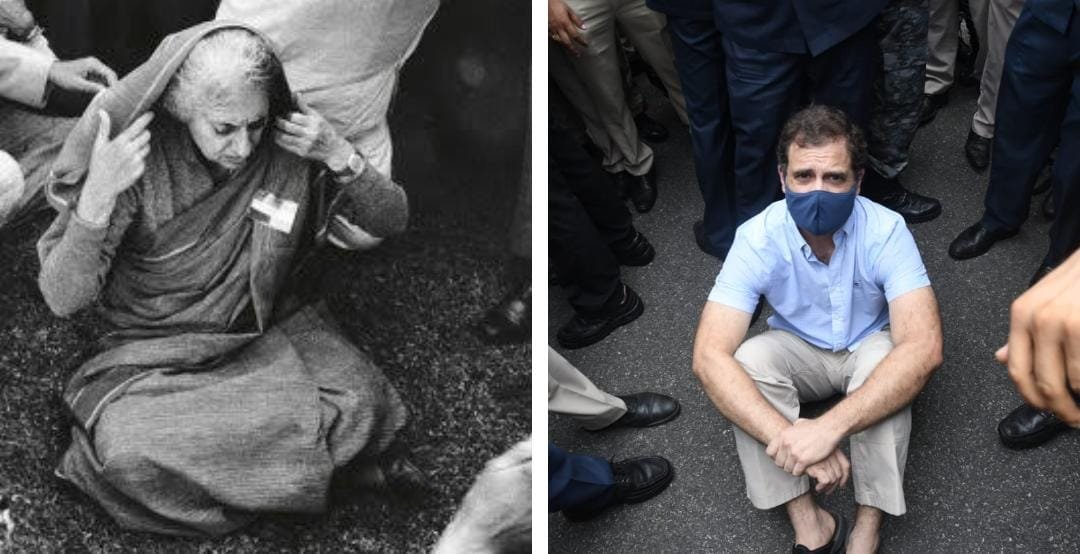
History echoes the same archetype Shivaji Maharaj challenging imperial power; Gandhi challenging an empire; Nehru emerging from the freedom struggle; Indira challenging the old Congress establishment; JP challenging authoritarian power; V. P. Singh
History echoes the same archetype Shivaji Maharaj challenging imperial power; Gandhi challenging an empire; Nehru emerging from the freedom struggle; Indira challenging the old Congress establishment; JP challenging authoritarian power; V. P. Singh
There is a recurring pattern in the Indian imagination: we are deeply drawn to the person who struggles, challenges power and rises against the odds.
From Prahlada standing against Hiranyakashipu, to the Pandavas resisting injustice, to Rama’s exile and struggle against Ravana